
Chapter 1: Index Pressure
The Ops Command Deck smelled of recycled air and cold metal, the kind of sterility that pretended it could scrub politics off a room. The lighting was tuned to keep people awake, not comfortable. It made everyone look slightly ill.
General Ayla Serrin stood at the holo-table with her hands behind her back, posture rigid enough to be welded. The projection between them showed a node label and nothing else: 02a-df8-179 / WLD-129. A red annotation pulsed beside it like an accusation, synced to a metronomic tick that had nothing to do with any human heartbeat.
Commander Elian Vos watched the data scroll, forcing himself to read it like it was just another report. “Null leyweb strength. No corridor formation from the far side. Yet we logged a structured bio-resonant pulse.”
“That is what the committees are circling,” Serrin said. Her voice was flat, controlled. “They smell fabrication. They smell an RCD that is padding the Omega-Black Index to justify funding.”
Dr. Marin Kess sat slightly apart, fingers steepled, eyes reflecting the blue of the projection through his neural lenses. He did not look like a man who believed in ghosts, which made his unease more convincing. “If they freeze deployments, they will not care whether the pulse was real. They will care that we cannot explain it. Contradictions become accusations.”
Vos looked to his team clustered near the bulkhead. Nyra Del’s face was unreadable, already in the posture of someone solving a problem that might not want to be solved. Brick’s jaw worked, a habitual grind when he wanted to speak but knew better. Oracle, Sera Lin, held her sketchbook against her chest like a shield, the way some people held a sidearm.
“We verify,” Vos said. “We do not retrieve, we do not provoke. We confirm the signal source and return. Minimal footprint.”
Serrin’s gaze cut to him. “You will bring me proof. A tangible origin point, or a reason ironclad enough that UNSCOR’s oversight cannot twist it.”
Vos felt the familiar pressure behind his partially deaf ear, a phantom throb that came with stress and old concussions. “General, if this is a spoof, it is a hijacked pulse signature. We do not have a registry for permanent traversal upgrades, and we are not going to improvise new pulse types in the field. Fort Resonance stays clean.”
Kess’s tone was softer, almost sympathetic, which made it worse. “Commander, an audit is already drafted. If WLD-129 remains a contradiction, the auditors will call every anomalous log into question. Including your last three missions. They will frame caution as concealment.”
Brick muttered, “So we’re doing this for paperwork.”
Serrin ignored him. “TRU-1 wheels up in two hours. You will verify the node and you will return.”
Oracle finally spoke, quiet but sharp. “If it is bio-resonant, there may be people.”
Serrin’s eyes flicked to her. “Then you will behave. And you will not let their folklore become our weakness.”
Vos nodded once, accepting under protest because refusal would not protect his team. It would only isolate them. He had learned that in the corridors of Fort Resonance, where the only door to elsewhere made every argument feel like a hostage negotiation.
As they filed out, Nyra fell into step beside him. “Null leyweb nodes don’t sing,” she said. “Not like that. Not structured.”
Vos did not answer. The dread here was not fear. It was procedure, and the knowledge that procedure could be used like a blade. He could already feel the mission report being written around them, shaping what they were allowed to see.
Chapter 2: Gate Open, Numbers Off
The Resonant Convergence Chamber always felt too large for what it contained. A cathedral built for a phenomenon that did not care about reverence. The floor plates held old scuffs from boots and equipment carts, reminders that even miracles had to be wheeled into place.
Patchwire, Milo Renner, bounced on the balls of his feet near the control rail, headphones crooked, eyes bloodshot with focus. “Outbound dual-pulse loaded. Primary and harmonic oscillation at seventeen hertz. Jitter within spec,” he said, then frowned as if the machinery had insulted him. “Mostly.”
Nyra stood at the diagnostic console with her ARK tethered to the chamber feed. Her braided hair was tucked into her hood, her mouth a thin line. “Patchwire, I’m seeing a timing jitter,” she said. “Five to six milliseconds. It’s subtle, but it’s there.”
Patchwire snapped his fingers at the waveform. “That’s not jitter. That’s… it’s like the phase is anticipating itself.”
Vos stepped closer, boots clicking on basalt composite. “In a stable pair, there’s no anticipation. There’s only response. Can you damp it?”
Patchwire’s hands hovered over the controls. “I can try to iron it, but if I overcorrect, we lose the braid. And Serrin wants this clean.”
As if summoned by her name, Serrin’s voice came over the chamber intercom, amplified and emotionless. “Proceed.”
Vos pressed his comm. “General, request delay. We have a timing anomaly. It could indicate hostile spoofing or environmental interference.”
A pause, long enough that the hum of the emitter core seemed to fill the gap with its own answer. The chamber’s air smelled faintly of ozone and sterilant, a scent that always made Vos think of hospitals.
“No delay,” Serrin said. “Oversight is already asking why a null-leyweb node is in the Index at all. If you abort for a jitter you cannot even characterize, they will call it cowardice and cover.”
Kess’s voice followed, quieter, threaded with calculation. “Record the miscalibration. Treat it as data. We need your eyes on WLD-129. If it is interference, we need to know its shape.”
Brick leaned toward Vos, visor reflecting the first faint shimmer in the air. “Boss, that’s an order.”
“I heard it,” Vos said. He hated how the word order made his body relax into compliance. That was the first trap humans ever built.
Oracle’s gloved hand touched Nyra’s forearm, a small anchoring gesture. “If it is a lure,” Oracle murmured, “it will want us to hurry.”
Nyra swallowed. “I can log it. But I don’t like it. The phase lead looks like a predictive filter, like something is trying to meet us halfway.”
Patchwire began the outbound sequence. The chamber’s air ionized, dust lifting from the floor as if gravity had briefly forgotten its job. At sixty seconds, invisible filaments began to converge, revealed only by their effect on light. At ninety, the golden cyan braid snapped into visibility, and the chamber rang with the familiar 432 Hz chime.
Brick exhaled hard. “There’s the bell.”
Vos listened. The chime was correct, but something in it felt too crisp, like a recording played back without room tone. It lacked the tiny imperfections he associated with Fort Resonance’s living machinery.
Nyra’s eyes stayed on her screen. “Jitter persists through lock. That should not happen. It’s riding the lock instead of being crushed by it.”
“Log everything,” Vos said. “Every millisecond. Every harmonic. If this becomes an inquiry, we need a timeline that doesn’t blink.”
He looked up at the corridor, at the shimmering tunnel that was Earth’s only access point, and felt the weight of Serrin’s override like a hand on his spine. Fort Resonance was stable, it had to be. If it wasn’t, then every mission was just a controlled fall.
“TRU-1,” he said, voice steady by force. “Traverse. Stay tethered. No heroics. No improvising beyond protocol.”
Brick grinned without humor. “Copy, Gravestone.”
Oracle’s voice was barely audible. “Listening is never passive.”
They stepped into the braid. The chamber’s hum fell away, replaced by a pressure in the bones, and then by the cold, amber dusk of somewhere else.
Chapter 3: First Steps on Acid Glass
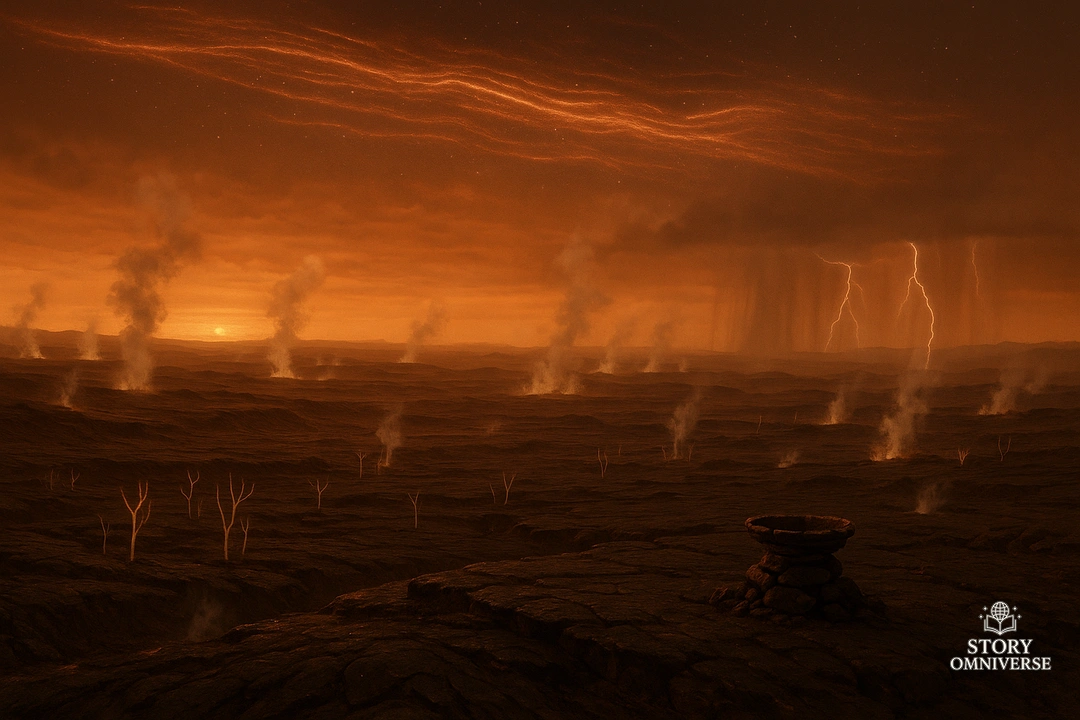
Seethe Scarp greeted them with a sky that looked bruised from the inside. Ionized layers shimmered overhead, a veil of charged particles that made distant lightning crawl sideways, as if the storm had forgotten which direction down was. The air had a metallic tang that caught in the throat even through suit filters, like the memory of blood.
The ground under their boots was solidified lava, dark and glossy, as if the plateau had been varnished by heat and then abandoned. In places the surface had crazed into thin, sharp plates that rang faintly when stepped on, a brittle music that made Vos keep his stride careful.
High gravity hit like a blunt instrument. Vos’s knees complained immediately, even with the joint-assist exoskeleton compensating. Brick made a sound that could have been a laugh or a grunt, then steadied himself with a hand on his thigh plate.
“1.4g,” Nyra confirmed, reading suit telemetry. “Everything’s heavier. Including bad decisions. Heart rates will climb faster. Hydration discipline.”
“Anchor first,” Vos ordered. “Then comms. Then perimeter. No wandering.”
Brick and Nyra drove stakes into the crust, the tips biting with a gritty squeal. They mounted the grounded surge suppressor, its prongs sinking into mineral-rich surface. The unit’s lights blinked from amber to steady green as it found a path to ground. It was a small comfort, like locking a door you knew could be kicked in.
Oracle knelt, pressing her acoustic spectrum mic toward a cluster of pale, hollow saplings that rose from cracks in the lava like bone flutes. Their surfaces were chalky and pitted, with thin slits that ran lengthwise. Wind passed through them and produced tones that wavered between mournful and precise, too stable to be purely accidental.
Oracle’s eyes narrowed. “They’re emitting harmonic resonance. Not random. Listen to the cadence.”
Brick circled outward, deploying the motion-detect perimeter alarm on the shallow terrace. The devices clicked into place, their small indicator lamps dimmed under the amber light. He set them wider than usual, compensating for the way sound carried strangely here. “Perimeter set,” he said. “If anything big moves, we’ll know.”
Vos watched the horizon. Fumaroles exhaled faintly, and the steam drifted low, hugging the ground as if the air itself was heavy. “Comms mast,” he said.
Nyra and Brick erected the sensor-shielded comms mast, wrapping it with shielding mesh to fight the atmospheric interference. The mast extended, then locked with a dull thunk. Nyra keyed her mic. “Fort Resonance, TRU-1 on ground. Telemetry intermittent. Ion layers heavy. Establishing local logs.”
Static answered, then Kess’s voice, clipped by interference. “Copy, TRU-1. Maintain logs. Verify origin of structured pulse. Do not attempt corridor formation from far side. Fort remains sole gateway.”
“Understood,” Vos said. He wanted that last line on record. He wanted it welded into the mission transcript.
Oracle adjusted her resonance interpreter, mapping the saplings’ tones into a spectral display. “The wind-tones match the cadence of the Fort’s incoming telemetry,” she said slowly. “Not the content. The rhythm. The spacing between status beeps.”
Vos turned to her. “That’s not possible. They’ve never heard our comms. There’s no corridor here to carry it.”
Oracle did not look up. “I’m not saying they heard. I’m saying the pattern is the same. Like a lock shape. Like the environment is shaped to accept a familiar key.”
Brick’s breathing was loud in Vos’s ear. “This place is singing our song.”
Nyra’s fingers danced over her tablet. “Atmospheric interference is also modulating at similar intervals. Either it’s coincidence, or the ion layers are acting like a resonant cavity. Reflecting and reinforcing certain frequencies.”
“Nothing is coincidence out here,” Vos said. He glanced back toward where the corridor had been. There was nothing, only empty air and the memory of a door. The absence felt intentional, like a blank page waiting for someone to sign it.
They moved along the terrace, boots scraping on acid-glass rock. The dread was impersonal, like weather. Not aimed at them, not angry. Just present, indifferent, and somehow expectant.
Oracle paused beside another sapling cluster. The tone shifted as the wind changed, and for a moment it sounded like a distant intercom beep, the kind that preceded an announcement. Her shoulders tightened.
Oracle’s voice was low. “If the pulse is structured, someone structured it. Or something did.”
Vos tightened his grip on his rifle, though he doubted bullets mattered to signals. “We find the source. We do not answer anything we did not authenticate. No responding to prompts, no confirming returns, no verbal call-and-response with unknowns.”
Brick muttered, “Hard to not answer when the world is calling collect.”
Chapter 4: The Nomad Shelters and the Silent Offer
They followed geological terraces toward a marker Nyra had flagged from subsurface aquifer scans. The plateau stepped down in layered shelves, each one offering a wider view of the volcanic expanse. In the distance, acidic rainfall bands marched like curtains, their edges glowing faintly where lightning strobed behind them. The storm fronts moved with slow certainty, like machinery.
The first shelter appeared as a low windbreak of mineral crust slabs, lashed together with worked metal fasteners. Not welded, not riveted in any Earth pattern, but hammered and bent with skill. A lean-to, then another, scattered as if a small group had camped and moved on. The arrangement suggested routine rather than desperation: windward walls, drainage grooves, a place for heat stones.
Brick swept his rifle across the empty structures. “Recently occupied,” he said. “No bodies. No blood. No trash. Whoever was here knows how to leave no trace.”
Oracle crouched at the threshold of one shelter. Inside, the ground had been smoothed, and a shallow depression suggested a sleeping place. It had been deliberately cleared, even of ash. A line of small stones marked a boundary near the entrance, too neat to be random.
“Deliberately emptied,” Vos said. “They didn’t flee in panic. They packed. That means they had time, and they expected to come back.”
Nyra’s dynamic magnetic mapping tool chirped, then recalibrated, confused by the polar inversion zone’s drift. “Nav is unstable here,” she warned. “Mag field is doing its periodic nonsense. I can keep us anchored by inertial and terrain mapping, but don’t trust compass headings. If we have to run in low visibility, we run on tether.”
Oracle removed small items from her pouch: cultural goodwill tokens, simple and non-resonant, designed for first contact. Smooth ceramic discs, a coil of inert wire, a packet of salt sealed in polymer. She placed them at the shelter threshold, palms open, then stepped back, careful not to cross the stone line.
Brick raised an eyebrow. “You think they’re watching?”
Oracle’s gaze stayed on the cliffline above. “If they built this, they know the terraces. They know sightlines. And that stone line is a rule. I’m not stepping over it without invitation.”
Vos felt it then, a pressure not in his ears but in his awareness, like being observed through glass. Not predatory. Appraising. The way a field medic might look at a wound before deciding whether to touch it.
A rustle of wings. Shapes appeared on the cliffline: avian sentients, tall and angular, feathers dark against the amber sky. Their faces were narrow, beaks hooked, eyes reflective like wet stone. They carried metal tools at their belts, and their hands, clawed but dexterous, rested on them without threat. Their stance said: we are armed, but we are not here to hunt you.
Brick’s voice dropped. “Contact.”
Vos lifted his empty left hand, weapon lowered. He kept his right hand near his sling, not gripping, not threatening. “We come in peace,” he said, knowing speech was likely useless but posture was not.
Oracle activated the resonance interpreter. It emitted a soft mapping pulse, non-invasive, designed to listen rather than speak. The avian figures tilted their heads in unison, as if hearing a familiar tune. One elder clicked its beak twice, then held still.
A phrase came through the interpreter, translated into a rough cadence of meaning rather than words. It repeated, layered with harmonic emotion: warning, restraint, ancestral weight.
Oracle spoke the translation aloud. “Do not answer the chime.”
Nyra’s eyes flicked to Vos. “They know about corridor lock. Or at least about our chime.”
Another phrase, sharper, almost urgent: Do not answer the chime.
Brick swallowed. “They mean our 432.”
Vos kept his posture neutral. “Oracle, ask how they know.”
Oracle adjusted the interpreter, sending a gentle query pulse shaped as curiosity without demand. The avian sentients responded not with explanation, but with another repetition, this time weighted with grief. The same warning, but with the emotional shape of a memorial.
“Do not answer the chime,” Oracle said again, voice tight. “They’re not refusing. They’re reciting. Like a rule taught to children.”
One of the avian elders stepped forward, feathers ruffling in the wind. It pointed, not at the team, but at the tokens Oracle had placed. Then it touched its own chest, and made a low, resonant sound that the interpreter struggled to map. The elder repeated it, then traced a small circle in the air with one claw, and finally tapped the stone boundary line.
Oracle’s eyes narrowed, then softened. “It’s a name-mark,” she murmured. “Lineage. And that circle gesture means something like ‘turn back’ or ‘close the loop.’ The boundary is important.”
Vos felt the impersonal dread shift, like a cloud passing over the sun. The warning was not for them alone. It was for anyone who could hear. A survival rule carved into culture.
He nodded once, a gesture of respect. “We will not answer,” he said, though he did not yet know what answering meant.
The elder’s gaze held him, then it pointed toward the terraces leading deeper into Seethe Scarp, toward where the saplings’ hollow tones grew denser. The elder made the circle gesture again, slower this time, then flattened its palm downward, a universal sign for restraint.
Nyra whispered, “They’re guiding us.”
Brick muttered, “Or herding us.”
Oracle’s voice was barely audible. “Both can be true. Guidance can still be containment.”
Chapter 5: A Gift That Points the Wrong Way
The avian elders moved with a cautious grace, hopping and gliding short distances between terrace edges, never fully taking flight in the heavy gravity. TRU-1 followed at a respectful distance, weapons lowered but ready. Vos kept the tether line between them and the comms mast spool taut, a physical reminder that they were not supposed to drift.
The wind carried the sapling tones, and the resonance interpreter’s readout flickered as if overwhelmed by overlapping harmonics. Nyra kept glancing at her ARK, watching for any auto-seek behavior. She had disabled every convenience feature she could without breaking core safety protocols.
They reached a rise where iron nodules clustered in the rock like rusted teeth. Here the locals had built something deliberate: a cairn shaped into a shallow bowl, iron pieces fitted together with patient precision. The bowl’s interior was polished smooth, reflecting the amber sky in a dull sheen. Around it, the lava crust had been cleared, swept clean in a circle. The same kind of boundary as the stone line at the shelter, but larger, more formal.
The elder stood beside it and made a low sound, almost a hum. The interpreter translated with unsettling clarity: “Listening cairn. Lost voices return.”
Brick leaned in despite himself, then caught Vos’s look and stopped short of the cleared circle. “So it’s like a… radio.”
Nyra’s tablet pinged. Her eyes widened a fraction. “Triangulation lock,” she said. “This matches the anomalous pulse source. This is it. The pulse is strongest here, and the ion layer reflection is cleanest along this terrace.”
Oracle’s shoulders tensed. “This is a ritual site,” she said. “If they warned us not to answer the chime, this is where the chime lives.”
Vos felt Fort Resonance like a second shadow, political gravity heavier than WLD-129’s. “We need an origin point,” he said, more to himself than to them. “Serrin wants proof.”
Oracle turned on him. “Proof is not worth stepping into their taboo. If this is a defense, we are the threat they defend against.”
Brick shifted his weight, exoskeleton servos whining softly. “Boss, we can just look. No touching. No stepping over the line.”
Nyra crouched near the bowl, careful not to cross the cleared circle. “It’s not emitting right now,” she said. “But the resonance field around it is primed. Like a spring under tension. The saplings around it are positioned like an array.”
The avian elder watched them with an expression that was hard to read through alien features. It extended one clawed hand toward the bowl, then pulled back, shaking its head. The interpreter rendered the intent as a simple phrase: “Do not answer.”
Vos nodded. “We hear you.”
Then his comm crackled, a thin thread through ion storm interference. Serrin’s voice, distorted but unmistakable. “TRU-1, report.”
Nyra keyed in. “We have visual on apparent source. Iron nodule cairn, cultural site. Strong resonance coupling with ion layer. Potential spoof mechanism.”
“Confirm it is origin,” Serrin said. “We need a tangible cause. Inspect.”
Vos closed his eyes for half a second. The false assumption formed in his mind like a convenient lie: that observation could be neutral, that they could take data without participating. But the cleared circle and the elder’s repeated refusal said otherwise. Here, attention itself might be a lever.
He opened his eyes and met Oracle’s stare. “We inspect,” he said, quiet. “Minimal intrusion. No activation unless unavoidable. No crossing the boundary.”
Oracle’s mouth tightened. “Listening is activation here. That is what they are telling us. The taboo is about response, not touch.”
Brick tried to lighten it, failed. “We’ll be deaf tourists.”
Nyra stood, gaze fixed on the bowl. “If this thing can spoof our suit heuristics, it might not need us to touch it. It might only need us to expect it. Expectation is a signal.”
Vos looked at the listening cairn, at the polished iron bowl that seemed too simple to be dangerous. In the saplings behind them, the wind shifted, and the hollow tones aligned into a brief, familiar rhythm.
A chime shape without the chime.
“Record everything,” Vos said. “And nobody answers anything that sounds like home. Not with voice, not with UI confirmation, not with reflex.”
Chapter 6: The Pulse Trap Springs
Brick set the PFR tripod a safe distance from the cairn, its legs splayed wide on the slick lava crust. He kept his movements controlled, as if sudden motion might offend the air. Nyra connected her ARK to the relay, eyes darting between the device and the listening bowl.
“Localized echo test only,” Nyra said. “No corridor attempt. No braid formation. We ping and read the response. Low power diagnostic, within existing protocols. We stay far below corridor thresholds.”
Oracle stood near the avian elders, hands open, posture deferential. The elders had not left. They watched with the stillness of people attending a funeral, as if they had seen this scene play out with different outsiders and the same ending.
Vos keyed his team channel. “Brick, you do not chase prompts. Nyra, you do not let the relay auto-seek. Manual mode only. Oracle, keep the interpreter passive. No call-and-response.”
Brick’s voice was tight. “Copy.”
Nyra inhaled, then initiated the test pulse. The PFR emitted a low sub-bass hum, a controlled injection meant to probe local resonance and reflection. For a moment, nothing happened. The saplings continued their wind-song, indifferent.
Then the cairn answered.
A 432 Hz chime rang out, perfect and clean, as if the air itself had become Fort Resonance’s Convergence Chamber. Vos’s stomach clenched. The sound was not loud, but it was intimate, inside the skull, like a memory you did not invite.
Every suit display blinked once. Text appeared across their visors in calm, official font:

0 Comments