
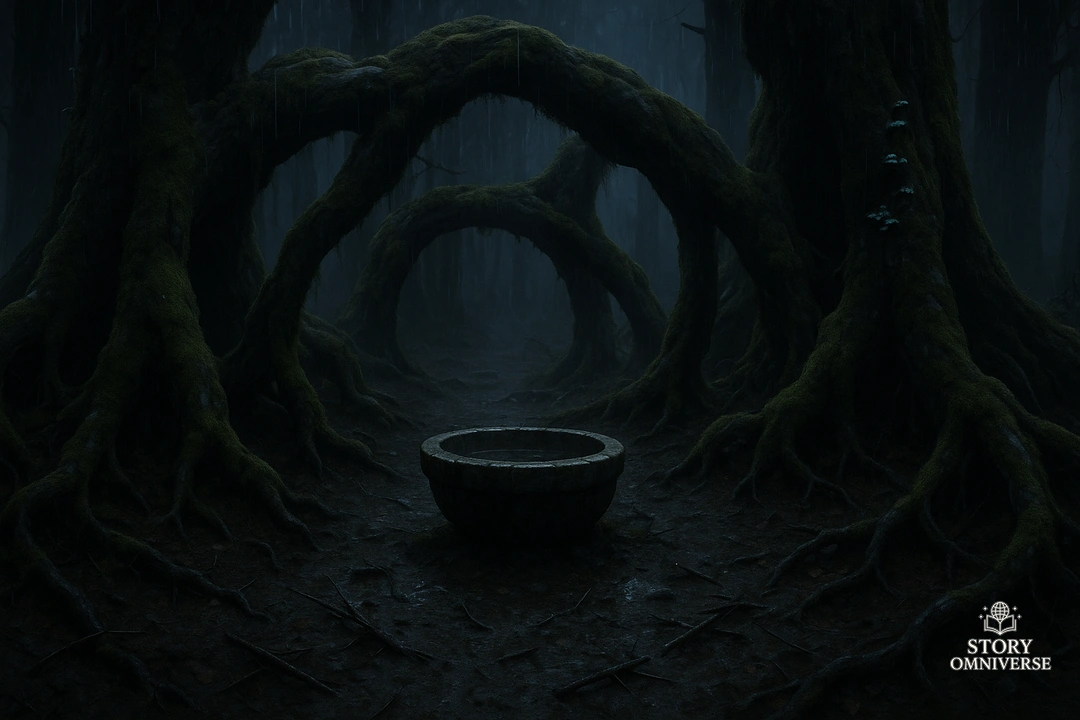
Chapter 1: The Historian in Thornhall Grove
I set this account down in the Verdant Circle’s own hand-archive at Thornhall Grove, in the waning of the rain season, when the moss grows heavy and even the birds sing as if they are apologizing. I was invited as a recorder, not as a judge. Yet I have learned that ink, once welcomed into a grove, becomes part of its rootwork.
Thornhall never lets a stranger arrive alone. The forest greeted me with a hush that felt practiced, as if the boughs had rehearsed my name. Moss hung in long braids from the elder oaks. The air tasted green and old, sweet with crushed fern and something sharper beneath.
Rootcaller Brannok met me at the root-bridge. He was broad-shouldered, with bear-dark eyes and a jaw set like a gate bar. His cloak was stitched from barkcloth and boarhide, and his patience looked already spent.
“Historian,” he rumbled. “Your ink better be honest.”
“My ink is all I have left,” I said, and even as I spoke, guilt tightened in my throat like a too-tight collar.
He snorted, unimpressed. “Keep it leashed. Fen waits.”
They led me past living halls grown from interwoven trunks. Lantern fungus glowed in hollows, and the Verdant Circle’s spiral sigil was carved into heartwood doors. When I reached the central grove, Archdruid Fen Mossbark stood beneath a canopy woven with ritual ribbons and fresh ivy. Antlers rose from his brow, pale as birch, and his voice carried the calm of deep soil.
“Edrin Vale,” he said. “You asked to record a season of peace.”
“I did,” I answered, bowing. “I meant to write of harvest songs and quiet borders.”
Fen’s gaze held mine. “Then write this too.”
Three bodies lay on reed mats near the roots of a singing oak. They looked as if they had fallen asleep mid-breath, mouths slightly open, hands loose. No wounds. No bruising. No curse-mark burned into skin, no blackened veins, no frost, no ash. The only wrongness was the stillness, too complete, as if the grove had exhaled and forgotten to inhale again.
Kara Windshade knelt beside them. She rose when she saw me, her face drawn into a hard line that did not invite comfort. A druid’s braid fell over one shoulder, threaded with dried thorns like warning beads.
“You’re late,” she said.
“I came as fast as Itharûn’s road allowed,” I replied, then regretted naming any road at all. Roads led outward. Accusations followed.
Fen stepped closer. “These are our dead. Three in seven nights. No sign of Thornspine strike, yet the grove whispers poison.”
Brannok’s hands flexed at his sides. “And the Mire sits at our edge, smiling through fog.”
Kara’s eyes flicked to him. “Smiling, or waiting.”
Fen turned back to me. “You are not Circle, but you are bound to truth. I want your honest ink, Edrin. Not what soothes. Not what rallies. What is.”
My mouth went dry. Honest ink. Years ago, I had written things for this Circle that I never meant to see used outside a lesson. I had left Galdrowen with a satchel of notes and a heart full of reasons I would not name.
“I promise,” I said, and the word felt like stepping onto thin ice.
Kara’s voice softened, just a fraction. “Then come. Look closely. The forest remembers. It will remember what you write, too.”
I knelt by the first body. The skin smelled faintly of crushed leaves and something else, almost clean, almost empty. I pressed my fingers to the wrist. Cold. Not cursed. Not cut. Just ended.
Behind me, Brannok muttered, “Peace season, Historian. Welcome to it.”
Chapter 2: Kara Windshade’s Unwelcome Proof
Kara did not let me linger in grief. She led me to a healer’s shelter grown from a hollowed stump, its roof layered with living moss. Inside, jars of dried petals and bundled herbs hung like quiet prayers. A shallow basin held water steeped with green-brown tincture.
She set a small cloth packet on the table. “Look.”
Brannok stood in the doorway, blocking the light with his bulk. “If this is more guessing, Windshade, I will take my sentries and find a real enemy.”
“It is not guessing,” Kara said. “It is proof that I hate.”
She unwrapped the packet. Inside lay a sliver of thorn-dark quill, and beside it, a smear of dried residue in a tiny glass dish. The quill looked like any Thornspine shedding, the kind children dared each other to touch and then cried about.
Kara dipped a reed into the dish and held it under my nose. I expected the bite of Thornspine venom, the sour-metal stink that clung to wounds and made the tongue go numb.
Instead, there was almost nothing. A thin sweetness, like sap diluted in rain.
“That is wrong,” I said before I could stop myself.
Kara’s eyes sharpened. “Yes.”
Brannok stepped forward, nostrils flaring. “Venom is venom. If it kills, it kills.”
“Thornspine venom announces itself,” Kara replied. “It burns the air. It clings. This does not.”
She moved to the basin and lifted a strip of barkcloth. Beneath it lay a small carving, a practice token used by apprentices, etched with the Verdant Circle’s spiral. A faint stain marked its edge.
“I found this near the second body,” she said. “And this.”
She produced a small vial, stoppered with wax. The liquid inside was clear as springwater.
Brannok’s voice rose. “A vial means trespass. A vial means a hand, not a beast. Tell Fen we have proof of Mire craft.”
Kara’s jaw tightened. “The symptoms mimic Thornspine venom. The sleep, the breath slowing, the heart faltering. But the timing is too clean. Thornspine venom fights. It makes the body thrash. These died as if persuaded.”
“Persuaded?” Brannok echoed, disgusted. “Poison does not persuade.”
“It can,” Kara said, and for a moment her stoicism cracked into something like fear. “If it was made to.”
I looked at the clear vial. In my mind, a memory stirred. Ink on rough paper. A list of measurements. A note in my own hand: Remove scent with ash-filter. Distill until the draught lies like water.
I swallowed. “Where did you find the vial?”
“Half-buried under fern root,” Kara said. “Near the border path.”
Brannok seized on it. “Border. Mire. Done.”
I heard, in his certainty, the beginning of shouting, of sentries marching, of Thornspines stirred into frenzy. Galdrowen already had disputes with Duskfall Mire over resources and creeping wetlands. A whisper could become a spear.
“Brannok,” I said carefully, “a staged find is still a find. We should not name the Mire until we know.”
He turned his bear-eyes on me. “You came here to write peace and preach patience. Meanwhile my people lie dead.”
Kara’s gaze moved between us. “Truth might start a border war,” she said quietly, voicing the trap I had felt but not dared to speak. “But false truth will start it faster.”
Brannok’s hands tapped the doorframe. “Then find me truth that bites as hard as your caution.”
Kara corked the vial again. “Come with me, Historian. If someone wants the Mire blamed, they will leave us a trail. And if the trail is real, we will know by the smell of it.”
I nodded, though my stomach had turned to stone. “Lead.”
As we stepped back into the green hush, Brannok followed, and his footfalls sounded like a verdict hunting for a name.
Chapter 3: Quills in the Rain, Lies in the Mud
Rain came in thin needles by afternoon, threading the grove with silver. Leaves shivered and released their scents, and the forest floor turned slick, a patchwork of moss and mud that held every footprint like a confession.
Kara moved ahead of me, silent as a deer. Brannok insisted on coming, though he kept a few paces back, as if my doubt had a smell he did not want on his cloak.
We reached the border path where Galdrowen’s trees thinned and the ground began to sag toward wetland. Thornspines patrolled here sometimes, their thorny ridges blending with bramble. I saw none, only the dark shape of quills scattered near a broken branch.
Kara crouched. Her fingers hovered, not touching at first. “These were snapped, not shed.”
Brannok grunted. “A struggle.”
“Or a performance,” I said.
He shot me a look. “You see stagecraft in mud.”
“I see someone who wants us to see,” I replied, and hated how thin my voice sounded.
Kara lifted one quill with a twig and held it to the rain. “Fresh break,” she murmured. “Within a day.”
She followed the line of scattered quills to a shallow rut where something heavy had been dragged. The rut led toward the Mire edge, where fog lay low even in daylight, breathing between reeds like an animal asleep.
A pair of Circle sentries waited under a leaning oak, their cloaks dark with rain. One, a young grove-guard with fox-sharp features and ears pressed flat, stepped forward.
“Rootcaller,” he said to Brannok, then nodded to Kara and me. “We saw lights last night. Blue-green, like swamp fire. Near the edge.”
Brannok’s shoulders rose. “You see? Mire tricks.”
The sentry hesitated. “We also heard singing. Soft. Like someone trying to remember a lullaby.”
Kara’s eyes narrowed. “From the Mire?”
“From the trees,” the sentry admitted, uneasy. “As if the grove was answering.”
My skin prickled. Galdrowen did remember. Not in words, but in scent and sound and the way branches leaned. If something had been done here, the forest might echo it back without knowing why.
We followed the drag mark until it ended at a puddle the color of weak tea. In the center, a single bootprint pressed deep. Not a druid barefoot. A human boot, narrow-heeled, the tread worn smooth.
Brannok saw it too, and his certainty faltered for the first time. “Who walks here in boots?”
Kara’s voice was flat. “Someone who wants to keep their feet dry.”
I leaned closer. The print’s edge was too crisp for rain-soaked mud. It looked pressed, then protected. As if someone had covered it until we arrived.
“A false trail,” I whispered.
Brannok’s patience snapped. “Or your excuse. You have always loved ink more than action, Edrin.”
Kara stood and faced him. “If you charge into the Mire on this, you will spill blood for a footprint someone placed like bait.”
“And if we do nothing?” he demanded. “We wait for a fourth body?”
The fog thickened ahead, curling around reed stalks. For a heartbeat I thought I saw movement within it, a long shape sliding just under the mist, then it was only the Mire shifting its breath. Rumor lived well in wetlands. Fear fed it.
Kara touched my sleeve. “Do you smell it?”
I inhaled. Beneath rain and rot, there was that faint sweetness again, clean as water, wrong as a lie.
“It’s here,” I said.
Brannok’s voice lowered. “Then we follow.”
We stepped toward the fog, and the border between forest and swamp felt less like a line and more like a wound someone kept picking open.
Chapter 4: Thistlebrand’s Game of Names
The fog did not swallow us. The forest did, instead. As we neared the Mire edge, the trees subtly shifted, their roots rising like knuckles, guiding our feet away from the wetland and deeper into Galdrowen’s own shadowed heart.
Kara noticed first. “This is not the border path.”
Brannok sniffed, suspicious. “The grove turns us.”
A laugh snapped through the rain like a twig underfoot. Something small and bright flickered between ferns, then perched on a low branch. Thistlebrand, a local grove-spirit the Circle named in their older songs, wore no fixed shape for long. One moment a child-sized figure made of leaves and lichen, the next a knot of roots with eyes like dew.
“Lost?” it chimed. “Or found?”
Kara’s hand went to the charm at her neck. “Thistlebrand. We do not have time.”
“You have all the time,” Thistlebrand said, swinging its legs as if the branch were a tavern stool. “Time is a ring in wood. You are only walking in circles.”
Brannok growled. “Guide us or get out of our way.”
Thistlebrand’s grin widened. “Such manners. I will guide. But first, a name for a name.”
Its eyes fixed on me, and the forest seemed to lean closer. “Historian Edrin Vale. Why did you leave Galdrowen years ago?”
My mouth went numb. Kara glanced at me, startled. Brannok’s stare sharpened, as if he had always suspected there was rot beneath my words.
“I left,” I said carefully, “because I was not needed.”
Thistlebrand clapped, the sound like acorns striking bark. “That is a pretty lie. Try again.”
Rain slid down my temples. I tasted iron, not from blood, but from memory. “I left because I wrote something I should not have written,” I admitted. “And I was afraid of what it could become.”
Kara’s eyes softened, then hardened again. “What did you write?”
Thistlebrand hopped down, landing without bending a blade of grass. “Good. Honest ink. Now come.”
It darted ahead, and the forest opened in small, reluctant spaces. We followed to a hollow beneath an ancient oak whose roots formed a natural vault. Thistlebrand gestured with a flourish.
“Treasure,” it sang.
Inside the root-vault lay a cache: several venom sacs, dark and glossy, tied with vine cord. They looked like Thornspine sacs, harvested by someone who knew where to cut. Beside them were snapped quills and a strip of mire-reed, wet and stinking.
Brannok exhaled like a bellows. “There. Proof.”
Kara knelt, her fingers hovering again. “These are too clean,” she murmured. “No dirt. No leaf grit.”
Thistlebrand’s laughter turned soft. “You wanted a culprit. The forest provides.”
I picked up one sac with a cloth, feeling its weight. It was real enough to fool a frightened council. Real enough to harden suspicion into action.
Kara looked at me. “This will push Fen toward the Mire.”
“And you?” I asked quietly.
“I will not let a cache decide a war,” she said, but her voice shook. “Yet if these are genuine, someone has been harvesting Thornspines. That is a sin in itself.”
Brannok straightened. “We take this to Fen. Tonight.”
Thistlebrand’s eyes gleamed. “And the question, Historian. The one you did not answer.”
“I answered,” I said.
“No,” it whispered, suddenly close to my ear. “You said you were afraid. But you did not say of whom.”
I could not breathe for a moment. Then I said the only truth I had. “Of myself.”
Thistlebrand leaned back, satisfied. “Good. Now watch your friends. The poison is not only in sacs.”
As we left the hollow with the cache bound in Brannok’s arms, the false trail felt heavy as stone, and I feared it would sink us all.
Chapter 5: The Thornspine That Did Not Bite
Brannok wanted torches and a hunting party. Kara refused him with a look that could have frozen sap. “Noise will scatter what we need to see,” she said. “If someone staged this, they will stage again.”
Instead, we went at dusk to a fern-choked hollow where Thornspines were known to nest. The air there was thick with damp earth and the sharp tang of poison plants, the kind Kara studied for healing rituals. My boots sank into loam, and every shadow looked like a coiled spine.
A rustle, then a low hiss. The Thornspine emerged half-hidden, its ridged back bristling with toxic quills. It was medium-sized, but in the dim green light it felt larger, a moving wall of thorns and hunger.
Brannok lifted his staff, ready to strike. “Now we see if the beast is guilty.”
Kara stepped between him and the creature, palms open. “No,” she said, voice low. “Let me speak.”
“You cannot speak to poison,” Brannok snapped.
Kara did not turn her head. “I can speak to fear.”
She began to hum, a simple note that rose and fell like wind through reeds. The Thornspine’s head tilted. Its nostrils flared, tasting her breath. It shifted, quills trembling, but it did not lunge.
I held my own breath, waiting for the snap of teeth. Instead, the creature lowered its spined head, slow as a bow.
Brannok’s staff wavered. “What trick is this?”
“Not a trick,” Kara whispered. “A truth. It is guarding, not hunting.”
She drew a small blade, not for harm but for a precise cut. “I need a sample. Just a drop.”
The Thornspine’s eyes, dark and reflective, stayed on her. It extended a clawed forelimb, exposing a small gland near the base of a quill. Kara moved with reverence, slicing a thin line and catching the bead of venom in a glass cap.
The smell hit me at once. Sour-metal, sharp as lightning. It stung my nose and made my tongue tingle.
Kara stoppered the cap and stepped back. The Thornspine retreated into the ferns, vanishing as if it had never been.
Brannok rounded on her. “You coddle it.”
“I spared it,” she corrected. “And it spared us. Now watch.”
We returned to her shelter and compared the Thornspine sample to the clear vial residue. Kara set both beneath a simple leaf-lens and warmed them over a low ember.
The Thornspine venom darkened, thickened, and released its unmistakable bite. The clear residue stayed clear. No scent rose. No bitterness. It was like water that had learned to kill.
Kara’s hands tightened around the lens. “Not the same.”
Brannok’s face flushed. “Then who?”
His gaze swung to me, heavy with accusation. “You have doubted every sign. You have questioned our sentries, our spirits, our beasts. Are you protecting someone?”
The question hit harder than I expected because, somewhere in me, the answer was yes, even if I did not yet know the name.
“I am protecting the grove from a lie,” I said. “And perhaps protecting myself from what I might have set in motion.”
Brannok stepped close, breath hot with anger. “Your doubt is betrayal when people are dying.”
Kara placed herself at my side, her voice breaking through the tension like a blade through vine. “No. Betrayal is choosing the easy culprit. If we blame the Mire and we are wrong, we become the poison.”
Brannok’s eyes flicked to the bodies’ memory, then away. “Find me the hand that made water into death,” he growled. “Or I will find a hand to punish anyway.”
When he left, the shelter felt smaller. Kara stared at the clear residue, and her whisper barely reached me.
“Someone in Galdrowen knows how to strip venom of its scent.”
I swallowed hard, hearing the scratch of my own old quill in my mind. “Yes,” I said. “Someone does.”
Chapter 6: The Ledger Under the Root
Night in Thornhall Grove was never fully dark. Bioluminescent fungus dotted the trunks like scattered stars, and fireflies drifted in slow spirals, as if practicing the Verdant Circle’s symbol in the air. I should have been comforted. Instead, every glow felt like an eye.
Kara slept in her shelter, exhaustion finally winning. I could not. My guilt had teeth, and it gnawed at every breath until I could taste old ash on my tongue.
I went alone to an old healer’s hut at the grove’s edge, one no longer used except for storage. The door was sealed with a simple vine-knot, not a ward. The Circle did not expect thieves among their own. That trust, I would learn, was both their strength and their wound.
Inside, dust lay thick on shelves. Mortars and pestles sat like abandoned skulls. The air smelled of dried yarrow and forgotten smoke.
I knelt and pressed my palm to the floorboards. Years ago, as an apprentice scribe, I had cataloged supplies here. I remembered a loose plank near the back, where the roots pushed up like fingers.
It took effort to pry it free. Beneath was a root-cellar hollow, and in it, wrapped in oilcloth, a ledger.
My hands shook as I unrolled it. The first page bore a seal I knew too well: the Verdant Circle’s spiral, pressed in green wax. Beneath it, in a neat hand I could never mistake, was my name.
Edrin Vale. Apprentice record. Distillation notes.
My stomach lurched. I flipped pages, and the past rose like rot from wet wood.
Measurements. Warnings. Methods. A recipe for taking Thornspine venom and filtering it through ash and reed-char until it ran clear. Scentless. Nearly tasteless. The margin notes were worse than the formula.
Use only in controlled mercy rites. Consent witnessed. Record kept.
Mercy rites. The Circle had always debated them in whispers. A way to end suffering when healing failed, but only under strict witness. I had written the method as theory, as an exercise in precise language. I had never imagined it would leave paper.
Behind me, a soft creak. I spun, heart hammering.
Kara stood in the doorway, hair loose, eyes narrowed with sleepless suspicion. “What are you doing?”
I clutched the ledger to my chest like a child holding a wound shut. “Finding the reason I cannot breathe.”
She stepped closer, gaze dropping to the pages. Her face went pale, then hard. “That is your handwriting.”
“Yes,” I said. The word tasted like ash.
Kara took the ledger gently, as if it might bite. She read in silence, lips moving once or twice over a line. Then she looked up, and her voice was quiet enough to hurt.
“You knew this existed.”
“I knew I wrote it,” I corrected. “I did not know it was still here. I thought Fen burned my apprentice notes when I left.”
“Why did you leave?” she asked again, not as Thistlebrand’s game, but as a knife seeking the bone.
“Because I was proud,” I said. “Because I wanted to be useful. And because when I realized what my words could do, I ran instead of confessing.”
Kara’s eyes glistened, but she did not let tears fall. “Three are dead. More may follow. Your redemption cannot be quiet.”
“I know,” I whispered. “I need to tell Fen. I need to testify. Even if Brannok tears me apart with his hands.”
Kara closed the ledger. “Then we go together.”
I nodded, and the relief I felt was not peace. It was the heavy knowledge that my own ink had become a weapon, and atonement would not unwrite a single line.
Chapter 7: A Grove-Wyrm’s Warning
We did not reach Fen at dawn. The grove itself stopped us.
The path to the sacred heartwood ran beneath arches of living branches, their leaves braided into natural vaults. As we walked, the air thickened with the scent of sap and damp bark. Birds fell silent. Even the insects seemed to hold their breath.
Kara slowed. “Do you feel that?”
I did. A pressure in the chest, like standing too close to a storm.
Then the ground rose.
At first I thought it was a hill shifting, moss sliding in a slow avalanche. But the hill had eyes, deep amber pools opening beneath a mane of lichen. An old grove-wyrm, one of the great root-sleepers the Circle spoke of in half-prayers, lifted its head from the forest floor, bark-like scales creaking softly. It was large, ancient, camouflaged so perfectly that the forest had worn it like a cloak.
Kara bowed instinctively. I did too, though my knees wanted to fold.
The grove-wyrm’s breath washed over us, warm and wet with the smell of crushed leaves. It did not roar. It did not threaten. It simply blocked the path, a living gate.
Brannok emerged from behind us with two sentries, his staff raised. He froze at the sight. “By root and oath,” he murmured, anger turning to wary reverence.
Kara whispered, “It will not let us pass.”
The grove-wyrm’s head tilted toward me. Its gaze felt like being read, page by page. Then it exhaled again, and the world shifted.
Not a spell like a court-mage would cast, no structured sigil in the air. This was older, a language of scent and image pressed directly into thought, the grove’s memory pushed through a creature that had lain under it for seasons beyond counting. I saw a hand holding a clear vial. I saw the healer’s shelter. I saw a familiar cloak, one worn by someone who walked freely among the Circle. Trusted.
Then I saw the vial tucked into a basket of herbs. Carried with calm purpose toward the heartwood gathering.
I staggered, catching myself on Kara’s arm.
“What did it show you?” she demanded, voice tight.
Brannok stepped forward. “If it is warning, speak.”
I swallowed, tasting sap and fear. “The poison is being carried by trusted hands,” I said. “Into the gathering.”
Brannok’s eyes flared. “Name them.”
“I cannot,” I admitted, shame burning. “It showed me a cloak, a basket, a path. Not a face.”
Kara’s grip tightened on my sleeve. “Accuse without proof and we tear the Circle apart from inside.”
Brannok’s voice dropped to a growl. “Or we do nothing and let the trusted hand kill again.”
The grove-wyrm lowered its head until it was close enough that I could see tiny vines growing between its scales. Its breath came slow, patient. It was not ordering. It was asking.
Kara spoke softly to it, as she had to the Thornspine. “We hear you. We will not waste your warning.”
The grove-wyrm blinked, then shifted aside, just enough to allow passage, but not without weight. It was granting us a chance, not forgiveness.
As we walked on, Brannok fell into step beside me, his voice a harsh whisper. “If your old ink armed this, Historian, then you will stand before Fen and bleed truth.”
“I will,” I said. “And if I must accuse a friend, I will do it with my own name on the blade.”
Kara looked ahead toward the heartwood, her face set like stone. “Then we find the hand before it pours again.”
Behind us, the grove-wyrm settled back into moss, becoming forest once more. But its warning stayed in my skull like a drumbeat: trusted hands, trusted hands.
Chapter 8: The Healer’s Mercy, the Healer’s Sin
The elder healer’s hut sat near the heartwood, wrapped in flowering vines that should have felt welcoming. Today they looked like restraints. The door was open, as if expecting us, as if the grove itself had already carried word.
Inside, the elder healer, Lysa of the Circle, sat at a low table sorting dried herbs with hands that did not tremble. Her hair was white as milkweed fluff, her eyes clear and tired. She looked up as we entered, and her gaze went straight to the ledger under Kara’s arm.
“So,” Lysa said softly. “The past crawls back.”
Kara set the ledger on the table with care that bordered on anger. “Did you use this?”
Lysa did not pretend confusion. “Yes.”
Brannok stepped into the doorway behind us, blocking escape. “You admit it?”
“I admit what I did,” Lysa said. “Not what you will call it.”
Kara’s voice rose, cracking for the first time since I had met her. “Three are dead. No wounds. No curse. Just gone. You did that.”
Lysa’s hands paused over the herbs. “Two begged me. One had rot in the lungs that no poultice could touch. Another screamed through every night until the grove itself seemed to flinch. They asked for release. We have spoken of mercy rites for generations, Kara. You know this.”
Kara’s eyes flashed. “Mercy rites require witness. Consent recorded. Fen’s seal. You hid it.”
Lysa’s gaze flicked to me, and I felt the full weight of her disappointment. “Because the Circle fears what it does not control. Because Brannok would rather see someone suffer bravely than choose an ending.”
Brannok bared his teeth. “Do not speak of bravery, old one. You stole choice from the third.”
Lysa’s shoulders sagged, a fraction. “Yes,” she whispered. “The third did not ask.”
Silence fell like wet cloth. Even the hut’s small fire seemed to dim.
Kara’s voice went low, shaking. “Why?”
Lysa closed her eyes. “Because after the first two, the grove began to whisper. People came to me in secret, asking if I could do it for their sick mothers, their broken brothers, their children who would not wake. I said no. I said only those who asked, only those who understood.”
Her eyes opened again, shining with grief. “Then the deaths spread beyond consent. Someone learned of the draught. Someone took it. I hid the remaining distillate, thinking I could stop it quietly. I thought if I swallowed my sin, it would not grow.”
Kara’s hands curled into fists. “Where is it?”
Lysa looked at the ledger. “Where it always was. Under the floor, in the root-cellar. But not all of it. Not anymore.”
My throat tightened. “My notes,” I said, voice raw. “You used my notes.”
Lysa’s gaze softened, and that softness hurt worse than blame. “You wrote them with care. You wrote them with warnings. But ink does not stay on paper, Edrin. It seeps into hands.”
Brannok slammed his staff against the doorframe. “Enough poetry. Who took it?”
Lysa’s lips pressed together. “I do not know. I suspected the Mire at first. That was my cowardice. It was easier to fear outsiders than to watch my own Circle.”
Kara’s eyes filled, finally, and one tear tracked down her cheek. She wiped it away with the back of her hand, furious at herself. “You tried to end suffering,” she said, voice breaking. “And you made more.”
Lysa bowed her head. “Yes.”
I stepped forward, unable to stay silent. “Fen must know. The trial must be held.”
Lysa met my gaze. “Then let it be quiet,” she pleaded. “No spectacle. No rallying cries. Let the grove heal without becoming a battlefield.”
Kara inhaled shakily. “Quiet,” she agreed. “But not hidden.”
Brannok’s eyes burned. “Fen will decide your fate. And yours, Historian. Your ink started this root-rot.”
He was not wrong. And as we led Lysa toward the heartwood, I realized redemption would not be found in uncovering the culprit alone. It would be found in standing still while the Circle judged the harm my words had made possible, and in letting the grove see that I did not flee again.
Chapter 9: Trial of Roots and Breath
Fen Mossbark convened the trial beneath living boughs, not in the open council ring where voices could swell into a crowd. He chose a glade where the trees grew close, their branches interlaced overhead like clasped hands. Lantern fungus glowed softly at the roots, casting green-gold light that made every face look half-drowned.
No drums. No banners. Still, fear filled the air, and every whisper felt like a knife drawn but not yet used. I noted the day in the Circle’s calendar marks, because historians are meant to anchor grief to something firmer than memory. Yet my hand shook as I did it.
Lysa stood before Fen, hands folded. Kara stood beside her, not in support, not in accusation, but as witness. Brannok paced at the edge of the circle like a bear caged by courtesy. I stood where Fen placed me, directly under the oldest oak, as if the tree itself wanted to hear my confession.
Fen’s voice was calm, but it carried. “We have three dead. No wounds. No curse-mark. We have suspicion like smoke and grief like stone. We will not turn this into spectacle.”
Brannok’s growl cut in. “Quiet trials do not quiet rage.”
Fen’s antlers dipped slightly. “Rage is not justice, Rootcaller. Speak when called.”
Brannok’s hands flexed, but he fell silent.
Fen looked to Kara. “Kara Windshade. You brought this to my roots. Speak.”
Kara’s voice was steady until the end of each sentence, where it trembled. “The deaths mimic Thornspine venom, but the scent is wrong. We found staged quills and a cache of venom sacs. A false trail toward the Mire. We tested a Thornspine. Its venom does not match. We found a ledger under a healer’s hut, written by Edrin Vale, describing how to distill venom into a clear, scentless draught.”
A murmur moved through the gathered Circle members, sharp and frightened. I saw hands drift toward talismans. I saw eyes flick toward the border, as if the Mire might be listening through bark.
Fen’s gaze turned to me. “Edrin. Is it your hand?”
I lifted my chin, though shame tried to bow it. “Yes. I wrote the recipe as an apprentice. I wrote warnings. I did not destroy it. I left without confessing. My ink made this possible.”
Brannok barked a laugh without humor. “There. The outsider poisons us and calls it scholarship.”
Kara snapped, “He is not the one who poured it.”
Fen raised a hand, and the forest seemed to obey. “Lysa. Elder healer. Speak.”
Lysa’s voice was soft, but it did not waver. “I used the recipe for two who begged for release. I did so without proper witness. I hid the distillate when the deaths spread beyond consent. I failed to bring it to Fen. My mercy became secrecy. My secrecy became harm.”
Brannok stepped forward, unable to hold back. “Exile,” he demanded. “Bind her and send her beyond the grove. Let the Mire take her if it wants.”
Kara turned on him, eyes bright with pain. “Exile is a clean word for abandonment. She must atone here, where the harm was done.”
Brannok’s voice rose. “Atonement does not bring back breath.”
Kara’s voice broke. “Neither does vengeance.”
Fen watched them both, patient as root and stone. Then he looked at me again. “Edrin. You came to record peace. Instead you bring rot from old pages. Why should we not cast you out as well?”
Because I deserve it, I thought. Because leaving is what I always do.
Aloud, I said, “If you exile me, I will go. But my redemption cannot live in distance. Let me stay long enough to set my words in order. Let me write the full truth into your archive, so no one can pretend this was the Mire’s doing.”
Fen’s eyes narrowed. “You seek redemption through ink.”
“I seek it through accountability,” I said. “Ink is only the method I have left.”
The glade held its breath. Fen’s voice, when it came, was quiet. “Then we will decide not as a crowd, but as a Circle. Not for spectacle, but for balance.”
Brannok’s anger did not fade. Kara’s sorrow did not either. And I realized the trial’s hardest part was not the judgment to come, but the fact that truth, once spoken, could not be folded back into silence.
Chapter 10: The Venom-Seed Burned, the Wound Left Open
Fen did not pronounce a sentence like a king. He spoke like a gardener deciding what to prune and what to bind, knowing either choice would leave a scar.
We gathered at dawn in a small clearing near the healer’s shelter, away from the central halls. Fen insisted on containment. No new laws. No grand proclamations. No change to leylines, no dramatic purges. Only the ending of the immediate threat, and the sealing of what had made it possible.
Even so, the grove trembled with near-violence. I saw sentries clustered in twos and threes, whispering about the Mire, about retaliation, about how easily a staged quill could have become a marching order. Brannok had not called them to arms, but his silence had been sharp enough that others tried to fill it with their own fury. It frightened me how quickly grief sought a border to throw itself against.
A shallow stone bowl sat in the center, ringed by damp earth. Lysa knelt beside it, holding the remaining vials of clear distillate in both hands. Her face looked older than it had the day before, as if confession had pulled years forward.
Kara stood opposite her with a bundle of herbs and a clay jar of ash-filter, tools for destruction rather than healing. Brannok stood behind Fen, arms crossed, his silence a growl held in the throat. When his eyes met mine, there was no promise of forgiveness there, only the hard demand that I keep standing.
Fen’s voice was low. “The distillate ends today. Not by spectacle. By responsibility.”
Lysa’s fingers tightened around the vials. “I accept.”
Kara’s eyes were red-rimmed, but her voice held. “Pour it.”
One by one, Lysa uncorked the vials and tipped them into the stone bowl. The liquid caught the pale morning light and looked harmless, like dew. My stomach turned at the thought of it sliding down a throat.
Kara added the ash-filter, stirring with a carved wooden spoon. The mixture clouded, then darkened. She sprinkled crushed bitterleaf, a neutralizing herb used in antidotes, and whispered a druidic binding phrase that was more vow than spell.
Fen nodded to me. “Edrin. The recipe.”
My hands shook as I produced a copied page from the ledger, the crucial portion rewritten in my own hand. I had spent the night copying it, not to preserve it, but to ensure the Circle knew exactly what they were sealing away. The original ledger lay wrapped, ready for deep archive, with my confession to be bound beside it.
“This page dies,” Fen said. “The knowledge does not vanish, but it will not sit loose in huts and hands.”
I held the page over the bowl. “My ink did this,” I whispered.
Kara looked at me, and there was no comfort in her gaze, only shared burden. “Then let your ink end it too.”
I lowered the page into the darkened mixture. The fibers soaked, curled, and sank. Fen touched the bowl’s rim, and the forest’s damp air seemed to thicken, holding the scent down. No flare of wild magic. No world-shaking purge. Just a quiet, final ruin of a tool.
Brannok finally spoke. “And the healer?”
Fen turned to Lysa. “You will not be exiled. Exile would push our sin into someone else’s shadow. You will be bound to service and watch. You will tend the sick under Kara’s oversight. You will not administer mercy rites without witness. You will live where your hands can be seen.”
Lysa bowed her head. “I accept the binding.”
Kara’s shoulders sagged, as if the weight had been set on her spine. “I accept oversight,” she said, though the words tasted like grief.
Fen’s gaze shifted to me. “And you, Historian.”
I braced for banishment.
“You will write the full account,” Fen said. “Not to shame, but to remember. The ledger will be sealed in the Circle’s deepest archive, guarded by vow rather than force. You will add your confession to it. Until the season turns, you will be permitted to work only in the archive grove, under witness. No border paths. No healer’s stores. No private counsel. You asked to be bound to truth. This is the binding.”
The restriction landed like a collar, and I deserved the weight of it. It was not cruelty. It was the Circle choosing to keep itself safe from my good intentions.
Brannok’s eyes narrowed. “And if he runs anyway?”
Fen’s answer was simple. “Then the grove will remember. And so will his own breath.”
Later, as the clearing emptied, Kara remained beside the stone bowl until the last dark residue was poured into a pit and covered with soil and bitterroot. She did not look at me at first.
“I thought redemption would feel lighter,” I said.
Kara’s voice was quiet. “Redemption is not a pardon. It’s a lifelong accounting.”
I watched the forest sway, intact but uneasy. The borders remained. The Verdant Circle remained. The disputes with the Mire would still simmer, but the false trail had been named for what it was, and no sentry marched on fog today.
The venom-seed was burned. The wound stayed open, clean enough to heal, if we kept our hands honest.

0 Comments