
Chapter 1: Ice Harbor, Quiet Mouths
Ice Harbor was less a town than a settlement and more a hinge between sea and tundra. Low roofs hunched beneath rime, and the daylight had the thinness of watered milk. The Field Core stepped off the packet boat into a wind that tasted of iron and old storms.
Marcus Renn adjusted his scarf and forced his voice into warmth. “We’re not here to cause trouble. We’re looking for records. Old ones.”
The dockmaster, a broad woman with frost caught in her lashes, did not offer her name. Her eyes moved over their gear, then to the Archivian Museum seal on Marcus’s travel papers. “Records don’t walk onto the ice,” she said. “Outsiders do.”
Tamsin Vale rocked on her heels, hands shoved into patched pockets. “We can pay for a room and a meal like anyone.”
“A meal, yes.” The dockmaster’s gaze sharpened. “But questions cost more than coin.”
Kaelen Dross said nothing. He watched the sea-ice, the way it formed a pale shelf beyond the harbor pilings. The surface looked smooth as blown glass, but the wind carved it into ridges that could swallow a sled.
Isolde Maren drew closer to Marcus, her notebook already open, the page trembling in the cold. “The rumor started here,” she murmured. “If the compass existed, it passed through these hands.”
Marcus nodded, then tried again with the dockmaster. “We heard of a navigational instrument. Old. Unusual. We’re not buying. We’re verifying.”
At the word buying, a fisherman nearby spat into the snow and turned away. A boy hauling nets stopped, listened, then hurried off as if chased.
The dockmaster’s mouth tightened. “Unverified stories go to black markets. Verified stories get people buried.” She leaned in just enough for Marcus to smell brine on her breath. “You museum folk bring trouble with your lanterns and your polite words.”
“We bring blankets too,” Tamsin muttered.
Marcus ignored her. “We don’t want anyone harmed.”
The dockmaster’s laugh was short and humorless. “Then leave it. The sea-ice beyond is not empty. It remembers. And it does not like being measured.”
Isolde’s eyes flicked up. “Measured?”
The dockmaster straightened. “You’ll find no guide from me. Ask your questions in the tavern if you must. But mind this, Northstar.” She had read his callsign from the papers. “In Ice Harbor, quiet mouths live longer.”
As they shouldered their packs and headed toward the clustered lights of the town, Kaelen finally spoke, low and wary. “Someone’s watching. Window on the left, above the net-mender’s shop.”
Marcus glanced without turning his head. A curtain shifted, then fell still.
Tamsin exhaled. “So. Friendly welcome.”
Marcus kept walking. “We came for a compass that refuses the north,” he said. “Let’s find out why this place refuses to speak.”
Isolde’s pen scratched. “Or why it’s afraid to.”
Chapter 2: The Enlightenment Packet
The tavern was called The Glass Gull, and its windows were thick with frost that turned lanternlight into blurred halos. Inside, heat fought the cold in weary waves. Men and women drank in silence, their voices kept low as if sound itself might crack the air.
Isolde moved like she belonged in libraries, not taverns, but she carried herself with a scholar’s certainty. She approached the barkeep, an older man polishing a cup that did not need polishing.
“We’re seeking a packet,” she said. “Letters. From an Enlightenment natural philosopher. He wintered here decades ago. He wrote of auroras.”
The barkeep’s hand paused. His eyes slid to Marcus, then to Kaelen, then to Tamsin, as if counting trouble. “Names?”
Isolde produced one with care. “Edrin Halvorn.”
A murmur traveled the room, quickly swallowed. The barkeep’s mouth tightened. “Halvorn measured the sky and lost his mind to it.”
“Or found something,” Isolde replied.
Marcus stepped in, gentle but firm. “We’re historians. The Archivian Museum of Lost Histories. We preserve what others discard.”
The barkeep snorted. “Preserve. Like a jar preserves fish.”
Tamsin leaned on the bar, flashing a grin that was more blade than charm. “We can pay. Or we can keep asking until your customers can’t hear their own thoughts.”
Marcus shot her a warning look. “Tamsin.”
She raised both hands. “Diplomacy. Right.”
The barkeep sighed as if surrendering to weather. He reached beneath the counter and pulled out a salt-stained oilskin packet, edges frayed, tied with a cord that had been replaced more than once. He set it down as if it might bite.
“Read it here,” he said. “No taking it. It brings bad luck across thresholds.”
Isolde’s fingers hovered, reverent. “You kept it all this time.”
“I kept it because no one else would,” the barkeep said. “And because I promised his widow I would not burn it. She said the margins were wrong.”
Isolde untied the cord. The letters inside were brittle, ink faded to brown. Halvorn’s hand was precise, the language crisp with Enlightenment confidence.
She read aloud, voice steady despite the crowd’s attention. “‘Observed auroral arcs at twenty-two degrees above the horizon. Magnetic declination inconsistent. Hypothesis: the sky itself is a field, corrigible by instrument.’”
Marcus frowned. “Corrigible?”
Isolde turned a page. “‘A compass may correct the sky. Not merely point within it.’” Her breath caught. In the margins, beside the neat lines, were symbols. Not decorative. Not idle. A cipher, repeating in patterns that made her pulse quicken.
Kaelen leaned closer, eyes narrowed. “That’s not math.”
“No,” Isolde whispered. “It’s a prophecy dressed as calculus.”
Marcus’s unease sharpened. “Prophecy doesn’t belong in field notes.”
“It does when a mind tries to justify what it saw,” Isolde said, already copying the symbols into her notebook. “Look. The same mark repeats at intervals. Like a refrain.”
Tamsin craned her neck. “Can it tell us where the compass is?”
Isolde traced a symbol shaped like a hooked star. “It tells us who the compass wants.”
Marcus’s jaw tightened. “Isolde, don’t romanticize it. We’re here because of a leak. Because black markets are sniffing at a rumor.”
Isolde did not look up. “And because Halvorn believed the compass could do something impossible. Correct the sky.”
The barkeep leaned in, voice low. “He wrote those symbols after the men started dying.”
Marcus met the man’s eyes. “How many?”
The barkeep’s gaze dropped to the packet. “Enough that we learned to keep our mouths quiet.”
Isolde’s pen did not stop moving. “Quiet mouths,” she murmured, and the phrase sounded suddenly like a warning and a vow.
Chapter 3: Black-Market Echoes, Unverified
Morning in Ice Harbor arrived without brightness. The sky was a lid of pewter, and the wind combed the streets clean of footprints. Marcus sent Kaelen to secure supplies, while he and Isolde returned to the tavern’s back room to finish copying Halvorn’s cipher. Tamsin, restless and smiling like trouble, took the docks.
She found the traders where the harbor met the ice, clustered around crates of dried fish and seal oil. A man with a scarf wrapped high over his mouth watched her too closely.
Tamsin sidled up to a younger dockhand with a chipped ear. “Heard anything interesting come through?” she asked lightly. “Odd instruments. Brass. Maybe warm to the touch.”
The dockhand’s eyes flicked to the scarfed man. “No.”
Tamsin’s smile widened. “That was fast.”
“I said no.”
She lowered her voice. “Look, I’m not here to buy. I’m here to confirm. People talk. Someone leaked the story beyond the tundra. That means someone here saw something.”
The dockhand swallowed. “Stories travel. That doesn’t mean they’re true.”
“Unverified,” Tamsin agreed. “But unverified stories still get sold. Who’s doing the selling?”
The scarfed man stepped closer. “You should leave,” he said, voice muffled. “Ice Harbor isn’t a market for your kind.”
Tamsin turned to him, eyes bright. “My kind? Engineers?”
“Outsiders,” he corrected. “And the compass rumor brings outsiders like flies.”
Tamsin held his gaze. “So you’ve heard of it.”
A beat of silence. The man’s eyes hardened. “I’ve heard men scream in whiteouts because they followed a needle that wasn’t theirs. That’s all.”
The dockhand blurted, as if desperate to end the conversation. “People died. Three winters ago. A sledge team went out. Only one came back, and he wouldn’t speak. He just pointed south and cried.”
Tamsin’s grin faltered. “South?”
The scarfed man’s hand closed around his own wrist, knuckles white. “The compass doesn’t point where you think. That’s why it sells. That’s why it kills.”
Tamsin leaned in, voice sharp now. “Who leaked it to the black markets?”
The dockhand’s gaze darted again. “No one knows. Or no one admits it. A trader from the inland route came through, asked about Halvorn, offered coin for any scrap. Then he vanished. After that, letters started showing up in places they shouldn’t. Snippets. Coordinates that didn’t match maps.”
“Show me,” Tamsin demanded.
The dockhand shook his head violently. “I don’t have them.”
The scarfed man stepped between them. “You’re digging in the wrong snowdrift. Go back to your museum.”
Tamsin’s hand twitched toward the lockpicks in her pocket, then stopped. Marcus’s voice echoed in her head: We’re verifying, not stealing.
She backed off, forcing levity. “Fine. Keep your secrets. But if you hear of anyone selling ‘unverified’ directions, tell them Wildcard says they’re amateurs.”
She walked away, boots crunching, and felt eyes on her back until she reached the street. When she rejoined the others later, she tossed her scarf onto a chair in their rented room.
“They’ve all heard it,” she said, rubbing warmth into her fingers. “They all deny it. And they’re terrified.”
Marcus looked up from Halvorn’s copied symbols. “Of black markets?”
“Of the compass,” Tamsin replied. “Because people die chasing its direction. And because it points wrong.”
Isolde’s eyes lifted, fever-bright. “Wrong to us,” she said. “Perhaps not to it.”
Marcus stared at the cipher, at Halvorn’s careful hand and frantic margins. “Unverified rumors don’t scare a whole town,” he said quietly. “Something happened out on that ice.”
Kaelen returned then, cheeks raw from wind. “Supplies secured,” he said. “And someone followed me from the storehouse. Didn’t want to be seen.”
Tamsin’s laugh was thin. “Quiet mouths. Quiet footsteps too.”
Marcus stood. “We leave at first light tomorrow. Whatever the compass is, it’s already pulling strings. We’re just late to the tug.”
Chapter 4: Over the White Plain
They left Ice Harbor behind as a smear of dark shapes against the snow. Kaelen led, moving with a certainty that made the tundra seem less like emptiness and more like a text only he could read. He paused at wind-carved ridges, touched the hard drifts, and nodded as if listening.
“This way,” he said. “The snow’s packed. Old wind. We can make time.”
Marcus adjusted the sled harness. “We make time, we conserve energy. No heroics.”
Tamsin muttered, “No promises,” and earned a sharp look from Isolde, who was already guarding her packet of copied letters as if it were a beating heart.
For the first hours, the world was quiet. The kind of quiet that felt like an enormous ear pressed to the ground. Their breath steamed and vanished. Their footsteps made the only sound.
Kaelen lifted a hand. “Stop.”
They halted. Marcus scanned the horizon. Nothing but white, sky and ground blending at the edges.
Kaelen crouched, brushing snow from a shallow groove. “Sled marks,” he said. “Old. Half-filled.”
Isolde frowned. “From the deaths three winters ago?”
“Maybe,” Kaelen said. “Or someone more recent. Wind can lie about age.”
Marcus’s mouth tightened. “We’re not alone out here.”
“No,” Kaelen agreed, rising. “But we keep moving. If you stop in this country, it decides you’re part of it.”
By midday, the light thinned further. Clouds lowered. The wind shifted, bringing a fine grit of snow that pricked exposed skin.
Tamsin squinted. “That’s a front.”
Kaelen’s head tilted. “Whiteout coming. Fast.”
Marcus’s pulse quickened. “Shelter?”
Kaelen pointed to a low rise, barely visible. “There. A drift against stone. We can dig in.”
They hurried, but the storm arrived like a door slammed shut. The world turned to spinning white. Sound flattened. Even Marcus’s voice seemed swallowed as he shouted, “Stay close! Rope up!”
Tamsin fumbled with the line, fingers stiff. Isolde’s scarf whipped loose, and she caught it with a curse that sounded too loud in the muffled air.
Kaelen moved ahead, rope taut, a dark shape in the storm. Then, abruptly, the line slackened.
“Kaelen!” Marcus yanked. “Answer!”
No response. Only the hiss of snow.
Isolde’s eyes widened. “He went ahead.”
“He always does,” Tamsin snapped, fear sharpening her words. “Trailhawk thinks he’s immune to weather.”
Marcus forced himself to breathe. “Hold,” he commanded. “No one moves without the line.”
Minutes stretched. Then the rope jerked twice, a signal. Kaelen’s silhouette reappeared, closer, his face rimed with ice.
“Found stone,” he shouted. “Cairn marker, maybe. We dig in now or we die standing.”
They clawed at the drift with shovels, hands burning, until they hollowed a space behind a boulder. Huddled inside, they listened to the storm batter their shelter.
Tamsin leaned toward Kaelen, voice tight. “You disappeared.”
Kaelen’s eyes flicked away. “I scouted. We needed cover.”
Marcus’s tone was controlled, but the edge showed. “Your habit of scouting alone buys speed,” he said. “It also leaves the rest of us blind. If you vanish again in a whiteout, I can’t lead.”
Kaelen met his gaze, jaw clenched. “Then keep up,” he said.
Isolde, pressed between them, whispered, “Something followed our tracks. I saw it. A shadow in the snow.”
Marcus’s stomach dropped. “You’re sure?”
“I’m sure,” Isolde said, and her hand tightened around her notebook as if it could anchor her.
Outside, the wind screamed. Inside, the silence between them was worse. Marcus stared at the boulder that had saved them and thought of Ice Harbor’s warning. The tundra did not like being measured.
And they were here to measure it anyway.
Chapter 5: The Compass in the Cairn
The storm passed in the night, leaving a brittle stillness. When Marcus crawled out of their shelter, the sky had cleared to a pale, indifferent blue. The world glittered, every surface crusted with fresh ice.
Kaelen stood already, scanning the horizon. “We’re near something,” he said. “The boulder’s not alone. There are stones under the drift.”
Tamsin stretched, joints cracking. “A cairn?”
Isolde emerged last, hair mussed from sleep, eyes already searching. “Halvorn wrote of markers,” she said. “He said the land was signed.”
They dug where Kaelen indicated. Shovels struck stone. A ring of rocks emerged, stacked with deliberate care, half-swallowed by ice. At its center, a flat slab lay like a lid.
Marcus knelt, brushing frost away. “This isn’t natural.”
“Nothing out here is,” Kaelen said quietly.
Tamsin wedged her pry bar under the slab. “Stand back.”
The stone lifted with a groan, as if reluctant. Cold air spilled out, and beneath it, a small cavity lined with leather that had somehow not rotted. In the center sat a brass instrument, circular, etched with faint star patterns.
Isolde inhaled sharply. “A compass.”
Tamsin reached in, then jerked her hand back. “It’s warm.”
Marcus stared. The air was well below freezing. Nothing should be warm.
Isolde’s voice trembled with reverence. “Halvorn’s corrector.”
Kaelen watched the horizon again, uneasy. “Take it and go. Cairns aren’t left unguarded in stories like this.”
Marcus hesitated. The Archivian Museum trained leaders to retrieve, to preserve, to bring back proof. But the warmth rising from that brass felt like a living thing’s breath.
He reached in and lifted it.
Heat pulsed into his palm, not burning, but intimate. The compass was heavier than it looked. The lid was clouded glass, but the needle inside was sharp, black, and restless.
For a moment, it spun wildly, as if dizzy in open air. Then it slowed. It pointed, not north, but toward the white horizon where sky met tundra.
Tamsin leaned close, eyes wide. “That’s not right.”
Marcus turned, orienting himself by the sun’s weak position. The needle did not care. It held steady, cutting a line through the world.
Isolde’s fingers hovered above the etched stars. “It’s choosing,” she whispered.
Marcus swallowed. “Choosing what?”
Isolde looked up at him, and her expression was a mix of triumph and dread. “A bearer.”
Kaelen’s voice was rough. “Or a victim.”
Marcus closed his hand around the compass. The warmth seeped through his glove. It felt like holding a secret too heavy for a pocket.
Tamsin tried to laugh, but it came out thin. “So. Unverified rumor verified.”
Isolde’s eyes did not leave the needle. “And it points through blizzard and doubt alike,” she said softly, quoting Halvorn.
Marcus forced himself to speak like a leader, not a man holding something impossible. “We mark the cairn. We document. Then we follow the line. Carefully.”
Kaelen nodded once. “And we watch our backtrail.”
Isolde tucked her notes away, hands shaking. “Marcus,” she said, “if Halvorn was right, this compass does not merely point. It decides.”
Marcus looked down at the needle, unwavering. The tundra stretched ahead, silent and waiting.
“Then,” he said, voice low, “we’d better be worthy witnesses.”
Chapter 6: The Needle’s Prophecy
They made camp behind a ridge of hard-packed snow, the compass set on a folded cloth between them like a fifth team member. Its warmth melted a shallow ring in the frost, a small defiance of the tundra’s rule.
Isolde spread Halvorn’s copied cipher pages beside it. Her breath fogged the paper. “The symbols repeat in groups of three,” she said, tapping with a pencil. “Choice. Price. Revelation.”
Tamsin crouched opposite, tools out, as if she might unscrew meaning from brass. “So it’s a machine with opinions.”
Marcus sat back on his heels. “Translate it plainly.”
Isolde swallowed. “It says the compass corrects the sky only when it is fed. A path can be revealed only if something is willingly surrendered.”
Kaelen’s eyes narrowed. “Surrendered how?”
Isolde’s gaze flicked to the compass, then away. “Not taken. Given. The wording matters.”
Marcus’s mouth tightened. “We don’t bargain with artifacts.”
Tamsin snorted. “Artifacts bargain with us all the time. We just pretend we’re in charge.”
Marcus ignored her and opened his field journal. “We test it. Enlightenment method. Observation, hypothesis, controlled trial. No theatrics.”
Isolde’s lips twitched, half pride, half fear. “Halvorn would approve.”
Trial one was simple. Marcus set the compass on the cloth and said, feeling foolish, “Show us a safe route to the next marker.”
The needle quivered, then steadied. It pointed the same direction as before. Nothing else changed.
Tamsin rolled her eyes. “That’s not a test. That’s a request.”
Marcus exhaled. “Fine. We offer something small. Something we can spare.”
Kaelen pulled a strip of dried meat from his ration pouch. “Food,” he said flatly. “We can replace it.”
Isolde’s voice was tight. “Willingly. No resentment.”
Kaelen hesitated, then placed the meat beside the compass. “Take it,” he said, as if speaking to a wary animal.
The compass grew warmer. The needle trembled, then swung a fraction, correcting by a hair’s breadth. Outside the tent, the wind shifted, and snow hissed along the ridge in a new direction.
Tamsin stared. “Did we just pay for weather?”
Marcus’s stomach sank. “Coincidence.”
Isolde shook her head, eyes wide. “No. It answered.”
A crack sounded. Kaelen’s face tightened. His snowshoe binding snapped, leather stiff from cold and strain. He swore under his breath.
Tamsin grabbed it. “I can fix that.”
Marcus looked from the broken binding to the compass’s warmth. “Small loss,” he murmured. “Broken gear.”
Isolde’s pencil flew. “Halvorn wrote of it. Each trial brings losses. The compass measures willingness.”
They tried again, more controlled. Tamsin offered a length of copper wire. The needle corrected again. Moments later, her lantern sputtered, wick soaked with fuel but refusing to catch until she replaced it entirely.
Kaelen glared at the compass. “It takes from us anyway.”
Isolde’s voice softened. “It demands a price. But it also chooses what matters.”
Marcus rubbed his temples. The scientific thrill of testing the unknown now felt like bait on a hook. “We stop,” he said. “No more feeding it.”
The compass’s warmth did not fade. The needle held its line, patient.
Tamsin leaned in, whispering as if it could hear. “What do you want, then? A coat? A finger? A confession?”
Marcus snapped, “Enough.”
Silence fell. Even Kaelen looked surprised at Marcus’s sharpness.
Isolde closed her notebook slowly. “Marcus,” she said, quiet, “it’s not measuring our supplies. It’s measuring our resolve. Halvorn wasn’t writing superstition. He was documenting a law.”
Marcus stared at the compass until his eyes watered from cold and strain. “Then we follow it once,” he said. “We get what we came for, and we leave. No more experiments.”
Kaelen’s voice was grim. “Assuming it lets us.”
Outside, the tundra waited, vast and indifferent. Inside, the compass warmed the air like a small, stubborn heart, and Marcus could not shake the sense that it listened to every word.
Chapter 7: The False Lead at Aurora Ridge
Two days later, the sky began to glow.
At first it was a faint smear of green at the horizon, like light leaking through a crack. Then, as night settled, auroral curtains unfurled across the heavens, rippling in slow, silent waves. Isolde stood in the open, face upturned, tears freezing at the corners of her eyes.
“Halvorn’s ridge,” she whispered. “He promised an observatory beneath the lights.”
Kaelen did not share her wonder. He watched the snow underfoot, the way it drifted oddly around the ridge’s base. “Ground’s unstable,” he warned. “Wind scoured it hollow.”
Marcus held the compass in his gloved hand. The needle pointed straight toward the ridge, unwavering. “It insists,” he said.
Tamsin stamped her feet for warmth. “Then we dig fast. In and out. No romance.”
They climbed, the ridge rising like a spine from the tundra. The aurora painted their shadows green and violet. For a moment, it felt like walking under a cathedral ceiling.
At the crest, Kaelen found a depression in the snow. “Here,” he said. “Something buried.”
They dug, shovels biting into packed snow and brittle ice. Isolde’s breath came in short bursts, excitement pushing her past fatigue. “If Halvorn built instruments here,” she said, “there may be charts, readings, proof the compass was real.”
Marcus glanced at the compass. It was warmer than ever, almost comforting. “Then we document and return. Director Veyra will want chain of custody airtight.”
Tamsin paused mid-dig. “Assuming we keep it.”
Marcus shot her a look. “We keep it.”
The shovel struck metal. Tamsin whooped, then immediately coughed as cold air burned her throat. “Found something!”
They cleared snow away to reveal a collapsed framework of brass and wood, shattered as if stomped by giants. Lenses lay cracked, their glass clouded. A sextant arm bent at an impossible angle. Beneath it all, a stone hatch, split and filled with ice.
Isolde dropped to her knees, hands trembling as she brushed frost from a broken plate engraved with numbers. “This was his,” she breathed. “This is the observatory.”
Kaelen’s voice was flat. “Was.”
Marcus pried at the hatch with a crowbar. It did not budge. He tried again, muscles straining. The stone shifted, then crumbled, revealing not a chamber but a shallow cavity filled with snow and fragments of paper turned to pulp.
Isolde’s face drained. “No.”
Tamsin poked at the ruins. “No vault. No hidden room. Just wreckage.”
Marcus stared, dread rising. “The compass brought us here.”
Isolde clutched the engraved plate. “Halvorn said it was buried intact.”
Kaelen’s eyes narrowed. “Or he thought it would be. Weather and time don’t care about promises.”
Marcus looked down at the compass. The needle quivered, then, for the first time, swung in a slow circle as if uncertain. It settled again toward the ridge’s far side.
Tamsin’s laugh was brittle. “So it can be wrong.”
Marcus’s voice was quiet, heavy. “Or it can mislead.”
Isolde’s eyes flashed, wounded. “Why would it?”
Marcus met her gaze. “Because it isn’t a tool. It’s a will. And wills have motives.”
Above them, the aurora rippled, beautiful and indifferent. Under their hands, Halvorn’s dream lay shattered. Isolde’s fingers tightened around the broken plate until her knuckles whitened.
“We lost time,” Kaelen said, scanning the sky. “Storm building again.”
Marcus nodded, guilt tightening his chest. “Pack up,” he ordered. “We move now.”
Isolde rose slowly, her voice barely audible. “Halvorn died for this,” she said. “And all we found was proof that the compass can lie.”
Marcus slid the compass into his coat. Its warmth felt suddenly like mockery.
Chapter 8: The Cost of Rescue
The storm arrived before they cleared the ridge.
Wind slammed into them from the north, driving snow like needles. The ridge groaned under the weight of fresh drifts. Kaelen took the lead, rope taut between them, but the ground beneath their feet shifted with a sickening softness.
“Keep moving!” Marcus shouted, though his voice vanished into the roar.
A crack split the air. The snow shelf near the ridge’s edge collapsed, dropping away in a churn of white. Kaelen’s shout cut off as the ground gave beneath him.
“Kaelen!” Tamsin lunged, grabbing the rope. The line snapped taut, yanking her forward. Marcus threw himself down, driving his ice axe into the hardpack and wrapping the rope around his forearm.
Isolde screamed Kaelen’s callsign, “Trailhawk!” Her voice was thin, almost lost.
The rope burned through Marcus’s glove. He gritted his teeth. “Hold!” he snarled. “Hold!”
Below, Kaelen dangled in a cloud of blowing snow, boots scraping for purchase against nothing. His face was a pale blur. “Cut me loose!” he yelled. “The shelf’s going!”
Marcus’s mind flashed to his brother, to a rope slipping, to a choice made too late. His hands shook.
“No,” Marcus said, voice breaking. “Not again.”
Tamsin’s face was twisted with effort. “We can’t haul him alone!”
Isolde dropped to her knees, fumbling with a piton. “Anchor,” she gasped. “Anchor and pull together!”
The snow beneath them shifted again. The ridge groaned.
Then, through the storm, a new sound. Shouts. The clatter of sled runners. Shapes emerged like ghosts, bundled figures with goggles and heavy coats, moving with practiced speed.
A man at their front raised a hand. “Hold your line!” he barked. “We’ve got you!”
He drove a steel anchor into the ridge with brutal efficiency. Two others clipped their rope to Marcus’s, braced, and hauled. Kaelen rose inch by inch, coughing, eyes wild, until hands grabbed his arms and dragged him onto solid ground.
Kaelen lay on his side, heaving. He looked up at Marcus, expression raw. “You should’ve cut me,” he rasped.
Marcus could not answer. His throat was tight with relief and shame.
The leader of the newcomers pulled off his goggles. His face was wind-carved, beard rimed with ice. “Name’s Harker,” he said curtly. “We saw your tracks. Figured you’d die without help.”
Tamsin stared. “Who are you?”
Harker’s gaze flicked to Marcus’s coat, to the bulge where the compass lay. “People who don’t ignore a profitable trail,” he said. “And who don’t let storms waste good assets.”
Isolde’s eyes narrowed. “There are no rivals,” she said, as if insisting could make it true.
Harker’s mouth twitched. “Out here, there’s weather and there’s leverage. Call it what you want.”
Marcus’s hand went instinctively to the compass. “That’s none of your concern.”
Harker nodded toward the white fury around them. “It is if you want shelter. We’ve got a storm tent and fuel. You’ve got frostbite waiting to happen.”
Kaelen pushed himself up, swaying. “We don’t need you.”
Harker’s men laughed, short and sharp. “You almost died,” one said. “That’s what need looks like.”
The wind howled. Snow swallowed the ridge behind them. Marcus looked at his team: Kaelen shaking, Tamsin’s hands bleeding from rope burn, Isolde’s lips blue with cold.
Harker leaned closer, voice calm. “Cost is simple. We get access to the compass. We see where it points. We share the route.”
Marcus’s stomach turned. “You want to take it.”
“We want to live,” Harker corrected. “Same as you. Only we’re honest about prices.”
Isolde’s voice was hoarse. “Marcus, don’t.”
Kaelen spat into the snow. “Let us freeze rather than bargain.”
Marcus closed his eyes for a heartbeat. Leadership was choices that tasted like ash. He opened them and met Harker’s gaze.
“Fine,” Marcus said, each word heavy. “Access. Not ownership. We keep the compass. You get the direction.”
Harker nodded once. “Good. Then you live tonight.”
As they followed Harker into the storm toward a darker shape of shelter, Marcus felt the compass warm against his chest, as if pleased.
And he wondered what, exactly, he had just surrendered.
Chapter 9: The Hidden Hand Behind the Storm
Harker’s storm tent was a low dome of canvas and reinforced ribs, half-buried for stability. Inside, heat from a compact stove turned the air damp. The Field Core huddled close, thawing hands and swallowing bitterness with each breath.
Harker’s crew moved with quiet competence. They were not the ragged opportunists Marcus had expected. Their gear was uniform, their maps neatly folded, their speech clipped.
Tamsin whispered to Isolde, “These aren’t dockside amateurs.”
Isolde’s gaze stayed on Harker’s hands as he poured melted snow into tin cups. “No,” she murmured. “They’re provisioned.”
Kaelen sat apart, jaw clenched, eyes fixed on the tent flap as if expecting the storm itself to betray them. “We should leave at dawn,” he said.
Marcus nodded. “We will.”
Harker crouched near the stove, warming his fingers. “You museum folk always say that,” he said. “Then you chase one more marker.”
Marcus kept his voice even. “You saved our lives. I won’t deny it.”
Harker’s smile returned, thin. “Gratitude is a currency. Spend it wisely.”
While the others ate, Tamsin pretended to check her pack straps and drifted toward the far side of the tent where two of Harker’s crew spoke in low voices. She kept her head down, listening.
“Seal-ring confirmed,” one murmured.
“Emissary arrives at last light,” the other replied. “We hold until then. Compass goes to the Circle, not to market.”
Tamsin’s skin prickled. She shifted closer. The first man tapped papers spread on his knee. The symbols on them were familiar, hooked stars and repeating marks like refrains.
Her heart thudded. Halvorn’s cipher.
She retreated, moving carefully, then slid beside Marcus as if simply seeking warmth.
“Marcus,” she whispered, “they’ve got coded papers. Same symbols as Halvorn’s margins.”
Isolde’s head snapped up. “What?”
Tamsin nodded, voice tight. “And one of them has a ring. A seal-ring. They said ‘the Circle.’ An emissary is coming.”
Isolde’s face went pale. “A secret society,” she breathed. “The cipher wasn’t just prophecy. It was a signature.”
Marcus’s stomach dropped. “They weren’t following a rumor. They were sent.”
Kaelen’s eyes narrowed. “Sent to collect what we found.”
Isolde looked at the compass under Marcus’s coat as if it were suddenly a loaded weapon. “Halvorn may have been guided,” she said. “Or cornered.”
Marcus’s voice was low. “And we’ve walked into the same net.”
Tamsin swallowed. “They said they weren’t here to sell it. They’re waiting for someone to take it once the Museum did the hard work.”
Across the tent, Harker glanced up, as if sensing the shift. “Something wrong?” he asked mildly.
Marcus forced a smile that did not reach his eyes. “Just tired,” he said. “It’s been a long day.”
Harker nodded, watching them a moment too long. “Rest, then. Dawn comes quick out here.”
Later, when Harker’s crew slept, Isolde leaned close to Marcus, voice barely audible. “If the Circle has Halvorn’s symbols, then the leak was deliberate.”
Marcus stared at the stove’s dim glow. “To draw us,” he said. “Unverified, so no one official moves hard. Just enough scent for the black markets to whisper, and for the Museum to come verify.”
Kaelen’s voice came from the shadows. “We’re being used as pack animals.”
Marcus closed his fist around the compass through his coat. Its warmth felt like a pulse. “Not if we move first,” he said.
Tamsin’s eyes were bright with fear and anger. “And if they stop us?”
Marcus looked at his team, at their exhaustion, at the storm still clawing the tent. “Then we pay another price,” he said quietly. “But we don’t hand it over willingly.”
Outside, the wind eased for a moment, as if listening.
Chapter 10: Sacrifice on the Singing Ice
They left before full dawn, slipping out while Harker’s crew still packed their own gear. Marcus offered a curt word of thanks that tasted like lies, then led his team into the gray light. Harker watched them go, expression unreadable behind goggles.
Kaelen took point, moving fast, refusing to look back. “Sea-ice ahead,” he warned. “We should stay inland.”
Marcus checked the compass. The needle insisted on a line that angled toward the coast, toward the frozen sea beyond the tundra’s edge. “It wants the ice,” Marcus said.
Isolde’s voice shook. “Halvorn wrote of singing ice. A place where sound carries through the frozen sea like a hymn.”
Tamsin tried to make it a joke. “Great. A musical deathtrap.”
By midday, they reached the sea-ice. It stretched outward, a vast pale plate. Under their boots, it hummed. Not loud, but present, a low vibration that traveled up bones. When the wind gusted, the hum shifted pitch, as if the world were a string plucked by invisible fingers.
Tamsin froze mid-step. “Tell me you hear that.”
Kaelen nodded once, grim. “Ice talking. Means stress. Means thin spots.”
Marcus tightened the rope between them. “We spread out. Slow. No sudden moves.”
The compass in his hand grew warmer as they stepped onto the singing ice. The needle quivered, then steadied, pointing across a maze of pressure ridges and dark seams.
Isolde walked close to Marcus, eyes fixed on the compass. “It’s tuning us,” she whispered. “Like Halvorn said. Correcting the sky, correcting the ground.”
A crack sounded to their left. Kaelen raised a hand sharply. “Stop.”
They halted, hearts pounding. A dark line spread under the snow, water whispering beneath. The hum deepened.
Tamsin swallowed. “That’s thin.”
Kaelen edged forward, probing with his pole. “We go right. Follow the thick ridge.”
Marcus looked at the compass. The needle pointed left, straight toward the thin seam.
“It’s wrong,” Marcus said, voice tight.
Isolde’s face was strained. “Or it wants a price.”
Marcus’s mind raced. They had supplies on the sled, crates of preserved food, spare fuel, a collapsible return marker system. Their planned route back depended on those markers and that fuel. Without them, the return would be guesswork in a country that ate guesswork alive.
He looked at his team. Kaelen’s jaw was set, Tamsin’s eyes wide, Isolde’s hands trembling around her notes.
“We can’t cross there,” Kaelen said. “We’ll die.”
Marcus stared at the compass, then made a decision that felt like tearing off a limb. “We lighten,” he said.
Tamsin blinked. “What?”
Marcus unclipped the sled lashings. “We abandon the crates. Most of them. We take only what we can carry and the stove fuel. We move faster, spread weight less. We follow the needle’s line but with less load.”
Kaelen’s eyes flashed. “That’s our return.”
“I know,” Marcus said, voice rough. “But it keeps us alive now.”
Isolde whispered, “Willing surrender.”
Marcus did not answer. He hauled a crate off the sled and shoved it aside. It thudded on the ice, and the hum changed, rising slightly as if the world approved.
Tamsin’s throat worked. “Marcus, that’s months of planning.”
Marcus met her gaze. “It’s also months we won’t live to spend if we keep dragging it.”
Kaelen began stripping weight without argument, movements sharp with anger. Isolde placed a hand briefly on Marcus’s arm. “You’re paying,” she said softly. “It’s noticing.”
Marcus felt the compass warm further, almost hot. The needle steadied with renewed certainty.
They moved on, lighter, faster. Behind them, their abandoned supplies sat like offerings on the singing ice, already frosting over.
Hours later, when the sky began to dim, Tamsin looked back and whispered, “How do we get home?”
Marcus kept his eyes forward. “We find the marker,” he said. “Then we improvise.”
The hum underfoot followed them like a mournful song, and Marcus knew, with cold clarity, that sacrifice was not a single act. It was a path.
Chapter 11: The Theft at Last Light
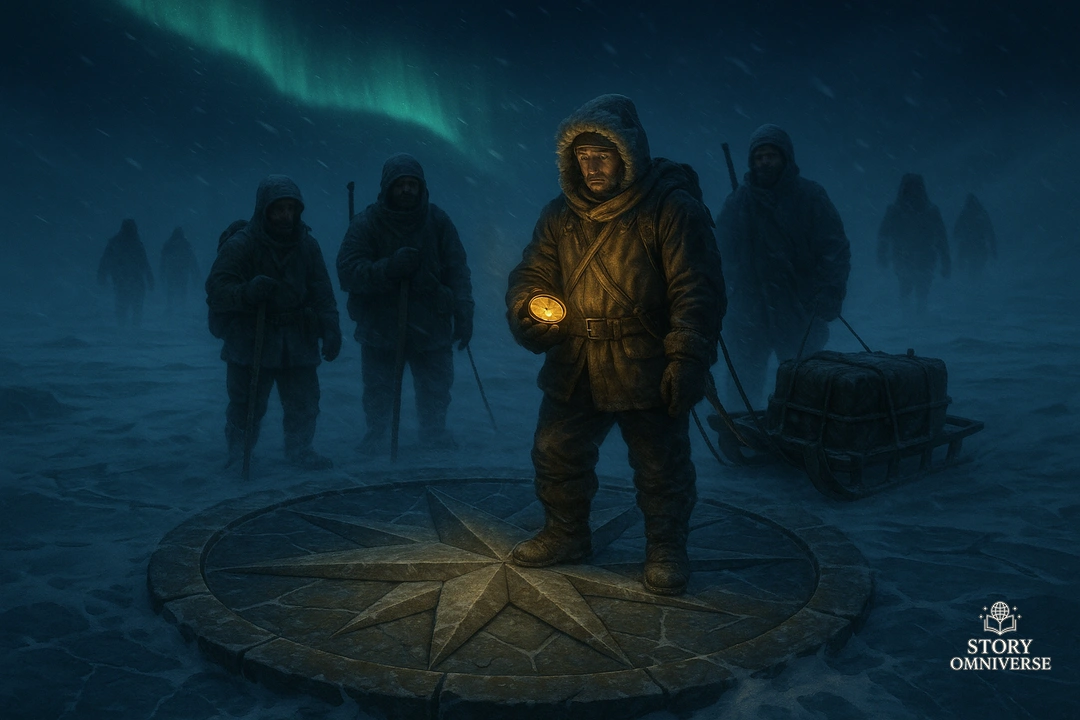
Last light in the tundra did not fall like a curtain. It seeped away, leaving the world in shades of blue. Ahead, half-buried in wind-packed snow, a stone structure emerged from the sea-ice like a drowned thought.
Kaelen crouched beside it, brushing away frost. “A dial,” he said. “Star table. Old.”
The stone was carved with concentric circles and shallow grooves, some filled with ice that glittered faintly. Markings ringed the edge, not quite runes, not quite numbers. Isolde knelt, breath catching.
“This matches Halvorn’s sketches,” she whispered. “The final marker.”
Marcus stepped onto the stone, the compass heavy in his hand. The warmth had become intense, as if it had stored all the cold they had crossed and was now releasing it in one concentrated pulse.
“Careful,” Kaelen warned. “Ice around the base is thin.”
Harker’s crew appeared behind them, silhouettes against the dim horizon. They had followed, quietly, patiently. Harker raised a hand in greeting that looked too much like a claim.
“Northstar,” he called. “You made good time.”
Tamsin’s hand went to her tools, useless against rifles and numbers. “You weren’t supposed to catch up,” she hissed.
Kaelen’s eyes were flint. “We should’ve left you in the storm.”
Harker’s voice carried no offense. “And miss the end? No.”
Marcus ignored him and set the compass above the stone dial. The needle spun violently, faster than ever before, clicking against its housing. The hum of the sea-ice rose, vibrating through the stone into Marcus’s boots.
Isolde leaned in, eyes shining with dread and longing. “It’s aligning,” she said. “Correcting something.”
Then the needle slowed. It did not settle toward any horizon. It pointed inward, toward Marcus’s chest, as if the compass had turned its gaze from world to bearer.
Marcus’s breath caught. He felt suddenly seen, measured down to grief and guilt. The compass’s warmth pressed against his palm like a question.
Tamsin whispered, “Marcus. It’s pointing at you.”
Isolde’s voice broke. “The bearer. The witness. Halvorn wrote it. The compass chooses.”
Behind them, footsteps crunched. A new figure approached, not bundled like a hunter but cloaked in dark, fine fabric that did not belong to this wasteland. He wore gloves of pale leather and on his finger, a seal-ring that caught the last light.
Harker stepped aside, deferential. “Emissary,” he said.
The emissary’s voice was calm, precise. “Marcus Renn of the Archivian Museum of Lost Histories. Thank you for delivering what was misplaced.”
Marcus tightened his grip. “It belongs with the Museum,” he said. “In the Archivian vaults, under Director Veyra’s custody.”
The emissary’s eyes flicked to Isolde’s notes. “The Museum preserves,” he said softly. “But it also invites the curious. Some instruments should not be displayed, not even as warnings.”
Isolde stood, trembling. “Who are you?”
“A steward,” the emissary replied. “Of the Circle that Halvorn served, however unwillingly.”
Tamsin stepped forward. “We have an agreement with Harker. Access, not ownership.”
Harker’s gaze slid away. “Agreements change,” he said, almost apologetic. “When the Circle pays.”
So the rescue had never been charity. It had been a receipt, waiting to be presented. Marcus felt the weight of his choice on the ridge, the bargain that kept them breathing and marked them as deliverers.
Kaelen moved, quick as a striking animal, but two of Harker’s crew blocked him. “Don’t,” Harker warned. “You’ll die for a compass you can’t keep.”
Marcus looked at his team. They were alive. Barely. And they had no return route, no crates, no margin for heroics. His sacrifice on the singing ice had bought them forward motion, not a way back.
Slowly, with bitterness that tasted like iron, Marcus opened his hand.
The emissary took the compass. The warmth left Marcus’s palm at once, replaced by a cold that felt deeper than weather. The emissary slipped the instrument into a padded case, as careful as a priest handling a relic.
Isolde’s voice was a whisper. “We lost it.”
Marcus swallowed hard. “We bring back what we can,” he said, forcing steadiness. “Notes. Proof. The story.”
The emissary inclined his head. “Bring your guilt to Veyra’s door,” he said. “It will keep you honest.”
Then he turned, and with Harker’s crew around him like a moving wall, he disappeared into the blue dusk. The humming sea-ice softened, as if the song had ended.
Tamsin stared after them, eyes wet with rage. “All that for nothing.”
Marcus shook his head, though it felt like lying. “Not nothing,” he said quietly. “We’re alive. And we know the Circle exists.”
Isolde clutched her notebook to her chest like a wound. “Halvorn died chasing a compass that refused the north,” she said. “And we lived long enough to hand it away.”
Marcus looked down at the star table, at the grooves that had held the compass for a moment. “We go home,” he said, voice thick. “To the Archivian Museum. And we tell Director Veyra exactly what took it.”
Kaelen’s gaze stayed on the dark horizon. “If we can find our way back without it.”
Marcus did not answer. The tundra offered no comfort, only distance. And the loss, inevitable as the cold, settled over them as they turned away from the final marker with empty hands.

0 Comments