
Chapter 1: Clay and Oaths
The wheel hummed under Marcellus’s foot, a steady song that filled the workshop and pushed away the winter wind slipping through the shutters. Clay rose between his palms, soft and obedient. He drew it up, pressed it down, and shaped a belly for a jar meant to hold oil or grain, something useful and honest.
His father watched from the doorway, arms folded in his wool cloak. Gaius Valerius had the posture of a man who had once stood straighter under a soldier’s belt, though his service was years behind him, back when the frontier still felt staffed and sure. Now he measured life in stacks of fired pots and in the coin that came from the river trade.
“Keep the lip even,” his father said. “A jar that leaks is a lie.”
Marcellus wet his fingers and smoothed the rim. Outside, a horn sounded from the wall. The sound made his chest tighten with a wanting he could not name without shame.
“I could go up there,” Marcellus said, trying to make it casual. “Just to watch. Lucius goes. He is not older than me.”
“Lucius is a cooper’s boy with nothing to lose but his hands,” Gaius said. “You have hands that feed us.”
Marcellus glanced at the shelf where finished vessels waited, their red surfaces dull in the low light. He imagined those same hands gripping a spear shaft, knuckles white, breath steaming as he stood with the men at the river road.
“The Rhine is Rome’s wall,” his father went on. “It has been there all your life. Order is not a dream. It is built, like a kiln. Brick by brick. Oath by oath.”
Marcellus’s mother, Flavia, moved near the hearth, stirring a pot of lentils that smelled thin. “Order is also bread,” she said softly.
Gaius’s jaw tightened at that, but he did not answer. He stepped closer to the wheel and laid his hand over Marcellus’s for a moment, guiding the pressure. His palm was rough, scarred from old work and old fights.
“You want to be a man,” Gaius said, quieter now. “Then learn this. A man keeps his household. He does not chase noise.”
Marcellus swallowed. “And if the noise comes here?”
“It will not,” Gaius said, too quickly. He looked past the jars, past the clay, as if he could see the river through the wall. “Not while there is Rome.”
Marcellus stared at the spinning clay until his eyes blurred. The wheel did not care about oaths. It only turned. He shaped the jar and tried to believe his father’s certainty, but the horn on the wall had left an echo in his bones.
Chapter 2: The Thin Garrison
The next morning Marcellus carried two large jars on a wooden yoke across his shoulders. The straps bit through his tunic, and the cold made the clay feel heavier, as if winter wanted to drag everything down. The street stones of Mogontiacum were slick with frost. Smoke rose from chimneys in thin threads that broke apart in the wind.
The granary stood near the old barracks, a long building with thick doors and iron hinges. A guard at the entrance wore a patched cloak and held a spear that looked older than he was. He nodded at Marcellus without much interest.
Inside, the air smelled of grain dust and mouse droppings. Sacks were stacked in careful rows, but there were gaps where Marcellus expected more. A man with ink-stained fingers sat at a table, rubbing his temples as if the very sight of numbers gave him pain.
“Jars,” Marcellus announced.
The man looked up. His face was pale and tired, his beard untrimmed. “Put them there,” he said, pointing without standing. “If they break, it will be added to my list of troubles.”
Marcellus set the jars down with care. “Are you the official here?”
“Official,” the man repeated, as if tasting something bitter. “I am Decimus Severus, appointed to keep the annona for the town and the garrison. I am meant to count grain, issue receipts, and answer to the governor’s agent. But soldiers vanish like smoke, and pay arrives like a promise that never becomes a coin.”
Marcellus hesitated. “Vanished?”
Decimus leaned closer, lowering his voice though the room was mostly empty. “Drawn away. South, west, wherever some commander thinks his fortune lies. They say the court needs men. They say Constantine in Britannia has taken the purple and needs men too. All I know is that our rolls are thin, and the Rhine does not care whose banner a man follows.”
A veteran shuffled past, limping, carrying a sack with the help of a boy. The veteran’s hair was white, but his back was still broad. He glanced at Marcellus and gave a humorless smile.
“We have the town watch,” Marcellus said, repeating what he had heard at home. “And the wall.”
“The wall is stone,” Decimus said. “Stone does not lift a spear. The watch is good men, but they are bakers and smiths and widowers, called up by the curiales when the trumpet sounds. And the veterans,” he nodded toward the limping man, “are proud, but pride does not put youth back in the knees.”
From outside came a burst of laughter, then a cough. Marcellus imagined the river wall with fewer helmets along it, more spaces between torches.
Decimus tapped his ledger with a grim finger. “Tell your father I will pay for the jars when the governor’s office releases funds. If he threatens me, I will weep. It is all I have left.”
Marcellus felt heat rise in his face, not at the insult but at the helplessness in the man’s tone. “I will tell him,” he said.
As he turned to leave, Decimus called after him. “Boy. Keep your eyes open. These are years when a quiet street can become a loud one.”
Outside, the cold struck like a slap. Marcellus adjusted the yoke and stared toward the direction of the river, where the sky sat low and gray. The granary door closed behind him with a heavy sound, like a lid on a jar.
Chapter 3: Traders, Tales, and Hunger
Market day should have smelled of warm bread and spiced wine, but this winter it smelled of damp wool, sour breath, and fear. Marcellus moved between stalls with a basket of small cups to sell, their rims painted with simple lines. He watched hands reach for food more often than for pottery.
A woman from a village upriver held out a rusted sickle. “Two loaves,” she begged a baker. “It still cuts.”
The baker shook his head. “Iron is not flour.”
Her shoulders sagged as if she had been struck. Behind her, a man with a child on his hip offered a wooden stool for a handful of dried peas. The child’s cheeks were too hollow for winter.
Marcellus tried to call out his wares, but his voice felt small in the crowd. People listened with half an ear, eyes always drifting toward the north road and the river.
Near the notice board by the basilica, a girl stood on a low step, holding a wax tablet. Her hair was pinned neatly, though her cloak was worn at the hem. She read aloud, clear and steady, while men muttered and women clutched baskets.
“By order of the governor’s office at Mogontiacum,” she read, “and under the seal of the imperial administration, new levies are to be raised for the defense of the provinces. The curiales are to assess households for coin or goods. Arrears will be pursued.”
A man spat. “Pursued,” he said. “Like a debtor chased by dogs.”
Marcellus edged closer. The girl’s voice did not shake, but her eyes flicked over the crowd as if she expected someone to throw something. When she finished, she stepped down and began to write notes quickly, stylus scratching.
Marcellus found himself beside her. “You read like a herald,” he said.
She looked up, wary. “Someone has to. My father says words on a board mean nothing if no one can understand them.”
“You are a scribe’s daughter,” Marcellus guessed, noticing the ink on her fingers.
“Aelia,” she said, then nodded toward his basket. “And you sell cups.”
“Marcellus. My father is a potter.”
Aelia’s gaze softened a little. “Then you know what it is to count clay and coin. These notices,” she tapped her tablet, “they press the honest ones hardest. Those with patrons always find a way to be ‘unavailable’ when the lists are made.”
A shout rose from the far end of the market. Two men argued over a sack of barley. One grabbed, the other pulled back, and the sack tore. Grain spilled onto the mud. For a heartbeat everyone stared, then hands dove down like birds pecking at seed.
Marcellus flinched. “It was not like this last year.”
Aelia’s mouth tightened. “Last year the river still felt like a promise.”
“What do you hear?” Marcellus asked, lowering his voice. “Beyond the frontier?”
Aelia hesitated, then said, “Travelers speak of fighting among the peoples across the Rhine. They say whole groups are moving, not just raiders. Families. Wagons. They name Vandals, Alans, Suebi, as if naming them makes them smaller.”
Marcellus imagined the river road crowded not with merchants but with strangers. “My father says panic is worse than rumor.”
“Panic can be foolish,” Aelia said. “But ignoring hunger is also foolish.”
A man pushed past them, clutching a handful of spilled grain to his chest as if it were gold. Aelia watched him go, then looked back at Marcellus.
“If you hear anything,” she said, “tell me. My father needs witness, not charms.”
Marcellus nodded, though he had little to offer. Still, as he walked away, he felt the strange comfort of being asked, as if his eyes and ears might matter in a town that suddenly seemed to be shrinking.
Chapter 4: A Night of Fire on the Far Bank
The wind shifted one evening and carried a sharp smell over the Rhine, like burned pitch and wet wood. Marcellus stood on the river road with his father, both of them wrapped in cloaks. The sky was a deep iron color, and the water below moved slow and dark.
They had come because the watchman at the corner had said there was light on the far bank. “Just a village fire,” the man had claimed, but his eyes had darted as he spoke.
Now Marcellus saw it. Across the river, beyond the line of bare trees, a glow pulsed low to the ground. It was too wide to be a single hearth. It flickered and leaped as if something fed it in bursts.
A group of men stood nearby, murmuring. One was an old veteran with a scar that pulled his mouth into a permanent twist. Another wore a merchant’s cap and kept wringing his hands.
“I tell you,” the merchant said, “they are moving. Vandals, some say. Alans. Suebi. Names like stones in the mouth. They come because other peoples press them, and because our posts are thin.”
The scarred veteran snorted. “Every winter brings stories. Every spring brings trade again.”
“But not like this,” the merchant insisted. “My cousin’s wagon was turned back from the frontier stations. He said the stations were quiet. Too quiet. And he heard talk that troops were marched away for the quarrels of Romans.”
Marcellus looked at his father. Gaius’s face was set, his eyes narrowed at the distant light. “Rumors,” Gaius said, but his voice had lost some of its weight.
A cry sounded from the far bank, faint but human. Marcellus’s stomach tightened. The glow flared higher, and for a moment he thought he saw figures moving in front of it, black shapes against orange.
“Do you think they are fighting?” Marcellus asked.
Gaius did not answer at once. He pulled his cloak tighter and turned away from the river as if the sight offended him. “Come,” he said. “We have work.”
At home, he barred the workshop door with a wooden beam. The sound of it sliding into place made Marcellus think of a prison.
Flavia watched, worry lines deepening around her mouth. “Gaius, what is it?”
“Nothing we can touch,” Gaius said. He went to the shelf where their best wares sat, glazed bowls and painted jugs meant for wealthier buyers. He began to wrap them in cloth and stack them in a chest.
Marcellus helped, though his hands shook a little. “If it is nothing, why hide them?”
Gaius’s eyes flashed. “Because people become thieves when they fear. Disorder is more dangerous than any tale.”
Flavia’s voice was small. “And hunger?”
Gaius paused. For a moment his shoulders sagged, and he looked older than Marcellus had ever seen him. Then he straightened again, as if pulling on armor he no longer owned.
“The Rhine has held,” he said, more to himself than to them. “It will hold.”
Marcellus carried the last wrapped bowl to the chest. The cloth smelled of smoke from old firings. Outside, somewhere beyond the walls, a dog barked and kept barking, as if it had seen something it could not understand.
That night Marcellus lay awake, listening to the wind. In his mind the distant glow kept pulsing, like a heartbeat that did not belong to the town but was coming closer all the same.
Chapter 5: Ice Underfoot
The frost deepened until even the air felt brittle. In the mornings, the water buckets in the yard held a skin of ice. The roofs of Mogontiacum glittered white, and the streets rang hard underfoot.
One afternoon Marcellus’s uncle, Publius, came to the workshop with a cart and a grim expression. Publius had been a soldier once, long ago, and still wore his old belt on feast days as if it could remind the world who he had been.
“We need hands,” Publius said to Gaius. “The watch post by the river bend is short on supplies. They want dried meat, lamp oil, and two jars for water.”
Gaius looked at Marcellus, then away. “Take him,” he said at last. “He is strong enough to carry and to keep his mouth shut.”
Marcellus’s heart lifted and sank at the same time. He wrapped his scarf tight and climbed onto the cart beside Publius. The road to the post ran along the river, past bare willows that clacked in the wind like bones.
As they neared the bend, the Rhine came into view. Marcellus stopped breathing for a moment. The river was not moving. It lay under a pale sheet, cracked in places, dusted with snow. Here and there dark lines showed where water still seeped, but the wide center looked solid.
Publius spat into the snow. “I have seen it freeze before,” he muttered, “but not like this.”
At the watch post, a low wooden structure near the wall, men huddled around a brazier. Their cheeks were red from cold, their eyes bright with too much wakefulness. One, a young watchman with a patchy beard, tried to grin.
“Ah,” he said, “fresh oil. We can see our own fear better now.”
The others laughed, but the laughter sounded forced. A veteran with a stiff leg stepped out and thumped his spear butt on the ground. “Test it,” he said to another man, nodding toward the ice.
They walked down to the river edge. The man raised his spear and struck the ice. The sound was dull, like hitting thick wood. He struck again, harder. The ice held.
Marcellus swallowed. “If it holds,” he said, “then anyone can cross.”
Publius shot him a look. “Anyone can try,” he said. “Crossing is one thing. Coming back alive is another.”
The young watchman leaned close to Marcellus. “Your father makes pots, yes? Good. When this is over, we will need jars for the dead. And cups for the living.” He tried to smile again, but his lips trembled.
Publius handed out the supplies with brisk movements, as if speed could keep dread away. When the last sack was unloaded, he clasped the veteran’s forearm.
“Any word?” Publius asked.
The veteran’s scarred face tightened. “Smoke north of here. Tracks in the snow on the far bank. Not deer.”
Marcellus stared at the ice. It looked calm, almost beautiful under the gray sky. He had grown up believing the Rhine was a barrier set by God and enforced by Rome. Now it was a road.
As they turned back toward town, Publius kept his eyes on the frozen surface. “Do not wander,” he warned Marcellus. “Do not try to be brave alone.”
Marcellus nodded, but his mind was already walking on the ice, hearing it creak under the weight of strangers and wagons that did not belong to Rome.
Chapter 6: The Crossing
The last night of the year came with a sky like slate and a moon hidden behind clouds. In Mogontiacum, on the frontier of Germania Superior, it was the closing of 406 after Christ, and the turning of the kalends felt less like a feast than a held breath. The streets should have been preparing for small celebrations, for shared bread and a cup of thin wine, but they were tense. People moved quickly, heads down, as if the cold could see them.
Marcellus went with Publius again, this time to bring messages between posts. The wall torches burned low, their flames struggling in the wind. From the river came a sound that was not water. It was a distant groan, like wood under strain.
At the bend, men stood in a line, peering into the darkness. Publius climbed onto a low rise and shaded his eyes. “There,” he whispered.
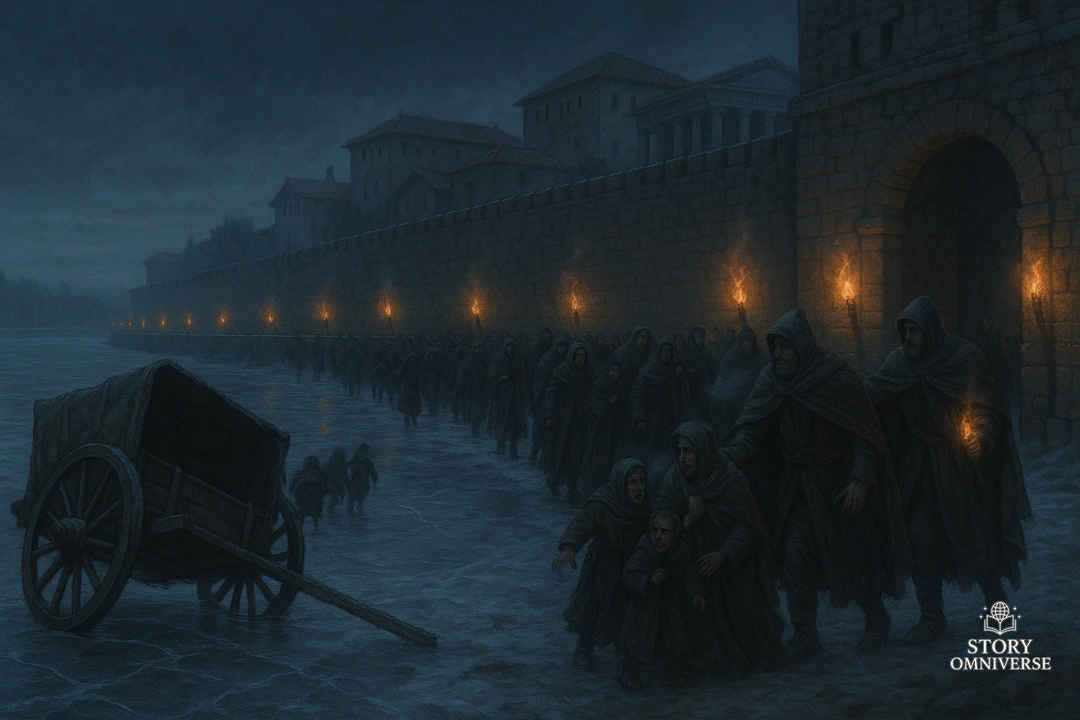
Marcellus saw it then. Shapes on the ice, moving slowly at first. A wagon, its wheels wrapped in cloth. A cluster of people hunched together. Then more behind them, a long shadowy chain.
A watchman hissed, “Families.”
Another answered, “And fighters with them.”
The first group reached the near side. A woman stumbled, clutching a bundle. A child cried, thin and sharp. Behind them, darker figures moved with more purpose, carrying spears and shields that caught faint torchlight.
“Back!” someone shouted in Latin. “Back across the river!”
But the people did not understand, or did not care. They kept coming, driven by the press behind them. The ice creaked, and a crack shot across the surface like lightning. For a moment the whole line hesitated, then surged forward in panic.
Publius grabbed Marcellus’s shoulder. “Stay close,” he ordered. “We go to the gate. We warn the officer.”
They pushed through a crowd of townsfolk who had gathered despite orders, drawn by fear and curiosity. Someone shoved Marcellus from behind. He stumbled, lost his grip on Publius’s cloak, and the press of bodies swallowed him.
“Uncle!” he shouted, but his voice vanished in the noise. People shouted in Latin, in rougher tongues he did not know. A horse screamed. A wagon tipped, spilling bundles onto the ice. The armed men behind it cursed and shoved, trying to force a path.
Marcellus found himself near the river edge, close enough to see faces. A man with braided hair and a fur cap stared at him, eyes wide, not with hatred but with the same fear Marcellus felt. The man’s hands were empty, held out as if to show he carried no weapon.
A stone flew from somewhere and struck the ice. Another followed, hitting a woman’s shoulder. She cried out, and the crowd surged again. Marcellus saw two townsfolk pinned against a tipped wagon, their legs trapped.
He could run. Home was behind him, warm compared to this chaos. His father’s barred door, his mother’s hearth. But the trapped people screamed, and no one could reach them because everyone was pushing the other way.
Marcellus forced himself forward, bracing his shoulder against the wagon’s side. “Help!” he shouted in Latin. “Lift it!”
A young watchman joined him, teeth clenched. Together they heaved. The wagon shifted a little. Marcellus’s boots slid on the ice dusted with snow. The trapped man grabbed at Marcellus’s arm, eyes wild.
“Pull your leg free!” Marcellus yelled.
Another pair of hands joined, then another. The wagon lifted enough for the trapped townsfolk to crawl out, sobbing. Marcellus’s arms burned. His breath came in gasps that froze in his scarf.
“Gate!” the watchman shouted. “This way!”
Marcellus turned and saw the line of people now spilling toward the wall, some begging, some pushing, some armed. Torches bobbed, and the night felt alive with danger.
He did not know where Publius was. He did not know if his father was safe. But he knew the way to the gate, and he could see children being shoved aside by bigger bodies.
Marcellus climbed onto a low stone and waved his arms. “This way!” he shouted, voice cracking. “To the gate!”
A woman with a child looked up at him, desperate. Marcellus jumped down and guided them, one hand on the woman’s elbow, as if that small touch could keep them from being crushed.
Somewhere in the darkness, the year turned. Marcellus did not feel it. He only felt the ice underfoot and the weight of choice settling in his chest like a stone that would not melt.
Chapter 7: The Price of Shelter
By dawn, the streets inside Mogontiacum were packed with bodies and breath. The gate had opened and closed in fits, letting in some, turning back others, until the guards could barely hold their line. Now the newcomers huddled in corners, under arches, in any space that blocked the wind. Townsfolk stared from doorways, clutching keys and knives.
Marcellus stood in the basilica hall, where the curiales and their clerks had gathered in haste under the eyes of a few weary soldiers. The air smelled of damp cloaks and old incense. Aelia was there, her tablet pressed to her chest. Beside her stood her father, Marcus Aelius, a thin man with careful eyes and a scribe’s calm that looked strained at the edges.
“You,” Marcus said to Marcellus, recognizing him from the market. “You were at the river.”
Marcellus nodded. “I was separated from my uncle. I helped bring people to the gate.”
Marcus’s gaze flicked over him, measuring. “Then you can run messages. We need legs more than speeches.”
Aelia touched Marcellus’s sleeve briefly, a silent question. He shook his head, uncertain, and her mouth tightened with worry.
The men argued in sharp bursts. One, a heavy man with a gold ring, pounded a fist on the table. “We cannot feed them all. Our stores are for citizens. For those assessed and registered.”
A thinner councilor snapped back, “If we leave them outside, they will join the armed bands. Then we will have enemies at our wall.”
A priest raised his hands. “We must show mercy, for the sake of our souls and the peace of the city.”
“And starve?” the heavy man demanded.
From the doorway came a sound of crying. A woman with frostbitten hands held out a loaf, pleading for more. A guard pushed her back gently but firmly.
Marcus Aelius leaned toward Marcellus. “Take this,” he said, handing him a small wax tablet with a list scratched into it. “Go to the granary. Ask Decimus Severus what remains. Then to the north gate. Count how many have come in since midnight. Be quick.”
Marcellus took the tablet. “Yes, sir.”
As he hurried through the streets, he saw how quickly old rules bent. A baker who had refused barter yesterday now traded bread for a fur cloak. A man who had always boasted of his Roman blood now whispered to a newcomer in broken words, asking if they knew where to find salt. A watchman accepted a silver pin to let a family sleep in a storage shed.
At the granary, Decimus Severus met Marcellus with red eyes. “More mouths,” he said before Marcellus could speak. “Always more mouths.”
Marcellus showed the tablet. “We need numbers.”
Decimus barked a laugh that sounded like a cough. “Numbers? Tell your scribe that numbers do not stop hunger. But fine.” He led Marcellus down the rows of sacks, pointing. “That much barley. That much wheat. Less than last month. The shipments from the south are late. The soldiers who should escort them are gone, marched to serve men who call themselves Augustus.”
Outside the granary, Marcellus nearly collided with Publius. His uncle’s face was bruised, one eye swollen. Relief hit Marcellus so hard his knees went weak.
“Where were you?” Marcellus blurted.
Publius grabbed his shoulders. “Alive,” he said. “That is enough. Your father is asking for you like a madman. Come home.”
“I have work,” Marcellus said, surprising himself with the firmness of his voice. “I am running for Marcus Aelius.”
Publius stared, then nodded once, slow. “Then run,” he said. “But do not think it makes you safe.”
Marcellus ran on, tablet in hand, breath burning in his throat. The town felt like a jar filled too full, the lid pressed down hard. He did not know what would crack first, but he could feel the strain in every shouted order and every hungry stare.
Chapter 8: A Choice in the Granary
The second night after the crossing, the cold sharpened again. Marcellus returned to the granary with a message for Decimus Severus, but the building was quieter than it should have been. No guards joked by the door. No carts creaked nearby. Moonlight made the yard look empty and flat.
He pushed inside and paused. A lantern glowed deeper within, moving. Voices murmured, low and urgent.
Marcellus stepped softly between the sacks. Grain dust tickled his nose. He saw Decimus near the back, not at his table but beside a small side door that led to the alley. Two men stood with him, one holding a sack, the other watching the doorway.
Decimus’s voice was tight. “Quickly. My household will not beg in the street. I have children, and my wife is ill. I have kept this town’s accounts for ten years. I have not always been a thief.”
The man with the sack grunted. “Everyone has children.”
Decimus snapped, “Not everyone has responsibility. When the governor’s agent demanded the last tally, I gave it. When the soldiers came for their issue, I found it. When the curiales argued, I stood here and counted until my eyes bled. And now they will make me the face of hunger.”
Marcellus’s stomach turned. He thought of the woman at the basilica door holding out her loaf like an offering. He thought of his own mother thinning lentils with water.
He stepped out from behind the sacks. “Decimus,” he said, voice shaking but loud enough to cut through the whispers. “What are you doing?”
All three men froze. The sack holder’s hand went to a knife at his belt.
Decimus’s face went gray in the lantern light. “Boy,” he said, forcing a smile that did not reach his eyes. “You should not be here.”
“I came with a message,” Marcellus said. He held up the wax tablet, then lowered it. “But I see you have your own business. In the dark.”
Decimus’s mouth tightened. “You do not understand. If my family starves, what good is my duty? What good is fides when the river itself breaks faith?”
Marcellus took a step closer, hands open. “If you steal from the stores, others starve sooner. Then there will be fighting in the streets. Then your family will not be safe anyway.”
The knife man shifted, eyes flicking between Marcellus and the door as if weighing whether silence was worth blood.
Decimus’s voice rose, sharp. “You think fairness will stop armed men on the ice? You think a hungry crowd cares about ledgers?”
Marcellus felt fear like cold water in his gut, but he did not back away. “Maybe not,” he said. “But if those set over the grain take first, everyone will take. Then we are finished without a single spear thrown.”
For a moment Decimus looked as if he might strike him. Then his shoulders sagged. He looked suddenly very small among the towering sacks.
“What do you want?” Decimus whispered.
Marcellus swallowed. He wanted to run. He wanted his father’s workshop and the simple truth of clay. But he had seen the crossing, and he had seen how quickly people became animals when pressed.
“I want you to stop,” Marcellus said. “And I will tell Marcus Aelius. The curiales must know. They must set watchers here. They must ration openly, in the light, so no one can say the grain vanished by sorcery.”
The knife man cursed under his breath. The sack holder lowered the sack slowly, as if it had become too heavy.
Decimus closed his eyes for a long moment. When he opened them, they were wet. “Go,” he said, voice hoarse. “Tell your scribe. Tell them all. Let them despise me. I am tired of being the hinge on a door everyone kicks.”
Marcellus turned and walked out before his courage could fail. The night air outside was brutal, but it felt cleaner than the grain-dust secrecy within.
As he ran toward the basilica, the tablet thumped against his palm. He realized his hands were not only for shaping clay. They could also carry truth, even when truth made enemies. In a town packed tight with fear, that choice felt like stepping onto thin ice.
Chapter 9: Smoke, Mud, and Manhood
A week into the new year, the snow near the outskirts turned to churned mud. Too many feet, too many carts, too many desperate searches for firewood had ground the white down into brown slush. Smoke hung low over the fields where small fires burned in pits, watched by hungry eyes.
Marcellus stood on the wall walk with a borrowed club and a small shield that had once belonged to Publius. It was scarred and heavy. He was part of a night watch now, not a legion unit, just neighbors and veterans and boys old enough to hold a weapon without dropping it. The officer of the gate, a hard-faced man with a worn crest, had told them plainly: hold until help comes, if help comes.
Publius leaned on the stone beside him, his bruised eye fading to yellow. “Keep your ears open,” he muttered. “Not just your eyes.”
Below, in the dark, a dog barked once, then fell silent. Farther out, a faint shout rose and died.
A watchman named Lucius, the cooper’s boy Marcellus had envied, stood on the other side. His face was pale in the torchlight. “Do you think they will attack?” Lucius asked.
Marcellus listened to the wind. “I think they will test us,” he said. “Like we test the ice.”
Lucius gave a weak laugh. “I would rather test barrels.”
From the north came a sudden flare of light. Not a torch, but a brief burst, like dry reeds catching. Then another. Shouts followed, harsh and panicked.
The veterans on the wall moved at once, not with speed but with practiced purpose. “To the north post!” someone called.
Marcellus ran with the others down the steps and along the inner path. His boots slipped in mud. He tasted smoke already.
At the north gate yard, townsfolk clustered, clutching sticks and stones. A man shouted, “They are burning the outer sheds!”
Aelia appeared near the gatehouse, her cloak pulled tight, her hair escaping its pin. She looked at Marcellus with wide eyes. “My father is inside with the curiales,” she said quickly. “They are arguing whether to send men out.”
“Send them,” Marcellus said, then caught himself. He was not a commander. He was a potter’s son with a club.
A veteran near them spat. “If we do nothing, they will come closer next time.”
The gate opened a crack, just enough for a small group to slip out. Marcellus saw Publius step forward with them.
“No,” Marcellus said, grabbing his uncle’s sleeve. “You cannot. You are hurt.”
Publius looked at him, steady. “Hurt is not dead,” he said. “Stay here. Hold the line.”
Marcellus’s throat tightened. He wanted to follow. He wanted to prove something bright and simple. But he remembered the wagon on the ice and the trapped legs, and how strength had been lifting, guiding, holding steady.
He nodded once. “I will.”
The gate closed. The sounds outside grew louder, then muffled by stone. Smoke seeped in through cracks, carrying the stink of burning straw. People coughed. Children cried.
Marcellus took his place by the gate, club raised, shoulders tense. Lucius stood beside him, hands shaking.
“Steady,” Marcellus said, surprising himself again. He did not feel heroic. He felt tired and cold and scared. But he stayed.
Hours later the gate opened again and the men stumbled back in, faces smeared with soot. Publius was among them, limping worse but alive.
“They ran when we came,” Publius said, voice rough. “Not a battle. A warning.”
Marcellus looked at the smoke-stained sky and understood. Manhood was not one bright moment. It was standing in the mud, breathing smoke, and not leaving when fear told you to.
Chapter 10: After the Ice Breaks
By late winter the air softened, almost without anyone noticing at first. One morning Marcellus woke to a different sound from the river, a low shifting murmur like a giant turning in sleep. He went to the wall with Publius and listened.
The Rhine was moving again. Dark water showed in widening cracks, and chunks of ice bumped and rolled, grinding against each other. The river that had become a road was slowly becoming a barrier once more.
On the far bank, the camps that had clustered in the cold were thinner now. Some had moved on westward into Gaul. Some had been scattered by hunger, by skirmishes, by decisions made in the dark. The worst of the crossing, the thing people would speak of as the great breaking of the Rhine at the end of 406, was over, but the town did not feel safe. It felt older.
Inside Mogontiacum, rationing had become a daily habit. After Marcellus exposed Decimus’s attempt to hide grain, the curiales had placed guards at the granary and made distribution public, with tallies read aloud and tablets sealed. Decimus still walked with his head down, but the riots many had feared had not come. People grumbled, but they lined up, and the line itself became a kind of peace.
Marcellus returned to the workshop as the days lengthened. The wheel waited like an old friend. When he pressed his foot down, the familiar hum rose, steady as breath. Clay spun beneath his hands, cool and patient.
Gaius watched him work, quieter than before. The certainty that had once filled his father’s voice had cracked, but something else had taken its place, a sober attention. He touched the edge of a newly formed bowl and nodded.
“You were on the watch,” Gaius said.
Marcellus kept shaping. “Yes.”
“You ran messages for the scribe.”
“Yes.”
Gaius’s throat worked as if swallowing pride. “You did not die,” he said at last, as if it were the only blessing he dared name.
Flavia set a small loaf on the table, still warm. The smell filled the room with a comfort that felt earned. “Eat,” she said.
Later that day Marcellus met Aelia near the basilica. The notice board was crowded with new lists: names of those assigned to work parties, counts of grain, orders for repairs, and warnings against hoarding. Aelia held a stack of tablets now, her arms full.
“My father says he needs help,” she said, looking up at Marcellus. “Not just running. Writing. Counting. Keeping record so no one can steal in the dark again.”
Marcellus glanced at his hands. They were stained with clay, the lines under his nails dark. “I can learn,” he said. “Slowly.”
Aelia’s expression softened into something like hope. “Slowly is better than never.”
They walked together toward the workshop district. The streets were still scarred, and some buildings stood blackened at the edges where fire had licked them. But people were mending roofs, patching doors, hauling broken timber away. The town smelled of wet earth and fresh-cut wood.
At the river, ice chunks drifted past like broken plates. Marcellus watched them and felt the winter of 406 settle into him as a line, clear and unmoving. Before it, he had been a boy who wanted noise and glory. After it, he was a young man who understood that borders could fail and that order was not a gift. It was labor, shared and argued over, measured in bread and names.
He returned to the wheel with that knowledge. And when he left the workshop in the evenings, he carried not a spear but a tablet, walking beside Aelia toward the basilica, ready to help rebuild a life measured in honest counts and shared bread.

0 Comments