
Chapter 1: The King’s Winter
Snow lay in ridges along the stone wall of the monastery, like old wool left out to sour. Inside the scriptorium, the air smelled of smoke, damp vellum, and lamp fat. Eadric kept his fingers close to the brazier as he trimmed a quill, shaving it to a clean tongue. His breath fogged the narrow opening high in the wall, a slit more than a window. Beyond it, Bernicia’s hills were hard gray, and the river below carried slush like shattered ice.
Brother Cuthwine bent over a page, lips moving as he copied a psalm. The scrape of reed on skin was steady, like a mouse gnawing grain. Eadric wanted that steadiness. He wanted it more than food, more than sleep.
The door opened and let in a blade of cold. Abbot Herefrith came in with two lay brothers. Between them stood a man in a torn cloak, boots caked with frozen mud. His hair was stiff with soot, and his hands shook as if he still felt fire.
“From the river villages,” the abbot said. His voice was low so the novices would not hear, but sound carried in stone rooms. “Speak.”
The man swallowed. “They came at dawn. Men from Mercia, they said. Or men who want us to think so. They crossed where the old boundary stones sit. They took cattle first. Then the thatch caught. My sister’s house went like dry straw.”
Eadric’s quill paused. The ink blot widened on the page like a bruise.
“King Oswiu will answer,” Abbot Herefrith said, but the words sounded like a prayer spoken without warmth. “Did they take captives?”
“Aye. And they laughed. They said our king grows old and heavy behind his walls.”
Brother Cuthwine muttered, “Blasphemers.”
The messenger’s eyes flicked to the crucifix on the wall. “And there is talk of sickness too. A fever that steals breath. It is in the low farms. Folk say it is God’s rod.”
Silence settled. In the last years, they had heard such talk like distant thunder. Now it was near enough to taste. Eadric looked at the shelf where their few books stood. Each one was a treasure bought with sheep and labor. Each one felt suddenly fragile, as if a single spark could unmake it.
Abbot Herefrith turned to Eadric. “You will write to the king’s reeve at Bamburgh. Tell him what we have heard. Ask for protection for the road and for our granges. Mark the date as we keep it: in the year of our Lord six hundred and sixty-six, in the reign of Oswiu.”
Eadric nodded, though his throat tightened. He dipped his quill again. The ink shone wet and black, obedient as a hound. He wrote the king’s name with care, as if the right shape of letters could raise a shield over burning roofs.
Outside, the wind worried the bare trees. Somewhere beyond the hills, a village was already ash. Eadric pressed harder, as though force could make words into iron, and prayed that the page could bear the weight of what the world demanded.
Chapter 2: A Letter for Wearmouth
Two days later, the abbot called Eadric to the guest hall where a small fire struggled in the hearth. A thin skin of ice floated in the water bucket. The abbot’s hands were red with cold, but his eyes were sharp with the kind of attention hunger brings.
“Wearmouth rises,” Abbot Herefrith said. “Benedict Biscop’s house by the river. Stone walls, Roman fashion. They say he has brought masons from over the sea, and glass for the church, dear as silver.”
Eadric had heard the name spoken with wonder and suspicion. Stone walls sounded like pride, yet pride had its uses when raiders came. He pictured their own timber outbuildings, patched and leaning, and felt a sudden shame that was also longing.
The abbot reached under his cloak and drew out a folded piece of parchment, bound with a cord. A small lump of wax sealed it, stamped with the monastery’s simple cross.
“You will take this,” he said. “To Wearmouth. Ask their abbot, or their prior, for counsel. They have books and men who know how to set stone. We need both.”
Eadric’s fingers hovered. A sealed letter was a living thing. It carried not only words, but the weight of the one who sent them. “What does it ask?” he said, though he knew better than to press.
“Hands,” the abbot replied. “A man who can true a wall. And books. A psalter, if they can spare it. Our novices copy from worn pages until the letters vanish. Northumbria needs learning as much as spears, especially in a year like this.”
A lay brother, Osric, stood by the door with a small pack and a staff. “I’ll go with him,” Osric said. “The tracks are not safe.”
The abbot’s mouth tightened. “No track is safe this winter. But the king’s men watch the main ways. Stay near them. Avoid the low marsh where water stands. And do not lodge where folk cough in the dark.”
Eadric took the letter. The wax was cool, the cord rough. He felt the abbot’s trust like a stone set on his chest.
Before he left, Eadric went to the chapel. The candles were short, their wicks blackened. He knelt on the cold floor and listened to his own breath, counting it as if it were a psalm.
“Lord,” he whispered, “make my steps straight. Let me not be the cause of harm.”
Behind him, Brother Cuthwine entered and set a hand on his shoulder. “Do not look back too often,” Cuthwine said. “The road steals courage when you measure it.”
Eadric managed a small smile. “And if I do not return?”
“Then your words will,” Cuthwine answered, nodding at the letter. “Sometimes that is all a man can leave. Sometimes it is enough.”
They stepped out into the yard. The sky was the color of old pewter. A raven perched on the gatepost, head cocked as if judging them. Osric pulled his cloak tight.
“Keep the seal dry,” Osric warned. “Wax does not love winter.”
Eadric tucked the letter inside his tunic, close to his ribs where his warmth could guard it. When the monastery gate closed behind them, the sound was final. The path ahead ran between bare hedges and frozen ruts, and smoke rose in thin lines from far-off places where people still had roofs, and still feared losing them.
Chapter 3: Roads of Smoke
The way south was not a road so much as a wound through fields. Mud clung to their boots, then froze, then broke off in heavy chunks. Osric walked ahead, staff probing puddles that hid deep ruts. Eadric kept his hand near his chest, feeling the sealed letter under his tunic as if it were a second heart.
They passed a farm where the door hung open. A pot lay on its side in the yard, rim bent. Chickens scratched at ash. No one came out to greet them. The silence had the wrong shape, as if the place had forgotten how to be lived in.
At midday they met a small group moving north: a woman with a baby pressed to her shoulder, two children dragging a sled with a sack, and an old man limping behind. Their faces were gray with cold and hunger. The baby’s cry was thin, more like a kitten than a child.
Osric raised a hand. “Where do you go?”
“Anywhere the smoke is not,” the woman said. Her voice was flat, as if she had spent it all on crying. “They came from the river. Men with round shields. They took our grain. They took my brother.”
Eadric swallowed. “Mercian?”
She spat into the mud. “So they shouted. Or so the men wanted us to believe. Does it matter? A spear is a spear.”
The old man coughed, a wet sound that made Eadric step back without thinking. He leaned on a stick too thin for his weight. “And the fever comes,” he rasped. “In the low houses. It takes the strong first. Like God is plucking the best sheaves.”
One of the children, a girl with chapped lips, stared at Eadric’s tonsure and whispered, “Is it because we angered Him?”
Osric’s jaw tightened. “God does not delight in sickness.”
The woman’s eyes flashed. “Then why does it come? Why this year? Why now, when the border burns?”
Eadric felt the question strike him like cold water. In the monastery, answers lived in books and sermons. On the road, questions had teeth. He said carefully, “We do penance because we are sinners, and we pray because we are small. Keep your hands and cups as clean as you can. Do not crowd if you can help it. And ask a priest for blessing. That is what we know.”
The old man laughed without humor. “Clean cups. We drink what the ditch gives.”
They moved on, and Eadric watched them go, smaller and smaller against the white fields. He wanted to call them back and offer something, but he had only a crust of bread and a letter sealed for another man’s eyes. He hated himself for the smallness of what he could give.
Later, near a crossing where willow trees bent over black water, they found fresh graves. Mounds of earth rose like sleeping beasts, each marked with a simple stick. A scrap of cloth fluttered from one stick, caught there by someone who needed to remember.
Osric made the sign of the cross. “How many?”
Eadric counted without meaning to. Seven. Then he saw the eighth, smaller than the rest.
A man appeared from behind a hedge, holding a spade. His cheeks were hollow. “Do not drink from the stream,” he said before they asked. “A cow died upstream. And do not stop in the village. We have the cough. The priest says it is chastisement.”
Osric backed away at once. Eadric’s skin prickled. The pestilence. It was no longer rumor. It lived here, in soil and breath, and in the way men would not meet a stranger’s eyes.
As they walked, smoke smeared the horizon. It was not one fire but many, thin as thread. Eadric thought of the abbot’s words: learning as much as spears. Yet on these roads, it was spears and sickness that ruled. He pressed the letter harder against his chest and tried to believe that ink could still matter, even when the world seemed to answer only to flame.
Chapter 4: The Roman House
Wearmouth stood near the river like a promise made in stone. Eadric saw it first as a pale line against the winter trees, then as walls fitted with care. Unlike the timber halls of Bernicia, these stones sat straight, as if they had been taught obedience. A bell hung over the gate, and when it rang the sound was clean, not swallowed by thatch.
A porter admitted them after questions. Inside, the yard was swept, and the paths were laid with gravel that crunched underfoot. Eadric stared at a church opening set with small panes of glass, not everywhere, but where the altar stood. It caught the weak sun and held it, turning it into a soft glow. He had heard of such things, but seeing it made his throat tighten. Light that did not flicker. Light that did not smell of smoke. Light that spoke of ships and distant coasts.
They were led to a hall where monks moved quietly, their tonsures neat. Latin flowed in their chanting like water over stones. Eadric understood enough to feel both pride and shame, as if his own tongue were a tool not yet sharpened.
A tall monk approached, his face lined but lively. “You come from the north,” he said in English. “Bernicia’s cold is on your cloaks.”
Osric bowed. “We bring a letter from Abbot Herefrith.”
The monk’s eyes went to Eadric’s hands. “You are the scribe.”
Eadric nodded and produced the sealed parchment. “For your abbot, or prior.”
The monk took it and weighed the wax with a thumb. “I am Ceolfrith, priest of this house, set over the school and the books. Our abbot is away on the king’s business.” He smiled slightly, as if to soften the disappointment. “But I can answer what can be answered.”
Eadric’s stomach loosened. He had imagined a distant figure, not a man who could look straight through him. He bowed deeper. “Forgive me, Father.”
Ceolfrith nodded at the seal. “You have kept it whole. That is not a small thing on these roads.”
They were given broth and a corner by the fire. As Eadric warmed his hands, he watched men at work beyond the hall. A mason chipped stone with an iron tool that rang like a bell. Another monk carried a board of wax tablets, scratching notes with a stylus, then rubbing them smooth with the heel of his hand.
A youth sat apart near the glass-lit opening, a book open on his knees. He was not dressed as a monk, though his hair was cut short. His cloak was fine but worn at the edges, as if it had traveled and been slept in. He looked up when Eadric glanced his way, then back down as if the page were safer than faces.
Ceolfrith followed Eadric’s gaze. “That is Aldfrith,” he said quietly, and then corrected himself with care. “Aldfrith is what we call him here. A noble ward. His kin placed him under church care for peace. In these years, names can be snares.”
Aldfrith’s lips moved as he read, not chanting but tasting the words. Eadric felt a strange envy. In Bernicia, boys learned to hold a spear before they learned to hold a book, and many never learned the book at all.
Later, as Ceolfrith broke the seal and read, Aldfrith approached Eadric. Up close, Eadric saw ink stains on the youth’s fingers.
“You walked far,” Aldfrith said. His voice was soft, careful. “Are the villages truly burning?”
Eadric hesitated, then nodded. “Some. And there is sickness. Folk fear it is God’s anger.”
Aldfrith’s eyes flickered. “My mother says God tests kings.”
Eadric looked at the stone walls, the imported tools laid neatly on racks, the glass that held light like water in a cup. “And monasteries,” he said.
Aldfrith gave a thin smile. “And scribes.”
For a moment, the chant from the chapel rose and fell. In that Roman house, knowledge felt like a weapon that did not rust. Eadric wondered who would wield it, and against whom, and whether a man could carry such a blade without cutting his own hands.
Chapter 5: A Bargain in Ink
Ceolfrith received Eadric the next morning in a room that smelled of wax and fresh-cut wood. On a table lay a stack of parchments, a small knife, pumice for smoothing, and a seal press of carved bone. The priest’s eyes were calm, but his hands moved with purpose, as if every motion were part of prayer.
“We can spare a psalter,” Ceolfrith said. “And a man who knows stone. Brother Maccus has set walls in Kent and across the sea. He will go north if your king’s protection is sure.”
Eadric’s relief came too quickly. He almost thanked God aloud. Then Ceolfrith continued.
“But we do not send treasure into a burning field without a hedge,” he said. “Wearmouth also needs safety. Raiders do not love books, but they love cattle and silver. We require land enough to feed our brothers and to house those we train. In writing.”
Osric shifted uneasily. “The king has given lands before.”
“Oral gifts are eaten by time,” Ceolfrith replied. “A thegn dies and his son forgets. A boundary stone is moved in the night. A charter endures, if men fear God and the king’s anger.”
Eadric felt the weight of the word charter. In his monastery, they had a few, stored like relics, wrapped in cloth. Ink could hold a boundary line more firmly than a sword, if men agreed to honor it. If they did not, ink became a mockery.
Ceolfrith watched him. “You will draft the terms.”
Eadric’s mouth went dry. “Here? Without the king’s witness?”
“You will draft,” Ceolfrith said. “Then you will carry it to Oswiu. He will seal it or refuse. But he must see what is required, plainly, without flattery.”
Osric frowned. “This is bargaining with holy things.”
Ceolfrith’s gaze did not waver. “Holy things live in hungry bodies. A monastery without land is a beggar at every door. We can teach boys to read, we can copy books, we can pray for the king. But we cannot do it on air. In this year, when pestilence and raiding strip the poor, we must be able to feed them, or our prayers will sound like empty bowls.”
Eadric sat at the table. The parchment before him was clean, pale as bone. He sharpened his quill with the knife, hands steady from habit even as his thoughts churned.
Outside the gate, he had seen a line of poor folk waiting for alms. A woman held out a bowl; a monk dropped barley into it with a measured hand. The woman’s cheeks were hollow. Her eyes were bright with fever or hunger. A child behind her licked his lips as if imagining the grain already cooked.
Eadric began to write, setting the words in the form he had learned: In the name of God, in the year of our Lord six hundred and sixty-six, in the reign of Oswiu, king of the Northumbrians… The letters marched in neat rows. Each stroke felt like a nail.
Aldfrith entered quietly and leaned over the table. “So many words,” he murmured, half in awe, half in dread.
“So many lives,” Eadric answered before he could stop himself.
Aldfrith’s brow creased. “Do you think it is wrong?”
Eadric looked at the ink shining wet. “I do not know,” he said. “I only know that my hand makes promises for men with swords, and those promises will be tested by men with axes.”
Ceolfrith stood behind them, listening. “Words are not clean because they are sacred,” he said. “They are clean only if they are true, and if the writer fears God more than he fears men.”
Eadric kept writing. He wrote of land and protection, of boundaries and obligations, of prayers owed and hospitality given. He wrote as the poor waited outside and the winter wind pressed against stone. When he finished, his fingers cramped. He blew gently on the ink to dry it, as if he could cool the heat of what he had set down, and wondered whether he had just helped build a wall, or a snare.
Chapter 6: The King’s Burden
Oswiu’s hall at Bamburgh smelled of wet wool, ale, and smoke that clung to the rafters. The fire pit glowed, and above it hung a blackened cauldron. Warriors sat on benches with their spears propped beside them, faces hard from winter and burial. A harp lay silent in the corner, its strings slack, as if music itself had grown cautious.
Eadric stood near the hearth with Osric and the king’s reeve. He held the drafted charter in a leather wrap, the parchment protected from damp. His journey back had been faster, driven by fear of what might follow the road behind him, and by the knowledge that delay could turn a request into a corpse.
King Oswiu sat on a raised seat, his hair graying at the temples. He wore a cloak pinned with a brooch, and a small cross hung at his throat. His eyes were tired, but when he spoke the hall listened, as if the sound of his voice were a roof.
“A writing from Wearmouth,” Oswiu said. “Read.”
Eadric stepped forward, bowed, and unwrapped the parchment. His voice carried in the smoky air as he read Ceolfrith’s terms. When he reached the request for land and written protection, a murmur rose like wind in dry grass.
A thegn named Beornwulf slammed his fist on the bench. “We bleed on the border and monks ask for fields.”
A priest near the king lifted his hand. “They ask so they may pray and teach. A kingdom without learning is blind. A blind man swings his sword at his own kin.”
Beornwulf snorted. “A kingdom without warriors is dead.”
Oswiu raised his hand, and the hall quieted like a hound under a whip. “Mercia raids again,” he said. “Wulfhere grows bold. He tests our boundary stones as if they are children’s toys.”
At the name Wulfhere, several men spat. Mercia’s king was young and hungry, and his reach was felt even where his men did not stand. Traders brought tales of his power, and tales were tinder.
A gray-haired priest, Father Eata, spoke softly. “The sickness also tests us. God may be calling us to penance, my lord. To humble ourselves. In such a year, a house of prayer is not a luxury.”
Beornwulf’s laugh was sharp. “Penance will not stop a spear.”
Father Eata’s eyes narrowed. “Nor will pride stop a pestilence.”
Eadric watched Oswiu’s face. The king’s jaw tightened, then loosened. He looked older in that moment, as if each argument in his hall stacked another stone on his shoulders.
“What do you counsel?” Oswiu asked Eadric suddenly.
Eadric’s heart lurched. Scribes were meant to speak with ink, not in councils. He glanced at the priests, then the warriors. “My lord,” he said carefully, “Wearmouth offers books and a mason. They ask for written surety. If we refuse, we lose what they offer. If we agree, we bind ourselves in a year when many things are unbound. But binding can be strength, if it is honest.”
Oswiu studied him. “You speak like a man who has seen the roads.”
“I have,” Eadric said. He saw again the graves by the stream, the woman with the baby. “People are frightened. Fear makes them listen to any voice, even the old whispers that the priests have spent years driving out.”
The priest crossed himself. “Old gods,” he murmured.
Oswiu’s gaze hardened. “Then we must give them something firm. A wall, a law, a promise.” He reached for the parchment. “I will consider this. And I will send men to the river villages, not only to fight, but to guard the living and bury the dead.”
Beornwulf leaned forward. “Send more than men, my king. Send fire back.”
Oswiu did not answer at once. The hall’s smoke stung Eadric’s eyes. In that haze, the king’s burden looked like a shadow that could swallow him. Eadric wondered if any words, however carefully written, could keep a kingdom from breaking when winter, war, and pestilence pressed at every seam, and when even a king’s will could be pulled apart by hunger.
Chapter 7: The Year of Pestilence
The sickness came like a thief that did not care for locks. It entered the monastery on the breath of a lay brother who had gone to trade for salt and returned pale, sweating under his cloak. By nightfall he could not stand. By dawn he could not pray aloud.
At first they prayed harder. They scrubbed floors with ash and water. They burned herbs in the corridors until the air was sharp and bitter, and hung rushes fresh-cut to sweeten the stench of sweat and fear. Abbot Herefrith ordered the brothers to sleep apart, to eat in silence, to avoid touching. He told them to keep the well covered, to boil what could be boiled, and to carry the dead quickly, before grief turned to panic. But prayer and caution were small nets for such a tide.
Brother Cuthwine was the first of the scribes to fall. Eadric found him in the scriptorium, head on the desk, the page beneath him smeared with ink and saliva. His skin was hot as a stone left by the fire. When he tried to speak, only a rasp came out.
“Water,” Cuthwine whispered.
Eadric brought it, holding the cup with cloth so their fingers would not meet. Cuthwine’s eyes were bright and unfocused. “Finish the psalm,” he said, nodding weakly toward the page. “Do not leave it broken.”
Eadric swallowed. “Rest. I will finish.”
Cuthwine’s mouth twitched as if he wanted to smile. “Good. Words should be whole. Even when men are not.”
By the next day, Cuthwine was dead.
The bell rope hung untouched. At first, Eadric thought someone would come, that some brother would take it up and ring for the dead. But men were too weak, too afraid, and the abbot had ordered quiet so the sick could sleep. The bell stayed silent, and that silence was worse than any tolling.
Eadric wrote names. He wrote them on scraps of parchment, on wax tablets, on the backs of old practice sheets. Novices who had laughed in the yard were now still under blankets. Elders who had taught him Latin endings now stared at nothing. Eadric’s ink pot ran low. He stretched it with water until the letters turned gray, as if the names themselves were fading.
They buried men in frozen ground, hacking at it with spades and axes. When the earth would not yield, they piled stones and marked them with crosses cut from hazel. The dead were wrapped in what cloth could be spared. There was not enough for dignity, only for haste.
In the infirmary, Abbot Herefrith lay breathing shallowly. His lips were cracked. When Eadric knelt beside him, the abbot’s hand groped and found Eadric’s sleeve.
“Do not let the books rot,” the abbot whispered. “Keep them dry. Keep the words. If we lose the words, we lose more than men.”
Eadric’s throat tightened. “I will.”
The abbot’s eyes searched his face. “Do you think this is judgment?”
Eadric wanted to say no. He wanted to speak of crowded huts and foul water, of God’s mercy. But the chapel had been full of prayers, and still the brothers died. He heard again the child’s question on the road. Is it because we angered Him?
“I do not know,” Eadric admitted. “I only know we must not turn from Him.”
Abbot Herefrith exhaled, a thin sound. “Silence can be a test,” he said. “Do not fill it with despair. Fill it with duty.”
That night, Eadric sat alone in the scriptorium. The brazier had gone out. Frost crept along the edges of the slit window. He held a quill over a blank scrap, but his hand shook. He listened for the bell, for footsteps, for any sign that the world still moved in order.
Nothing came. Only the distant cough of someone dying, and the soft scurry of a mouse bold with hunger.
Eadric bowed his head over the desk. “Lord,” he whispered into the cold, “if my words cannot save them, let them at least remember.”
He dipped the quill in the last of the ink and wrote another name. The letters looked small against the wide page, like a man standing alone in a field of snow, trying to be seen by heaven.
Chapter 8: The Oath at the River
Spring did not come cleanly. It arrived in patches of thaw and sudden cold, in mud that swallowed ankles, in wind that smelled of wet earth and old smoke. The monastery had fewer voices now. The psalms sounded thin, like cloth worn through. Even the ravens seemed quieter, as if they had eaten their fill.
A messenger from Oswiu arrived with a token ring and a hard face. “The king calls men to the border,” he announced. “Thegns waver. Some speak of making terms with Mercia. The king requires oaths. Written and sealed, so no man can later claim he never spoke.”
Eadric’s stomach clenched. He had hoped to stay among quiet walls, to copy prayers and bury the dead. But kings did not allow hope to choose its own path. In 666, nothing belonged to itself. Not even grief.
He rode with the messenger and a small escort to the river crossing that marked a contested edge of land. The water ran fast with spring melt, brown and angry. On the near bank, Northumbrian men gathered, shields stacked, cloaks flapping. Their faces were drawn, not only from hunger but from uncertainty. A few wore strips of cloth at their throats, charms or tokens, as if God could be persuaded by objects when prayer felt too slow.
A thegn named Cynric approached Eadric, eyes narrowed. “You bring parchment to bind us,” he said.
“I bring the king’s words,” Eadric replied, trying to keep his voice steady. He laid out the charters on a flat stone, weighting the corners with pebbles so the wind would not take them. He set out wax and a small knife, and warmed the wax near a guarded flame, careful not to spill it into the mud.
Cynric spat into the river. “Words do not stop Mercian axes.”
“No,” Eadric said. “But they tell the king who stands with him. And they tell God who swore and who lied.”
Cynric’s gaze flicked to the opposite bank, where trees stood thick. “And if the king cannot protect us?”
The question hung like fog. Eadric thought of the burned farms. He thought of Abbot Herefrith’s last breath. “Then we are all prey,” he said quietly. “But if we scatter, we become prey one by one.”
A priest accompanying the host began to recite an oath, and men repeated it, some with conviction, some like cattle driven through a gate. Eadric wrote names, marked crosses for those who could not write, and pressed wax with the king’s emblem. Each seal was a small sun of red on dull parchment. Each one felt like a promise made at knife point, even before the knives appeared.
A shout cracked the air. From the trees across the river, figures burst out, running low. Round shields flashed. Spears flew.
“Raiders!” someone screamed.
Northumbrian men surged forward, shields up. The crossing became a churn of bodies and water. Eadric stumbled back, clutching the satchel of charters as if it were his own skin. An arrow hissed past and struck the stone near his hand, splintering rock.
Oswiu’s captain roared orders. Steel rang. Men fell into the river and vanished under the brown current. A Mercian raider leaped onto the bank, face smeared with ash, eyes wild. He swung an axe at a young Northumbrian who raised his shield too late. The axe bit wood, then flesh.
Eadric’s breath caught. He had written the boy’s oath minutes earlier. The ink was not even dry. The boy’s mouth opened as if to speak the words again, but only blood came.
Osric, who had come as part of the escort, grabbed Eadric’s arm. “Run to the rear!” he shouted.
Eadric tried, but the ground was slick. He fell, hands in mud. The satchel spilled. Parchments slid out, edges darkening with wet. He scrambled to gather them, panicked not for their value but for what they represented. Promises. Names. The fragile web holding men to a king.
A shadow fell over him. A Mercian spearpoint hovered inches from his face.
“Clerk,” a voice snarled. “You carry your king’s lies.”
Eadric froze. Around him, the river roared. Shields crashed. Men screamed. In that storm of iron, his careful words lay in the mud, helpless as feathers, and he understood with sudden clarity that parchment could not swim.
Chapter 9: The Turning of the Seal
They bound Eadric’s wrists with a strip of leather and dragged him across the shallow part of the river where stones broke the current. His boots filled with water. Cold soaked his legs up to the knee. On the far bank, Mercian men jeered, their breath steaming. One tossed a Northumbrian seal into the river as if it were a pebble.
Among them stood a man with a better cloak and a mail shirt under it. His hair was braided, his beard trimmed. He watched Eadric with the calm of someone used to fear in others, and used to turning it into profit.
“Who are you?” the man asked.
“Eadric,” he said, voice hoarse. “A scribe.”
The man’s mouth curled. “A scribe. Then you carry more than ink.” He nodded at the satchel, now in Mercian hands. “Read.”
They shoved Eadric to his knees on damp ground. A parchment was thrust before his eyes. It was one of Oswiu’s oaths, smeared at the edge but legible. The Mercian leader tapped the names with a knife tip.
“Tell me which of these men hesitate,” he said. “Which ones speak against Oswiu when his back is turned. Tell me who will bend, and we will not waste time breaking the ones who will not.”
Eadric’s mouth went dry. If he spoke, men would die. If he refused, he would die, and perhaps others with him. He had always feared sin as a stain on the soul. Now he feared it as a blade in another man’s hand.
A movement at the edge of the group caught his eye. A familiar face, pale with fear, hair damp from the river. Aldfrith.
Eadric’s heart lurched. The quiet youth from Wearmouth stood with his hands bound, a bruise darkening his cheek. He met Eadric’s gaze, and in his eyes Eadric saw both apology and stubbornness, as if he had followed not from bravery but from the simple refusal to be left behind.
“You followed,” Eadric whispered, barely moving his lips.
A Mercian man struck him across the mouth. “No whispering. Read.”
The leader stepped toward Aldfrith and tilted his chin with the knife. “This one is worth ransom,” he said. “A noble ward, church-taught. But ransom takes time. Time is a gift. Give me the truth, clerk, and the boy lives.”
Aldfrith’s throat bobbed. He tried to speak, but no sound came.
Eadric’s mind raced. He remembered Ceolfrith’s warning: words are clean only if they are true. He remembered Abbot Herefrith: do not fill silence with despair. He also remembered the axe biting into the oath-sworn boy, and the way the river swallowed him without caring what he had promised.
The Mercian leader produced another sealed message, taken from Eadric’s satchel. The wax seal was cracked but not broken. “This is from Oswiu,” the leader said. “To his thegns. Read it. And tell me who doubts.”
Eadric stared at the seal. Breaking it without leave was sin and crime. Yet Aldfrith’s bound hands trembled. The boy’s life hung on a lump of wax.
Eadric took the parchment when they shoved it at him. His fingers were numb, but he could still feel the seal’s ridges. He looked up at the leader. “If I read, you swear the boy goes free.”
The leader’s eyes narrowed. “I swear.”
Oaths between enemies were thin, but it was all Eadric had.
He bent his head and, with a quick motion, broke the seal. The wax snapped with a sound like a small bone cracking. He unfolded the message and read, but as he spoke he shifted words, small changes that would steer Mercian suspicion away from the most vulnerable names. He turned doubt into loyalty, loyalty into careful silence. He made the letter say less than it did, and more than it should, shaping it like clay in his mouth.
The leader listened, knife still at Aldfrith’s throat. When Eadric finished, the Mercian man grunted. “So Oswiu’s men are united,” he said, disappointed.
Eadric forced himself to meet his gaze. “They are,” he lied with a steadiness built from years of copying scripture, where a single stroke could change meaning and damn a soul.
The leader shoved the parchment back. “Then Oswiu is a stronger dog than I thought.” He nodded at Aldfrith. “Loose the boy. We will take the clerk. A scribe is useful. A scribe can be sold.”
As they cut Aldfrith’s bonds, the youth stumbled toward Eadric. Their eyes met for a heartbeat.
“I am sorry,” Aldfrith mouthed.
Eadric’s lips were swollen, blood tasting of iron. “Live,” he whispered.
They dragged him away, deeper into Mercian ground. Behind him, Aldfrith stood free but shaking, watching as Eadric was taken. The broken seal lay in the mud like a fallen tooth, and Eadric felt, with a cold certainty, that something in him had broken with it.
Chapter 10: Judgment in the Hall
Eadric returned to Northumbria weeks later, thinner, with wrists scarred and a cough that would not leave. A Mercian farmer had taken pity and slipped him out at night, more afraid of God than of kings. Eadric did not ask the man’s name. Mercy, too, could be dangerous if spoken aloud.
He found Aldfrith at Wearmouth, alive as promised, though the youth’s eyes had changed. They traveled north together, silent for long stretches, as if speech might wake the past. When they did speak, it was of small things: where to find dry ground, which village had bread, which track avoided the marsh. Neither spoke of the seal.
Oswiu’s hall received them with heat and suspicion. Warriors watched from benches, hands near knife hilts. The king sat rigid, his face carved from anger and exhaustion. Father Eata stood beside him, lips pressed tight. The air held the sharpness of a place where men had argued too much and buried too many.
Eadric knelt. Aldfrith knelt too, though no one had ordered him.
“My lord,” Eadric began, “I was taken at the river. I returned as I could.”
Oswiu’s gaze fixed on him like a spearpoint. “And the king’s message?” he asked.
Eadric’s mouth went dry. “It was seized.”
“Aye,” Beornwulf said from the benches. “Seized and read, if Mercian tongues speak true.”
A murmur ran through the hall. Someone had heard. Traders carried news like fleas, and fear made men scratch at it until it bled.
Oswiu held up a hand. “Bring the letter,” he ordered.
A guard stepped forward with a parchment. It was the same message, now returned through some chain of hands, the wax seal broken and the folds worn. A Mercian mark had been scratched on the corner, a crude sign of contempt, as if to say: we touched this, and you could not stop us.
Father Eata took it and read aloud. His voice was steady until he reached a line that did not match what Oswiu remembered dictating. He paused, then read it again, slower. His eyes lifted to Eadric.
“This is not as the king spoke it,” the priest said quietly.
Eadric felt the hall tilt. The fire’s heat seemed to vanish. “I altered it,” he said, forcing the words out before fear could choke them. “They held a knife to Aldfrith. They demanded names. I changed the message so fewer would die.”
Aldfrith’s head snapped up. “He saved me,” the youth said, voice breaking. “And he spared others. They would have killed us both. They would have taken names and burned farms until the border was empty.”
Beornwulf rose. “He broke the king’s seal,” he thundered. “He twisted the king’s words. That is treason.”
Oswiu’s face did not change, but Eadric saw pain under the anger, like a bruise under skin. “You made my promise into something else,” Oswiu said. “You made my authority a thing that can be bent. In a year when men already doubt, you gave them reason.”
Eadric’s hands clenched on the floor. “I did it to keep your men alive,” he said. “A smaller betrayal to prevent a larger death.”
Father Eata’s voice was soft, and that softness was worse than shouting. “A seal is not only law, Eadric. It is truth. You broke it. You spoke falsehood with your mouth. Good intent does not wash away sin, and it does not mend what doubt does to a kingdom.”
Aldfrith reached toward Eadric, but a guard blocked him.
Oswiu leaned forward. “What else did you tell them?” he demanded.
“Nothing that would harm you,” Eadric said. “I swear it by Christ.”
Beornwulf laughed. “He swears. A man who breaks seals swears.”
The hall felt crowded with eyes. Eadric realized then that his act, meant to save, had given others a weapon. If a scribe could alter a message under duress, what did any charter mean? What did any oath mean? In a kingdom already trembling from pestilence and border war, doubt was a crack that could split stone.
Oswiu sat back. “Take him,” he said, voice heavy. “The church will judge his soul. I will judge his service. Let no man say the king’s words are clay.”
Two guards seized Eadric by the arms. As they dragged him away, he looked once at Aldfrith. The youth’s face was wet with tears he did not wipe.
Eadric tried to speak, but his throat closed. The hall’s fire blurred. Behind him, the king’s silence fell like a door shutting, and Eadric understood that he had not only broken a seal. He had broken the one thing he had believed could hold men together.
Chapter 11: Ashes Before the Altar
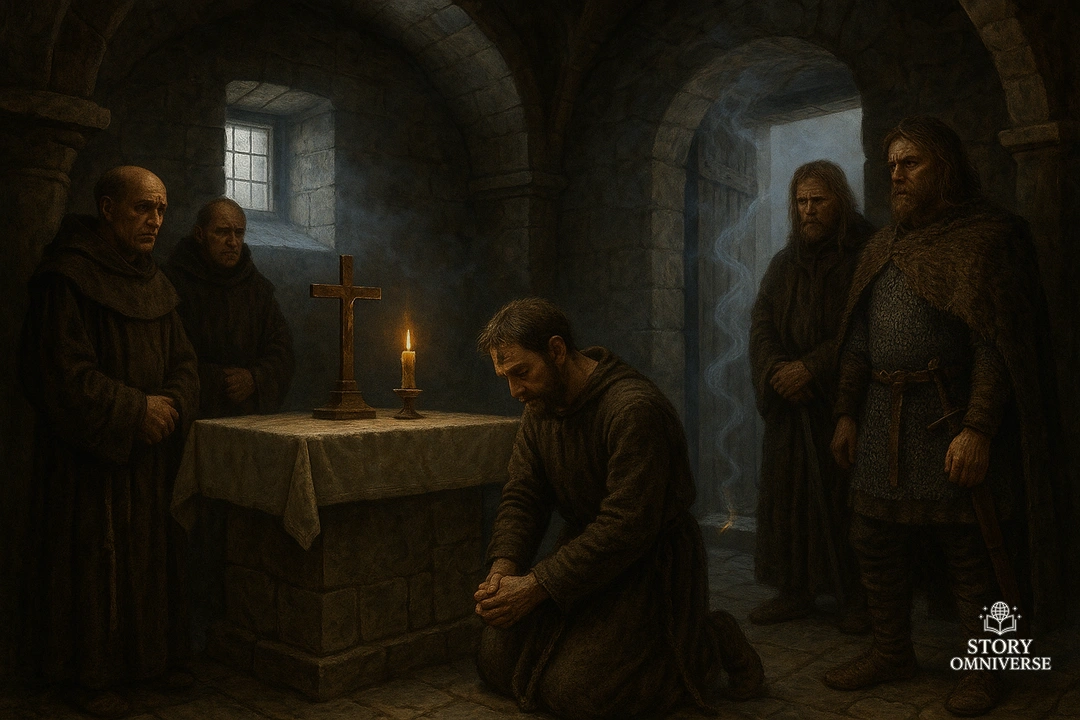
They stripped Eadric of his belt and his writing tools first. The knife, the quills, the small horn of ink. Each item was taken as if it were a sin made solid. Then they led him to the monastery chapel near the king’s seat, larger than his own, where men could gather and watch.
The day was cold and bright. Frost glittered on the grass like ground glass. People stood in a half circle, peasants and warriors alike, drawn by the need to see order restored. A kingdom frightened by plague and border war wanted a lesson it could understand, something plain enough to hold in the mind when everything else slipped.
Inside the chapel, the air smelled of incense and old stone. The altar cloth was clean, white as snow. Above it, the crucifix looked down with a face carved into calm suffering. Near the sanctuary, a small opening held panes of glass, precious and uneven, catching winter light like a thin blessing.
Father Eata stood before the altar. Oswiu stood to one side, not in the sanctuary but close enough that no one could miss him. Aldfrith was there too, pale and rigid, hands clenched at his sides, as if he could hold back what had already happened.
Eadric was made to kneel on bare stone. His knees ached at once. A monk brought a small dish of ashes from the hearth and set it before Father Eata. The ashes were the color of old sorrow.
“You broke a seal,” the priest said, voice carrying. “You altered a king’s words. You lied to save a life. You returned alive while others did not. For these things, you will do public penance, that men may fear sin and honor truth.”
Eadric’s mouth tasted of bitterness. “I accept,” he said, because refusal would be pride, and pride was another stone on the pile. He did not say that he accepted because he was tired, and because in 666 a man did not argue with both king and church and expect to keep his skin.
Father Eata dipped two fingers into the ashes and marked Eadric’s forehead. The ash was cold and gritty. “Remember, man, that you are dust,” he said, “and to dust you shall return.”
A murmur ran through the watchers. Some looked satisfied. Some looked uneasy. Eadric saw a woman in the back with a scarf over her mouth, eyes hollow from grief. He wondered if she had lost a child to the fever. He wondered if she needed this spectacle to believe God still ruled, and that the world had not become a place where the strong simply took.
Oswiu spoke then, his voice harsh from restraint. “Let all know,” he said, “that the king’s seal is not a toy. That oaths bind. That fear does not excuse the breaking of law. If charters fail, the border fails. If words fail, men turn to knives.”
Eadric lowered his head. The ash fell in small flakes onto the stone.
Father Eata continued. “You are stripped of your place as scribe in the king’s service. You will not write charters. You will not bear sealed messages. You will labor in silence and take your bread last. You will copy only what your superior sets before you, and you will not set your own hand to any binding word.”
Aldfrith stepped forward, unable to keep still. “Father,” he said, voice shaking, “he saved me.”
Father Eata’s eyes softened for a heartbeat. “And he wounded truth to do it,” he replied. “We do not heal one limb by cutting another, child. If we teach men that seals may be broken for pity, we teach them that seals may be broken for profit.”
Oswiu did not look at Aldfrith. The king’s face was set, but his hands clenched and unclenched at his sides as if he fought an unseen enemy, one that wore many faces: Mercian raiders, hunger, pestilence, and doubt.
They led Eadric from the chapel to the yard, where a small pile of his old writing scraps had been gathered. Drafts, practice sheets, lists of names from the dead. A monk set them alight. The flame took quickly, licking up the curled edges. Smoke rose, thin and gray, into the cold air.
Eadric watched his own hand’s work turn to ash. Names, careful lines, the small labor of days when he believed ink could mend what steel tore. Not all of it was wrong, yet all of it burned the same.
Aldfrith stood a few paces away, tears freezing on his cheeks. He whispered, “I will remember what you did.”
Eadric’s voice came out rough. “Remember what it cost,” he said. “And do not spend other men’s lives lightly, even to save your own.”
As the fire died down, the smell of charred parchment mingled with incense drifting from the open chapel door. In the distance, a bell finally rang, not for a funeral but for prayer. The pestilence still moved through the land, unseen. Raiders still crossed rivers. Yet for a moment, people stood straighter, as if the sight of one man humbled could shore up the crumbling edges of their world.
Eadric turned away from the altar and the ashes. His life in service of peace had been built on words. Now he would live without them, marked and emptied, while the kingdom tried to steady itself on his ruin, and the year 666 pressed on, indifferent to ink, to mercy, and to the men who carried both.

0 Comments