
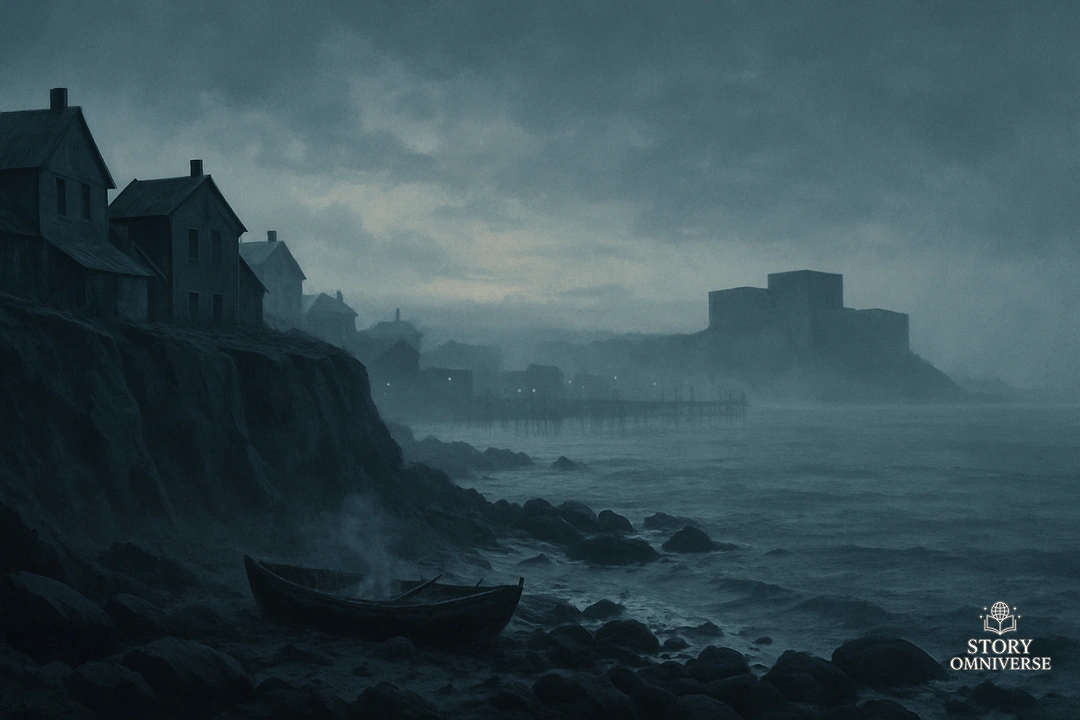
Chapter 1: The Wind Finds the Body
The SCU van took the last bend into Blackharbor like it was pushing into a headwind made of people.
“Back to Greyhaven!” someone shouted, the words snatched and shredded by salt air. A fist thumped the van’s flank. Another local spat onto the road and made the old warding sign sailors used when they passed the Blackrock.
Mira Lorne kept her eyes forward. “No one engages,” she said. “We are guests in a town that does not want guests.”
Yara Novik, in the passenger seat, watched the crowd with a flat calm. “They want a story that ends quickly.”
“Then we give them a case that ends correctly,” Mira said.
At the dock office, Dockmaster-in-Chief Harlan Soot met them on the threshold, shoulders wide as a hatch cover. His beard was wind-burned grey, his eyes sharp.
“This is port business,” Soot said. “Our constabulary handled it. Boy ran. Officer fired. Boat burned. You can write your report and go.”
Mira showed her credentials without flourish. “Special Crimes Unit. Police-involved shooting. We do not write reports from your doorway.”
Soot’s gaze slid to the SCU emblem. “Blackharbor settles its own.”
“Blackharbor just lost a child,” Mira replied. “That is not something you settle. That is something you answer.”
The cliffside path was slick with grit and sea mist. Constabulary tape flapped like tired flags. Below, a skiff lay canted among black stones, its hull charred, the air still carrying the bitter tang of burned resin.
Mira crouched at the edge where the cliff dropped away. She raised her camera and photographed the scene in methodical sequence: the footpath, the scuffed earth near the tape, the angle down to the skiff, the pattern of soot on the rocks. She added a shot of the tide line and the burn scar’s reach, because fire on a coast always told two stories: what it touched, and what it could not.
A constable hovered, shifting from heel to toe. “We already documented.”
“Then you will not mind us documenting again,” Mira said, still shooting. “Independent review requires independent work.”
A knot of locals gathered behind the tape. They murmured a name with the rhythm of prayer and accusation. The involved officer stood among them, stiff as a mast, his uniform collar damp with mist.
Mira lowered her camera. “Yara.”
Yara’s eyes tracked the officer. “Ren Dask.”
“Separate him,” Mira said. “Now. Before the crowd gives him a script.”
Yara stepped through the tape with a practiced authority. “Constable Dask,” she called, voice carrying without shouting. “With me. We need you away from witnesses.”
A man in a fisher’s cap leaned in, hissing, “Leave him. He did what he had to.”
Yara did not look at him. “You can say that later, sir. Over there.”
She guided Dask toward the constabulary cruiser parked upwind. The officer’s jaw worked as if he was chewing words he had been told to swallow.
Mira watched the burned skiff below and the cliff above it, the distance between them too neat for accident. Wind tugged her coat and brought with it the town’s superstition, the sense that Blackharbor believed the sea could take a secret and keep it.
Her eyes caught on a small thing near the tape: a torn strip of bright fabric snagged on gorse, the kind teens tied to backpacks when they biked home in fog. She photographed it, bagged it, and wrote a note to ask the family what it was.
“Not this one,” Mira murmured, and clicked another photo.
Chapter 2: Duty Weapon, Burnt Boat
The walk-through began with the ritual of permission.
Superintendent Corentin Faure stood beside the Marleaux Coastal Constabulary sergeant, hands clasped behind his back as if he were attending a memorial. His uniform was immaculate, a detail that read wrong in the damp grit of the cliffs.
“SCU has access,” Faure said, voice smooth. “Within reason.”
“Within law,” Yara corrected, and opened her tablet. TacMesh lit up with a map overlay. “We are logging every movement from this point forward. No one steps into the scene without being tagged. Evidence custody starts now.”
The sergeant bristled. “We already secured it.”
Mira answered before Yara could. “Then this will be easy.”
Yara paced the cliff path, eyes down, reading the ground like a chart. “Casing here,” she said, pointing with a gloved finger. “And another here.”
Elias Vann, hunched over a portable reader at the cruiser’s hood, looked up. “Bodycam file list is loaded. I’m pulling metadata, not video yet. I want to see if there are gaps.”
“Show me,” Mira said.
Elias turned the screen. “Constable Dask’s bodycam begins at 21:14. There’s a timestamp jump at 21:19. Five minutes missing. It resumes at 21:24.”
Faure’s head tilted. “Signal drops on cliffs all the time.”
Elias kept his tone polite. “It can. But metadata shows manual stop and start, not signal loss. The device logs it differently.”
Yara crouched near the casings again, measuring distance to the cliff edge. “If he fired from where he says, these should be farther upslope. Unless someone moved them after.”
The sergeant scoffed. “You implying we staged it?”
“I’m saying the casings are where they are,” Yara replied. “And we will map it before anyone argues about it.”
Dr. Ivo Grell arrived with a field kit and the unhurried air of a man who had learned patience from bodies that did not answer back. He knelt where the teen had fallen, studying the ground, the faint darkening of soil, the smudged soot caught in a crevice.
“Smoke exposure,” Grell said softly.
Mira turned. “From the skiff?”
Grell lifted his gaze to the burned boat below. “Possible. But the markers on the airway, from what I saw at the preliminary check, suggest inhalation before collapse. That implies the fire was already producing smoke when the shooting occurred.”
Faure’s jaw tightened. “The boat burned after. Everyone saw the flames later.”
Grell’s voice stayed mild. “Later needs a timestamp. And if the fire was started with an accelerant, you can get heavy smoke before you get a visible blaze. Wind can hide flame and carry smoke.”
Mira felt the case shift under her feet, like a plank loosening on a pier. “If the fire started first,” she said, “then this was not just an officer reacting. It was a scene already in motion.”
Elias tapped his screen. “And someone chose to create missing minutes.”
Yara stood, brushing grit from her gloves. “We need dispatch logs, radio traffic, and every officer movement. Full. And we need the duty weapon secured into SCU custody for independent ballistics.”
The sergeant’s eyes flicked to Faure.
Faure smiled without warmth. “We will cooperate.”
Mira met his gaze. “Good. Because a teenager is dead, Superintendent. And the wind is not going to put the truth back where it belongs.”
Chapter 3: The Family That Won’t Let Go
The station smelled of wet wool and old coffee. Blackharbor’s constabulary building was small, built to handle lost nets and bar fights, not the weight of a dead teenager and an outside unit.
The victim’s parents arrived like a storm front.
His mother, Sela Marrow, pushed past the front desk with her brother at her shoulder. Her eyes were red-rimmed, but her voice was sharp. “You stop digging,” she said. “You stop dragging his name through the harbor.”
A constable rose. “Ma’am, please.”
Mira stepped into the lobby. “Mrs. Marrow. I’m Detective Mira Lorne. I’m sorry for your loss.”
Sela pointed at Mira’s badge. “Sorry does not bring him back. Your people come in and make it worse. We know what happened. He ran. He was stupid. He paid.”
Her brother, Kellan, leaned close, lowering his voice as if the walls had ears. “If you need someone to blame, look at the Regatta crews. Blackrock boys. They’ve been after him. You want a clean answer, there it is.”
Mira held his gaze. “We do not pick answers. We verify them.”
Kellan’s mouth twisted. “Verify this: you are not wanted.”
Yara hovered near the hall, watching the constables who pretended not to listen. Elias sat on a bench with his tablet, quiet, eyes moving between faces. Dr. Grell had already retreated to a back room to file preliminary notes.
Mira gestured toward an interview room. “I need to talk to you privately. Both of you.”
Inside, Sela sat rigid, hands clasped so tight her knuckles blanched. Kellan stood behind her chair, a protective shadow.
Mira placed a consent form on the table. “I need your son’s phone.”
Sela flinched. “No.”
“It may contain his last messages,” Mira said. “It may show where he was going. It may clear his name.”
Kellan’s voice softened, almost persuasive. “Clear it by blaming the right people. The Regatta crew. The ones who run their mouths about the sea taking what it’s owed.”
Mira did not look away. “Your son’s name will be cleared by truth, not by convenience.”
Sela’s eyes glistened. “He was headed home.”
Mira opened her notebook. “From where?”
“The docks,” Sela said quickly.
Kellan cut in. “From my place. He stopped by. He was upset.”
Mira paused, pen hovering. “Those are two different locations.”
Sela’s lips parted, then pressed shut. “He… he went to the docks after. To think.”
Mira let the silence settle. “What was he upset about?”
Kellan’s hand tightened on the chair back. “Does it matter? He’s dead.”
“It matters,” Mira said. “Because he ended up on a cliff above a burning skiff, shot by an officer. If you want me to stop digging, give me a reason that makes sense.”
Sela’s shoulders shook once. “He said there was something at the old fort. Something people were hiding.”
Kellan snapped, “He said stupid things. He read tide-ghost stories and thought he saw smugglers in every shadow.”
Mira’s voice stayed even. “Did he go there often?”
Sela hesitated. “He… he took pictures. He wanted to be a surveyor, like my father was. He’d map the shoreline on his phone. He said the fort was part of the coast, so it counted.”
Mira wrote it down. A teenager with a habit, a purpose, and a phone full of maps. Not just a body on rocks.
She slid the consent form closer. “Let me see his phone.”
Sela stared at the paper as if it were an accusation. Then she reached into her coat and placed the phone on the table with a trembling hand. “He texted me,” she whispered. “Before he left. He said, ‘Back soon. Don’t wait up.’ He always said that when he knew he was pushing it.”
Mira’s voice gentled. “We will treat it carefully. And we will bring him back clean, as much as truth can.”
As they left, Kellan lingered by the door. “Detective,” he said, low. “Blackharbor remembers who stirs the harbor mud.”
Mira watched him go, feeling the weight of the phone in her evidence bag. Family interference came in many forms. Sometimes it was grief. Sometimes it was steering.
And sometimes it was both.
Chapter 4: A Confession on the Pier
The pier outside the station was crowded by noon, as if the town believed proximity could turn rumor into fact. Nets hung to dry, and gulls screamed over the wind. The sea slapped the pilings with impatient rhythm.
Jory Pell waited at the station entrance, cap in his hands. He was a wiry man with rope-burn scars on his palms. Two elders from the harbor council stood behind him like bookends.
“I did it,” Jory said as soon as Mira stepped into view. His eyes were fixed on the ground. “I started the fire. I forced the police to shoot. It’s on me.”
The elders nodded in solemn satisfaction. One of them, a woman with a silver braid, spoke to the gathered locals. “It is settled. The harbor keeps its own account.”
Yara’s gaze sharpened. “Inside,” she said. “Now.”
In the interview room, Mira set the recorder down and stated the time, the names, the rights. Jory recited his waiver too smoothly, like he had practiced in front of a mirror.
Mira leaned forward. “Tell me what happened.”
Jory swallowed. “I was down by the skiff. The boy came along. He was yelling, saying he’d tell. I lit it to scare him off. It got out of hand. The constable came up on the cliff. The boy ran. The constable fired.”
Yara’s pen scratched. “What did you light it with?”
“Fuel,” Jory said quickly. “Boat fuel.”
Mira kept her voice even. “What kind? Diesel? Gasoline? Kerosene?”
Jory blinked. “Just fuel.”
Yara asked, “From where did you get it?”
“My shed,” Jory said. “A can.”
Mira nodded slowly, as if accepting. “How did you ignite it?”
Jory hesitated. “A lighter.”
“What kind?” Yara asked. “Torch? Flint? Wick?”
“A cheap one,” Jory said, and his eyes flicked toward the door again.
Mira pressed gently. “What was the tide doing when you lit it?”
Jory’s mouth opened, closed. “Going out.”
Mira glanced at Yara. Yara did not react, but her eyes flicked to the window where the harbor chart hung. Everyone in Blackharbor knew the tide like they knew their own breath.
Mira continued, still calm. “At what time did you light it?”
“About nine,” Jory said. “Maybe a bit after.”
Elias, standing behind Mira, tapped a note onto her tablet: High tide 21:07. Turning in, not out.
Mira turned back. “You said going out. But high tide was just after nine.”
Jory’s cheeks flushed. “I meant, it was… it was moving.”
“Tell me how you got to the skiff,” Yara said. “Which path?”
Jory exhaled hard. “The cliff path.”
Mira heard the phrasing in his answers, the way he said “forced the police to shoot” like it was a line from a statement template. “Who told you to come in today, Jory?”
“No one,” Jory said, too fast.
Mira softened her tone. “Jory, you are confessing to a serious crime. If you are lying, you are making this worse for yourself. You also have the right to stop this interview and ask for counsel.”
Jory’s eyes darted to the recorder. “I’m trying to do the right thing.”
“The right thing has details,” Mira said. “What did it smell like when it caught? Sharp? Sweet? Chemical?”
“Like… like fuel,” Jory repeated, and the repetition landed with a hollow thunk.
Yara leaned in. “Say it again. In your own words.”
Jory’s lips trembled. “I started the fire. I accept full responsibility for the events that followed.”
Mira sat back. The sentence was too clean. Too legal.
Outside, voices rose, satisfied and relieved. Blackharbor wanted a confession like it wanted calm seas. But Mira felt the undertow.
“This isn’t over,” she said quietly to Yara once the recorder clicked off.
Yara’s expression did not change. “No. It’s just been packaged.”
Chapter 5: Red Herring in Black Stone
Celeste Arbour arrived from Greyhaven with a folder thick enough to bruise. She was SCU’s research spine, the one who could turn local history into searchable patterns.
She dropped the folder onto the station’s small conference table. “Blackharbor had an arson two years ago,” she said. “Quarry dispute. Black stone shipments. Someone burned equipment sheds to stop extraction. Suspect: Tavin Rusk.”
Yara flipped through photos. A lean man with a hollow-cheeked stare. “Known to hate police?”
Celeste nodded. “Claims the constabulary covered for quarry bosses. He threatened to ‘light their lies’ in court. Charges were dropped on a technicality. Locals still think he did it.”
Mira listened, weighing. “Town would love an easy villain.”
Elias scrolled on his tablet. “And it gives them distance from the badge.”
Celeste slid a purchase record across. “Rusk bought flares and a jerrycan of fuel last month. Lives in Marleaux outskirts. Shed on his property.”
Mira exhaled. “Probable cause to seek a warrant, at least.”
The warrant came through by late afternoon, signed by a magistrate who sounded tired over the comm and reminded Mira, twice, to keep the return inventory clean. The SCU drove out of Blackharbor, past salt-stunted pines and the looming silhouette of Fort Blackmoor in the distance, its old bunkers like teeth in the hills.
Rusk’s property sat back from the road, a sagging house and a corrugated shed. A Marleaux deputy accompanied them, not eager, but present. Yara and Mira approached with bodycams live, announcing themselves.
“Tavin Rusk,” Yara called. “SCU. Warrant.”
Rusk opened the door with a glare sharp enough to cut rope. “You people again,” he said. “Always looking for a fire to blame on the man who knows how to make one.”
“We’re looking for evidence,” Mira replied. “Step aside.”
Inside the shed, the smell of oil and rust. Elias photographed shelves while Yara cataloged. They found flares in a crate, fuel cans, rags, a cheap lighter.
“Looks promising,” the deputy muttered.
Mira held up a flare, reading the stamp. “Lot number.”
Elias leaned in. “Send me that.”
Rusk barked a laugh. “You found my emergency kit. Congratulations. You going to arrest every sailor with a flare?”
Yara’s voice stayed level. “Where were you last night between nine and ten?”
Rusk’s eyes narrowed. “At the Breakline Tavern in Marleaux. Ask anyone. I was loud.”
Back at the station, Elias cross-checked purchase dates and lot distribution. He turned his screen toward Mira. “Flares and fuel were purchased three months ago. The lot number on the flares does not match residue samples Grell pulled from the skiff’s char. Also, Rusk’s tavern alibi is strong. Receipts, witnesses, security stills.”
Celeste frowned. “So he’s our red herring.”
Mira tapped the folder. “The town handed us a villain they already hated. That alone tells me they are protecting someone else.”
Yara looked toward the window where Blackharbor’s pier lights blinked in the mist. “Or protecting an idea. That the badge cannot be wrong.”
Mira thought of Jory’s rehearsed words. “We go back to the confession. And we go back to the officer. The fire is not a personality trait. It’s a tool.”
Elias nodded. “And tools have owners.”
Chapter 6: The Officer Who Fired
Constable Ren Dask sat in the interview room with his cap on his knees. His hands were steady, but his eyes looked sanded raw. A constabulary liaison hovered outside the door until Yara asked him, politely, to leave.
Mira began again, stricter this time. “Constable Dask, you’ve given a statement. We are going to go through it line by line. If you remember something differently now, you say so. If you want counsel, you tell us and we stop.”
Dask swallowed. “Yes, ma’am.”
Yara set a printout on the table. “Dispatch log shows you were not assigned to cliff patrol. Your unit was listed on harbor traffic.”
Dask’s gaze flicked to the paper. “I was redirected.”
“By whom?” Mira asked.
Dask hesitated. “Superintendent Faure.”
Mira kept her tone neutral. “Did he direct you over recorded radio or personal comm?”
Dask’s jaw tightened. “He called my personal comm. Said there was a situation. Said not to clog dispatch.”
Yara leaned forward. “Why would a superintendent bypass radio protocol for a cliff call?”
Dask’s shoulders rose and fell once. “He said it was sensitive. That if it got out, it would cause panic.”
Mira slid Elias’s metadata report across. “Your bodycam was manually stopped for five minutes.”
Dask stared at it. “I… I turned it off. He told me to.”
“Faure told you to turn off your bodycam,” Mira repeated, making it plain and heavy in the air.
Dask’s eyes shone with anger and shame. “He said it would protect me. That the SCU would come in and make an example.”
Yara’s voice softened, but only slightly. “You understand how that looks.”
“I know,” Dask said, and his voice cracked. “I know.”
Mira spoke carefully. “Walk us through the moment you fired.”
Dask’s breath came shallow. “I saw the boy on the cliff path. Smoke below, like someone had lit tar. He looked back over his shoulder and ran. I shouted. He didn’t stop. I thought he had something in his hand.”
“What did you think it was?” Yara asked.
“A flare,” Dask said. “Or a knife. I don’t know. It was dark and the wind kept shifting the smoke.”
Mira glanced at Yara. “Did you see the fire start?”
“No,” Dask said. “It was already burning. I could smell it. Not like wood. Like chemicals.”
Mira’s pen paused. “Did Faure tell you the boy was the arsonist?”
Dask hesitated, then nodded. “He said, ‘He’s lighting it. Catch him before he jumps.’”
Outside the room, voices rose in the hall. The liaison was arguing with Elias. The word “jurisdiction” floated through the thin walls like smoke.
Yara stood and opened the door. “Detective Vann is allowed to be here,” she said sharply. “If you want to contest SCU authority, do it through the proper channel. Not in the hallway.”
Mira kept her eyes on Dask. “Constable, if you were ordered into an off-book response, and ordered to disable your camera, you were put in a position you should never have been in.”
Dask’s face twisted. “I’m not a victim. The boy is.”
“You can still help us,” Mira said. “Tell us everything. Even what makes your superintendent look bad.”
Dask’s voice dropped. “If I do, I’m done in this town.”
Mira nodded once. “If you don’t, you’ll be done everywhere.”
When they stepped out, Faure was waiting in the corridor, expression controlled.
“You’re upsetting my officers,” he said.
Mira met him. “Your officer just told us you ordered an off-book response and a bodycam shutdown.”
Faure’s smile did not reach his eyes. “Then he is confused.”
Yara’s voice was cold. “Then we will compare his account to your logs, your calls, and your vehicle movements.”
Faure’s gaze slid to Mira, and something old flickered there, recognition buried under rank. Mira felt it like a hook. She did not name it yet.
Not until she knew what it meant.
Chapter 7: Cindertrace and the Missing Minutes
Elias set up in the SCU’s rented room above a shuttered bait shop. The walls creaked with wind pressure, and somewhere below, a buoy bell clanged like a warning.
The victim’s phone lay on a towel under a lamp. Its edges were heat-warped, screen spidered. Elias worked with delicate tools, coaxing life from damaged circuits.
“Cindertrace is running,” he said, voice low with focus. “It’s pulling fragments from the audio cache. If the heat didn’t scramble it completely, we might get something. I’m logging every step for chain of custody.”
Mira stood behind him, arms folded. Yara leaned against the door, listening to the hallway as much as the room.
After a minute, Elias’s eyes widened. “Got a partial voice note.”
He played it through a small speaker. Static, wind, the distant roar of surf. Then a teen’s breathless whisper.
“…fort stash… someone’s here… they’re lighting it early…”
The recording cut off.
Yara straightened. “Fort Blackmoor.”
Mira felt the pieces tug toward each other. “He wasn’t just wandering. He found something.”
Elias rewound, replayed, and pointed to the waveform. “There’s a second voice. Too faint. But close. And there’s a scrape like a door or a hatch.”
“Can you isolate it?” Mira asked.
“Not cleanly,” Elias said. “But the proximity suggests he wasn’t alone.”
They drove out before dawn, the road hugging Marleaux Bay. Fort Blackmoor rose from the fog, concrete bunkers half-swallowed by scrub. Officially sealed. Unofficially, every coastal town had places young people dared each other to enter.
At the perimeter fence, Yara checked the lock. “Cut and re-twisted,” she said. “Recent.”
Mira raised her comm. “We do this by the book. We request access and document refusal if we get it.”
The constabulary unit that arrived did so grudgingly. The deputy with them muttered, “It’s just old war rooms. And this is not your jurisdiction.”
Mira kept her voice controlled. “It’s a potential crime scene connected to a police-involved shooting. SCU has authority to investigate. If you want to contest that, call your legal liaison. Until then, you can witness our process.”
They launched a small drone from a patch of gravel. Elias piloted, screen reflecting in his glasses. The drone slipped through a broken vent cover and into the bunker’s throat.
“Thermal shows residual heat,” Elias said. “Not from sun. It’s inside. That suggests a burn within the last day.”
The camera panned along concrete corridors. Then it found a vent shaft with soot rimming the edges like a fresh bruise, and a scatter of melted plastic that looked like binder rings.
Dr. Grell, peering at the feed, murmured, “That soot is recent. Still matte. Not weathered. And the melt pattern suggests a fast, hot ignition, not slow smolder.”
Yara’s voice was tight. “So someone burned something here. Recently. And the teen mentioned a stash.”
Mira watched the drone hover, its tiny hum swallowed by the fort’s silence. “The skiff fire might not be the main fire,” she said. “It might be the cover fire.”
Elias nodded. “Burn here to erase records, then burn there to create a simple narrative. Arsonist teen. Officer reacts.”
A constabulary deputy shifted, uneasy. “You’re saying our superintendent is running fires in sealed bunkers?”
“I’m saying,” Mira replied, “that a teenager died after whispering about someone lighting something early. And we have fresh soot in a place that should be cold.”
The deputy looked away toward the bay, where fog hid the horizon. “Blackharbor won’t like this.”
Mira pocketed her gloves. “Blackharbor doesn’t have to like it. They have to live with what’s true.”
Chapter 8: Night of No Lights
Blackharbor’s annual blackout was not on any provincial calendar. It was a tradition, the locals said, older than the municipality itself. One night a year, they killed every lamp and lantern to “let the sea rest” and “confuse what hunted on shore.”
Mira heard the superstition in the way people spoke about it. Not joking. Not quaint. Protective.
At dusk, the last shop shutters closed like eyelids. The pier lights clicked off one by one until the harbor became a bowl of ink. In their rented rooms, the SCU sat with battery lamps turned low.
“They’re using it,” Yara said, watching the dark window. “Cover for movement.”
Elias checked his comm. “Signal is spotty. Either the blackout includes jammers or everyone is simply off-grid. I’m logging our location and times anyway.”
Celeste, seated cross-legged on the floor with her notes, looked up. “Blackout nights coincide with old smuggling routes in other coastal towns. No lights means no silhouettes, no watchers. It also means anyone seen moving is either local or bold.”
Mira strapped on her jacket. “We don’t break curfew, and we don’t trespass. We do a controlled perimeter check from public access. We observe. We document.”
Yara’s mouth tightened in approval. “I’ll take the south lane by the waterfront. Mira, you’re with me. Elias, stay on comm and track any vehicle pings. If we see a crime in progress, we call it in. We do not freelance arrests in the dark.”
Outside, the air felt thicker without light. The sea sounded closer, like it had crept up while no one watched. Mira moved with Yara along the edge of town, boots quiet on damp boards.
A truck engine murmured ahead, then cut. A shape loomed near the waterfront, darker than the dark around it.
Yara crouched behind a stack of crab pots. “Constabulary truck,” she whispered. “No running lights.”
Mira’s pulse steadied into procedure. “Plate?”
Yara angled her small camera, zoomed. “MCC-17.”
Elias’s voice crackled faintly in Mira’s earpiece. “MCC-17 is assigned to Superintendent Faure’s office pool.”
They watched two figures unload something. A bundle, carried carefully. Not heavy, but handled like it mattered. One figure paused, head turning as if listening for footsteps, then hurried the other along.
Yara waited until the figures disappeared into a warehouse shadow. Then she moved, fast and quiet, to the spot where the bundle had brushed the ground. Her gloved hand found a curled, scorched page snagged on a nail.
She held it up to Mira’s lamp for a second, shielded by her body. The page was half-burned, edges blackened. Rows of numbers and handwritten notes remained, the ink smeared where heat had licked it.
“Boat numbers,” Mira murmured. “And dates.”
Yara traced a line. “These are not fishing logs. These are runs. And someone tried to burn them, but not enough.”
Footsteps sounded nearby. Mira killed the lamp. They pressed into darkness as a constable passed, humming to himself as if the night belonged to him.
When he was gone, Yara exhaled. “Evidence secured.”
Mira tucked the page into an evidence sleeve and logged the time in a whisper. “This town thinks darkness makes them safe,” she said. “It only makes them careless.”
Back in their rooms, Elias photographed and enhanced the page. Celeste leaned over his shoulder.
“Quiet smuggling,” Celeste said, voice tight. “If Faure’s truck is moving this, it’s not folklore. It’s commerce.”
Mira stared at the soot-smudged paper. “And a teenager found the wrong corner of it.”
Outside, Blackharbor remained unlit and watchful, as if the sea itself had joined the conspiracy.
Chapter 9: The Confession That Breaks
Jory Pell returned to the station interview room with the posture of a man walking into a net he had helped weave. His cap twisted in his hands until the brim creased.
Mira sat across from him. Yara stood to the side, arms folded. Elias was behind the glass, feeding notes through Mira’s earpiece.
Mira clicked on the recorder. “Jory Pell, second interview. We are clarifying your confession. You are free to stop at any time. If you want counsel, we pause.”
Jory nodded quickly. “I already told you. I did it.”
Mira slid a photo across the table. A close-up of the burned skiff’s registration number, taken from Mira’s cliffside shots and enhanced. “Identify the boat.”
Jory stared too long. “It’s… a skiff. Lots of them look like that.”
Mira kept her voice patient. “You said you were down by it. You said you lit it. Tell me the number.”
Jory’s throat bobbed. “I didn’t look.”
Yara stepped in. “You also said you used the cliff path. Which access point did you take down to the rocks?”
Jory blinked. “The one by the old marker.”
“There are three markers,” Yara said. “Which one?”
Jory’s fingers tightened on the cap. “The… the one with the gull.”
Mira listened to the lie form itself in real time, shaped by panic and the hope that vague could pass for true. She nodded once, as if accepting, then tapped her earpiece.
Elias’s voice came through, low. “Now.”
Mira opened her notebook and read, careful to keep her tone neutral. “We recovered an audio fragment from the victim’s phone. He says, quote, ‘fort stash’ and ‘someone’s here’ and ‘they’re lighting it early.’”
Jory’s face drained. “What?”
Mira leaned forward. “What fort access point did you use, Jory?”
“I didn’t,” he said, then caught himself. “I mean, I didn’t go to any fort. I was at the skiff.”
Yara’s eyes narrowed. “But your confession included the phrase ‘forcing the police to shoot.’ Why would you say that if you were not present on the cliff?”
Jory’s mouth opened, and nothing came out.
Mira softened, just a fraction. “Jory, you are not protecting anyone by lying. You are only giving them a second victim.”
His shoulders shook once. “I was trying to help.”
“Who asked you to?” Mira asked.
Jory stared at the table. “No one.”
Yara’s voice was firm. “Name them.”
Jory’s eyes flicked up, wet and desperate. “You don’t understand this town.”
“I understand leverage,” Mira said. “And I understand promises made to men who don’t have much.”
Silence stretched until it hurt.
Then Jory sagged, as if the confession’s weight finally became real. “It was Kellan,” he whispered. “The boy’s uncle.”
Mira felt the air change. “What did he say?”
Jory swallowed hard. “He said… he said the harbor would be safe again. That people would stop looking at me like I brought bad luck. He said if I took the blame, they’d square my debts. He said the elders would back it.”
Yara’s jaw clenched. “Witness intimidation,” she murmured, more to herself than anyone.
Mira kept her voice steady. “Did Kellan tell you what to say?”
Jory nodded, shame burning through his expression. “He gave me lines. Said it had to sound official. Said the SCU likes tidy.”
Mira glanced toward the glass where Elias stood. Elias’s face was grim, but there was relief too. The clue that broke the case was not a fingerprint. It was a confession that failed under light.
Mira turned back to Jory. “We are going to document this. And we are going to request protective measures. I can’t promise this town will be kind, but I can promise the record will be accurate.”
Jory’s voice cracked. “I didn’t mean for the boy to stay dead.”
Mira’s eyes stung, but she kept them clear. “Neither did someone else. And that is why we keep going.”
Chapter 10: Pressure on the Superintendent
Superintendent Faure received them in his office like a man welcoming auditors, not detectives carrying a dead child’s last whisper. The window behind him looked out on the harbor, grey and restless. On his wall hung an old photo of a Marleaux raid team, younger faces, harder eyes.
Mira’s gaze snagged on it. A memory surfaced, unwanted and sharp. A warehouse in Marleaux. A door kicked too early. An informant named Lio, trembling, promised protection that never held. A career that began with a compromise she had told herself was necessary.
Faure watched her notice. “Detective Lorne,” he said softly. “It’s been a long time.”
Yara’s posture stiffened. Elias set his tablet on the desk without asking. “We have evidence,” Elias said. “Ledger fragment recovered during blackout. Fort soot documented. Dispatch anomalies logged.”
Faure’s smile was thin. “You have scraps and suspicions.”
Mira placed the evidence sleeve on the desk. The scorched ledger page looked small against Faure’s polished wood. “Boat numbers,” she said. “Dates. Quiet runs. Your truck was seen moving during the blackout.”
Faure did not touch the sleeve. “Blackharbor has traditions.”
“Traditions do not sign out vehicles,” Yara replied. “Your pool does.”
Elias pulled up the dispatch log. “Constable Dask was ordered off-book. His bodycam was manually stopped. He says you told him to.”
Faure’s eyes hardened. “Constable Dask is young. He panicked. Now he wants a scapegoat.”
Mira leaned forward. “The teen’s phone contains a voice note mentioning ‘the fort stash’ and ‘someone lighting it early.’ We found fresh soot in a Fort Blackmoor vent. That is not panic. That is activity.”
Faure’s voice cooled. “You are out of your depth in local waters, Detective.”
A chime sounded at Mira’s comm. Governor Silvestre DuPont’s aide, then the Governor himself, voice lowered to a confidential murmur. Mira stepped into the hall to take it.
“Detective Lorne,” DuPont said, measured. “I understand tensions are high. Blackharbor is sensitive. Keep it out of the Herald, if you can. We do not need provincial unrest.”
Mira stared at the peeling paint on the corridor wall. “Governor, a teenager is dead. We will not run this through rumor control.”
“I know,” DuPont said. “But you know how stories travel. Handle it quietly.”
Mira ended the call and stood still for a beat, feeling the familiar pressure: contain, manage, smooth. The same instinct that had ruined Lio years ago.
She went back into Faure’s office.
Faure’s gaze flicked to her face, reading the conflict. “We can resolve this without spectacle,” he said. “You and I both know what the press does. What oversight does. It chews people and leaves bones.”
Mira’s throat tightened. “An informant got chewed in Marleaux,” she said, voice low. “Because someone decided procedure was optional.”
Faure’s expression barely changed. “We did what we had to.”
Yara’s eyes moved between them. “You know him,” she said quietly to Mira.
Mira did not look away from Faure. “I know what happens when you protect an institution instead of a person.”
Faure’s tone sharpened. “Careful.”
Mira straightened. “No. You be careful. Because we are done with quiet resolutions that protect the powerful. We will file our findings. We will request your supply records. We will interview your staff. And if you attempt to bury us in jurisdictional complaints, we will document that too.”
Faure’s smile returned, brittle. “You will find Blackharbor does not welcome crusaders.”
Mira gathered the evidence sleeve. “I’m not here to be welcomed,” she said. “I’m here to be accurate.”
As they left, Yara fell into step beside her. “That took something,” she murmured.
Mira’s voice was tight. “It should not have to.”
Chapter 11: The Fire Behind the Shot
Dr. Grell’s lab work came back in a plain report, but his delivery was personal. He met them in the station’s cramped evidence room, holding a sealed vial and a printed analysis.
“The accelerant residue from the skiff,” Grell said, “matches a compound used in coastal signal flares. Not standard boat fuel. The burn pattern on the hull also supports a fast ignition, poured or smeared, then lit. It wasn’t an accidental flare drop. It was applied.”
Yara’s eyes narrowed. “Flares like constabulary carries?”
Grell nodded. “The stabilizers are distinctive. I compared it to samples from local suppliers and to a constabulary-issued flare compound sample. The match is strong.”
Elias was already tapping. “If it is flare compound, then it has a chain. Procurement, sign-out, distribution.”
He pulled records through provincial systems, but the access was not frictionless. A permissions prompt flashed, then a delay. Elias’s jaw tightened.
“Marleaux is trying to slow-walk,” he said. “I’m escalating through SCU legal liaison.”
Yara nodded. “Do it clean.”
Minutes later, the screen filled with lines. Elias stopped and turned it toward Mira and Yara.
“Marleaux Coastal Constabulary supply,” Elias said. “Batch signed out two weeks ago under Superintendent Faure’s authority. Quantity matches what you’d need to start a hot, smoky fire fast, especially in wind. And it explains the chemical smell Dask described.”
Mira felt a cold clarity settle. “So the fire was not a dockhand’s panic. It was planned. It was meant to erase and to frame.”
Yara’s expression was hard, but her voice stayed procedural. “We pressure him lawfully. No threats. No promises we can’t make.”
Mira nodded. “We bring in the Crown liaison. We document every word.”
They requested Faure in for a formal interview. This time it was in the larger room, with a second recorder, a posted rights form, and SCU’s provincial prosecutor liaison on comm for consultation. Faure arrived with a tight-lipped attorney and the posture of a man offended by the idea that rules applied upward.
Yara began. “Superintendent, you are not under arrest at this moment. You are here voluntarily with counsel. You can end this interview at any time. Do you understand?”
Faure’s attorney answered. “We understand.”
Yara continued, measured. “We have lab confirmation that accelerant residue matches flare compound. We have supply sign-out under your authority. We have evidence of a recent burn at Fort Blackmoor consistent with record destruction. We have an off-book call to Constable Dask and a bodycam shutdown.”
Faure’s attorney lifted a hand. “My client denies wrongdoing. This is circumstantial.”
Elias spoke, calm. “It’s a pattern with documentation.”
Mira watched Faure’s face, looking for cracks. She saw them in the small things. A blink too slow when the ledger was mentioned. A jaw clench at the word “fort.”
Yara slid a document across, but she did not call it an offer. “This is a notice of investigative direction and potential charging exposure based on current evidence. We have consulted with the provincial prosecutor liaison. If the evidence supports it, we will recommend charges related to arson used to conceal another crime, obstruction, and misconduct in directing an off-book response.”
Faure’s attorney’s eyes narrowed. “And what are you implying about Constable Dask?”
Yara kept her voice level. “We are not bargaining with you. We are stating reality. Dask fired the shot. That will be examined on its own merits. But we also have evidence he was directed off-book and instructed to disable his camera. If that direction came from you, it changes the context and the charging assessment. That is for prosecutors, not us.”
Faure’s eyes flashed. “You would sacrifice an officer to get me.”
Mira’s voice was quiet. “You already did.”
The room held its breath. Outside, Blackharbor’s murmurs pressed against the building like fog.
Faure’s hands curled on the table. “You don’t understand,” he said, and for the first time his composure slipped. “If those ledgers got out, it would ruin families. Not just me.”
Elias’s tone was even. “It already ruined one family.”
Yara leaned in, not looming, just present. “Superintendent. You have counsel. You have choices. If you want to correct the record, do it now, while it still belongs to you.”
Mira felt the redemptive edge of it, the thin possibility that confession could be more than surrender. “Corentin,” she said, using his name once, carefully. “Do not make another young person pay for your secret.”
Faure’s eyes flicked to her, and the old raid photo seemed to loom between them. His voice dropped. “If I speak, I burn.”
“You already lit the fire,” Mira replied. “Now choose what it consumes.”
Chapter 12: A Harbor That Has to Live With It
Faure’s confession came in the small hours, when the station’s fluorescent lights made everyone look tired and honest by force. His attorney sat rigid beside him, no longer interrupting. Yara recorded. Elias monitored time stamps. Mira listened, pen still. The provincial prosecutor liaison remained on comm, confirming procedure and advising on next steps.
Faure’s voice was hoarse. “I set the fire at Fort Blackmoor,” he said. “Not the skiff first. The fort. There were records there. Ledgers. Names. Boat numbers. Payments. I was trying to erase the scheme.”
Mira’s stomach tightened. “Smuggling,” she said.
Faure nodded once. “Quiet runs. Not weapons. Goods. Untaxed shipments. It started as favors. It became income. It became… normal.”
Yara’s tone was precise. “And the teenager.”
Faure stared at the table. “He stumbled onto the stash. He was curious. He came to the fort, recorded something on his phone. I saw him. I panicked.”
Elias asked, “You followed him to the cliffs?”
“I called Dask,” Faure said. “Off-book. I told him the boy was lighting a fire. I told him to hurry.”
Mira heard the shape of it, the way a lie became an order and an order became a bullet. “You instructed him to disable his bodycam.”
Faure’s shoulders sagged. “Yes. I said it would protect him. I meant it would protect me.”
Yara’s voice tightened. “And the skiff.”
Faure swallowed. “I used flare compound from supply. I started the skiff fire to make it look like the boy was the arsonist. Fast smoke, fast panic, a story people could repeat. If the town believed he set it, they would stop asking why he was there. They would blame him and move on.”
Mira closed her eyes for a beat, then opened them. “Jory Pell’s false confession.”
Faure’s brow furrowed. “I didn’t arrange that.”
“No,” Mira said. “The family did. Your mess gave them a reason to control the story.”
Yara ended the recording segment and stated the time. Her voice was steady, not triumphant. “Superintendent Faure, you are under arrest.”
Outside, dawn seeped into Blackharbor, pale and reluctant. The harbor looked the same as it always had, boats rocking, gulls circling, superstition clinging like salt. No world changed. No borders shifted. But a truth had been pulled up like a net, heavy and unavoidable.
Later, Mira met Constable Dask in the corridor. He looked smaller without his cap.
“They’re saying the prosecutor will consider the coercion,” he said, voice raw. “Not a free pass. Just… context.”
Mira nodded. “You still fired. You will answer for your choices. But you will not carry Faure’s alone.”
Dask’s eyes filled. “I keep seeing him, the kid. I didn’t even know his name.”
“Say it,” Mira urged gently.
“Rian,” Dask whispered. “Rian Marrow.”
Mira felt something in her chest ease, not forgiveness, but the first step toward it. “Remember him as a person,” she said. “Not a case. He mapped the shoreline. He texted his mother he’d be back soon. He thought the coast belonged to him too.”
On the pier, Kellan Marrow was taken in for witness intimidation related to the false confession. Sela watched from a distance, face hollow. When Mira approached, Sela flinched as if bracing for condemnation.
“You were trying to protect your family,” Mira said quietly.
Sela’s voice broke. “I was trying to protect what we had left.”
Mira nodded. “Protecting secrets is not the same as protecting children.”
Sela looked past Mira to the water. “What happens now?”
“Now,” Mira said, “the harbor lives with it. With arrests made. With the truth documented. With no more tidy lies.”
As the SCU van rolled out of Blackharbor, a few locals still stared hard. But one elderly woman on the seawall lifted a hand, not waving, not forgiving. Just acknowledging.
Mira watched the town recede into mist and wind. Redemption, she knew, was rarely loud. Sometimes it was simply refusing to let the dead be used as cover.

0 Comments