
Chapter 1: Smoke Without Heat
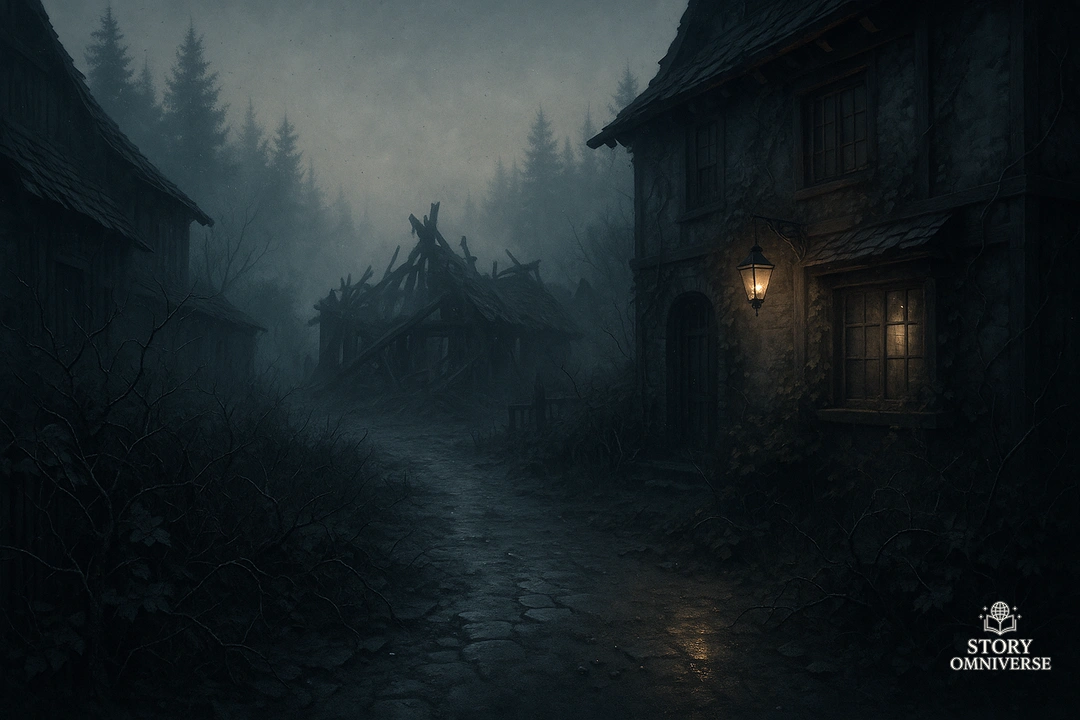
The SCU van rolled under the Briar’s Edge gate arch where ivy had eaten the carved motto into a blur. Fog sat low, holding the smell of wet earth and something sharper, like burned herbs. The derelict apothecary outbuilding crouched behind the main shop, its roof half-collapsed, its timbers still breathing out smoke that did not match the cold.
Yara Novik stepped out first, badge and coat catching the lantern glow. Two Thornwatch Rangers waited at the cordon with the rigid patience of people who expected to be obeyed in their own woods.
“We’ve got it contained,” the taller Ranger said. His cloak was damp at the hem. “Local handling is standard. You can file your report and move on.”
Yara looked past him at the blackened doorway. “A body was found. SCU jurisdiction applies when the death is suspicious and the origin and cause aren’t established.”
“Cause is fire,” the Ranger said, too quick.
Dr. Ivo Grell ducked under the tape with a case in one hand. His voice stayed mild, almost polite. “Fire leaves a story. So does a throat. Let me read both.”
Mira Lorne came around the van, clipboard tucked under her arm. She did not rush. She rarely did. Her eyes traveled from the Rangers to the watching villagers on the overgrown path beyond the fence line. They stood spaced like posts, faces turning away whenever she met their gaze.
“Origin and cause first,” Mira said to Yara. “Photograph, diagram, collect. Then we talk about the body. No shortcuts.”
Elias Vann, already gloved, lifted a portable lamp and aimed it at the soot-choked threshold. “Heat pattern is odd,” he murmured. “Not much spalling on the stones. And the smoke staining is patchy.”
“Quiet for a fresh blaze,” Yara said, and her tone carried the edge of someone who had learned to distrust quiet.
Inside, ash lay like gray snow. The air tasted of char and stale tinctures. Grell knelt near the outline where Lysa Fen had been found, the stretcher already gone, only a dark smear in the soot. He tilted his head, studying the wall and floor.
“Body wasn’t here long,” he said. “Or the fire didn’t burn long. Either way, the smoke deposition is light.”
Mira watched him work, then turned toward the Rangers. “Lock the perimeter. Nobody in, nobody out. Not even your elders.”
The shorter Ranger’s jaw tightened. “Briar’s Edge keeps its own oaths.”
Mira’s pen clicked once. “Tonight, it keeps ours.”
Behind the tape, a villager whispered something and another shushed them. The sound carried anyway, thin and practiced, like a prayer repeated until it lost meaning. Mira felt the town’s distrust settle on her shoulders with the ash.
Yara leaned close, voice low. “They’re waiting for us to blink.”
Mira stared at the black doorway. “Then we don’t.”
Chapter 2: The Wrong Story in the Right Ash
At first light, the outbuilding looked smaller, as if daylight embarrassed it. Yara stood with the Thornwatch Rangers beside a TacMesh projector balanced on a crate. The device cast a faint grid across the charred frame, mapping angles, entry points, and burn progression.
“Window latch was forced,” Yara said, pointing. “But the break is clean. Tool use. Not panic.”
The taller Ranger, nameplate reading Rusk, crossed his arms. “Or someone tried to save her.”
“Then they’d likely break glass inward,” Yara replied. “This looks opened, then burned.”
Mira crouched near the floor where the worst charring pooled. Her gloved fingers hovered over a low blackened crater. “Fire started here,” she said. “Low and controlled. Not a flash. Not a spill pattern.”
Elias worked the debris field with a small sieve, patient as a monk. “If someone wanted it to look accidental,” he said, “they’d often overdo it. This is restrained. Like they wanted smoke and confusion, not a full collapse.”
Mira nodded once. “Staging.”
She photographed the crater, then the nearby wall where soot thinned abruptly. “We’ll need an origin-and-cause report that can stand up,” she said. “Collect debris from the crater and the threshold. If there’s an accelerant, the lab will tell us.”
Elias’s lamp caught a glint. He pinched it free: a warped rectangle, half-melted, circuitry exposed like bone. “Phone fragment,” he said. “Cindertrace might pull something.”
Rusk watched with narrowed eyes. “You people and your toys.”
Yara didn’t look up. “You people and your rumors.”
By midday, Mira walked into the Herbal Exchange Hall where Briar’s Edge held meetings and traded salves. Bundles of dried plants hung from rafters like old trophies. Lysa Fen’s protest circle sat in a loose cluster, hands wrapped around mugs they did not drink from.
A young man with ink-stained fingers spoke first. “Lysa was warned. She broke an oath at the Briar Crown Circle. Everyone knows.”
A woman beside him nodded too quickly. “The Crown doesn’t forgive. She was cursed.”
Mira took a seat, notebook open, voice calm. “Tell me what you saw, not what you’ve heard.”
They traded glances, as if checking lines. Another voice, older, chimed in. “She went to the Circle and spat on the stones. The woods took her.”
Mira’s eyes moved from face to face. The story came out polished, identical in rhythm, like a chant taught to children. It was too neat. Real memories were messy. Real grief stumbled.
“Who told you that?” Mira asked.
Ink-fingers shrugged. “It’s just… what happened.”
“Did any of you see her at the Circle?” Mira pressed.
Silence, then the woman said, “My cousin heard. From his aunt.”
Mira wrote it down anyway, then asked, “When did you last speak to Lysa?”
A different protester, cheeks hollow with sleeplessness, swallowed. “Two nights ago. She said she had a meeting. In Thornhollow. She didn’t say with who.”
Outside, through the hall’s open door, Mira saw villagers passing by without looking in. The town moved like it had rehearsed ignoring pain.
Yara entered quietly and stood behind Mira’s shoulder. “Rangers say the Circle story is old,” she murmured. “Useful. Keeps outsiders spooked.”
Mira closed her notebook with a soft snap. “It’s the wrong story in the right ash.”
Ink-fingers leaned forward, voice lowering. “You shouldn’t dig. Briar’s Edge doesn’t like being watched.”
Mira met his stare. “Then Briar’s Edge can start by telling the truth.”
Chapter 3: Family Hands on the Scale
Lysa Fen’s family home sat at the end of an overgrown lane where brambles reached for the windows. A wreath of dried briar hung on the door, its thorns sharp even in death. Mira stood on the stoop with Yara beside her, warrant folder tucked under Mira’s arm like a shield.
Lysa’s mother opened the door only a crack. Her eyes were red-rimmed but steady, as if she had cried everything out before dawn and left nothing for strangers. Behind her, Lysa’s brother hovered, shoulders broad, jaw clenched.
“We are not doing this,” the mother said. “We will speak at the tribunal.”
“There’s no tribunal for a homicide,” Yara snapped, then caught herself when Mira’s hand lifted slightly.
Mira kept her voice even. “Mrs. Fen, we need a formal interview. About threats, contacts, anything that might explain why Lysa was in that outbuilding.”
“She was unstable,” the brother said, stepping into view. “Always making enemies. Always shouting at people who never did her harm.”
Mira’s gaze stayed on him. “Name one enemy.”
He hesitated, then lifted his chin. “Half the town.”
“That’s not an answer,” Mira said.
A figure moved in the yard, approaching with the slow authority of someone used to being obeyed. Sister Hedra Malrow wore a dark shawl pinned with a briar clasp. Her smile did not reach her eyes.
“Detectives,” Sister Hedra said. “You will leave this family in peace. Grief is not your evidence.”
Yara’s hands curled at her sides. “Obstruction is a crime.”
Sister Hedra’s voice stayed soft. “In Briar’s Edge, we handle our own. Outsiders come, stir the mud, then go back to Greyhaven with clean boots.”
Mira opened the warrant folder and held it where all could see. “We have legal authority to interview and to seize relevant items. I would prefer cooperation.”
Lysa’s mother’s mouth tightened. “Legal authority doesn’t mend anything.”
“No,” Mira said. “But it can stop it happening again.”
Inside, a kettle whistled and was silenced abruptly, as if even steam had to obey. The brother’s eyes flicked toward a side room, then back.
“We have nothing,” he said. “She made stories. She wanted attention.”
Yara took a step forward. “Your daughter is dead.”
“And you think your questions honor her?” the mother replied, voice cracking at the end despite her effort. “You want to make her a lesson.”
Mira’s throat felt tight, but she kept her posture neutral. “I want to make her a case. A solved one.”
Outside, Sister Hedra leaned closer, speaking only for Mira and Yara. “Force will not serve you here. Briar’s Edge remembers pressure. It repays it.”
When they walked back down the lane, Yara’s impatience finally broke. “We should haul them in. They’re stonewalling.”
Mira didn’t stop walking. “If we drag them, the whole town will close ranks. We need cracks, not walls.”
Yara’s laugh was bitter. “Cracks? They’re pouring mortar in front of us.”
Mira glanced back at the bramble-choked house. “Then we find where their hands are busy. People block when they’re hiding something specific.”
“And if we wait,” Yara said, “we give them time to bury it.”
Mira’s voice went low. “We don’t wait. We work quieter.”
Chapter 4: Strangulation Beneath the Soot
The mobile autopsy tent smelled of antiseptic and damp canvas. Rain tapped the roof in a steady, indifferent rhythm. Dr. Grell washed his hands with careful thoroughness, then looked up at Mira and Yara through his glasses.
“I can be brief,” he said. “It was not the fire.”
Mira’s pen hovered. “Cause of death?”
“Strangulation,” Grell replied. “Pre-fire. The soot in the airway is minimal. There’s no meaningful carbon in the lower respiratory tract. She wasn’t breathing when the smoke built.”
Yara’s jaw tightened. “So the fire was theater.”
Grell lifted a laminated photo under the tent light. It showed Lysa’s neck with faint, parallel bruising. Not dramatic, but unmistakably deliberate. “Ligature pattern,” he said. “Narrow cord. Not hands. Something like braided line, thin rope, or a drawcord.”
Mira leaned in, eyes narrowing. “Any signs she fought?”
“Some,” Grell said. “Defensive abrasions. A struggle, but not prolonged. Whoever did it was close. Controlled.”
Outside the tent, Elias stood under an awning with a portable recovery kit, coaxing life out of the scorched phone fragment. His fingers moved with practiced patience. When Mira stepped out, he looked up.
“I got partials,” he said. “Not much, but enough to point us.”
He handed her a slate displaying reconstructed text, words missing like teeth.
“…if you don’t stop… we send the records… your funding… everyone will know…”
Mira’s eyes tracked the lines. “Blackmail.”
Elias nodded. “And a draft complaint. Harassment. She started to file something formal. Plus a calendar entry. Meeting in Thornhollow. Two days before the fire.”
Yara stepped closer. “Who was the meeting with?”
Elias shook his head. “Name field is burned. But the location tag is clear. Thornhollow freight yard office.”
Mira felt the case stretch beyond Briar’s Edge, tugging at municipal boundaries like a seam under strain. “That puts us under Warden Graye’s oversight for operations in Thornhollow,” she said quietly. “Thornwatch can hold a scene here. Thornhollow can demand review there.”
As if summoned, a Thornhollow courier arrived with a sealed message. Mira broke it open with her thumb. Warden Elsabeth Graye’s signature sat sharp at the bottom.
“Effective immediately,” Mira read aloud, “SCU operations in Thornhollow Frontier Municipality will be subject to Warden review. Maintain procedural compliance. Avoid civic disruption.”
Yara scoffed. “Avoid disruption. In Briar’s Edge.”
Mira folded the letter. “We will comply. And we will document everything.”
Grell stepped out behind them, pulling his coat tighter against the rain. “One more thing,” he said. “The bruising is faint. Whoever did this knew how to apply pressure without leaving dramatic marks.”
Elias’s eyes flicked up. “Someone practiced.”
“Or someone careful,” Mira said.
From the road, a pair of villagers watched the tent, faces blank. When Mira met their gaze, they turned away in unison. The town’s quiet felt less like peace now and more like a lid held down by many hands.
Yara’s voice dropped. “If the fire was staged, then Briar’s Edge didn’t just lose an activist. Someone tried to make her death look like anything but a crime.”
Mira looked back at the soot-stained outbuilding beyond the cordon. “Then we prove the fire,” she said. “And we prove the hands that lit it.”
Chapter 5: The First Suspect is Too Convenient
Rowan Pell waited in the Ranger station’s side room, elbows on the table, hands folded as if in prayer. He was known in Briar’s Edge as an agitator, the kind who argued at protests for sport and called it principle. His boots sat by the chair, damp and dark with soot.
Yara stood across from him, arms crossed. “You fought with Lysa at the herbal levy protest. Loud enough for half the town to hear.”
Rowan’s mouth twitched. “We argued. That’s what activists do when they care.”
Mira sat, notepad open. “Where were you last night between midnight and two?”
Rowan’s eyes flicked to her pen. “At the fuel kiosk on the Thornhollow road. Then home.”
Yara leaned forward. “Your boots say you were at the outbuilding.”
Rowan’s gaze hardened. “Everyone was. The bell rang. We ran. Even the ones who hated her.”
Mira’s voice stayed soft. “Did you hate her?”
Rowan exhaled slowly. “I hated that she believed the council would listen. I hated that she thought oaths could be rewritten with petitions. But I didn’t want her dead.”
Outside the room, Elias spoke with a Ranger clerk, then returned holding a small printout strip and a data slate. “Roadside relay log,” he said to Mira, tapping the time stamps. “Rowan’s comm tag pinged at the Thornhollow relay at 12:41. Then a kiosk payment at 12:58, timestamped and matched to his card imprint.”
Yara’s shoulders sank a fraction. “So he wasn’t here when the fire started.”
Rowan’s laugh was humorless. “You wanted me. Easy story. Town gives you a villain, you take it, you leave.”
Mira looked at the soot on his boots again. “Where did that come from?”
Rowan’s eyes didn’t waver. “From trying to put it out. I carried water. I pulled boards. Ask Rusk. He watched me like I was going to steal the flames.”
Yara’s jaw worked as if she were chewing anger. “Briar’s Edge pointed us at you.”
Rowan leaned forward, voice low. “Briar’s Edge points outsiders at whoever keeps the peace by being disliked. That’s my job here. I say the ugly things so the pretty ones can pretend they never thought them.”
Mira closed her notebook. “You’re free to go, Rowan. For now.”
He stood, boots still off, and looked at Mira with something like pity. “You cleared me with your city logs. But you still don’t understand the town. They fed you a clean red herring because they knew you’d bite. It makes you feel done.”
Yara bristled. “We’re not done.”
Rowan’s gaze slid to her. “No. You’re just getting tired.”
After he left, Mira stepped into the hallway where the Rangers pretended not to listen. Rusk avoided her eyes. That told her enough.
Yara spoke first, voice tight. “We have to admit it. We let them steer us.”
Mira’s reply was quiet. “We followed procedure. Procedure cleared him. That matters.”
Elias tucked the logs into his folder. “And it tells us something else. Whoever did it counted on the town supplying a suspect.”
Mira looked out the station window at the overgrown paths, the villagers moving like shadows between hedges. “Then our killer isn’t the loud one,” she said. “It’s the one the town protects by offering us someone else.”
Chapter 6: Blackmail in Plain Sight
Elias set up in the temporary SCU workspace, a borrowed room above the apothecary shop that still smelled faintly of camphor. Rain streaked the window. On the table, the recovered message fragments glowed on his slate, lines of text stitched together by SpectralStack’s patterning.
Mira watched from the chair opposite, coffee untouched. “You said the phrasing felt familiar.”
Elias nodded, tapping the screen. “Look at this repetition. ‘Everyone will know.’ ‘We keep receipts.’ ‘You can choose quiet.’ It’s not just threats. It’s a voice.”
Yara paced near the door, restless. “Lots of blackmailers threaten to expose things.”
“Not like this,” Elias said. He opened a second file, older, scanned and yellowed. “I pulled a sealed SCU archive pattern. Ten years ago. Thornhollow case. Unsolved. Anonymous letters to a dock foreman who was about to testify on corruption. Same cadence. Same sentence length. Same weird politeness.”
Mira leaned forward. The old letter’s words were careful, almost gentle, like someone offering a blanket before pushing a head under water.
Celeste Arbour arrived with a keyring and a look that said she had argued with three administrators to get it. She set a slim folder on the table. “Archive access,” she said. “Don’t make me regret it.”
Mira opened the folder. Inside were photos, witness summaries, and a note stamped: CLOSED UNSOLVED. A name appeared repeatedly in the margins, not as suspect, but as a “local mediator.”
“Who is this?” Mira asked.
Celeste read. “Orin Sable. He ‘handled disputes’ between Thornhollow and frontier towns. No formal authority. Lots of informal influence.”
Yara snorted. “So a fixer.”
Elias traced a line of text with his finger. “The foreman backed down. The letters stopped. Case went cold. Orin Sable was interviewed, released, and then… nothing.”
Mira’s eyes stayed on the mediator’s name. “If this is the same pattern, then Lysa wasn’t threatened by a random villager. She was targeted by someone who learned a method.”
Celeste’s voice softened, almost reluctant. “These mediator networks keep towns from tearing each other apart. Sometimes. But intimidation is cheaper than court.”
Yara stopped pacing. “How many crimes got ‘resolved’ that way?”
Mira looked out at Briar’s Edge below, its paths swallowed by green, its calm too complete. “Enough that people stopped expecting paper to protect them.”
Elias pulled up the reconstructed draft complaint. “Lysa tried to go formal. That’s what changed. Whoever was blackmailing her had to stop her from making it real.”
Mira’s gaze dropped to the complaint header. Lysa’s name. Her address. A line in the body that Elias had recovered more cleanly than the threats: I am organizing against the Herbal Levy and the freight-yard diversion. I believe funds are being siphoned through ‘community mediation.’
It was specific. It was dangerous. It was Lysa, stubborn enough to write it down.
Celeste closed the old file with a decisive thud. “We need to find who’s using that voice now. Or if Orin Sable is still alive and still teaching.”
Mira gathered the files. “And we need to do it without letting Briar’s Edge decide who we’re allowed to see.”
Yara’s eyes flicked to the door, where footsteps passed and paused, then moved on. “Too late,” she muttered. “They’re already deciding.”
Mira stood. “Then we make our own map,” she said, “and follow the lines they don’t want us to notice.”
Chapter 7: The Restraining Order That Should Not Exist Here
The Thornhollow circuit clerk’s office smelled of ink, dust, and old paper that had absorbed too many secrets. Mira stood at the counter with a Thornwatch Ranger escort behind her, more guard than guide. The clerk, a thin man with watery eyes, glanced at the SCU credentials as if they might stain his hands.
“I’m requesting all civil protective filings under Lysa Fen,” Mira said. “Including pending service and service logs.”
The clerk’s fingers hesitated on the ledger. “Briar’s Edge doesn’t usually file those.”
Mira kept her expression neutral. “Usually isn’t never.”
The clerk disappeared into the stacks. Mira listened to the building’s quiet, the distant scrape of chairs, the muted cough of someone waiting to be processed. She thought of Lysa, an activist trying to use paper and procedure in a place that preferred oaths and gatherings. It felt like bringing a candle into rain.
The clerk returned with a thin packet and set it down like it might bite. “Restraining order,” he said. “Filed eight months ago. Against Bram Kess.”
Mira opened the packet and read the details. Lysa’s handwriting was sharp in the scanned copy. She described unwanted contact, threats, and a warning that he would “ruin her” if she did not stop organizing. Attached was a short notebook excerpt, copied into the filing as supporting detail: He knows about the clinic visit. He said he can make the donors leave. He said he can make Mother ashamed of me.
Service status: DELAYED.
Mira flipped to the back pages. “Where are the attempts? Dates. Names.”
The clerk swallowed. “There’s a routing sheet.”
He slid out a single-page form, corners soft from handling. A stamp read: RECEIVED BY RANGER LIAISON DESK. Under it, a signature line: Liaison Deputy S. Marr. A handwritten note in the margin: Hold for coordinated service. Avoid disturbance. Await guidance.
Mira looked up. “This isn’t backlog. This is a hold.”
The escort shifted, boots squeaking faintly. “We’re stretched thin,” he said. “Service in Briar’s Edge takes tact.”
Mira kept her voice flat. “Who wrote ‘await guidance’?”
The clerk’s eyes slid away. “That’s… internal. The liaison desk coordinates with municipal command when there’s risk of escalation.”
“Which command,” Mira asked, “and where is the follow-up?”
The clerk’s mouth tightened. “There isn’t one.”
Back outside, she met Chief Marshal Halden Creek near the courthouse steps. He wore his authority like a heavy coat, not quite fitting. His gaze fixed on the packet in Mira’s hand.
“You’re stirring a hornet nest,” Creek said.
“I’m reading a paper trail,” Mira replied. “Why was it held at the liaison desk? Who asked for ‘guidance’?”
Creek’s mouth tightened. “Bram Kess is a logistics runner. Keeps goods moving between Briar’s Edge and Thornhollow. People depend on him.”
“So you protected him,” Mira said.
Creek’s voice lowered. “I’m saying if SCU turns this into a spectacle, you lose provincial cooperation. Warden Graye wants calm. The Frontier wants calm. Briar’s Edge wants calm.”
Mira’s grip on the packet hardened. “Calm makes it easy to look away.”
Creek leaned closer, eyes tired. “You don’t understand this place. Restraining orders are seen as insults. You file one, you’re declaring war on a family network. Serving it takes planning.”
“Planning didn’t keep Lysa alive,” Mira said.
Creek exhaled, looking past her at the street where townsfolk moved with heads down. “If you push too hard, they’ll stop talking entirely. They’ll take it to their oaths. You’ll get nothing.”
Mira tucked the packet into her case. “I already have something. A document that should not exist here, but does. And it names Bram Kess. It also names a desk that decided her fear was inconvenient.”
Creek’s eyes narrowed. “Be careful, Detective Lorne. You’re not the only one with leverage.”
Mira met his stare. “Neither is Bram.”
As she walked away, the paper felt heavier than its weight. Not because it proved motive by itself, but because it proved a choice. Someone had written “avoid disturbance” and let it sit.
Now it was evidence.
Chapter 8: Closing the Net Across Town Lines
Yara spread delivery ledgers across the table in the SCU workspace, pages smelling of diesel and damp. Elias sat beside her with a slate showing toll-gate stamps and relay pings. Mira listened, restraining order packet tucked in her bag like a loaded tool.
“Bram Kess runs a predictable loop,” Yara said, tapping the ledger. “Briar’s Edge to Thornhollow freight yard. Then out toward Gallows Reach. Twice a week, sometimes more.”
Elias zoomed in on a map overlay. “We also got a burner number. It pinged near Gallows Reach the night of the fire, then went dark. That’s not a local habit. That’s someone trying to vanish.”
Yara’s eyes were sharp. “Rusk says Bram’s supposed to be delivering tincture stock today. He hasn’t checked in.”
Mira’s voice was measured. “We stop him before he reaches the Vale. And we do it clean. Thornwatch on the roadblock, SCU on arrest and evidence. No freelancing.”
The coordinated stop happened on a narrow road bordered by Dreadpine scrub, where the trees leaned in like eavesdroppers. Thornwatch Rangers blocked the front with a marked wagon. SCU took the rear. The air smelled of wet pine and old smoke.
Bram Kess sat behind the wheel of a small delivery cart, hands visible, face calm in a way Mira did not trust. He was mid-thirties, clean-shaven, with the kind of plainness that helped a man pass through rooms unnoticed.
Yara approached first. “Bram Kess. Step out. We need to ask you about Lysa Fen.”
Bram blinked slowly. “I barely knew her.”
Mira watched his eyes flick to the Rangers, as if checking which authority mattered more.
Elias circled the cart, photographing the cargo ties, the lamp oil canister strapped under the seat, the spare cord coiled in a side bin. “You work logistics between towns,” he said. “You were in Thornhollow the week she died.”
Bram’s voice stayed even. “So were dozens of people.”
They brought him to the Ranger station interview room. Bram sat straight-backed, hands folded. Yara set a recorder down. Mira placed the restraining order copy on the table without theatrics.
Bram’s gaze dropped to it, then lifted. The calm cracked, just slightly.
“That was never served,” he said. “Doesn’t mean anything.”
“It means she was afraid of you,” Mira replied. “And she tried to use law anyway.”
Bram’s jaw tightened. “She tried to ruin me. She said things.”
Yara leaned forward. “Where were you the night of the fire?”
“On the road,” Bram said. “Delivering. Ask the toll.”
Elias slid a printout across. “We did. Your cart passed the Gallows Reach stamp at 11:12. Then nothing. No stamp, no relay, no payment, until morning.”
Bram’s eyes flicked to the paper, then away. “Back roads.”
Grell arrived with a sealed evidence bag and a small kit. “We collected trace fibers from the ligature impression and her clothing,” he said calmly. “The lab is running comparisons. On-site, we can only say whether something is consistent, not that it’s a match.”
Bram’s mouth curled. “You think I strangled her with rope from my cart? That’s… ridiculous.”
“Not rope,” Grell said. “Microfibers. From a braided synthetic cord. Often used in cargo ties.”
Elias produced Bram’s work gloves, taken during booking. Grell’s portable scope hummed softly. The room fell quiet except for the distant creak of the building settling.
Grell adjusted the focus, then looked up. “Preliminary,” he said. “Blue-gray microfibers embedded in the glove seam. Consistent in color and twist with the fibers recovered from the ligature impression.”
Yara’s voice went hard. “That’s probable cause, Bram. And the lab will either confirm or it won’t.”
Bram’s face drained of color, but he kept his posture. “You can make fibers say anything.”
Mira watched him carefully. “Fibers don’t talk,” she said. “People do. And you’ve got a lot of explaining to do.”
Outside, rain began again, tapping the window like impatient fingers. The net was tightening across town lines, and Briar’s Edge could not keep this one inside its hedges.
Chapter 9: Family Interference, Recorded and Weaponized
Briar’s Edge reacted the way a body reacts to cold. It pulled inward. Doors stayed shut. Faces turned away. And words, when they came, sounded rehearsed.
Mira stood in the Herbal Exchange Hall again, this time with her EchoPen clipped to her collar. A small crowd had gathered, drawn by Sister Hedra’s quiet summons. The Sister stood near the hearth, hands folded, speaking in a tone that suggested comfort while delivering warning.
“The forest has its ways,” Sister Hedra said. “Outsiders bring trouble with their questions. We must protect our own.”
Mira listened, eyes scanning the room. Several of Lysa’s protest circle were present. So was Lysa’s brother, shoulders squared, gaze fixed on the floor.
After the gathering, Mira approached two witnesses who had previously mentioned the Briar Crown Circle curse. “I need you to repeat what you told me,” she said. “In your own words.”
The first witness, the ink-fingered young man, nodded quickly. “She broke an oath. The woods took her.”
The second, an older woman, said the same thing. Same cadence. Same pauses. Mira’s EchoPen captured it all.
Mira held up a hand. “Stop. Who told you to say it like that?”
They both stiffened.
“No one,” the older woman said, too fast.
Mira’s voice stayed level. “You both used the phrase ‘the woods took her.’ Word for word. That’s not how memory usually sounds. That’s how instruction sounds.”
Behind them, Sister Hedra appeared like a shadow at the edge of lantern light. “Detective,” she said, “you are harassing grieving people.”
“I’m documenting interference,” Mira replied. “And I’m giving you a chance to stop.”
Yara, who had been working the station side, stepped into the hall and locked eyes with Lysa’s brother. “You,” she said. “Interview. Now.”
He tried to turn away, but Yara’s presence was a wall. In a side room that smelled of dried mint, Yara sat across from him, recorder on. Mira stayed by the door, silent, letting Yara’s intensity do what it did best.
“You blocked us,” Yara said. “You said Lysa was unstable. You tried to make her look unreliable. Why?”
The brother’s hands clenched. “Because she was making it worse.”
“Worse for who?” Yara asked.
His throat bobbed. “For all of us.”
Yara leaned in. “Did Bram Kess threaten her?”
Silence.
Mira clicked her EchoPen, a small sound that filled the gap.
The brother’s eyes flicked toward the door, toward where Sister Hedra’s voice could be heard in the main hall, smoothing the crowd like a hand over fur. “You don’t understand,” he whispered. “Bram helps people. He brings supplies when the roads wash out. He… he’s family, even if not blood.”
Yara’s voice sharpened. “Did you take money?”
The brother flinched. “It wasn’t like that.”
Mira stepped forward, placing the restraining order copy on the table. “This was held,” she said softly, tapping the liaison note. “Someone wrote ‘avoid disturbance’ and left her exposed. Someone benefited.”
His shoulders sagged. “He paid me,” he admitted, barely audible. “Said it would keep things quiet. Said the order would shame everyone. He said Lysa would calm down.”
Yara’s eyes were cold. “How much?”
The brother swallowed. “Enough to fix the roof. Enough to keep Ma from losing the house.”
Mira felt something sink in her chest, heavy and familiar. Need made accomplices out of people who still thought they were good.
In the main hall, Sister Hedra’s laughter rose, warm and false. The town was weaponizing family, turning love into a barrier.
Mira clicked off the EchoPen and met Yara’s gaze. The evidence was cleaner now, but the air felt dirtier.
Chapter 10: Confession in the Aftermath, Ash in the Throat
The interview room light was too bright for the hour, bleaching Bram Kess’s face into something flat. Elias sat with a slate angled toward Mira and Yara, lines of call data and message routing stacked like a staircase leading to one door.
Bram’s counsel sat beside him now, silent but present, eyes tracking every word. The recorder’s red light stayed steady.
“Burner number ties to Bram’s logistics route,” Elias said. “Purchase was cash, but the activation pinged off his usual relay corridor. Message sends align with his toll stamps. The content matches the fragments from Lysa’s phone.”
Mira watched Bram’s hands. They were steady, but the fingertips pressed too hard into each other.
Elias continued, voice precise. “The threats were specific. Private medical records. Protest funding sources. The kind of information someone could get through municipal channels or through a mediator network with access.”
Celeste Arbour slid a scanned page across the table. “And the phrasing,” she said, “matches the old Thornhollow unsolved file. Same sentence structure. Same ‘choose quiet’ line. That doesn’t prove authorship, but it supports a pattern.”
Bram’s eyes narrowed. “You’re making stories.”
Mira placed the restraining order copy in front of him again, then added Grell’s preliminary fiber note. “Here’s what we can prove today,” she said. “She filed against you. It was held. Your burner sent threats. Your route places you off-grid during the critical window. And we have trace evidence that is consistent with your work materials.”
Yara’s voice was low, controlled. “The lab results are coming. The fire debris is being tested. If accelerant shows, that becomes another charge and another set of questions.”
Bram’s throat worked. For the first time, his calm looked like exhaustion.
“She wouldn’t stop,” he said finally, voice hoarse. “She kept pushing. Kept saying she’d go to Thornhollow, to Greyhaven, to anyone who would listen. She didn’t understand what she was breaking.”
Mira kept her tone even. “You met her.”
Bram nodded once, a small, defeated motion. “At the freight yard office. She wanted me to admit I’d been watching her. That I’d told people things. She said she had proof.”
Elias asked, “Did you?”
Bram’s eyes flicked up, then away. “I had enough. Enough to make her stop. That was the point.”
Yara’s jaw clenched. “And when she didn’t stop?”
Bram’s breath shuddered. “She laughed. She said my threats were old tricks. She said she’d file more. She said she’d make it public.”
Mira’s voice softened, not with sympathy for him, but to keep him talking. “So you followed her to the outbuilding.”
Bram nodded again. “She wanted privacy. Said she’d talk if no one watched. I brought cord from the cart. Just to scare her. To show her I was serious.”
Grell’s earlier words echoed in Mira’s mind: controlled. Close.
Bram’s eyes reddened. “She fought. She scratched. She called me coward. I pulled too hard. Too long. Then she went quiet.”
The room fell into a heavy silence. Even Yara stopped moving.
“And the fire?” Mira asked.
Bram swallowed. “I couldn’t leave her there. People would ask questions. I used lamp oil, set it low. Not to burn the whole place down. Just to make it look like an accident. Like the woods took her.”
Celeste’s voice cut in, sharp. “Who helped hold the restraining order?”
Bram’s mouth tightened. His counsel shifted, a warning in the movement.
Mira watched Bram’s face. The same stubbornness returned, like a door closing.
“I’m not naming anyone,” Bram said. “You got me. That’s enough.”
Yara’s hand hit the table once, hard. “It’s not enough.”
Mira didn’t flinch, but she felt the same anger, colder. The case was closing, but the mechanism that protected him had already slipped away into the town’s roots.
Bram lowered his head. “I’ll sign what you want,” he rasped. “Just… stop digging.”
Mira looked at the paper, at the confession taking shape under counsel’s careful eye. Closed, on record. And still it tasted like ash.
Chapter 11: Case Closed, Oaths Unbroken
Paperwork had its own gravity. In Warden Graye’s office, the air smelled of polished wood and restraint. Mira stood with Yara, Elias, Grell, and Celeste as the final arrest packet was reviewed, stamped, and filed into the municipal machine.
Warden Elsabeth Graye did not smile. She read the summary, eyes moving with practiced speed. “Arson staging,” she said. “Homicide by ligature strangulation. Digital blackmail. Confession obtained with counsel present.”
Grell added, “Lab confirmation is in. Fire debris from the origin crater tested positive for petroleum distillate consistent with lamp oil. The burn pattern and ignition point support deliberate ignition. And the fiber comparison is confirmed as consistent with Bram’s cargo tie cord, to the limits of the material class.”
“Plus interference and witness coaching,” Mira said. “And a documented hold on service of a protective order at the liaison desk.”
Graye’s gaze lifted. “Be cautious with that last phrasing in any public summary. Thornhollow Frontier Municipality cannot afford a civic rupture with Briar’s Edge.”
Yara’s voice sharpened. “So we pretend it was all ‘local cooperation’?”
Graye’s expression stayed flat. “We present a stable narrative. Thornwatch will publicly credit local cooperation. The town needs to believe it solved its own rot, or it will reject the solution.”
Elias muttered, barely audible, “They’ll reject it anyway. They’ll just do it quietly.”
Graye signed the final page. “Case closed,” she said, and the words sounded like a door shutting.
Two days later, Mira returned to Briar’s Edge alone with a small box of Lysa Fen’s effects: a ring of keys, a notebook, a scarf that still held a faint scent of smoke and herbs. The Fen house looked unchanged, brambles still clawing at the lane.
Lysa’s mother opened the door wider this time, but her face remained guarded. The brother stood behind her, eyes downcast.
Mira held out the box. “These are hers.”
The mother took it without thanks, fingers tightening around the lid. “They say you arrested Bram,” she said.
“Yes,” Mira replied. “He confessed.”
The brother’s voice was raw. “People say you forced it out of him.”
Mira met his gaze. “We corroborated it. Then he spoke.”
Inside the house, the air felt heavy with unsaid things. The mother set the box on a table as if it were fragile glass. Mira’s eyes caught the edge of Lysa’s notebook, the cover warped slightly from heat. A page corner stuck out where someone had marked it.
The mother noticed Mira looking. Her voice went thinner. “She wrote everything down. Like paper could protect her.”
Mira’s throat tightened. “She deserved grief,” she said, “not a town turning her into a cautionary tale.”
The mother’s eyes flicked up, wet and angry. “You don’t live here. You don’t know what it costs to be the family that called law into a town of oaths.”
Outside, Sister Hedra’s voice drifted from somewhere down the lane, speaking to unseen listeners, calm as ever. Mira felt the town closing around its story, sanding the edges until nothing sharp remained.
Back in Greyhaven, Mira stood at her office board. She pinned the restraining order copy beside the reopened old Thornhollow file. Two papers, ten years apart, linked by phrasing and by the same quiet failure to serve, to act, to interrupt.
Yara leaned in the doorway, coat still on. “We got him,” she said, but it sounded like a question.
Mira stared at the pinned documents. “We got one,” she replied.
Elias’s voice came from the hall. “The mediator network doesn’t vanish because one runner confessed.”
Grell, passing by with his case, paused. “Bodies tell truths,” he said softly. “But towns tell stories. Stories last longer.”
Mira looked at the board until the lines blurred. The system had technically worked. The confession sat in a file. The charges would hold.
Yet she could still hear Briar’s Edge’s practiced silence, the way it had tried to make Lysa’s death into a curse instead of a crime. The machinery that hid the truth had not broken. It had simply adjusted.
Mira turned off the office light. In the dark, the restraining order copy looked like a pale leaf pressed under glass. Preserved. Too late.

0 Comments