
Opening Frame
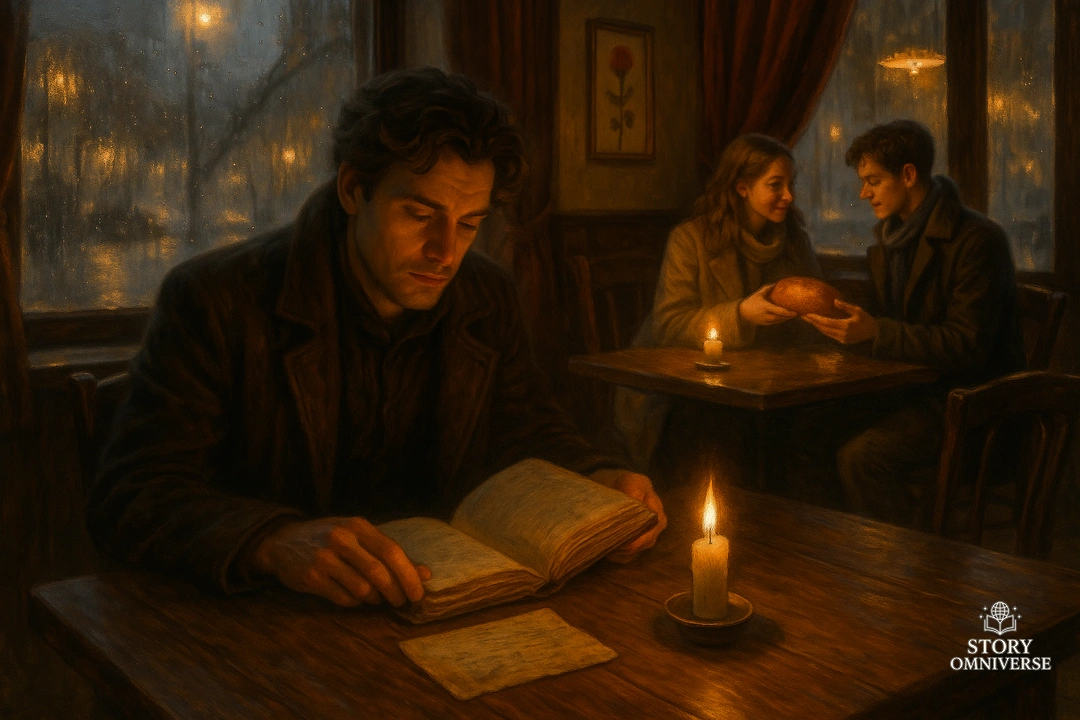
The Velvet Quill Café is crowded with raincoats and softened voices, the windows fogged as if the street outside is trying to forget itself. Wet wool and rose-steeped tea mingle in the air. A violin somewhere in the back corner tries not to be noticed. The velvet curtains sway like they are breathing.
I take the seat nearest the central table, where the open communal journal rests like a promise. The pressed rose between its pages looks newly mourned and newly loved at once. A few faces turn toward me, then away again, polite and curious. The Café has a way of making curiosity feel like kindness.
“I’m not here to tell a legend,” I say, keeping my voice low so it fits among the murmurs. “Not a grand romance with duels and declarations. Just a first love I kept calling friendship.”
Across from me, a woman with rain in her lashes lifts her cup. “Those are the ones that hurt,” she says, not unkindly.
“Or heal,” someone else offers.
I reach into my satchel and place a slim, weathered diary on the table. The cover is soft from handling, the corners blunted like they have bumped into too many library shelves. It is the kind a student might lose and never realize they are missing until the semester ends and the world feels too quiet.
A candle is lit, and its glow pools over the diary’s spine. The flame flickers as if it recognizes what it is about to illuminate.
“Tucked into its back cover,” I tell them, “was a handwritten recipe card. Stained with tea and time.”
I slide it out carefully. The paper is thick, the ink darkened at the edges. There is a smudge where a thumb once paused, as if the writer hesitated over a word.
My throat tightens anyway, because I know that hesitation. I have lived in it.
A young man at the next table leans forward. “Did you know whose it was?”
“Not at first,” I say. “I only knew it belonged to someone who wrote like they were trying to keep a heart from slipping away.”
“And you?” the woman asks softly. “How do you fit in?”
The question lands true. I let it.
“I was the friend who stayed,” I admit. “The one who always felt more, and never said it in time. This diary is not mine, but the ache in it is familiar.”
Outside, the rain taps the windows in patient rhythm.
Inside, I open the diary. The first line is dated with a campus day and a weather note, as if the sky mattered as much as the heart.
I begin.
Chapter 1: Rain at the Campus Gate
That night, the rain brought them in, and the campus paths turned into silver ribbons under streetlamps. The diary’s ink begins with urgency, as if the writer feared memory might evaporate.
I can see it as I read: the main gate of the university, ironwork slick with water, ivy shivering along the stone. Students hurry past in hunched silhouettes, backpacks held like shields. A bus sighs at the curb and pulls away, leaving spray.
The dreamer in the diary is named Mara. She writes her name once, small, then never again, as if names are too intimate for paper.
Mara stands under the archway, clutching a tote bag to her chest. Her hair is damp at the edges. She has been walking without noticing the cold, because grief has its own weather. A recent loss is there in the way she counts her breaths, like she is afraid of running out.
A voice cuts through the rain. “You’re going to drown out here.”
Mara turns. Theo. His hair is plastered to his forehead, his coat unbuttoned, an umbrella in his hand that looks too small for the storm. His eyes are bright with concern that has nowhere to go.
“I’m fine,” Mara says automatically.
Theo looks at the sky, then at her soaked sleeves. “You’re not.”
He opens the umbrella and steps closer. The canopy tilts, sheltering her first, even before himself. The closeness is sudden. The sound of rain changes when it hits fabric instead of skin. It becomes softer, almost private.
“I thought you left after seminar,” Mara says. Her voice wobbles on the word thought.
“I did,” Theo admits. “Then I remembered you never bring an umbrella. Like you’re trying to prove something to the clouds.”
Mara snorts, and it almost becomes a laugh. “Maybe I am.”
Theo shifts the umbrella so their shoulders brush. “Come on. I’ll walk you. Where are you going?”
“Library,” she says, then hesitates. “Or… nowhere. I just didn’t want to go back to my room.”
Theo’s expression gentles. “Then we’ll go somewhere else.”
“Where?”
He nods toward a side street where warm light spills onto wet pavement. “There’s a café. Not far. It stays open late.”
Mara studies him, as if weighing whether connection is still allowed. “You don’t have to.”
“I know.” Theo’s smile is small, steady. “I want to.”
They start walking. Their steps sync without effort, like a melody finding its rhythm again. Mara writes that she felt the first strange thing she’d felt in months: not relief, exactly. Something like possibility.
Under the umbrella, Theo says, “Tell me one true thing about today.”
Mara swallows. “I missed… I missed someone who isn’t here.”
Theo’s hand tightens on the umbrella handle. “Tell me another.”
Mara looks at him, rainwater clinging to her lashes. “I’m glad you came back.”
Theo does not answer right away. He only angles the umbrella closer, as if guarding that sentence from the storm.
Chapter 2: The Diary with a Pressed Rose
In the Velvet Quill Café, the diary’s next pages smell faintly of old paper and something floral, like a memory pressed too hard. When I turn them, a dried rose slips free, flattened and delicate. A listener near the window inhales sharply, as if the scent reached them too.
The entry is dated two days after the rain, early September, the semester still new enough to feel like a promise.
Mara writes about a garden blooming at twilight behind the humanities hall. It is not the manicured campus showpiece with plaques and tours. It is a tucked-away strip of life, half-wild, half-tended, where roses climb a trellis that leans like it is tired of holding itself up.
She describes how the sky turns violet there, how the first stars appear like hesitant confessions. Students come with books, with coffee, with grief they do not name out loud. The garden holds it all without comment.
Theo is there in her writing, steady as a melody returning.
“I didn’t know this place existed,” Mara says in the scene, sitting on the low stone wall that borders the beds. Her fingers worry the edge of a page.
Theo shrugs, but his gaze is careful. “Most people don’t. They walk past the humanities hall like it’s only a building. They forget it has a back.”
Mara laughs softly. “Everything has a back.”
Theo looks at her then, a long look. “Yeah,” he says. “It does.”
A breeze lifts the rose branches. Petals tremble, catching the last light. Mara tips her face up, and for the first time in the diary, she writes about the loss that made every day feel muted. It is her mother, gone in spring, when the world insisted on blooming anyway. Mara has been moving through campus like a ghost among living things.
Theo does not ask for details. He does not do the thing people do, the thing that makes grief feel like a lesson. He only sits beside her, close enough that their sleeves touch, not so close that she feels trapped.
“I keep thinking I hear her,” Mara admits, voice thin. “Like if I turn fast enough, I’ll catch her voice behind me.”
Theo’s fingers curl on his knee. “What did she sound like?”
Mara’s eyes sting. “Like humming while she cooked. Like she had music in her hands.”
Theo nods, as if storing that. “Then maybe you do hear her. Not as a trick. As… as something that stays.”
Mara turns her head. “You talk like you’ve practiced comforting people.”
He grimaces. “I’ve practiced failing at it.”
“You’re not failing,” Mara says, surprised by her own certainty.
Theo’s smile is brief, like a note played and released. “Stay here a while,” he says. “Twilight makes everything softer.”
Mara writes that she watched the garden darken, watched Theo’s profile become a silhouette against the last light, and felt grief loosen its grip by a fraction. Not gone. Never gone. But held.
When I lift my eyes from the diary, the Café’s candle flame wavers. Someone at the far table wipes at their cheek and pretends it is only rain.
Chapter 3: A Friend Who Stayed Too Long
The next entries shift, as if Mara’s pen has warmed to the act of telling. The scenes come in quick, affectionate strokes: late seminars where the professor’s voice drones and Theo passes Mara a folded note that says, You look like you’re about to run away. I support it. Shared tea in paper cups that burn their fingers. Laughter that arrives like sunlight through rain.
In one entry, Mara writes about the campus café near the library, not the Velvet Quill, but a bright place with cheap scones and too many undergraduates. She and Theo sit by the window with their books open and their attention mostly on each other.
Theo taps her textbook. “You’re reading the same paragraph over and over.”
Mara blinks. “Am I?”
“Yes.” He leans closer, lowering his voice as if the words are secret. “You’re thinking about something else.”
“Maybe I’m thinking about how you always notice,” Mara says.
Theo’s eyes flicker. “Someone has to.”
Mara’s pen in the diary pauses there, and then she writes something that makes my chest ache: He stayed. He stayed when everyone else said, time will help, and then disappeared into their own lives.
In the scene, Mara stirs honey into her tea. “You don’t have to keep… hovering.”
“I’m not hovering,” Theo says too quickly. “I’m studying.”
“With me.”
He looks away, jaw tightening. “You’re my friend.”
The word lands between them like a boundary drawn in chalk. Mara smiles as if it is enough. She has been starving for steadiness, and friendship is a meal she can accept without guilt.
Theo’s hand rests near hers on the table, close enough to warm her skin without touching. He watches her like he is listening for music only he can hear.
A classmate passes and calls, “Hey Theo, you coming to rehearsal tonight?”
“In a bit,” Theo answers, then adds, “Mara, you should come. It’s just a run-through.”
Mara hesitates. “I don’t belong there.”
Theo’s gaze softens. “You belong anywhere you want.”
She laughs, embarrassed by the tenderness of that. “That’s not how campus works.”
“That’s how I work,” Theo says, then clears his throat as if he has said too much.
Later, in the diary, Theo walks Mara back to her dorm. The air is cold, the sky clear. He stops at the door and shoves his hands in his pockets.
“I had fun today,” Mara says.
“Me too.” Theo’s voice is rougher than usual.
Mara tilts her head. “You’re a good friend, Theo.”
He flinches almost imperceptibly. “Yeah,” he says. “I’m trying to be.”
Mara writes, He always felt like a song that wanted lyrics, but I only let him hum.
In the Velvet Quill Café, someone across from me murmurs, “Oh, honey.”
I turn the page, and Theo’s careful lines begin to show through Mara’s, as if the diary itself is leaning toward confession.
Chapter 4: Letters Hidden in Plain Sight
A routine begins, and the diary captures it with reverence, like it knows it is recording the fragile architecture of a first love. Small letters appear in Mara’s life, slipped into borrowed books and notebook pockets. They are never signed plainly. Only a musical note in the corner, drawn with a quick, confident stroke.
Mara writes about finding the first one tucked inside her copy of a poetry anthology. She is in the humanities garden at twilight, knees drawn up, the air smelling of damp earth and roses. She opens the book and a folded paper falls into her lap.
Theo is there, pretending to read his own book, but his eyes lift too fast when she makes a sound.
“What is it?” he asks, too casual.
Mara unfolds the note. The handwriting is neat, slanted slightly right, like someone who walks quickly.
Tell me one true thing you haven’t said out loud yet.
In the corner: a single musical note.
Mara looks up. “Did you…?”
Theo raises his eyebrows. “Did I what?”
Mara laughs, flustered. “Never mind. It’s probably from… someone.”
Theo’s mouth tightens. “Probably.”
Mara reads the note again, then glances at him. “Fine. One true thing?”
Theo shrugs. “If you want.”
Mara’s voice is soft. “I’m afraid if I stop being busy, I’ll fall apart.”
Theo’s book lowers. His eyes are steady on her. “Then don’t stop being busy alone.”
Mara’s breath catches. She looks back at the note as if it has become proof of something she cannot name.
The letters continue. One in her notebook during seminar: You looked up when the professor said ‘loss’ like the word had teeth. One in a library book: If you could keep one sound forever, what would it be? Always the musical note.
Mara begins to answer them in her diary, then in small scraps of her own, slipped back into Theo’s books when he is not looking. She never signs either. She draws a tiny rose instead, awkward but earnest.
One evening in the student union, Theo catches her mid-swap. His hand closes gently over her wrist, stopping her from tucking the paper into his folder.
“Mara,” he says quietly.
Her cheeks burn. “I was just… returning your pen.”
“There’s no pen,” he says, but he is smiling now, a smile that looks like surrender.
Mara’s voice drops. “Are you the one leaving the notes?”
Theo’s thumb brushes her pulse once, a touch so light it could be accidental. It is not.
He does not answer. He only says, “Do you like them?”
Mara swallows. “Yes.”
Theo’s gaze holds hers, and for a moment the world narrows to paper and breath and the ache of almost.
“Then keep finding them,” he murmurs.
Mara writes that the letters bound two hearts without naming what they were doing. She clung to them as proof that love might last beyond a hard season. And Theo, she suspects, clung to them because he did not know how else to say what was swelling in his chest.
In the Café, the candle pops softly. The listeners lean in, as if paper can make sound.
Chapter 5: Twilight in the Garden
At dusk, they meet in the blooming garden behind the humanities hall, where petals catch the last light and the air smells of damp earth and roses. The diary lingers here, savoring the way twilight makes honesty feel possible.
Mara arrives first, her scarf loose, her hands tucked into her sleeves. She sits on the low wall and watches the sky deepen. When Theo appears, he carries two cups of tea and a folded sheet of paper.
“You’re late,” Mara says, but her smile ruins the accusation.
Theo hands her a cup. “I had to negotiate with the kettle. It was stubborn.”
Mara laughs, then quiets as she notices his expression. “What’s wrong?”
Theo sits beside her. Their knees almost touch. “Nothing’s wrong,” he says, then exhales. “Everything’s… loud.”
Mara looks at him. “Loud how?”
Theo taps the folded paper against his thigh. “Like when you hear a song and it keeps playing in your head even after it ends.”
Mara’s heart stutters. “I get that.”
Theo glances toward the rose trellis. “Do you?”
Mara doesn’t answer. She watches a petal fall, slow as a decision.
From somewhere across campus, music drifts faintly. A student practicing violin with a window cracked open. The melody is simple, repeating. Theo’s shoulders loosen as if the notes are a hand on his back.
Mara says, “You’re humming.”
Theo stops, surprised, then laughs under his breath. “Am I?”
“Yes.” Mara’s voice is fond. “What is it?”
He hums again, softer. “It’s from my grandmother’s old record player. She used to play it when she baked.”
Mara’s eyes sting unexpectedly. “My mother used to hum when she cooked.”
Theo’s gaze turns to her, careful and full. “I remember.”
The music from the distant window ends, but Theo keeps humming, and Mara realizes the motif they have been building without knowing it. Music lingering after the last note. A private language for what stays.
Theo unfolds the paper and holds it out. “I wrote you something.”
Mara’s hands tremble as she takes it. “Another letter?”
“Not exactly.” Theo’s voice is quiet. “Read it.”
Mara reads, lips moving soundlessly.
If you ever think you’re too much, remember: some people are built to hold storms. Some people want to.
In the corner: the musical note.
Mara looks up, eyes bright. “Theo…”
He flinches at his own bravery. “Don’t say it,” he whispers.
“Say what?”
“That I’m a good friend.” His laugh is strained. “I know I am. I’m tired of being only that.”
Mara’s breath catches. Friendship lines blur, shimmering like wet pavement under streetlamps. She wants to step over them. She is afraid to.
She whispers, “Then what are you?”
Theo’s gaze drops to her mouth, then back to her eyes, as if he is choosing restraint like a vow. “I’m the person who keeps showing up,” he says. “Even when the music stops.”
Mara’s throat tightens. She reaches out, not for his hand, but for his sleeve, gripping the fabric like an anchor. “Don’t stop showing up,” she says.
Theo closes his eyes for a beat, as if that sentence is both blessing and torture. “I won’t,” he promises.
In the Café, I turn the page slowly. The listeners are silent, but I can feel them hearing the hum beneath the words.
Chapter 6: The Recipe Card of Honey Bread
The handwritten recipe card appears in the diary like an heirloom. It is mentioned before it is shown, as if Mara herself could not believe it belonged in her life.
Theo brings it up one afternoon when the rain has finally paused and the campus smells rinsed clean. Mara is sitting in the library atrium, sunlight pooling on the floor. Theo drops into the chair across from her with a paper bag and a look of nervous pride.
“What’s that?” Mara asks.
Theo pushes the bag toward her. “A peace offering.”
“For what crime?” Mara teases.
“For being… me.” He rubs the back of his neck. “Just open it.”
Mara peeks inside. A small loaf, golden and slightly uneven, wrapped in parchment. The scent hits her first: warm honey, yeast, a hint of cinnamon. It makes her chest ache with home she no longer knows how to return to.
Mara looks up, stunned. “You baked?”
Theo’s ears redden. “Don’t act like it’s impossible.”
“It’s not impossible,” Mara says softly. “It’s just… you.”
Theo laughs, then sobers. “My grandmother taught me. When I was a kid, she said bread is a way of saying I’m glad you exist.”
Mara’s fingers hover over the loaf. “That’s a lot to say with flour.”
Theo meets her eyes. “Yeah.”
Mara breaks off a piece. The crust gives with a gentle crackle. She tastes it and closes her eyes. “It’s good,” she says, voice thick. “It’s really good.”
Theo exhales like he has been holding his breath for days. “I brought something else.”
He slides a card across the table. Handwritten. Looping script. A smudge where a thumb once paused.
At the top: Honey Bread.
Mara’s gaze flicks up. “Is this… your grandmother’s?”
Theo nods. “I copied it. She used to keep it in her recipe tin. I thought… I don’t know. I thought you might want something that lasts longer than a loaf.”
Mara runs her finger along the ink, reverent. “Theo, this is…” She searches for the right word and finds only the wrong one. “This is so kind.”
Theo’s mouth tightens, pain hidden under politeness. “Kind,” he repeats, like he is testing whether it will cut.
Mara, hopeful dreamer that she is, mistakes the gesture for simple care. Not the beginning of a confession. She does not see that Theo has given her a piece of his history the way people give rings, the way people give names.
She smiles brightly, trying to keep things safe. “We should share it in the garden sometime. Like a picnic.”
Theo’s eyes soften despite himself. “Yeah,” he says. “We should.”
A classmate passes and calls, “Theo! Coming to rehearsal?”
“In a minute,” Theo answers, then looks back at Mara. “Save me a piece?”
Mara holds up the loaf. “Always.”
Theo stands, hesitates, then reaches out and brushes a crumb from the corner of her mouth with his thumb. The touch is brief, but it leaves heat behind like a note that refuses to fade.
Mara freezes. Theo’s hand drops as if he has burned himself.
“Sorry,” he murmurs.
Mara forces a laugh. “It’s fine.”
But the diary ink darkens there, the way it does when a hand presses too hard. Even on paper, you can feel how close they are to saying the wrong thing, or the right one, and how terrifying it is that they might be the same.
Chapter 7: Misread Lines
A letter goes missing, and the absence speaks louder than any ink. The diary’s entries become jagged, dates closer together, as if Mara is writing to keep herself from unraveling.
It begins simply. Mara reaches into her notebook during seminar and expects to find a folded paper. The musical note. The small tether that has been holding her through the muted days.
There is nothing.
She checks again, fingers sliding along the pocket seam. Nothing.
After class, she catches up to Theo in the hallway. Students stream around them, voices bouncing off lockers and bulletin boards. Theo turns when he hears her footsteps, smiling, until he sees her face.
“What’s wrong?” he asks.
Mara tries to sound light. “Did you… stop?”
Theo blinks. “Stop what?”
“The notes,” Mara says, too quickly. “The letters. There wasn’t one today.”
Theo’s smile falters. “I left it.”
Mara’s pulse spikes. “Where?”
“In your notebook,” Theo says, defensive now. “Same place as always.”
“It wasn’t there,” Mara insists. Her voice rises, and she hates herself for it. Heads turn.
Theo’s jaw tightens. “Maybe you missed it.”
“I didn’t miss it,” Mara says, stung. “I looked.”
Theo’s eyes flash with hurt that looks like anger. “So what are you saying? That I’m lying?”
Mara’s throat closes. She hadn’t meant that. She only meant that the letter mattered more than she wanted to admit. “No,” she says, softer. “I’m saying it’s gone.”
Theo looks away, swallowing. “Then someone took it.”
Mara’s mind fills with sudden, ugly possibilities. A classmate finding it. Laughing. Theo deciding it was too risky and pretending it never existed. Theo deciding she was too much after all.
She whispers, “Maybe you didn’t want me to find it.”
Theo turns back sharply. “Why would you think that?”
Mara’s eyes burn. “Because you keep doing things that feel like more, and then you call it friendship. And I don’t know what I’m allowed to want.”
Theo’s face goes pale. For a moment, he looks like he might step closer, might finally cross the line. Then his shoulders stiffen.
“I’m not playing with you,” he says, voice low. “If you think I’m that kind of person, then maybe you don’t know me at all.”
Mara flinches. “That’s not what I meant.”
“It’s what it sounded like,” Theo says.
Miscommunication, sharp as broken glass, drives a wedge between them. Each assumes the other has grown tired. Each retreats to protect what is left.
Theo walks away first, because he cannot bear to stay and beg for belief.
Mara stands in the hallway, the noise of campus suddenly distant, like she is underwater. She presses her palm to her chest as if she can keep her heart from falling out.
That evening, she goes to the garden alone. Twilight arrives, violet and indifferent. The roses tremble in the breeze. The bench where Theo usually sits is empty.
Mara whispers into the air, “I’m sorry,” but the garden does not answer.
In the diary, her handwriting slopes downward.
Maybe I imagined the music. Maybe it was always just wind through leaves.
In the Velvet Quill Café, the rain outside taps harder for a moment, as if it remembers how it began.
Chapter 8: The Night the Music Stopped
The diary’s next entry is dated mid-October, the night of the campus recital. The ink is smudged in places, like Mara’s hand shook or her tears fell without permission.
The recital hall is small, old, with wooden seats that creak and a stage that smells faintly of varnish. Mara sits near the back, clutching the program until it wrinkles. She has come because Theo invited her weeks ago, before the missing letter, before the wedge.
She tells herself she is here for the music. She tells herself she is not scanning the stage door for his face.
A student quartet plays first. Applause. Then a piano solo. Applause. The air fills with sound and then empties again, over and over, like breathing.
Mara’s grief resurfaces in the spaces between notes. Not only for her mother, whose humming she can no longer ask for. But for what might be slipping away now, for the warmth she had begun to trust.
During intermission, Mara stands in the lobby near a table of pamphlets. Theo appears at the edge of the crowd, violin case slung over his shoulder. For a second, their eyes meet.
Theo starts toward her.
Mara’s heart leaps, painful and hopeful.
Then a girl from his ensemble reaches him first, touching his arm. “Theo, we need you backstage. Now.”
Theo’s gaze flicks to Mara, apology written across his face. He mouths, “After.”
Mara nods, pretending she is fine. Theo disappears into the flow of bodies.
When the second half begins, Theo plays. Mara recognizes his posture even from far away, the way he leans into the instrument like it is a confession he can make without words. The melody is the tune he hummed in the garden, the one his grandmother played, the one Mara’s mother might have hummed if she had known it.
Mara’s breath catches. Her hands tremble in her lap.
The piece ends. Applause rises, then fades. The last note hangs in the air like a question that will not be answered. For a heartbeat, the silence is so complete it feels holy.
Then the audience shifts, coughs, moves on.
Mara stays seated, stunned by how quickly sound becomes memory.
A boy beside her whispers to his friend, “Theo’s good. He’s always good.”
Mara swallows. “He is,” she says without meaning to.
The boy glances at her. “You know him?”
Mara hesitates. The word friend sits on her tongue like a lie and a safety. “Yes,” she says. “I do.”
After the recital, she waits by the stage door. Students cluster, laughing, congratulating. Minutes pass. Theo does not come out.
Finally, Mara spots him across the lobby, surrounded by ensemble members. He looks up, sees her, and his face changes, hope and fear tangled.
Mara takes a step forward.
Theo takes one too.
A professor calls Theo’s name, pulling him aside. Theo’s shoulders sag. He looks back at Mara, helpless.
Mara’s courage, already bruised, collapses. She turns away before he can see her cry.
Outside, the night is cold. The campus lights blur. Mara writes, When the music stopped, I realized I had been living in its echo, and I did not know how to ask it to stay.
Chapter 9: The Apology Written Too Late
The diary slows again, entries spaced by days, then weeks. November arrives with early dark and brittle leaves. Finals loom. Then winter break empties the campus in a single exhale. When Mara returns in January, the garden is mostly bare, the trellis a quiet skeleton that still remembers roses.
Then, one entry is different. The handwriting is steadier, as if someone else held the pen, or as if Mara is copying something she did not write.
It is Theo’s letter, transcribed into the diary, because Mara never received it when it mattered. She found it later, and by then the words had already done their damage.
Theo’s letter is plain. No musical note in the corner. No hiding.
Mara,
I have been trying to be careful, and I think careful has become cruel. I think my silence has been a kind of lie.
I always felt more. Not just after your mother died. Not just after the rain. Before that too, when you answered questions in seminar like you were reaching for the sky. I told myself friendship was enough because I did not want to lose you.
But I am already losing you, and I cannot keep pretending I do not want what I want.
I love you.
If that changes everything, I understand. If it changes nothing, I will still be here, but I cannot keep leaving pieces of myself in your books and hoping you will read between the lines.
Theo.
Mara’s diary voice returns beneath the copied letter, raw and small.
She writes about how the letter was left in the wrong place. Theo tucked it into the pocket of a library book he thought she would borrow, a history text she mentioned in passing. But Mara never checked it out. Someone else did. Someone else found the confession.
The “wrong hands” belong to a classmate, Jenna, who has always watched Theo with interest. Jenna brings the letter to Mara in late February, not with malice exactly, but with a brittle kind of triumph.
Mara records the scene in the student union.
Jenna slides the folded paper across the table. “This was in my book. I figured it was yours.”
Mara’s fingers hover. “Why would it be mine?”
Jenna’s smile is thin. “Because it’s about you.”
Mara unfolds it. Reads. The world tilts.
Her voice comes out as a whisper. “How long have you had this?”
Jenna shrugs. “A while.”
“A while,” Mara repeats, dizzy. “You didn’t think to give it to me?”
Jenna’s eyes flash. “I didn’t know you were owed anything.”
Mara’s hands shake. “He thought I ignored him. He thought I…” She swallows hard. “And I thought he stopped caring.”
Jenna leans in, voice low. “Maybe he did. Maybe you took too long.”
Mara stands abruptly, chair scraping. “Where is he?”
Jenna lifts her shoulders. “Graduation applications, rehearsal, life. People move on.”
But Theo has not moved on. He has only gone quiet, wounded by the missing letter and Mara’s distance, believing his confession fell into a void.
The misunderstanding deepens into silence that lasts through the winter and into the first hint of spring. Mara writes of seeing Theo across campus and looking away. Of hearing a violin through an open window and shutting hers. Of carrying love like an unsent reply.
In the Café, I feel the listeners holding their breath, as if we could reach back into the pages and deliver the letter on time.
But the diary does not bend for wishes. It only keeps going.
Chapter 10: A Gesture that Seals the Morning
The final entry returns to twilight in the garden, but it begins with an odd detail: Theo appears with an umbrella even though the sky is clear, as if refusing to let the first moment be wasted.
Mara writes that she went to the garden because she could not bear the weight of unsaid things anymore. It is early April. The roses are not fully back, but the vines have begun their stubborn reach. Twilight arrives like a familiar ache.
She sits on the stone wall, clutching the crumpled confession letter Jenna finally gave her. Her fingers are ink-stained from rereading it until the words feel carved into her skin.
Footsteps on gravel.
Mara looks up.
Theo stands at the edge of the path, umbrella open above his head in ridiculous defiance of the clear sky. His hair is longer than it used to be. His face is sharper with time and lack of sleep. His eyes, when they find hers, are still the same melody.
Mara rises, heart hammering. “Theo.”
He stops a few feet away, as if distance is a rule he does not trust anymore. “You got it,” he says. Not a question. A fragile statement.
Mara holds up the letter with shaking fingers. “I got it too late.”
Theo’s grip tightens on the umbrella handle. “I thought you didn’t want it.”
“I thought you stopped,” Mara says, voice breaking. “I thought you got tired of me.”
Theo’s laugh is hollow. “I got tired of being afraid.”
Mara steps closer. The air smells of damp earth and the last warmth of day.
“I’m sorry,” she whispers. “I’m so sorry. I should have asked. I should have believed you.”
Theo’s throat works. “I should have said it to your face.”
He closes the umbrella slowly, as if ending a spell, and sets it against the wall. Then he reaches into his coat and pulls out a card.
The recipe card, rewritten neatly. The same honey bread. The same looping script, but cleaner now, as if he wanted no smudges, no missing words. At the bottom, a signature at last.
Theo.
Mara’s eyes fill. “You brought this.”
“I brought… a way to start again,” Theo says. “If you want it.”
Mara laughs through tears. “You’re offering bread like it’s a proposal.”
Theo’s gaze softens. “My grandmother would approve.”
Mara takes the card with both hands, like something sacred. “I don’t know how to do this,” she admits. “I don’t know how to be someone’s… love. I only know how to be someone’s friend.”
Theo steps closer until their hands brush over the card. “Then we learn,” he says. “Slowly. We keep the friendship. We add the rest.”
Mara’s voice is small, fierce. “You love me?”
Theo nods once, as if the word is too important to toss around. “Yes.”
Mara’s breath shudders out. “Then… yes,” she says. “I love you too. I think I have for a while. I was just grieving too loudly to hear it.”
Theo’s eyes close for a moment, relief sweeping through him like music returning. When he opens them, they shine.
He pulls a small wrapped loaf from his bag. Honey bread, warm from somewhere, impossibly. They break it together, sharing the first piece in silence that feels like a vow.
As they walk home through campus, Theo hums softly. Mara joins in, hesitant at first, then sure. The tune lingers after the last note, and this time, neither of them lets it fade alone.
Closing Frame
Back in the Velvet Quill Café, I close the diary with hands that have stopped shaking, and the room seems to breathe with me. The rain has thinned outside, but the windows still hold its memory, like a song held in the walls.
A listener near the central table clears their throat. “So they found each other,” they say, voice careful, as if happiness might startle.
“They did,” I answer. “Not because it was easy. Because they finally stopped letting fear translate their silence.”
The woman with rain in her lashes sets her cup down. “And the recipe card?”
I lift it, the stained original, and the candlelight makes the ink shine. “It was tucked into the back cover, behind the last page, like a secret you could taste. The same hand that copied it once must have slid it there later, when the rewritten one was made. An ending hidden with the beginning.”
The young man who leaned forward earlier smiles faintly. “A gesture,” he says.
“A gesture that sealed the morning,” I agree.
I slide the diary gently beside the communal journal. For a moment, the pressed rose between the journal’s pages seems to deepen in color, as if memory has been fed.
No one speaks right away. The Café holds the silence the way the garden held twilight. Somewhere, that hidden violin offers a few soft notes, then stops, leaving the air trembling with what remains.
I set the velvet quill down beside the open journal, careful as if it might bruise. The candle’s flame draws small shadows across the recipe card’s ink. The listeners do not rush to fill the quiet. Each of us seems to be hearing the last note linger, and choosing, quietly, not to let it be the end.

0 Comments