
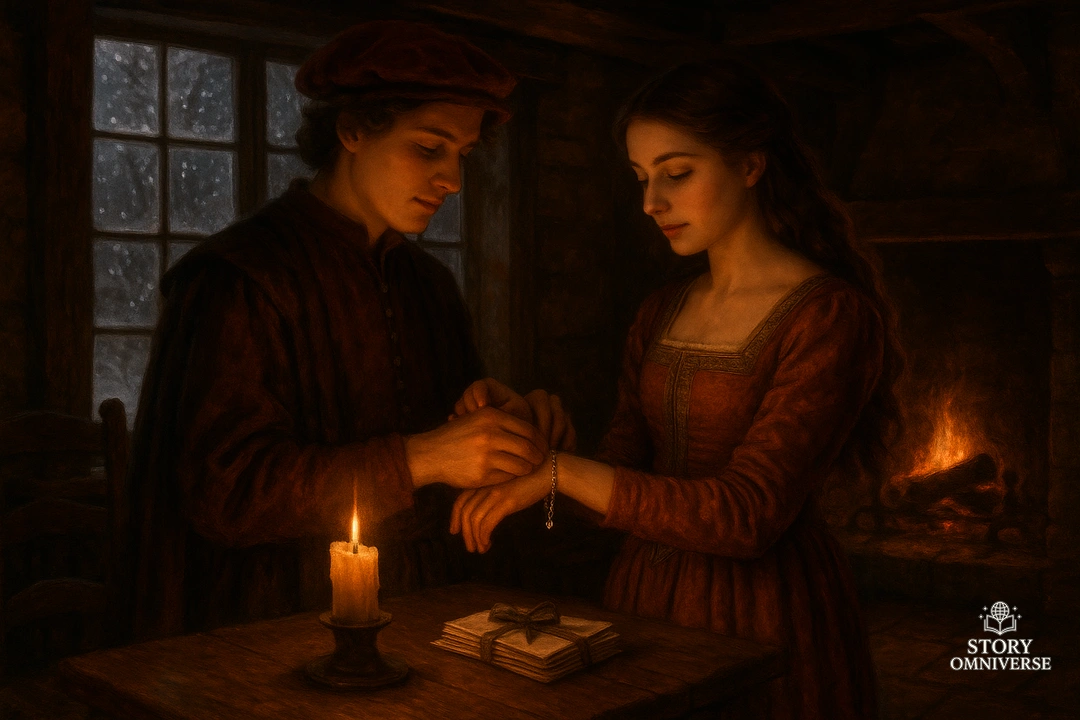
Chapter 1: The Letter on the Table
The Velvet Quill Café hums softly around me, all porcelain clinks and velvet hush. Snow clings to coats at the door as if winter followed everyone inside, and a candle near my hand trembles with each breath I take.
I have always been the quiet one here, the listener who nods and remembers. Tonight, a stack of courier cards lies beside the open journal, edges worn as if they have traveled farther than any road. Stiff paper, painted fronts, ink on the back. I touch them once, then begin, because some loves wait so long they start to feel like weather.
It began with a letter left on the table.
Not this table, not the Café’s central one with its pressed rose and open journal. Another table, long ago, in a country inn where the beams were dark with age and the windows were stitched shut by frost. Snow hammered the shutters like impatient knuckles. The hearth was stubborn, giving more smoke than warmth, and every candle burned low as if conserving itself.
I had gone down early to help the innkeeper’s wife, Mistress Agata, with bread. My hands smelled of flour and woodsmoke. The common room was empty except for the cat and the slow drip of meltwater from boots left too near the fire.
Then I saw it.
A sealed letter lay on the trestle table where travelers played dice. It was placed neatly, as if it belonged to the room itself. The wax was pale red, pressed with a mark I knew so well my throat tightened: a small lily inside a circle, the signet of House Valenti.
My name was written across the front in a hand that had once scribbled crude poems in the margins of my school primers.
“Matteo Ferri,” I whispered, because the room was empty and I could.
Mistress Agata came in with a basket of kindling. “You look as if you’ve seen a ghost.”
“Someone left a letter,” I said, and my voice did not sound like mine.
“Letters find their way in storms,” she replied, practical as ever. “If it’s yours, take it. If it’s not, leave it.”
Beside the letter sat a charm bracelet, its chain dulled by travel, its little rings like tiny mouths held open. Several links were bare, as if charms had been torn away. The remaining pieces caught the candlelight: a silver olive branch, a tiny book, a small bell that did not ring when I touched it.
I lifted the bracelet first. It was cold, but it warmed quickly against my palm, like something alive. On the clasp, scratched faintly, were the initials we had carved into a walnut tree as boys. M. and L.
“Luca,” I breathed.
Mistress Agata set down her basket with a thud. “Is that a lover’s token?”
“He was my friend,” I said, and felt the lie in the way I avoided the rest of the truth. Childhood friend. The one who had left for the city and never returned. The one whose name my family spoke now with tight mouths, as if it were a spice too costly for common stew.
Outside, the snow thickened, swallowing the road.
I broke the wax with my thumbnail. The seal snapped like a twig, and something in me snapped with it.
Chapter 2: An Old Friend Returns
The letter was brief, as if written by someone who feared the page itself might betray him.
Matteo, if you still keep the inn’s kindness in your bones, wait. Do not show this to your father. Do not ask why. Only wait.
No signature. None was needed.
I read it twice, then folded it back as carefully as a prayer. My hands shook, and I hated them for it. I had become a man who could lift sacks of grain, who could bargain with merchants, who could stand through long Mass without shifting. Yet a few lines in Luca Valenti’s hand turned me into the boy who once ran barefoot through vineyards.
Mistress Agata watched me from behind the counter where she poured watered wine. “Who is he to you?”
“A storm,” I said before I could stop myself.
She made a sound that might have been sympathy. “Storms pass. People remain.”
The day crawled. Snow turned the world into a blank page, and the inn into the only ink. Travelers arrived and left, stamping their feet, cursing the road, begging for beds. I served them stew and listened to their complaints, but my ears were tuned to one sound only: the hinge of the door.
Near dusk, when the candles had shortened and the room smelled of wet wool and onion broth, the door opened again.
A man stepped in under a hooded cloak. Snow clung to his shoulders like lace. He moved with a careful grace that did not belong to this rough place. Too straight-backed for a farmer, too clean-handed for a mule driver. His boots were dark leather, polished even under slush.
He lowered his hood.
Luca’s hair had grown longer, tied back with a ribbon. His face had sharpened, cheekbones like carved marble, mouth set in a line that looked practiced. City polish, court manners, the kind of composure that came from being watched.
But his eyes were the same, a deep brown that had once widened in wonder at everything. They met mine across the room, and for a breath the world went quiet, as if the snow outside had drifted into the inn and muffled every sound.
“Matteo,” he said softly.
I should have moved. I should have bowed, or offered my hand, or called him “my lord” the way my father would insist. Instead I stood frozen behind the table, the bracelet hidden in my pocket like contraband.
“You came,” I managed.
His gaze flicked to the candles, to the patrons, to Mistress Agata, then back to me. “I had no other safe road.”
A drunk merchant laughed too loudly at a joke. Dice clattered. The inn resumed its noise, but the space between Luca and me stayed strangely intimate, warmed by the low flame of the nearest candle.
Mistress Agata approached, eyes sharp. “Room?”
Luca’s mouth twitched, almost a smile. “If you have one.”
“For coin,” she said.
He reached into his cloak and produced a purse that looked heavier than it should. “For warmth, too.”
Her eyebrows rose, but she took it. “Upstairs. Last door.”
When she left, Luca stepped closer to me. I smelled snow and something finer beneath it, a faint spice like cloves. Court perfume, foreign to this inn’s honest odors.
“You received it,” he murmured, meaning the letter, meaning the bracelet, meaning everything he had not dared say outright.
“I did,” I replied. My voice came out steady, which surprised me. “And I did not show it to my father.”
His shoulders lowered a fraction, like a man setting down a burden. “Thank you.”
We stood there, opposite in every way now. He in velvet-lined wool, I in rough linen. He with careful speech, I with plain words. Yet when his hand brushed my sleeve, accidental or not, the contact felt like coming home.
“Matteo,” he said again, and this time it was not a greeting. It was a plea.
I nodded toward the back corridor. “Come. Before someone asks too many questions.”
He followed, and the candles burned low behind us, throwing long shadows that looked like hands reaching.
Chapter 3: Postcards Never Answered
I did not sleep that night. The inn’s walls were thin, and the storm made every sound feel near. I lay in my small room under the eaves, listening to wind worry the shutters, to the occasional cough of a traveler, to the creak of the building settling. Every time footsteps passed in the corridor, my heart leapt.
At dawn, when the sky was a pale bruise over the snow, I went down to fetch water from the pump in the courtyard. The cold bit my fingers through my gloves. I returned with the bucket sloshing, cheeks burning, and found Luca at the common table as if he had been there all night.
A candle sat near him, burned down to a stub. Wax had pooled like tears on the wood.
He looked up as I entered, and something in his face softened. “You rise early still.”
“I always did,” I said, setting the bucket by the hearth. “You always slept late.”
His laugh was quiet, surprised, as if he had forgotten he could still make that sound. “The court does not permit sleeping late. It permits only smiling when told.”
I took the seat across from him, hands wrapped around my mug. “Why are you here, Luca?”
He reached into his satchel and drew out a bundle tied with ribbon. Not letters. Not quite. Rectangles of stiff paper, edges softened by handling. Some corners were torn. One had a smear where ink had bled, as if rain or a careless hand had tried to erase it.
“Courier cards,” he said, the term more fitting, though the ache in it was the same. “Little painted billets. Travelers buy them at stalls. I wrote on the backs.”
My throat tightened. “Those are…”
“Yours,” he said, and pushed them toward me. “Or meant to be.”
I untied the ribbon with clumsy fingers. The first card showed Florence, the river like a ribbon of steel under bridges. On the back, Luca’s hand.
Matteo, I saw a painter today who spoke of light the way you speak of bread, as if it can be made with patience. I wished you here. I wished you always.
My chest ached. I flipped to the next. Venice, water and masks.
They say love is a game here. I do not know how to play. I only know your name.
Another. Siena, a square crowded with people. The date line was ripped away, leaving only a jagged edge.
My mother watches my every word. My father speaks of alliances. If you write, do not mention me. If you do not write, I will understand, and I will still wait.
I swallowed hard. “I never saw these.”
“I sent them,” he said, voice tight. “Or thought I did. I gave them to a messenger. He swore he would deliver them to your village.”
I looked up. “And you believed him.”
“I was sixteen,” Luca replied, and the bitterness in his tone was not aimed at me. “I believed in oaths then.”
I turned the cards over one by one. They were fragments, slices of time that should have been mine. One ended mid-sentence, the last word trailing into a blot.
Someone reads what I write. I can feel it. If you do not answer, Matteo, I will tell myself it is because you are safe and that I am the only one bleeding for this.
My hands trembled. “Luca… I would have answered. I swear it.”
He reached across the table, not quite touching my fingers. “I know that now. When I found your childhood ribbon in my chest, I knew you were not the sort to turn away without a word.”
I drew a breath that scraped. “Who read them?”
His jaw tightened. “My house. Your house. I do not know which hand, only that it was not mine.”
Outside, the snow kept falling, patient as a secret. Inside, Luca’s gaze held mine, and I felt the weight of years pressing down, not crushing, but insisting.
“I listened to silence for so long,” he said. “I came to see if it was truly yours.”
“It was not,” I whispered.
His eyes closed briefly, relief and sorrow braided together. “Then perhaps we have a chance to begin again.”
Chapter 4: The Bracelet and Its Missing Charms
That afternoon, the inn grew quieter. The storm had trapped most travelers in their rooms, and the common room held only the steady crackle of the fire and the occasional rustle of a page. Mistress Agata hummed as she kneaded dough, pretending not to watch us from the corner of her eye.
Luca and I sat near the hearth. The candle on our table burned low, its flame small but stubborn.
He held out his hand. “The bracelet.”
I hesitated, then drew it from my pocket. The chain glinted faintly. Empty links looked like missing teeth.
He took it carefully, as if it might cut him. “Do you remember when we made it?”
“We did not make it,” I said, a small smile tugging at my mouth despite everything. “You stole it from your sister’s jewelry box.”
“She never missed it,” he replied, then sobered. “Or she pretended not to.”
He placed the bracelet into my palm. The metal was warmer now, warmed by his touch. “I brought it because it is the only thing I have that still tells the truth.”
I turned it over, tracing the remaining charms. The olive branch, the book, the bell.
“You said it would be full one day,” I murmured. “Full of places we would go.”
“And it was,” Luca said, voice low. “For a time.”
He pointed to an empty ring near the clasp. “There was a tiny key there. I traded it.”
“For what?” I asked, though I already feared the answer.
“A night’s passage out of Florence,” he said. “A man at the gate wanted more than coin. He wanted proof I could be controlled.”
My fingers tightened. “And this one?” I touched another bare link.
“A little star,” Luca said, eyes distant. “I gave it to a courier to carry a message that could not be spoken aloud. He never returned.”
“And this?” I asked, touching a third.
“A small heart,” he whispered, and his gaze met mine. “I sold it for silence. There was a rumor. About us, about what we were when we were boys. A servant overheard me say your name like a prayer.”
My throat burned. “You should not have had to pay for that.”
“I paid so you would not,” he replied, fierce for the first time since he arrived. “So your father would not look at you differently. So your village would not spit when you passed.”
The fire popped, startling the cat. The candle flame bent, then steadied.
I swallowed. “Luca, why come now? After all this?”
He reached out, covering my hand and the bracelet with his. His skin was warm, his touch careful. “Because I am tired of trading pieces of myself away. Because I remembered something you said the day we promised.”
I blinked, and the memory rose like a scent. Two boys under a walnut tree, carving initials with a stolen knife. Luca’s hands ink-stained from copying Latin. Mine rough from helping my mother with washing.
“We promised,” I said, voice thick, “that we would choose our own lives.”
“Yes,” he whispered. “And I failed.”
“You survived,” I corrected, and surprised myself with the steadiness of it. “That is not failure.”
His eyes shone, and he looked away quickly, as if court training had taught him tears were a luxury.
Mistress Agata’s voice drifted from the counter. “If you two are going to stare at each other all day, at least drink something warm.”
Luca’s mouth curved. “Yes, Mistress.”
I glanced toward her. “Honey, if you have it.”
She snorted. “Always. Even in storms.”
When she brought the bread and honey, Luca watched me spread the golden sweetness with the same focus he might give a duke’s decree.
“You live simply,” he said softly.
“I live,” I replied. “And I have waited without knowing I was waiting.”
He touched the bracelet again, as if anchoring himself. “Then let us stop waiting.”
Chapter 5: Footsteps in the Snow
The next morning, the snow eased into a softer fall, the kind that looked gentle but hid depth. The inn’s courtyard was a white bowl. When I stepped outside to shake out rugs, the cold struck clean and sharp.
Footprints cut through the fresh snow.
Not the scattered marks of villagers. These were deliberate, evenly spaced, as if made by someone trained to walk without hurry. They led from the road to the inn door, then back again, as if someone had approached, listened, and retreated.
I stared until my breath hurt.
Inside, Luca sat by the window, pretending to read one of the inn’s tattered books. His eyes lifted the moment I entered.
“Someone has been here,” I said.
He did not ask how I knew. He only closed the book with careful calm. “How many?”
“Two sets of prints,” I replied. “Perhaps more under the drift.”
Luca’s fingers tightened around the cover. “Too soon.”
Mistress Agata bustled in with a tray of cups. “You boys look like you’ve swallowed bones.”
“Travelers,” I said quickly, forcing my voice to steadiness. “New ones?”
“Not inside,” she said, frowning. “But I saw men on the road. Fine cloaks. Too clean boots for this weather.”
Luca’s gaze flicked to mine, and the air between us sharpened.
Later, as I carried wood to the hearth, the inn door opened and two strangers stepped in. Their cloaks were dark and trimmed, their gloves spotless. Snow melted on their shoulders, but they did not look inconvenienced by it. They looked as if the storm had been instructed to fall and had obeyed.
One smiled at Mistress Agata. “Warmth, good woman. And perhaps a question answered.”
Her chin lifted. “Warmth costs. Questions cost more.”
The other man’s eyes swept the room. They paused on Luca, who sat with his hood up now, face turned slightly away. The stranger’s gaze lingered a heartbeat too long, then moved on.
“We seek a traveler,” the first said, voice smooth with courtly accent. “A young lord, perhaps, who has strayed from his rightful path. We were told he might have taken refuge here.”
Mistress Agata’s expression did not change. “Many take refuge here. I do not keep a list of their sins.”
I set down my armful of wood, forcing my hands not to shake. “What is his name?”
The second man’s eyes snapped to me. “Luca Valenti.”
Hearing it spoken aloud in that tone made my stomach drop.
Mistress Agata wiped her hands on her apron. “Never heard it.”
The first man’s smile sharpened. “You are certain? His family is concerned. They offer reward for information.”
Luca rose then, slow and controlled. “If you have business with House Valenti, you should take it to Florence. This is an inn, not a court.”
The strangers turned toward him as one. The second man’s gaze narrowed, assessing. “And you are?”
“A traveler,” Luca said, voice mild. “With no taste for gossip.”
The first man stepped closer, boots leaving wet marks on the floor. “Gossip is not what we seek. We seek obedience.”
Mistress Agata’s hand went to the ladle by the hearth, as if it were a weapon. “You will not threaten my guests.”
“No threats,” the man said, still smiling. “Only care. Those who wander from their family’s wishes often regret it.”
The candle on our table flickered violently, flame bending as if a breath had struck it.
I found myself watching that flame, measuring each tremor. Luca’s fingers brushed my sleeve, a silent warning and a silent anchor.
“Eat,” Mistress Agata snapped at the strangers. “Or leave.”
They ordered wine they did not drink, bread they barely touched. Their questions came wrapped in politeness, but every word felt like a hand searching under a cloak.
When they finally left, the door thudded shut, and the cold rushed in like a spy.
Luca exhaled slowly. “They know I am here,” he whispered.
“And now,” I said, voice low, “they will learn who stands beside you.”
Chapter 6: Bread, Honey, and a Bargain of Tradition
That evening, the inn quieted again, but it was not peaceful. It was the hush of a room holding its breath. The strangers had taken a room upstairs, claiming the storm demanded it. Their laughter in the corridor sounded rehearsed.
Luca and I sat close to the hearth with a plate of bread and honey between us, as if sweetness could blunt fear. The candle on our table was already low, its flame small and watchful.
“I should not have come,” Luca said, staring at the honey as if it might answer him.
“You came because you had to,” I replied. “Tell me the truth. All of it.”
He looked up, and the court polish slipped for a moment. “My father arranged a courtship. A match with the Contessa di Bardi’s niece. It is not love. It is land and influence.”
“And if you refuse?” I asked.
His mouth tightened. “Refusal is scandal. Scandal is weakness. Weakness is punished.”
I thought of my own father, of his heavy hands and heavier expectations. “My family expects me to marry Caterina Rosi,” I said, the name tasting like duty. “Her father owns half the mills. My father says it will secure our grain contracts for years.”
Luca’s eyes flashed. “Do you love her?”
“No,” I said simply. “She is kind. She deserves someone who wants her.”
He leaned back, rubbing his temple. “So we are both bound by invisible ropes.”
“Custom,” I said. “Tradition.”
Luca gave a bitter laugh. “Tradition is a blade that never dulls. It cuts quietly, and everyone calls it necessary.”
We fell silent, listening to the fire. Upstairs, a floorboard creaked. I imagined the strangers’ ears pressed to doors.
Luca leaned forward, lowering his voice. “Matteo, if my family agent finds proof of what we are, they will not merely drag me home. They will erase the story. They will say I was ill, or bewitched, or led astray by a miller’s son.”
My stomach twisted at the word, not because it was untrue, but because it was used like a weapon. “And my father,” I whispered, “will believe them. Or pretend to, because it is easier than defending me.”
Luca reached across the table and covered my hand with his. His touch was gentle, but his grip held urgency. “I did not come to ruin you.”
“You came,” I said, squeezing back, “because you trusted me.”
His eyes softened. “I trusted you when we were boys. I trust you now, even though you look at me as if I am made of glass.”
“I look at you as if you might vanish,” I admitted.
He swallowed. “I have vanished before.”
The candle guttered, and I instinctively shielded it with my palm. Luca mirrored the motion, our hands briefly touching over the flame.
“We cannot change our families overnight,” I said. “But we can decide what we do in this storm.”
Luca’s gaze held mine, steady now. “Say it plainly, Matteo. If I am to risk you, I need to know where you stand.”
My heart thudded hard enough to hurt. “I stand with you,” I said. “Not in shadows. Not as a borrowed hour.”
Upstairs, a door clicked. We both froze.
Luca’s thumb stroked my knuckles, a small comfort after hardship. “Then we must be clever,” he whispered. “Love will not save us if we are careless.”
“And tradition will not spare us if we are obedient,” I replied.
His mouth curved, a flash of the boy he had been. “There you are. The Matteo who never feared mud on his boots.”
“I fear plenty,” I said, leaning closer. “But not you.”
Chapter 7: A Charm Found in the Ashes
The next day, the storm loosened its grip. Snow still fell, but the sky brightened, and Mistress Agata declared it time to clean the hearth properly. Soot had built up, choking the fire. She handed me a shovel and a rag with the grim satisfaction of giving a man honest work.
“Scrape it out,” she ordered. “And do not make a cloud of it. My lungs are old.”
Luca appeared beside me, sleeves rolled, hair tied back. “Let me help.”
“You?” I raised an eyebrow. “Does the court teach you to clean hearths?”
“It teaches me to look useful,” he replied, and the corner of his mouth lifted. “Sometimes that is the same thing.”
We knelt before the hearth together. The ash was fine and gray, clinging to skin and cloth. I scraped carefully, tossing clumps into a bucket. Luca held the candle close, its flame trembling in the draft.
“Careful,” I murmured. “The wax is low.”
“I see,” he said, and his voice held something like tenderness, as if the candle were a small life.
My shovel struck something solid.
I paused, listening. “Did you hear that?”
Luca leaned closer. “What is it?”
I set the shovel down and reached into the ash with my fingers. The soot was cold, gritty. My hand closed around a small object wrapped in cloth, stiff with age and smoke.
I pulled it free. The bundle was no bigger than a walnut, tied with thread.
Luca’s breath caught. “Open it.”
I hesitated, then untied the thread. The cloth unfolded, revealing a charm.
A tiny silver wheel, delicate spokes, the sort of charm a miller might wear for luck. It was blackened with soot, but still recognizable.
And the cloth itself bore an embroidered crest. A simple sheaf of wheat with a ribbon, my family’s mark.
My mouth went dry. “This is my father’s crest.”
Luca’s eyes narrowed. “Why would your crest be here?”
I turned the charm over. Scratched into the back were the initials M. and L., the same as the bracelet’s clasp.
“It is ours,” I whispered. “It was meant for the bracelet.”
Luca’s hand hovered near mine, not touching yet. “I never traded a wheel,” he said slowly. “I never even had one.”
“Then someone took it,” I replied, anger rising like heat. “Someone hid it where no one would look, in the place that swallows everything.”
Mistress Agata bustled over, wiping flour from her hands. “What have you found? If it’s a rat, I will charge you extra for the fright.”
“It’s not a rat,” I said, holding up the charm.
Her eyes sharpened. “That’s fine silver.”
“And this cloth,” Luca added, voice careful, “is not from your inn.”
Mistress Agata leaned closer, squinting. “That mark. It’s a local crest.”
“My family,” I said.
She straightened, lips thinning. “Then someone wanted it hidden. Or wanted you to believe it never existed.”
Luca took the charm gently, wiping soot from it with his thumb. His expression was tight, controlled, but his eyes burned. “Matteo, if your family’s crest is tied to this, then the missing pieces of the bracelet were not merely lost in my travels.”
“They were taken from us,” I said, voice rough.
Mistress Agata glanced toward the stairs. “And the men upstairs. They ask questions like priests in confession.”
Luca nodded once. “They are not here for warmth.”
The candle flame bent again, reacting to a draft from the door. Or to something else. In that moment, the inn felt smaller, its routines more fragile.
Luca placed the soot-dark charm in my palm. “We are being handled,” he said. “Like pieces on a board.”
I closed my fingers around the charm, feeling its edges bite into my skin. “Then we stop being pieces,” I whispered. “We become hands.”
Chapter 8: The Quiet Listener Speaks
That night, I could not bear the silence any longer. It pressed on my ribs, making it hard to breathe. Luca sat by the window in my small room, watching the snow fall in the pale moonlight. His posture was composed, but his foot tapped, betraying his nerves.
I stood near the bed, turning the newly found charm over and over. The soot stained my fingertips.
“You have been quiet,” Luca said without turning. “Quieter than usual.”
“I have always been quiet,” I replied.
He looked at me then, really looked. “No. You have been listening. There is a difference.”
The words struck me, because they were true. All my life I had listened. To my father’s plans. To my mother’s sighs. To villagers’ gossip. To Luca’s courier cards, unread but somehow still heard in my bones. Listening was safer than speaking.
But the charm in my hand felt like a weight that demanded voice.
“I need to tell you something,” I said.
Luca’s face softened. “Then tell me.”
I sat on the edge of the bed, forcing myself not to fidget. The candle on the small table had burned low. Its light made Luca’s features look carved from warm stone.
“When we were boys,” I began, “and you left for Florence, my father called me to the barn. He told me I would marry Caterina one day. He said it as if it were already done.”
Luca’s brows drew together. “When you were a child?”
“Yes,” I said, bitterness rising. “He said our family needed the alliance. He said love was for songs, not for men who wanted to keep their land.”
Luca’s jaw clenched. “And you accepted it?”
“I nodded,” I admitted, shame burning. “Because I was afraid. Not of marriage, but of disappointing him. Of being cast out.”
Luca’s gaze held mine, steady and patient.
“And then,” I continued, voice shaking now, “I waited for your cards. I waited until waiting became part of me. When none came, I told myself you had forgotten. I told myself it was easier that way.”
“I never forgot,” Luca whispered.
“I know,” I said, and the words felt like a door opening in my chest. “But I carried a fear all those years. The fear that if you returned, I would not be brave enough to stand beside you. That I would fold my longing away like unused linen and call it virtue.”
Luca crossed the room in two strides and knelt in front of me, taking my hands. His fingers were warm, his grip sure.
“Matteo,” he said, voice thick, “look at me.”
I did. His eyes shone, and he did not hide it.
“You are brave,” he said. “You have kept your kindness in a world that punishes it. You have held a place for me without knowing. That is courage.”
Tears stung my eyes, surprising and unwelcome. “I am tired,” I confessed. “Tired of being quiet when my life is being decided by others.”
Luca pressed my hands to his lips, a gesture so tender it stole my breath. “Then speak. Tell the world, or tell me, or tell yourself. But do not swallow your truth anymore.”
The candle flickered, flame shrinking, then steadying again.
I inhaled, feeling the air burn cold in my throat. “I want a life where I can wake and know whose hand I will reach for,” I said. “I want it to be yours.”
Luca’s shoulders shook once, as if he had been holding himself too rigid for too long. “And I want a life where your name is not a danger in my mouth,” he replied. “Where I can say it without flinching.”
A thump sounded from the corridor. Footsteps paused outside my door.
Luca’s eyes snapped toward it. My heart hammered.
We stayed still, listening. The footsteps moved on.
Luca leaned closer, voice barely audible. “Danger presses close.”
“I know,” I whispered back. “But so do you.”
And in that narrow room under the eaves, with the candle burning low and the snow falling relentless outside, we held each other’s hands like a vow.
Chapter 9: The Court’s Shadow at the Inn
Morning brought a brittle brightness. The storm had thinned, leaving the world washed in white. The road might open soon, and with it, consequences.
I went down early to fetch water. Luca followed, hood up, moving like a shadow among the inn’s routines. We did what we always did, because ordinary tasks were armor. I pumped water, muscles aching. He split kindling with awkward determination, earning a rare grin from Mistress Agata.
“You swing like a poet,” she told him.
“I am not a poet,” Luca replied, wiping sweat from his brow.
“Then you are a lord,” she snorted. “Same uselessness, different hat.”
Luca laughed under his breath, then sobered as the inn door opened.
A messenger entered, cloak dusted with snow, boots worn but well cared for. He carried himself with the stiff posture of someone trained to deliver bad news without flinching. His eyes scanned the room and landed on Luca.
“My lord Valenti,” he said, voice formal.
Every muscle in Luca’s body tightened. “You should not address me here.”
The messenger bowed anyway. “I have orders.”
Mistress Agata stepped forward, ladle in hand. “No orders in my inn.”
The messenger glanced at her, then back to Luca. “Your father’s agent is on the road. Ser Piero Rinaldi.”
Luca’s face went pale. “Rinaldi.”
“He brings authority,” the messenger continued, eyes flicking to me. “And he brings threats. If you do not return quietly, he will ensure scandal reaches the Ferri household. Grain contracts revoked. Taxes raised. Perhaps worse.”
My stomach dropped. “My family?”
The messenger finally looked at me. His gaze held no cruelty, only resignation. “Collateral, sir. That is how houses enforce obedience.”
Luca stepped between me and the messenger as if shielding me could stop words. “Tell my father I will not be dragged.”
The messenger’s mouth tightened. “My lord, you misunderstand. Ser Piero is not sent to drag you. He is sent to erase the problem. He will claim you were robbed, misled, corrupted. He will make an example of anyone who helped you.”
Mistress Agata’s ladle shook slightly. “Not in my inn.”
The messenger lowered his voice. “Then you should send them away before he arrives.”
Luca’s hands curled into fists. “When?”
“By nightfall,” the messenger said. “He travels fast.”
The messenger bowed again, then turned to leave. At the door, he paused. “My lord. There are eyes everywhere. Even in snow.”
When he was gone, the inn seemed to exhale, but the air was colder.
Luca turned to me, eyes fierce. “I will not let them ruin you.”
“You did not bring them,” I said, forcing steadiness. “They were always there. Tradition, expectation. Only now we can see the hands that hold the strings.”
Mistress Agata set her ladle down with a clatter. “You two will not whisper yourselves into graves. Speak plainly. What do you need?”
Luca and I exchanged a look. In that glance lived years of missed words and unspoken longing, and also something new: partnership.
“We need time,” Luca said. “And we need the missing charms. Proof of what was taken.”
“And leverage,” I added. “Something to make them hesitate.”
Mistress Agata’s eyes narrowed. “Leverage costs.”
I nodded. “So will love.”
Luca reached for my hand briefly, a touch hidden by the table. “Then we plan,” he whispered, “while we fetch water and tend fires, as if nothing is changing.”
I looked at the hearth, at the candle stubs, at the snow beyond the window. Every ordinary task suddenly felt like a turning point.
“Then we begin now,” I said.
Chapter 10: Defying the Tradition, One Piece at a Time
We began with what we had: a bracelet, a soot-dark charm, and a stubborn innkeeper’s wife who believed in fairness more than fear.
Mistress Agata led us to the pantry under the stairs, where the air smelled of onions and dried herbs. “If you must whisper,” she said, “do it where the walls are thick.”
Luca unrolled a small cloth on a barrel top and laid the bracelet out like a map. The empty links looked accusing.
“The key,” Luca murmured, tapping one bare ring. “I traded it to a gatekeeper outside Florence. His cousin keeps an outpost near this road. If Ser Piero is coming, he will stop there.”
“And the heart?” I asked.
Luca’s mouth tightened. “A jeweler in Siena. But he sold it onward. To someone who collects leverage the way others collect saints’ bones.”
Mistress Agata snorted. “Leverage always ends up in local hands. People here hoard secrets like winter wood.”
I swallowed. “My father’s steward, Gianni, handles messages and coin. If anyone intercepted courier cards or bought charms, it would be him.”
Luca’s eyes darkened. “Then we go to him.”
“Not openly,” I said. “If Ser Piero’s men are upstairs, they will notice.”
Mistress Agata jabbed a finger at me. “You will deliver bread to the outpost. That is normal. You will deliver honey to Gianni. That is normal too, if you pretend it is a gift.”
“And Luca?” I asked.
Luca straightened. “I will be a traveler who stays unseen.”
Mistress Agata gave him a look. “You will be my nephew for the day. If anyone asks, you are clumsy and slow and in need of work.”
Luca blinked. “I can do clumsy.”
I almost laughed, the sound startling in the tense air.
By midday, I trudged through snow to the roadside outpost with a basket of bread. The wind stung my face. The outpost guard, a man with a scar on his chin, accepted the bread with suspicion.
“Agata sends this?” he asked.
“She sends it so you do not starve,” I replied. “And so you remember her kindness when travelers ask favors.”
His eyes narrowed. “What favor?”
I leaned closer, lowering my voice. “A charm. A tiny key. Silver. It was traded here once.”
The guard’s expression shifted, greed flickering. “Everything has a price.”
“I have coin,” I said, though it was not much. “And I have silence.”
He weighed the words, then jerked his chin toward the shed. “Inside. Quick.”
My pulse hammered as I stepped into the dim. A second man sat by the back wall, half hidden, a crossbow laid across his knees as casually as a broom. He looked up, eyes flat.
The guard said, “Show him.”
The crossbowman did not move, but his gaze pinned me. “If you are lying, you will not leave this shed.”
My mouth went dry. “I brought bread,” I said. “I ask for what was paid for.”
The guard reached into a box and produced the charm. Small, worn, unmistakable.
He held it out, then closed his fist around it. “Who wants it?”
“Someone who is tired of being owned,” I said, and hated the tremor in my voice.
The crossbowman’s eyes narrowed, then flicked toward the door, as if listening for hooves. “Take it and go,” he said. “Before the wrong man arrives and decides to count witnesses.”
I slid coin into the guard’s palm. He let the key charm drop into mine like a stone.
As I stepped back into the snow, I heard the crossbowman speak again, low. “Tell Agata her bread buys her more enemies than friends.”
I did not look back until the outpost was a blur behind me.
Back at the inn, Luca’s hands shook when I placed the key charm on the cloth. He fitted it onto the bracelet link with trembling care.
“One piece,” he whispered, eyes shining.
“That piece cost bread and coin,” I said. “And the knowledge that men are waiting with weapons.”
Luca looked up, and his voice softened. “And you still came back.”
Later, I delivered honey to Gianni at my father’s storehouse, my heart pounding. He was a thin man with clever eyes. He accepted the jar with a smile too wide.
“Matteo,” he said. “Sweetness from your mother’s hive? How kind.”
“I heard you handle messages,” I said casually, as if discussing weather. “Years ago, painted courier cards were sent to me. They never arrived.”
Gianni’s smile faltered. “Cards? Who sends such things?”
“A Valenti,” I said, watching him closely. “A lily seal.”
Gianni’s eyes flicked away. Just once. Enough.
“I think you know,” I pressed. “And I think you know where the heart charm went.”
His voice dropped. “You should not dig, Matteo. Your father’s tradition will crush you.”
I leaned in, quiet but firm. “Tradition is made of people. People can be made to answer.”
Gianni swallowed. “The heart is in the hands of Ser Piero. He keeps such tokens. Proof. Leash.”
My blood went cold. “Then we take it back,” I said.
When I returned to the inn, Luca listened, face tight. “Each charm costs something,” he murmured. “A favor. A confession. A near miss.”
“And each one proves something,” I replied, touching the bracelet. “That love can be built from what they tried to break.”
He took my hand, pressing it to the half-restored chain. “Then we keep building,” he said, voice steady. “Until it is whole.”
Chapter 11: Parting Under Low Candles
Night fell early, as it always did in snow. The inn’s windows glowed like lanterns in a white world. Upstairs, the too-clean strangers moved quietly, their footsteps measured. Downstairs, Mistress Agata kept the fire high and her ladle within reach.
Luca and I sat at the common table, the one where dice usually rolled. Tonight it held only a candle burned nearly to its end, a stack of courier cards, and the bracelet with one recovered charm now gleaming faintly.
“Ser Piero will arrive before dawn,” Luca said, voice low.
“And the heart charm is with him,” I replied. “If he has it, he has proof. Proof of what was taken, and proof of what we are.”
Luca’s gaze fixed on the candle flame. “If I stay, they will ruin your household. They will punish your father through you, and punish you through your mother.”
My chest tightened. “My father would punish me himself if he knew.”
Luca reached across the table, taking my hands. His fingers were cold. “Then I will not give them the chance.”
I stared at him. “You mean to leave.”
“I mean to return to court,” he said, and the words tasted like ash. “To face them from within. To pull Ser Piero’s teeth one by one. To take back what he holds, and make it dangerous for him to threaten you.”
My throat burned. “Alone?”
“Not alone,” Luca said, and his eyes softened. “With you in me. With every word you finally spoke.”
Mistress Agata approached, setting down a small bundle of food. “For the road,” she said gruffly, then glanced between us. “Love makes fools, but it also makes fighters. Which are you two?”
Luca managed a small smile. “Both, perhaps.”
She snorted. “Write, then. If you cannot stay, leave something that cannot be denied.”
Luca reached for a blank courier card, painted with a small scene of a snowy inn under candlelight. He dipped a quill into ink. His hand hovered, and I saw the tremor he tried to hide.
“Matteo,” he said softly, “I sent cards for years. You never answered.”
“I never received them,” I whispered.
“I know,” he replied. “But this one I will leave where you can touch it. Even if you never send anything back.”
He began to write, the scratch of the quill loud in the hush. The candle shrank lower, flame trembling. Wax slid down like tears.
I watched the ink form words, each letter careful, as if he were building a bridge.
When he finished, he slid the card toward me without letting go immediately.
“Read it,” he said.
I picked it up, hands shaking.
Matteo,
If I return to the court, it is not to abandon you. It is to fight for the life we promised beneath the walnut tree. I will bring back what was taken, and I will bring back myself, even if I must live under a name my father did not choose. Wait for me if you can. Do not wait if it destroys you. But know this: my love has never been a game, and it will not be used as a leash again.
Luca.
My vision blurred. I blinked hard, refusing tears in front of him, refusing to make this parting about weakness.
“I will keep the inn’s candle lit,” I said, voice rough. “I will keep your cards safe. And if anyone asks after you, I will remember how to lie.”
Luca’s breath hitched, and his thumb brushed my knuckles. “That is more than waiting,” he murmured. “That is living toward something.”
He stood, pulling me up with him. For a moment we simply held each other, foreheads nearly touching, warmth shared in a cold world. I wanted to memorize the exact weight of him, the scent of cloves and snow, the steadiness under his carefulness.
The candle gave one last strong flare, then sank lower.
Before dawn, Luca left by the back door, cloak pulled tight. Snow swallowed his footprints quickly, as if the world wanted to hide the evidence of love’s defiance.
I stood in the doorway until the cold drove me inside, the courier card pressed to my chest like a heartbeat.
Chapter 12: Reunion After Long Absence
Three winters passed, each one laying its white hand over the last. The first winter after Luca left, my father’s temper grew sharp with rumor. The second, the Contessa di Bardi’s niece married someone else, and the village pretended not to notice the relief in my mother’s eyes. By the third, Mistress Agata’s hair had gone nearly all gray, and she began to call me “boy” again, as if stubbornness made time circle back.
My father’s expectations did not soften. The village did not become kinder. I married no one, though offers came, and my refusal became its own quiet scandal. I worked, I endured, I listened.
And I kept the courier cards tied with ribbon in a wooden box beneath my bed.
Some nights, by candlelight, I would read Luca’s last words again, the ink faded but stubborn. I drafted answers on scraps of paper and burned them in the hearth before dawn, not because I did not want him to have them, but because every road from our village to the court felt watched. Silence was sometimes the only safe gift.
Then one evening, during another heavy snowfall, the inn’s door opened and the world shifted.
I was older, shoulders broader, hair touched with early gray at the temples. Mistress Agata’s hands had grown more knotted, but her eyes were still sharp. The hearth still smoked more than it should. Candles still burned low, as if they remembered.
A figure stepped in, cloak dark, snow dusting his shoulders like sifted flour. He moved with confidence now, not the careful grace of a watched boy but the steady stride of a man who had learned to be his own witness.
He lowered his hood.
Luca, and yet not.
His hair was cut shorter. His face bore a thin scar near his jaw, pale against his skin. His eyes were the same, but steadier, as if they had looked into fire and decided not to blink.
He smiled, small and real. “Matteo.”
My breath left me. For a moment I could not move, as if my body did not trust joy.
Mistress Agata made a sound that might have been a prayer. “Well,” she said briskly, wiping her hands on her apron. “The storm brings back what it steals.”
Luca stepped closer, stopping just within arm’s reach, as if asking permission without words. “I came as soon as I could.”
“What happened?” I asked, voice hoarse. “Your father? Ser Piero?”
Luca’s gaze flicked to the candle on the table, its flame low. “I fought. Quietly. For years. Ser Piero is gone from my father’s service. He cannot use your name as a threat anymore.”
My heart pounded. “And your father?”
Luca’s mouth tightened, then softened. “He is alive. He is not kind. But he is no longer the head of House Valenti. Power shifts, even in stone houses. I learned where to press.”
“Then who are you?” I asked, because the question was not about titles. It was about whether he had survived himself.
Luca reached into his cloak and drew out a small velvet pouch. “Someone who earned a new name through hard choices,” he said. “Not a title. A name I chose.”
He opened the pouch and poured a charm into his palm.
A final piece. A small silver heart, worn smooth by handling, but whole.
“I took it back,” he whispered. “It cost me my place at court. It cost me comfort. It cost me the lie that obedience keeps you safe. But it did not cost me you.”
My hands shook as he took my wrist. The bracelet, kept safe all these years, lay on the table. Luca fitted the heart charm onto the last empty link, then lifted the bracelet and closed it around my wrist.
The clasp clicked softly, like a door finally shutting against the wind.
It fit as if it had always belonged there.
I looked up at him. “You came back.”
“I promised,” Luca said, voice thick. “And I could not let my last card be a farewell.”
I stepped forward, closing the distance, and took his hands in mine. “I never answered you,” I said, pain and tenderness braided together. “But I carried every word. I carried you through three winters.”
Luca’s eyes shone. “Then answer me now,” he said. “Not with a vow meant for a candlelit moment. With a plan. With something we can live.”
I swallowed, and the truth rose steady. “Stay,” I said. “Here, for now. Help Agata mend the roof before spring. Let the village see you splitting kindling and paying your bread. Let them grow bored of their own suspicion.”
His breath caught, almost a laugh. “You would make me ordinary.”
“I would make us real,” I replied. “And when the road is safe, we go where no one owns our names. Together.”
The candle flame trembled, then steadied, as if listening.
Luca’s forehead rested against mine, warm and certain. “Then we begin,” he whispered.
In the Velvet Quill Café, my candle has sunk low, and the last line of ink shines wet on the page. The room stays still in that special way it does when a story lands softly, not like an ending, but like a door finally opening.
I set the quill down beside the open journal and the pressed rose, and I slide the courier cards back into their ribbon. Outside, snow keeps falling, patient and bright, and inside, the listeners breathe as if they, too, have found something they thought was lost.

0 Comments