
Chapter 1: A Seat Already Taken
The Velvet Quill Café holds its breath differently after midnight. Candlelight clings to velvet curtains, and the last violin phrase lingers as if it has nowhere else to go.
I had the communal journal open before me, its familiar weight steadying my hands. Ink stained my scholar’s fingers. Tea warmed the hollow of my palms. I was copying lyrics from memory, the kind that hide their meaning in plain words, and telling myself it was enough. Love, I insisted, was a subject. Not a sentence that could be spoken aloud.
“Closing,” murmured Elise behind the counter, stacking saucers with a gentleness that sounded like apology.
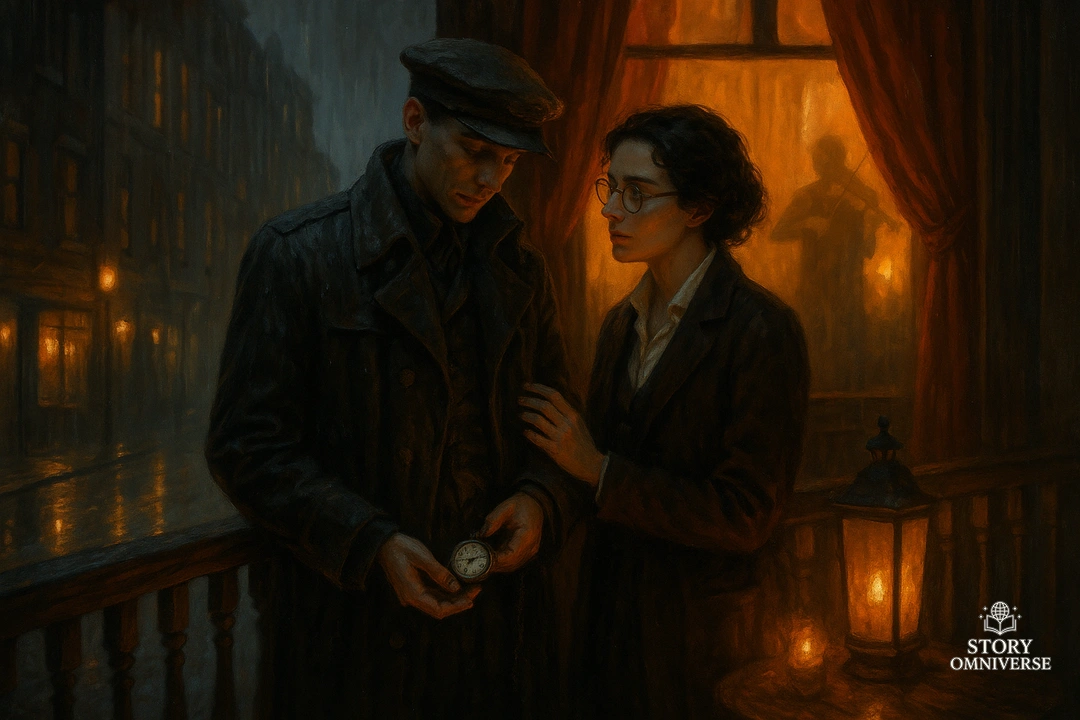
“I know,” I said, though I did not move. The balcony lanterns had just been lit. Their light spilled in soft circles on the floorboards beyond the open door, inviting and indifferent.
Then the front door opened.
Not a gust, not a dramatic entrance. Just the quiet click of the latch, as if the Café had decided to make room for one more line in the song.
A stranger stepped in, coat collar turned up, hair damp with night mist. They paused as if listening for permission. The room was nearly empty, chairs turned on tables, the last patrons long gone. Yet they walked with the calm certainty of someone who knew exactly where they were going.
To my table.
They pulled out the chair across from me and sat as if they belonged.
My cynicism flared on instinct, sharp and practiced. “We’re closed.”
Their eyes lifted to mine. Dark, steady, tired. “I know.”
“Then why are you here?”
They glanced toward the balcony, where lantern light softened the edges of everything. “Because the music didn’t end when it should have.”
“It ended,” I said, though the violin’s last note still seemed to hover near the ceiling.
They rested their hands on the table, ungloved. Their fingers were long, inkless, marked instead by faint scars that looked like old paper cuts. “May I sit just a moment? I won’t ask for anything.”
“You already have,” I replied, then regretted the bite in my voice. Elise looked over, eyebrow raised, but did not intervene.
The stranger’s mouth twitched, almost a smile. “You’re writing.”
“Copying,” I corrected. “From memory.”
“Then you understand,” they said softly. “Some things return when you don’t call them.”
I should have told them to leave. I should have closed the journal, gathered my coat, and walked out into the night with my heart intact.
Instead, I asked, “What’s your name?”
They hesitated, like someone stepping onto a familiar stage after years away. “Rowan.”
“Rowan,” I repeated, tasting the syllables. “I’m Adrian.”
Rowan nodded once, as if sealing a small pact. “Adrian. Thank you for letting me sit.”
“I haven’t,” I said, but my hand did not reach for the journal’s clasp. The candle between us flickered, and the Café did not object.
Chapter 2: Lyrics Between Us
Rowan’s presence changed the air. Not dramatically, not like a storm. More like a new instrument joining a melody, so quietly you only noticed when you realized you had been listening for it all along.
I dipped my quill again, pretending the page mattered more than the person across from me. “If you’re waiting for someone,” I said, “they’re not here.”
“I’m not waiting for someone,” Rowan replied. “I’m waiting for a moment.”
“That’s worse,” I muttered. “Moments are unreliable.”
Rowan’s gaze dropped to the journal. “You write songs down.”
“I study them,” I said. “Old lyrics. Old meanings.”
“Elise says you come after performances,” Rowan said, voice low, like they did not want the walls to overhear. “When the violinist has gone.”
“Elise talks too much.”
Rowan’s smile arrived fully this time, brief but real. “You don’t.”
I should have let that stand. Silence is safer than conversation. But the Café’s hush pressed close, and the candlelight made honesty feel like a lesser risk than usual.
“To fill the awkwardness,” I said, “I recite. It’s a habit.” I tapped the page. “Do you know this one?”
Rowan’s eyes lifted. “Try me.”
I leaned back, letting the words come as they always did, worn smooth by repetition. “Under lanterns, love speaks in borrowed light, and every promise is a thread pulled tight.”
Rowan did not blink. They answered immediately, but with a different emphasis, as if turning the lyric in their mouth until it showed a new face. “And every promise is a thread,” they said, “pulled tight.”
The pause after was small, but it held a weight that made my throat tighten.
“That line,” I said carefully, “is usually spoken as if the promise is beautiful.”
Rowan’s fingers traced a slow circle on the tabletop. “Threads can strangle,” they murmured. “Or they can keep you from falling.”
Somewhere in the back, a pianist tested a chord, the sound thin as a veil. It made Rowan’s words feel like something meant to be hidden.
“You changed it,” I said.
“I heard it differently,” Rowan replied. “Maybe because I’ve been away from lanterns.”
“Away where?” I asked before I could stop myself.
Rowan’s gaze flicked toward the window. Outside, the city was a blur of wet streetlamps and late-night footsteps. “Places where the light is harsher.”
That could have meant anything. Work. Travel. Trouble. I had learned not to pry. Curiosity is the first step toward caring, and caring is where people like me lose.
I kept my tone neutral. “If you know the song, you know the next verse.”
Rowan’s eyes returned to mine, steady again. “Say it.”
I did, though my voice softened without permission. “We trade our names like coins at dusk, and spend them on a hope we cannot trust.”
Rowan answered, and this time the emphasis made my chest ache. “We trade our names,” they said, “like coins at dusk.”
As if names were precious. As if spending them mattered.
The candle guttered, then steadied. Elise’s footsteps faded toward the back rooms, leaving us alone with the journal, the lingering music, and the strange sense that the lyrics were no longer about a song.
Rowan spoke first. “Do you believe the words you write down?”
“I believe they were true for someone,” I said.
“And for you?”
I looked at the ink on my fingers. “I believe in study.”
Rowan’s smile was quiet, almost sad. “Then let’s study,” they said, “what happens when a verse returns.”
Chapter 3: The Broken Pocket Watch
Rowan shifted in their chair, and something metallic slipped from their coat. It landed on the table with a soft, final sound, like punctuation.
A pocket watch.
The casing was scratched, the hinge slightly bent. The face was intact but spidered with a hairline crack. Its hands were fixed at a stubborn angle, refusing to move.
Rowan stared at it as if it had betrayed them. “I’m sorry.”
“It’s only a watch,” I said, though the stillness of it made my stomach tighten. “It’s stopped.”
Rowan’s thumb brushed the cracked glass. “It stopped a long time ago.”
I should have pushed it back across the table. Artifacts have stories, and stories have edges. But my fingers reached out before my caution could stop them.
“May I?” I asked.
Rowan hesitated, then nodded. “Be careful.”
The watch was heavier than I expected, warm from Rowan’s pocket. When I flipped it open, the scent of metal and old tobacco rose faintly, mixed with something like lavender that might have been soap. The hands pointed to a time that felt deliberate, as if it had chosen that moment to freeze.
“What happened to it?” I asked.
Rowan’s voice came out thin. “A fall. In a place where you learn quickly that time is not yours.”
I ran my thumb along the crack in the glass. “It could be repaired.”
Rowan let out a breath that sounded like a laugh without joy. “Everything can be repaired in theory.”
“That’s my profession,” I said before I could stop myself. “I restore texts. I mend pages, translate fragments. I make old things readable.”
Rowan’s gaze lifted. “And does it make them whole?”
The question landed too close to my own private doubts. I closed the watch gently. “Whole enough to be held.”
Rowan’s fingers touched mine as they took it back, a brief contact that sent a quiet shock through my hand. They did not pull away quickly. Their touch lingered like a note held just past comfort.
“You have ink on your skin,” Rowan said, and the observation felt intimate.
“It doesn’t come off,” I replied, too quickly.
Rowan’s mouth curved. “Some things don’t.”
The Café’s candlelight made the watch’s crack gleam like a fault line. My eyes kept returning to it. “Why carry a broken watch?”
Rowan’s shoulders lifted slightly, then fell. “Because it reminds me of the last time I thought I had a future that was simple.”
I swallowed. “And now?”
“Now,” Rowan said, “I measure time differently.”
“With what?” I asked.
Rowan looked at the journal, at the lines of lyrics I had copied. “With words,” they said. “With songs that survive when clocks do not.”
Outside, a carriage rolled past, wheels hissing on wet stone. Inside, the Café felt suspended, as if it too had stopped at a certain hour and refused to move on.
I slid the journal slightly toward Rowan. “Do you want to write something?” I asked, surprising myself.
Rowan’s eyes widened a fraction. “In your scholar’s book?”
“It belongs to the Café,” I corrected. “And it seems to have room.”
Rowan reached for the quill, then paused. Their hand hovered, trembling slightly. “I don’t know what to write.”
“Then speak,” I said, and my voice gentled despite my cynic’s armor. “Tell me what you remember.”
Rowan closed the watch and held it tight in their palm. “I remember,” they said, “a song I never finished.”
Chapter 4: Balcony Under Lantern Light
We drifted toward the balcony as if drawn by the lanterns. The door was already ajar, and the night air slid in, cool and damp, carrying the city’s distant restlessness. The lanterns hung in a row along the railing, their light softening every sharp thought.
Rowan stepped out first, hands on the wooden rail. Below, the street was quieter now, but not peaceful. Somewhere far off, a siren wailed, then cut short. A murmur of voices rose and fell like a tide.
I joined Rowan at the railing, careful not to stand too close. Delicate hesitation had become my posture, my way of keeping myself from falling into anything I could not control.
“It’s different out here,” Rowan said.
“It is,” I replied, and let the words stay simple. Rowan did not press. They only tilted their face up toward the lanterns. The light caught the planes of their cheekbones, the tired shadow under their eyes.
“It feels like borrowed time,” they murmured.
“It is,” I said, and the bluntness surprised me. “Everything after midnight is borrowed.”
Rowan’s gaze slid to mine. “Do you always speak like a man who expects to lose?”
I let out a short breath. “I speak like a man who has learned not to wager on miracles.”
“And yet you study songs,” Rowan said. “Songs are all miracles. Someone once felt something and refused to let it die.”
I looked away, toward the distant rooftops. “Songs are safer than people.”
Rowan’s laugh was quiet, almost tender. “Not tonight.”
A gust lifted the edge of Rowan’s coat. They pulled it tighter, and the motion revealed the watch chain at their vest, the broken watch tucked away again like a wound covered.
From inside the Café, a violin began again, not the full performance, just a musician lingering in the corner, playing to themselves. The melody floated out onto the balcony, thin but persistent.
Rowan’s shoulders eased as if the sound loosened something inside them. “That song,” they said, nodding toward the music, “it’s been on every street lately.”
“The city likes a refrain,” I said.
“The city likes rumors,” Rowan corrected. Their voice lowered. “Have you heard them? About conscription? About borders tightening?”
I had heard. Everyone had. The newspapers at the counter spoke in bold headlines, and the men at nearby tables spoke in quieter tones, counting names like debts.
“I’ve heard enough to keep me awake,” I said.
Rowan’s fingers tightened on the railing. “Then you know why I came in tonight.”
“To escape,” I guessed.
Rowan shook their head. “To remember what it feels like to be somewhere that isn’t preparing to break.”
The lantern light made their words look fragile. I wanted, unexpectedly, to offer something more than cynicism. But I had built my life on staying true to myself, to the version of Adrian who watched rather than joined, who studied rather than confessed.
“What do you want from me?” I asked, too direct.
Rowan turned fully toward me. “Nothing you don’t choose,” they said. “Only… don’t send me back into the street with nothing in my hands but a broken watch.”
The plea was quiet. It did not demand. It simply existed, like the violin’s note that refused to end.
I swallowed, feeling the old vow inside me crack, not with drama, but with a small, dangerous softness. “Then stay,” I said. “Until the lanterns burn lower.”
Rowan’s eyes held mine. “And after?”
I looked toward the city, where conflict brewed like a storm beyond the horizon. “After,” I admitted, “we will see what we are brave enough to do.”
Rowan nodded once, as if accepting a treaty. The violin’s melody curled around us, and for a moment the night felt almost gentle, as if our stolen time could be enough.
Chapter 5: A Scholar’s Footnotes, A Stranger’s Smile
Rowan did not vanish after that night, though I half expected them to. People who arrive during closing hours often feel like dreams. They dissolve with morning.
Instead, two evenings later, I found Rowan at the counter, speaking with Elise in a low voice. Elise glanced at me and smiled as if she had arranged this, as if coincidence could be deliberate in a place like the Velvet Quill Café.
Rowan held a folded paper, creased and worn. When they saw me, their expression shifted, cautious hope flickering like candle flames. “Adrian,” they said.
“Rowan,” I replied, and my voice betrayed how relieved I was.
Elise set down two cups of tea without being asked. Rose petals swirled at the surface, scenting the air with something soft and old-fashioned. A jazz program lay abandoned on the counter beside the evening paper, its headline half-hidden under a saucer. “Try not to scowl at each other,” Elise said, then left us with a knowing look.
Rowan sat across from me again, the same chair, as if the table had remembered them. They smoothed the folded paper with careful fingers. “I have something,” they said, “and I think you might help.”
I lifted an eyebrow. “You think I might enjoy being useful.”
Rowan’s smile answered. “I think you might enjoy pretending you don’t.”
They unfolded the paper. Lyrics, handwritten in a neat hand that slanted slightly, as if the writer had learned to keep their words compact. Some lines were crossed out. Others had notes in the margins, little stars and question marks.
“It’s in a dialect I don’t know well,” Rowan said. “My mother sang it. I remembered pieces. I wrote them down, but the meaning slips away.”
I took the paper, careful not to let my fingers brush theirs too long. The ink was faded in places, as if rewritten from memory. “This is old,” I murmured. “Where did you get it?”
Rowan watched my face closely. “From a lullaby,” they said. “And from a letter I never sent.”
I looked up. “A letter?”
Rowan’s gaze dropped to their cup. “It’s easier to hide truth in song.”
The line struck too close to my own habits. I cleared my throat and focused on the text. “This phrase here,” I said, pointing with the quill’s feathered end, “it can mean ‘stay’ or ‘return.’ The verb is… tender. It implies the speaker is waiting.”
Rowan leaned in. “Waiting like duty,” they asked, “or waiting like love?”
I hesitated. The scholar in me wanted precision. The man in me wanted to answer without armor. “Waiting like someone who has already chosen,” I said.
Rowan’s breath caught. Then they nodded, slow, as if a door had opened somewhere inside them. “That’s how it felt when she sang it,” they whispered.
We spent the next hour bent over the paper, our heads close enough that I could smell the faint soap on Rowan’s skin. Lavender, again. The Café’s music drifted around us, soft piano and occasional violin, the clink of cups marking time more kindly than any clock.
Rowan laughed once when I corrected a mistranslation. “You’re insufferable,” they said, fondness in the insult.
“And you’re reckless,” I replied, surprised by how easy it was.
Rowan’s eyes warmed. “Reckless is coming back,” they said. “I wasn’t sure you’d let me sit again.”
“I didn’t let you,” I said, then softened. “You sat.”
Rowan’s smile turned shy. “Then I’ll thank you,” they said, “by returning.”
And so they did.
Friendship formed in small rituals: shared tea, shared lines, and the quiet relief of being understood without being questioned. I began to look for Rowan’s coat at the door, to listen for their footsteps on the wooden floor. I told myself it was only habit.
But when Rowan’s fingers brushed mine as they took back their lyrics, I felt the truth humming under my skin, like music lingering after the last note.
Chapter 6: The War in the Margins
The war did not arrive all at once. It seeped in at the edges, like ink bleeding through paper.
One evening, a uniformed man sat at the table near the window, his cap on his knee, his gaze fixed on nothing. Another night, two women whispered over a newspaper, their hands trembling as they folded it away. Empty seats appeared and did not return, as if the Café had held places for people who were now elsewhere.
Rowan and I kept our rituals anyway. We met with deliberate coincidence, always around the same hour, always with the same careful politeness that had begun to feel like tenderness.
That night, Rowan was late.
I pretended I did not notice until the candle had burned down a finger’s length. When Rowan finally arrived, their coat was buttoned wrong, their hair wind-tossed, their eyes too bright.
“You’re rattled,” I said as they slid into the chair across from me.
Rowan exhaled. “I was at the office.”
“What office?” I asked, then caught myself. We had not spoken much of Rowan’s life beyond the Café. It had been an unspoken agreement, a way to keep the world from intruding.
Rowan did not rebuke me. They only reached into their coat and pulled out an envelope, unopened. A seal stamped on the back.
My stomach tightened. “Rowan…”
They placed it on the table between us. “It came today.”
I did not touch it. “Is it what I think it is?”
Rowan nodded once. “A summons. Not immediate. But soon.”
The Café’s music continued, a gentle waltz that felt suddenly cruel in its normalcy.
“You’re being called away,” I said, the words tasting like metal.
Rowan’s fingers curled around the broken pocket watch chain, as if anchoring themselves. “Yes.”
I forced myself to speak like the man I had always been, the cynic with clean boundaries. “Then you should go,” I said. “If it’s duty.”
Rowan’s gaze sharpened. “And if it’s not only duty?”
The question hung between us, trembling. I looked down at my ink-stained hands. Remaining true to oneself had always been my shield. I had built my identity on distance, on observation. Love had been a subject to be studied, not a risk to be taken.
“I don’t know what I am to you,” I said carefully, “and I don’t ask.”
Rowan’s laugh was short, pained. “You don’t ask because you’re afraid of the answer.”
I flinched. “I’m afraid of becoming someone I don’t recognize.”
Rowan leaned forward, voice low. “And who do you recognize now, Adrian? The man who recites lyrics to avoid speaking plainly? Or the man who waits for me at this table?”
The words struck with quiet accuracy. I had been waiting. I had felt my evenings bend around Rowan’s presence. I had begun to measure time by their arrival, not by my scholarly tasks.
Outside, distant shouting rose and fell, the city’s unrest threading through the night.
Rowan’s eyes softened. “I’m not asking you to promise anything,” they said. “I’m asking you to see me. Before I go somewhere that might change me.”
My throat tightened. “I see you,” I whispered, and it felt like stepping off a ledge.
Rowan’s hand moved across the table, stopping just short of mine. “Then say something true,” they urged.
I could not say I loved them. The words felt too large, too irreversible. But the crack in my old vow widened, and something tender slipped through.
“I don’t want you to go,” I admitted, barely audible.
Rowan’s eyes closed for a moment, as if savoring the sound. When they opened them again, they were shining. “That’s enough,” Rowan said softly. “For now.”
The waltz ended. For a heartbeat, silence filled the Café. Then a new song began, and in its first notes I heard the war pressing closer, waiting in the margins of our quiet, ready to tear the page.
Chapter 7: Distance Written in Refrains
Absence arrived like winter, sudden and complete.
Rowan’s last evening in the Café was quiet. No grand farewell, no dramatic declarations. We sat at our table while the lanterns on the balcony swayed slightly, though there was no wind. Rowan’s summons lay folded in their pocket, heavy as a stone.
“I’ll write,” Rowan said, fingers tight around their tea cup.
“I won’t expect it,” I lied.
Rowan’s smile was small, knowing. “You will,” they said. “And you’ll hate yourself for it.”
They were right.
The first letter came two weeks later, the envelope creased, the ink smudged as if it had traveled through too many hands. I opened it at my table in the Velvet Quill Café, the communal journal beside me like a witness.
Adrian, it began. No poetry. Just my name, written as if it mattered.
Rowan wrote of mud and noise, of days that blurred together, of comrades whose laughter sounded forced. They did not describe the worst. They skirted it with careful language, like someone stepping around broken glass.
At the bottom, Rowan added a single line, not in plain words but in lyric:
Under lanterns, love speaks in borrowed light.
My chest tightened. They had sent me our song, the one we began with, the one that had become a private bridge.
I answered that night, but I could not write plainly. I hated myself for it. I had always prided myself on being truthful, on being too sharp to indulge in sentiment. Yet when the pen hovered over the paper, my honesty tangled itself in fear.
If I wrote, I miss you, it would become real. If I wrote, I love you, it would become a promise I might not be allowed to keep.
So I wrote lyrics instead.
We trade our names like coins at dusk.
I added a footnote, scholar’s habit betraying my heart: Coin spent is coin remembered.
Weeks passed. Letters came irregularly, sometimes two in a row, sometimes none for long stretches that made my hands shake when I reached for the post. Each letter ended too soon, as if Rowan had been interrupted mid-sentence by something louder than paper.
In the Café, uniforms multiplied. Elise’s smile grew thinner. The violinist played more softly, as if afraid of being overheard by the wrong kind of ears.
One night, a man at the next table said, “They say the front is moving,” and his companion replied, “They say it always moves, until it moves over you.”
I kept my eyes on Rowan’s last letter, the ink faded at the edges. I wrote my reply anyway, hiding my longing in verses like contraband.
It is easier to hide truth in song, Rowan had said.
Yes, I thought bitterly. It is easier. And it is cowardice dressed as art.
Elise came by with tea and paused, looking at the stack of letters beside my cup. “You’re pale, Adrian,” she said gently.
“I’m fine,” I replied.
“You’re not,” she said. “But you’re here. That counts for something.”
Remaining true to oneself had been my guiding principle, and now I was unsure who that self even was. The cynic who claimed love was only study? Or the man who waited for a letter like it was oxygen?
I pressed my pen to paper again, writing the only confession I could manage:
And every promise is a thread pulled tight.
I sealed the envelope, fingers trembling. Outside, the city’s lights blurred in the rain. Inside, the Café held my unsent words in its velvet hush, and the music lingered after the last note, refusing to let me forget.
Chapter 8: The Watch That Will Not Start
The parcel arrived on a Tuesday, small and wrapped in brown paper that looked as if it had been handled too roughly. My name was written in a familiar hand, the letters slightly slanted.
For a long moment, I stared at it on my table in the Velvet Quill Café, as if looking too closely might make it disappear. Elise hovered nearby, pretending to wipe an already clean surface.
“Open it,” she said softly.
“I know,” I replied, though my fingers would not move.
The candle beside the communal journal flickered in a rhythm that felt too much like a heartbeat. Finally, I slid a knife under the twine and loosened it.
Inside was the broken pocket watch.
And a scrap of paper, folded once. Only one line, written in Rowan’s hand:
Keep time for me.
My throat tightened so sharply I had to set the watch down before my grip became a crush. The hands were still fixed at the same stubborn angle. The crack in the glass caught the candlelight, bright as a tear.
“Elise,” I said, voice rough, “do you know a watchmaker?”
Elise’s eyes softened. “On Briar Street,” she said. “But… Adrian, some things aren’t meant to be forced.”
“I can fix this,” I insisted, though the conviction sounded like pleading.
Elise touched my shoulder briefly, then withdrew. “If fixing it is how you pray,” she murmured, “then go.”
I took the watch to the watchmaker the next day. The shop smelled of oil and metal, nothing like the Café’s rose-steeped tea. The watchmaker, an older man with magnifying lenses, turned the watch over and over.
“It’s been dropped,” he said. “The balance staff is damaged. Possible to repair, but parts are scarce.”
“Do it anyway,” I said.
He looked at me. “It will take time.”
Time. The word felt like mockery.
When I returned to the Café that evening, the watch was not with me. My pocket felt too light. I sat at my table and opened the communal journal, intending to distract myself with lyrics, with scholarship, with anything that could be controlled.
But Rowan’s line kept repeating in my mind.
Keep time for me.
I wrote it in the margin of the journal, then crossed it out, then wrote it again more neatly, as if precision could make it less desperate.
A week passed. No letter from Rowan. Another week. The Café’s chairs filled with fewer familiar faces. A man at the counter cried into his coffee, shoulders shaking, while his friend stared straight ahead, jaw clenched. War had become a constant hum, like a note held too long.
When the watch finally returned from the shop, I opened the case with shaking hands. The watchmaker had polished the casing, replaced a small internal piece. It looked almost whole.
I wound it.
Nothing.
I wound it again, harder, as if force could command obedience.
Still nothing.
The watch would not start.
I sat at my table in the Velvet Quill Café and stared at the unmoving hands until my eyes burned. The failure became a mirror, cruel in its simplicity. Love, once lost to distance, does not come back. That was what I had always believed.
Elise approached quietly. “Did it work?” she asked.
I swallowed. “No.”
She set down a cup of tea without asking. “Then perhaps,” she said gently, “it isn’t meant to measure minutes. Perhaps it’s meant to measure you.”
I let out a shaky breath that was almost a laugh. “I’m a scholar,” I said. “I don’t want to be measured.”
Elise’s gaze held mine. “You already are,” she replied. “By what you wait for.”
I closed the watch and held it in my palm, heavy and silent. Somewhere inside the Café, a violin began a melody that sounded like our song, half-remembered, unfinished.
And I realized that my fear was not only of losing Rowan.
It was of discovering that I had already loved them, and that love had already changed the time inside me, whether the watch moved or not.
Chapter 9: A Return at Closing Hours
The night Rowan returned, the Café was nearly empty again. Chairs were being turned. Elise’s voice carried soft farewells. The balcony lanterns were lit, their glow spilling onto the floor like a path.
I sat at my table with the broken pocket watch in front of me, open to its unmoving face. The communal journal lay beside it, pages filled with other people’s stories, other people’s courage. My own ink stains looked darker than usual.
The door opened during closing hours.
I looked up so quickly my neck ached.
Rowan stepped inside.
They were thinner, their coat hanging looser on their frame. Their hair was cut shorter, their face sharpened by time and whatever it had demanded. But their eyes were the same, dark and steady, carrying a silence that did not explain itself.
For a heartbeat, I could not move. Memory surged up, bright and cruel, overlaying the present like a double exposure. The Rowan I had kept in my mind was warm with candlelight and tea. The Rowan in front of me wore the night like armor.
Rowan’s gaze found mine. “Adrian,” they said, voice hoarse.
I stood too quickly, chair scraping. “Rowan.”
Elise froze behind the counter, then quietly turned away, giving us the gift of privacy without making it obvious.
Rowan walked to my table, slower than before, as if testing whether the floor would hold. They did not sit immediately. Their eyes dropped to the watch. “You kept it,” they said.
“It came back to me,” I replied, and my voice sounded unfamiliar, stripped of its usual sharpness.
Rowan’s mouth tightened. “I sent it because I didn’t know what else to send.”
“You could have sent yourself,” I said, then regretted the accusation the moment it left my lips.
Rowan flinched, just slightly. “I tried,” they said quietly. “Not everything is decided by wanting.”
The Café’s music threaded through our pause, a soft piano line that seemed to tiptoe around us.
I forced myself to breathe. “Sit,” I said, gentler. “Please.”
Rowan sat, hands folded on the table. Up close, I could see faint bruising near their wrist, half-hidden by their cuff. I wanted to reach for them, to touch proof that they were real and here, but I kept my hands on my side of the table like a man obeying a rule.
We spoke as friends first, carefully.
“How long are you back?” I asked.
Rowan’s gaze drifted toward the balcony. “I don’t know,” they admitted. “Long enough to remember what quiet feels like.”
“And the war?” I asked, hating the word.
Rowan’s eyes darkened. “It’s still there,” they said. “Even when you come home, it follows.”
The present reality refused to match the hopeful version I had kept in memory. Rowan’s laughter was rarer. Their shoulders stayed tense, as if expecting a shout. When I asked about their letters, they looked away.
“I wrote when I could,” Rowan said.
“I know,” I replied, though the truth was I did not know. I had imagined Rowan safe enough to think of me. I had imagined my lyrics reaching them like lantern light.
Rowan’s fingers brushed the edge of the journal. “Are you still copying songs?” they asked.
“Yes,” I said, then added before I could stop myself, “and waiting.”
Rowan’s eyes lifted sharply. “For what?”
For you, I wanted to say. For the moment you walk back in. For a watch to start ticking. For a lyric to become plain speech.
Instead, I swallowed and said, “For the next line.”
Rowan’s expression softened, something old and familiar flickering through the exhaustion. “Then,” they murmured, “perhaps we should find it.”
Chapter 10: The Song Beneath the Words
We went to the balcony without discussing it, as if our feet remembered the path. Lantern light met us there, soft and forgiving, turning Rowan’s sharp edges gentler without erasing them. The city below was quieter than it had been months ago, but the quiet felt wary, like a pause between thunderclaps.
Rowan leaned on the railing, inhaling as if the air itself was a drink. I stood beside them, close enough to feel warmth through the fabric of their coat, not close enough to risk touching.
From inside the Café, the violin began again, the same song we had traded on our first night. The melody drifted out, thin and persistent, and something in Rowan’s shoulders loosened.
Rowan spoke first. “Do you remember the verse you recited?” they asked.
“I remember everything I’ve written down,” I said, then softened. “Yes.”
Rowan turned slightly, eyes on me. “Say it.”
My mouth went dry. Still, I gave the line, letting it fall into the lantern light. “Under lanterns, love speaks in borrowed light.”
Rowan answered, voice low, and the emphasis was different now, heavier with what they had lived. “Under lanterns,” they said, “love speaks in borrowed light.”
As if light itself was a gift that could be taken away.
I continued, because stopping felt like cowardice. “And every promise is a thread pulled tight.”
Rowan’s gaze dropped to their hands. “And every promise,” they echoed, “is a thread pulled tight.”
The violin held a note, then moved on. The music was a veil, but it did not hide us anymore. It only made the truth feel safer to approach.
Rowan swallowed. “I need to tell you something,” they said.
I nodded, unable to speak.
Rowan’s fingers gripped the railing until their knuckles paled. “The war took things,” they said, voice steady but strained. “Friends. Sleep. The ability to hear a door slam without flinching.” They let out a breath. “It took my certainty that I would come back the same.”
I wanted to reach out. I did not. My restraint felt suddenly like cruelty.
Rowan continued, eyes fixed on the street below. “But it did not take,” they said slowly, “the memory of this balcony. Or the taste of rose tea. Or the way you looked at me like I was a line in a song you couldn’t translate yet.”
My chest tightened. “Rowan…”
Rowan turned fully toward me then. Their eyes shone, not with tears, but with the effort of holding themselves together. “I carried your lyrics,” they confessed. “I read them when I couldn’t sleep. I hated you a little for hiding in metaphor,” they added, a faint smile flickering. “And I loved you for it too, because it sounded like you.”
The words struck deep, because they were true. I had hidden to remain true to who I claimed to be. But who had I been, really? A cynic performing distance. A scholar using footnotes as barricades. A man terrified of becoming someone who needed another person.
Yet I had needed Rowan. I had waited.
“I thought,” I admitted, voice rough, “that if I stayed myself, I would be safe.”
Rowan’s expression softened. “And are you safe?” they asked gently.
I looked at them under the lantern light, at the thinness, the silence, the stubbornness of their return. “No,” I said. “But I think I’m real.”
Rowan’s breath shivered. “Then tell me,” they whispered, “what’s beneath your words.”
The violin played on, and the music lingered in the spaces between us, urging me toward the line I had avoided for too long.
Chapter 11: After the Last Note
The balcony lanterns swayed slightly, though the night air was still. Their light fell across Rowan’s face in soft stripes, turning their exhaustion into something almost luminous. Inside, the violin’s melody thinned, as if the musician were listening too.
I held the broken pocket watch in my palm, having brought it out without thinking. Its hands remained fixed. Time, stubborn and silent. I closed it gently and slipped it back into my pocket, as if admitting that it had never been the real measure of anything.
Rowan watched me, waiting without pressing.
I drew in a breath that tasted of damp city air and rose tea drifting from inside. For once, I did not reach for quotation. I did not hide behind lyrics. I did not footnote my heart.
“Rowan,” I said, and my voice shook. “I have loved you.”
Rowan’s eyes widened slightly, as if the plainness of it was more dangerous than any metaphor.
“I have loved you,” I repeated, steadier now, “in every stolen moment. In every cup of tea. In every line I pretended was only study.” I swallowed hard. “Even when you were gone, even when I told myself love was a subject and not a choice. I stayed waiting, and I hated myself for it, because it meant I was not the man I performed.”
Rowan did not move. Their breath was audible, a quiet intake, a quiet release.
I stepped nearer, slow, giving them every chance to retreat. “I don’t know what you can offer,” I said, voice low. “I don’t know what the war has left you with. But I know what it left me with.”
Rowan’s gaze held mine, dark and unreadable. Their silence was not empty. It was full, like the pause after a final chord when the room cannot decide whether to applaud or weep.
“I don’t want to be brave in theory anymore,” I whispered. “I want to be brave in the only way that matters.”
Rowan’s throat bobbed. Their fingers lifted, hovering near my sleeve, then stopped short, trembling. They did not speak. They did not nod. They did not offer a neat answer that would make my confession feel safe.
They only stood, closing the small distance between us until I could feel the warmth of their body, the faint scent of lavender soap, the deeper scent of travel and cold nights. Their silence wrapped around my words, not rejecting them, not confirming them, simply holding them.
The violin inside the Café reached the end of the phrase and stopped.
The last note lingered anyway, as if the air refused to let it go.
Rowan’s breath brushed my cheek when they exhaled, and the softness of it felt like the closest thing to a reply I had ever deserved. I did not touch them. Not yet. I let the moment remain suspended, delicate as lantern light.
In the quiet, I understood that love was not always answered with words. Sometimes it was answered with presence. With staying. With silence that did not run away.
Closing Frame
When my tale ends, the candle before me has burned low, its flame a small, stubborn thing that makes the shadows kinder. The Velvet Quill Café feels fuller for having held it, as if the walls have leaned closer to catch every word and every pause.
The communal journal lies open where it always does, its pages thick with ink and longing. A pressed rose rests between them like a memory that refuses to fade, petals flattened but impossibly intact. My fingers, still stained with ink and tea, hover over the last line I wrote.
No one rushes to fill the quiet. They let it settle, the way we did on the balcony when confession met silence and neither of us broke.
I set the velvet quill down beside the open journal. The feathered tip points toward Rowan’s line, the one I copied from the scrap that came with the broken watch: Keep time for me.
Outside, the balcony lanterns still glow, soft circles of light against the night. Through the open door, I can see the railing where Rowan once leaned, where my own voice finally stopped hiding behind song. Somewhere in the Café’s depths, a violin begins again, gentle and unresolved, as if it never truly stopped.
Elise moves quietly among the tables, gathering cups, her steps careful not to disturb the lingering music. She glances at me, and there is a question in her eyes. I do not answer it. Not with words.
Because some confessions are answered in silence, and some silences are answers.
The candle’s flame dips, then steadies once more. The Café keeps the quiet the way it keeps everything that matters, as if silence were ink and love were the page it refuses to leave.

0 Comments