
🎙️
Listen to this episode
Chapter 1: Omega-Black Window
The Resonant Convergence Chamber always felt too clean for what it did. Basalt walls swallowed sound, and low-spectrum strips made every face look like it belonged to a sleepless stranger. Commander Elian Vos stood with his hands behind his back, still as a door guard, while Pulse Engineers called out numbers that were not supposed to be spoken outside Omega-Black.
“Primary confirmed,” an engineer said through a mask mic. “One one one zero zero zero one zero zero one zero one zero one one zero.”
“Harmonic confirmed,” another answered. “One one one one one zero zero one zero zero zero one one one zero zero.”
Nyra Del watched the readout like it was a living thing. Her pale eyes flicked between phase variance and timing jitter. “We have drift,” she said quietly.
Elian turned his head slightly, his partially deaf ear angled away from the room, his good ear toward her. “How much?”
“Point zero zero two six hertz, then it settles. That should not happen before buildup,” Nyra said. She did not sound afraid, which worried him more.
At Ops Command, UNSCOR auditors appeared on a wall screen, their faces boxed by clean office lighting that made Fort Resonance feel even more underground. One of them, Director Halden, leaned forward. “Commander Vos, your unit is cleared for a short window. We want confirmation that WLD-088 is viable and worth continued expenditure.”
Dr. Sera Lin stood beside her pack, sketchbook tucked into a chest pocket. “If the harmonic is pre-drifting,” she said, “it could be an echo condition. Something in the destination node is already answering.”
Corporal Jace Muran rolled his shoulders like he could shake the whole chamber off. “Or it is a sensor glitch. We go in, we set up, we come back. The grassland world, right? Low-risk.”
“Low-risk biome, extreme hazard index,” Nyra corrected, eyes still on the numbers. “Those are not the same.”
Elian looked at the chamber floor where dust never settled, because the air handlers never stopped. The mission badge on his chest held a resonance shard, their return promise, good for about seventy-two hours if the world did not chew it up. He felt the pressure that did not come from gravity, but from oversight.
On the screen, Director Halden tapped a pen. “The window closes in twelve minutes. Either you authorize, or we reassign the key to a team that will.”
Elian heard Sera inhale, a small sound, like she wanted to argue and knew it would not matter. He knew the politics, too, the way UNSCOR used urgency as a lever. Fort Resonance remained the only access point, and that made every mission feel like a vote on Earth’s right to touch the Leyweb at all.
Elian stepped to the authorization console and placed his palm on the reader. “TRU One deploys,” he said. “Nyra, you have tuning authority in-field. No hero corrections in the chamber. We go by protocol.”
Nyra’s jaw tightened. “Understood.”
Sera’s voice went softer. “If something is answering early, we keep our words careful.”
Jace gave a quick grin that did not reach his eyes. “I can do careful.”
The engineers began oscillation at seventeen hertz. The chamber’s hum rose from the floor into bone. At thirty seconds, vibration started, subtle but present, like a train that never arrived. At sixty, the air ionized, and the hair on Elian’s arms lifted. Nyra’s display flashed yellow, drift spikes like tiny wounds.
“Jitter within eight milliseconds,” an engineer called. “Hold steady.”
At ninety seconds, the 432 Hz chime rang out, clean and undeniable. Golden-cyan filaments braided in mid-air, a corridor shaped like a thought made visible.
Elian looked at his team. “Entry, now. We bring back data, not stories. And we do not feed anything we do not understand.”
Sera met his eyes and nodded once, as if she already heard something on the other side. Jace adjusted his pack straps. Nyra touched her ARK and checked the return shard seal, a ritual that looked like superstition until you had seen a corridor fail.
They stepped into the braid together, and the chamber’s sterile air vanished behind them, replaced by the quiet pressure of transit. Elian counted without speaking. He trusted numbers more than comfort. Behind his silence, one thought kept returning: if the node was already answering, it had learned before they arrived, and that meant the mission would test more than equipment.
Chapter 2: 432 Hz and Salt Air
Crossing always felt like stepping through a memory that did not belong to him. The corridor held its own silence, an evacuated wave-guide where even breath sounded distant. Then the far end opened into air that tasted of salt and wet leaves.
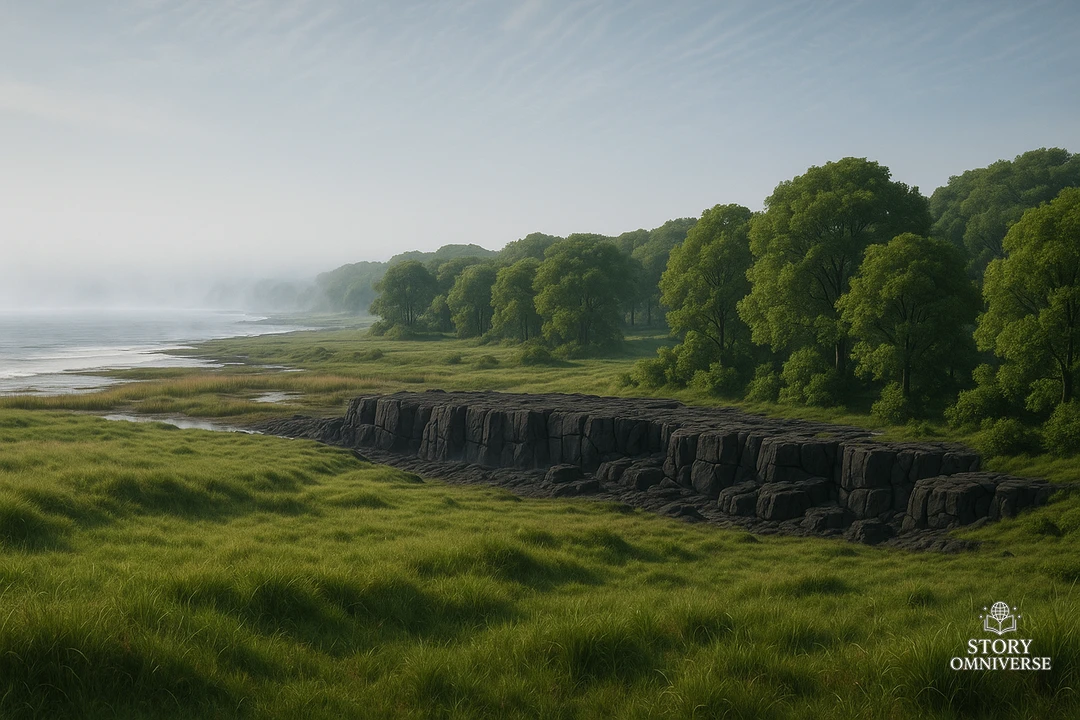
They emerged into Sunshade Rise under a sky that was too clear for coastal weather, until fog rolled in low and thin like smoke from a hidden sea. The light did not simply brighten and dim, it pulsed, rising and falling in a slow wave. Shadows beneath the grass seemed to breathe with it, swelling and shrinking like lungs.
Jace took off his helmet first, as always, like he needed proof he could. “Breathable,” he said, then laughed once, too loud. “Smells like a beach that got lost.”
Nyra raised her photo-adaptive goggles and watched the light rhythm. “Twenty-hour cycle, but not a normal sunrise. It is like a filter,” she murmured, half to herself. “Resonance-based solar modulation, maybe.”
Sera lifted a light-level dosimeter and held it under the broadleaf canopy nearby. “The canopy changes it. The shadows are not stable. They lag.”
Elian signaled them into procedure. “Base first. Low-profile. We do not assume friendly.”
They drove the all-terrain rover out of the corridor’s landing zone and into a shallow dip beside clustered trees. The grass was resilient, springy under boots, and the wind carried fine mist that left salt on their lips. They set boundary marker flags around a perimeter, not to claim it, but to know where they were when stress warped judgment.
Jace and Elian erected the wind-rated comm mast, anchoring it with stakes into soil that smelled rich and damp. Nyra deployed fog-penetrating beacons in a triangle, each one blinking a muted blue that would not carry far. Sera launched a canopy-rise drone that climbed through overlapping leaves, its camera feed showing a rolling plain broken by interlaced basalt flows, black ribbons cooled in overlapping patterns.
“Visibility is excellent,” Nyra said, checking the drone’s terrain overlay. “But route constraints are already showing. The mapping swarm is drawing preferred paths. That is strange for open grassland.”
Elian watched the horizon. In the distance, a line of cracked basalt ridges rose like a spine. Even from here, they looked wrong, as if the air around them bent slightly.
Sera noticed his gaze. “Those are the surface anomalies, tachyon-bent ridges,” she said. “Telemetry lag near them, per registry.”
As if on cue, the drone feed stuttered when it panned toward the ridges. The image doubled for a fraction of a second, then snapped back.
Nyra frowned. “That is not standard lag. That is a phase offset.”
Jace leaned closer to the tablet. “Looks like a glitch. Like the camera hiccupped.”
Sera’s voice dropped. “Or like the world blinked.”
Elian kept his tone even. “We log it. We do not chase it yet.”
They ran air composition checks, soil pH, and a quick wildlife scan. Burrowing rodent signatures popped up on the seismic ground microphone, faint scratching patterns under the grass. The atmosphere matched Earth closely enough that their rebreathers stayed clipped and unused, which made the place feel more intimate than a suit ever allowed.
At Fort Resonance, Ops Command came through the comms with a slight delay, but clean. “TRU One, telemetry received. Confirm base established.”
Elian keyed his mic. “Base established, comm mast up, beacons deployed. Noting telemetry phase lag near basalt ridges.”
Director Halden’s voice cut in, not a technician’s calm but an auditor’s impatience. “Your window is limited. We require confirmation of exploitable resources and any ley technology experimentation.”
Nyra muttered, not into the mic, “They want a prize.”
Elian answered professionally. “We will proceed along mapped safe routes. No boundary violations.”
Sera looked toward the ridges again. The pulsing light dipped, and the shadows under the canopy deepened, then rose like a slow breath. She spoke softly, almost as if addressing the air. “If this place remembers, we should speak as if it is listening.”
Jace gave her a sideways look. “You mean the locals?”
“I mean the node,” she replied.
Elian felt something he could not name, not fear exactly, more like standing near a sleeping animal and realizing it was awake. He set his jaw and checked their return-shard seals again, because it was easier than admitting the thought: if sound mattered here, then every routine call, every joke, every argument would become part of the terrain.
Chapter 3: Route Lines and Boundary Marks
By the second light pulse, the mapping drones had stitched together a net of suggested travel lanes that did not match terrain difficulty. The plains were easy, the slopes gentle, yet the swarm avoided certain open patches as if they were cliffs.
Nyra walked ahead of the rover, eyes scanning her overlay. “Route-constrained,” she said. “The algorithm is not deciding this. The drone swarm is responding to navigation distortion. Relic magnetosphere, flux zones, maybe. But it is patterned.”
Jace kicked at the grass where the overlay drew a red no-go line. “Patterned like what? Someone drew it?”
Elian motioned them to slow. “We treat every red line as a boundary until proven otherwise.”
They found the first cairn an hour later, a stack of flat stones set beside a basalt ribbon. The stones were not random. Each one had a smear of pale clay shaped like a crescent. At the base lay a bundle of dried reeds tied with fiber.
Sera crouched, careful not to touch. “Marking,” she said. “Territorial, as registry predicted.”
Nyra’s gaze stayed on the air above the cairn. “Also a flux node. The compass is drifting five degrees.”
The wind shifted, and a sound came with it, faint at first, then clear enough to raise hair on Elian’s neck. It was a human voice, almost. A soft “hello” shaped by breath, then repeated. The second time the pitch was slightly different, as if someone had heard it and tried to copy it.
Jace froze. “Did Ops just speak?”
Elian checked his comm unit. Silent. “No. Radio is quiet.”
The sound came again, “hello,” then a short whistle that matched the tone of their comm mast calibration ping from earlier. It traveled across the grass like a message carried by wind.
Sera’s eyes widened, not in panic, but in recognition. “Vocal mimicry,” she whispered. “The registry says their communication mode is mimicry. That could be locals. Or it could be wildlife that learned sounds.”
Nyra shook her head slightly. “Timing is wrong. It repeats in a fixed interval, like an echo. But the interval is not consistent with distance.”
Elian raised a hand. “No one answers. We observe.”
They moved along the safe route, keeping the cairn to their left. The breathing shadows made it hard to judge distance. When the light rose, the grass shimmered. When it fell, the world felt closer, like the air thickened.
A cluster of broadleaf trees formed a shaded corridor, and their drone feed improved under the canopy, then worsened when they stepped into open ground facing the basalt ridges. The ridges seemed to warp the air in subtle refraction, like heat haze without heat.
Sera walked beside Elian, her sketchbook open. She drew quick lines, then paused, listening. “It is not language,” she said quietly. “It is meaning built from borrowed sound. Like a child learning by repetition.”
Jace whispered, unable to help himself, “Creepy.”
Sera glanced at him. “It is not creepy if it is a people. It is only unfamiliar.”
Nyra stopped at another boundary marker, this one a line of stones laid across the grass, each stone painted with the same crescent. “They do not want us crossing,” she said. “But the safe route goes right up to it.”
Elian studied the line. Beyond it, the grass looked the same, but his instincts did not like the way the air felt, as if it pressed back. “We do not cross,” he decided. “We are guests, even if they do not know what we are.”
Ops Command crackled in, slight lag. “TRU One, UNSCOR requests you proceed toward industrial signatures. Dust scans indicate high-silicon particulates.”
Elian’s jaw tightened. “We are not violating local boundaries without cause.”
Director Halden’s voice came sharp. “Commander, you are authorized under Omega-Black. Boundaries are advisory.”
Nyra’s eyes flashed, rare emotion. “Advisory gets people killed.”
Elian keyed his mic, controlled. “We will investigate within safe routes. That is final.”
He clicked off and looked at his team. “Trust the map, trust each other,” he said. “And trust that the world does not care about our clearance.”
Sera listened again. The wind carried a new sound, a soft imitation of Elian’s earlier command, “No one answers,” but spoken with a different cadence, like someone practicing it.
Her throat tightened. “It is already learning us,” she said. This time, no one argued. Even Jace kept his mouth shut, as if silence might keep the world from getting better at being them.
Chapter 4: The First Red Herring
The silicon dust showed up as pale glitter in the grass, fine as flour. Jace scooped a pinch into a sample vial and held it up to the light pulse. It sparkled, then dulled as the light fell.
“High-silicon,” he said. “Like the registry hook. That screams industry. Glass, solar substrates, something.”
Nyra checked the particulate density on her tablet. “It is not uniform. It is drifting in lines, like it was poured.”
Elian looked at the direction of the drift lines. “It leads toward the river delta,” he said. “We follow, but we do not assume factory.”
Sera’s gaze stayed distant, unfocused in a way Elian recognized from other missions, when she listened to more than sound. “The dust is a story,” she murmured. “But we may be reading the wrong chapter.”
They moved along a firm path, then the ground softened, grass giving way to mud. The air grew wetter, thick with river smell. Ahead, the land opened into a delta where muddy water split into fingers and rejoined, carrying sediment in slow swirls. Reeds stood in clusters, and beyond them, a flat shoreline stretched toward a fog-hidden sea.
No smokestacks. No factories. No machinery. Only wind and water.
Jace stared, disappointed. “Where is the industry? The registry said early industrial, steam, cities.”
Nyra pointed to the far bank where the drones had marked another boundary line. “Settlements could be inland. This delta could be a resource route, not a factory site.”
Sera crouched near a drift of silicon dust piled against a reed cluster. “This looks placed,” she said. “But it could be wind trapped by vegetation. A natural red herring.”
Elian signaled for a drone sweep. The canopy-rise drone flew low over the delta, camera scanning for structures. The feed remained stable until the drone panned toward the basalt ridges visible even here, their cracked spine cutting across the horizon.
The image doubled.
For three heartbeats, the screen showed TRU One standing on the mud bank, and beside them, a second TRU One, half a step behind, slightly blurred, moving in the same way but delayed. Then the double image snapped back to one.
Jace’s grin vanished. “What the hell was that?”
Nyra’s fingers flew over controls, pulling time stamps. “Telemetry artifact,” she said, but her voice lacked conviction. “Tachyon refraction could cause a delay ghost.”
Sera swallowed. “It was too clean,” she said. “It was not random smear. It was us.”
Elian forced his focus to procedure. “No panic. We log, we verify. Nyra, run a temporal beacon flare?”
Nyra pulled a small cylinder from her kit and primed it. “Temporal beacon flare on my mark,” she said. She tossed it onto a flat stone. It ignited with a steady pulse of light, designed to anchor timing for nearby sensors.
The flare’s pulse reflected on the mud, and for a moment, Elian thought he saw a second reflection, slightly delayed. He blinked hard. The second reflection was gone.
Ops Command came through again, the lag slightly worse. “TRU One, we are seeing minor timing offsets in your feed. Confirm no corridor activity on your end.”
Elian answered, “No corridor activity. Visual anomaly observed, possible phase delay ghost. Continuing investigation.”
Director Halden cut in. “Retrieve samples. If there is a local industrial supply chain, we need proof.”
Jace muttered, “They want their dust.”
Sera looked at Elian, her eyes serious. “If the land can replay us,” she said softly, “then any signal we send might come back stronger. Like feedback.”
Nyra nodded once. “Echo-feedback loop is a known threat. But we have not triggered anything yet.”
Elian looked toward the ridges again. The breathing light dipped, and the shadows on the delta bank deepened, then rose. He felt the wrongness like a pressure behind his eyes.
“We pull back to firmer ground,” he ordered. “We do not linger in mud if we need to run.”
As they turned, the wind carried a sound from the reeds. It was not “hello” this time. It was the faint imitation of Jace’s earlier words, “Where is the industry?” repeated with a hollow cadence, like someone practicing disappointment.
Jace went pale. “It heard me.”
Sera closed her sketchbook with a careful hand, as if she could trap the sound inside. “It hears everything,” she said. “The question is what it does with it.”
Chapter 5: Miscalibration
Back at base, the fog thickened, rolling in from the unseen sea. The comm mast blinked steady, but the telemetry lag had increased by a fraction, enough that Nyra’s jaw stayed tight.
Elian stood watch while Nyra unpacked the Portable Field Relay. The PFR was a tripod buffer with a backpack power unit, designed to inject known pulse pairs into a latent node for short corridor openings. It was not supposed to be used casually. But Nyra had argued for a diagnostic.
“If the node is unstable,” she said, “we need to know before we get deeper. A short injection, just a handshake, no full braid.”
Sera watched from the edge of the setup area, arms wrapped around herself against the damp cold. “A handshake can still leave fingerprints,” she murmured.
Jace tried to lighten the mood. “We do a tiny pulse, the world says hi, we move on.”
Elian did not smile. “Nyra, you do it only if you can keep drift within tolerance. If it slips, you abort.”
Nyra’s fingers moved with precise calm over the manual tuning dials. Without Fort Resonance AI assistance, field tuning was a human art, and Nyra was the best Elian had seen. She keyed in the stored outbound pair, not to open a corridor, but to test echo-lock fidelity and local resonance response.
The PFR hummed, low and steady. The ground vibration returned, faint. The air tingled with static.
Nyra’s display showed oscillation at seventeen hertz. “Stable,” she said. “Jitter five milliseconds. Drift point zero zero one.”
Then the light pulse outside dipped, shadows deepening under the canopy, and Nyra’s display flickered. “No,” she whispered. “Drift spike, point zero zero three two.”
Elian stepped closer. “Abort.”
Nyra slapped the abort switch. The PFR’s hum cut off. Silence rushed in like water.
For a second, nothing happened. Then, from the direction of the basalt ridges, a faint tone rose, thin but clear. 432 Hz. The corridor chime, but distant, like it came from inside stone.
Jace’s mouth fell open. “We did not open anything.”
Sera’s face went very still. “Something opened a reply,” she said.
Nyra stared at her own hands as if they had betrayed her. “I aborted before ninety seconds. There should be no braid.”
Ops Command crackled, sharper now, alarm threaded through. “TRU One, Fort Resonance flagged an unauthorized injection attempt. Confirm status. You are approaching lockout thresholds if you repeat.”
Elian keyed his mic. “Diagnostic only, aborted due to drift. No corridor formed. We are hearing a remote 432 Hz response from local ridge direction.”
Director Halden’s voice was immediate, cold. “Commander Vos, you were instructed not to risk lattice lockout. Explain why your navigator initiated a pulse without prior UNSCOR approval.”
Nyra’s eyes flashed with anger and shame. “Because your approval would take longer than our survival window,” she said, but she did not key her mic. She let Elian be the shield.
Elian kept his tone flat. “We acted under mission safety protocol. No further injections will be performed without necessity.”
Sera stepped closer to Nyra, lowering her voice. “The ridge answered because the node is listening,” she said. “It may have stored the pattern from our arrival, or from the comm mast calibration. Your miscalibration gave it a cleaner sample to work with.”
Nyra swallowed hard. “I did not mean to.”
Jace shifted, restless. “So what now? We just do nothing and hope it stops?”
Elian looked at each of them. He could feel the trust lines tightening, the way stress made people search for someone to blame. “We do what we came for,” he said. “We gather data, we avoid feeding the anomaly. Radio discipline, minimal speech near ridges. Nyra, you do not touch the PFR again unless I order it.”
Nyra nodded, stiff. “Understood.”
Sera’s voice held a quiet sadness. “We already left a mark,” she said. “The question is whether we can leave without making it worse.”
Outside, the breathing shadows rose with the light pulse, and for a moment Elian thought he saw his own shadow move a fraction late, like it hesitated before obeying him. He did not mention it. He did not want the world to learn that fear had a sound, and he did not want his team to start doubting what their eyes reported.
Chapter 6: Villages at the Edge of the Canopy
They found the first village where the broadleaf canopy thickened, trees forming a natural roof over clustered huts made of woven reeds and timber. Smoke rose from low chimneys, and the smell of cooked grain mixed with salt air. The route-constrained map led them close, then stopped, as if the land itself refused to guide them further.
Elian signaled a halt. “We approach on foot,” he said. “No weapons raised. Jace, visible hands. Sera, you lead communication.”
Jace muttered, “My hands are always visible,” but he obeyed, unclipping his rifle and slinging it behind his back.
As they stepped into the village edge, a line of stones on the ground marked a boundary, crescents painted in pale clay. Children peeked from behind hut walls, their eyes wide. Adults emerged slowly, carrying farm tools that could become weapons. They were humanoid, similar in form to humans, but their skin tones carried a muted green-grey hue, and their hair was dark and coarse.
A man at the front raised a hand and made a sound that stopped Elian cold. It was the exact whistle of their comm mast calibration ping, repeated twice, then followed by a low hum that matched the PFR’s aborted cycle.
Sera’s breath caught. She stepped forward, palms open. “We did not mean harm,” she said, then paused, realizing words might be useless.
The man tilted his head, listening, then mimicked her last phrase, not in English, but in a rough approximation of tone and timing. “Mean harm,” he echoed, then pointed to the boundary stones and made a sharp clicking sound, repeated three times.
Nyra whispered, “He is telling us to stop.”
Elian nodded once, staying behind the line. He pointed to himself. “We are travelers,” he said slowly, then pointed to the ground and made a gentle downward motion, a universal sign of peace.
The man watched, then mimicked Elian’s phrase, “travelers,” with a different cadence. Another villager, a woman with a woven sash, stepped forward and made a sound like wind through reeds, then tapped her chest, then pointed to the sky where the light pulse was rising.
Sera’s eyes softened. “They are tying identity to cycles,” she said. “Path of renewal, belief system. The light rhythm is sacred.”
The woman repeated the wind sound, then made a sweeping gesture, like turning a wheel. Then she pointed toward the basalt ridges in the distance and made a harsh, broken version of the 432 Hz chime, like someone singing it off-key.
Jace shivered. “They know the tone.”
Elian felt a chill that was not from weather. “They have been hearing it,” he said. “Maybe for generations.”
Sera stepped closer to the boundary line and placed a small barter pack on the ground, then backed away. Inside were simple agro-tools and a hand-crank water purifier, things meant to be useful without revealing advanced tech. She spoke softly, even though she suspected words were only part of it. “A gift,” she said, then tapped her own chest, then the pack.
The man watched, then mimicked “gift” with a softer tone. He made a sound like a dove cooing, then repeated it while gesturing inward, not across the boundary, but parallel to it, as if offering a path that did not violate their line.
Nyra exhaled. “They will let us skirt the village, not enter.”
Elian nodded. “We accept. We do not push.”
As they moved along the offered path, Sera kept her gaze on the villagers’ faces. She saw fear there, yes, but also something else, a weary caution, like people who had learned the land could betray them.
A child mimicked Jace’s earlier laugh, perfectly, then looked startled when Jace turned. The child’s mother pulled them back, scolding in a string of borrowed sounds, including a sharp imitation of Elian’s command voice.
Sera’s stomach tightened. “They are collecting us,” she whispered.
Elian heard her, and for once his disciplined stillness cracked, a flicker of regret in his eyes. “Then we leave as little as possible,” he said. “No more than footprints.”
Behind them, the village wind carried a new mimicry, faint but clear, “travelers,” repeated like a prayer, like a warning, like a name the world might keep.
Chapter 7: Assembly of Echoes
The invitation came at dusk, if dusk was the right word for a light that did not set, but sank in a slow wave and made the grassland glow like it was underwater. A runner from the village approached along the boundary stones, stopping at the line. He made a sequence of sounds, borrowed from their earlier speech, then added something new, a rhythmic tapping on his chest and a gesture toward the inland hills.
Sera listened, eyes half-closed. “He is asking us to come,” she said. “To their assembly. Republican council, per registry.”
Nyra’s first instinct was refusal. “We do not know their motives.”
Elian weighed the risk. “We also do not know the anomaly’s scope. If they have been living with it, they may have data we cannot get from drones.” He looked at Jace. “No surprises.”
Jace gave a tight nod. “No jokes.”
They followed the runner along a route that felt chosen, not by them, but by the land. The assembly space was an open circle beneath tall trees, with benches carved from timber. Representatives sat in a ring, wearing sashes and clay crescents on their foreheads. In the center, a shallow basin held water that reflected the breathing light like a living mirror.
When TRU One stopped at the edge, the voices began, not in a language, but in a chorus of mimicry. A representative made the sound of rain, another answered with the creak of a door, another with a sharp imitation of the 432 Hz chime, broken into pieces. The timing carried meaning, and Sera felt it like music that almost made sense.
She stepped forward and spoke slowly. “We are here to listen,” she said, then waited.
A woman in the ring mimicked “listen” with a soft tone, then pointed to the basin. She made a sound like a footstep, then a second footstep, slightly delayed. Then she pointed to the shadows under the benches and made a low hum that matched the PFR’s aborted cycle.
Nyra’s skin prickled. “They are describing the delay ghosts,” she said.
Elian kept his face neutral. “How long has it been happening?” he asked, knowing Sera would translate in whatever way translation was possible.
Sera tried a different approach. She tapped her chest twice, then pointed to the basin, then made the delayed footstep sound herself, showing she understood. The representatives murmured, some mimicking her sounds back, approving.
A man in the ring stood and made a long sequence: the sound of a shovel striking stone, the hiss of steam, a factory whistle, then silence, then the 432 Hz chime, then laughter that sounded like Jace’s, but twisted, ending in a cough.
Jace’s face went tight. “That is me.”
Sera’s voice was quiet. “They are saying the problem grew when new sounds entered their world, industry, steam, and now us. The land is repeating people, half-step late, then vanishing. It frightens them.”
Ops Command cut into Elian’s earpiece, the lag now worse. “TRU One, UNSCOR requires you to document any local ley experimentation. If they are early industrial, they may be close to accidental node activation.”
Elian’s hand tightened on his mic. “We are in contact with local governance. We will proceed carefully.”
Director Halden’s voice came through, impatient. “Commander, you are not authorized to negotiate. Your mission is exploration and containment. Retrieve evidence, then extract.”
Nyra’s eyes darted to Elian, a silent question. How much did they obey? How much did they protect?
Elian looked at the assembly ring. These people did not know the Leyweb, did not know Earth’s politics, yet they lived with the consequences of a node that remembered. He felt the familiar weight of command, the way every decision cut something.
He spoke softly to his team, off-mic. “We do not escalate. We do not steal. We learn what we need to stop the loop, then we leave.”
Jace swallowed. “And UNSCOR?”
Elian’s storm-grey eyes hardened. “UNSCOR can write their reports. We are the ones standing here.”
Sera stepped closer to the basin and watched the water. For a moment, she saw her own reflection, then a second reflection, delayed. The second reflection smiled when she did not.
Her heart lurched. She forced her face still and stepped back.
The representatives began a new chorus, repeating “travelers” and “listen” in overlapping tones. Sera realized they were not only inviting help, they were testing trust. Would the strangers respect boundaries, or would they break the cycle that the path of renewal held sacred?
Elian unlatched a small data recorder from his belt and placed it on the ground, then backed away, offering transparency. “We will not hide,” he said.
The ring quieted, and in the silence, the breathing light dipped, shadows deepening. In that deepening, Elian heard a faint echo of his own voice, “We will not hide,” repeated half a step late, as if the world itself wanted to hold him to it.
Chapter 8: The Burrow Network
The rodent tunnels began near the basalt ribbons, small holes hidden in grass clumps. Their burrowing rodents were not dangerous, but their networks were extensive, and the seismic ground microphone picked up patterns like a living map beneath their feet.
Jace lay on his stomach, feeding the burrow camera probe into a hole with careful hands that did not match his usual blunt force. “Never thought I would be crawling after rats,” he whispered.
Elian answered in a whisper too, remembering Sera’s warning about feeding the loop. “They are engineers in their own way.”
Nyra monitored the probe’s feed. “Basalt seam below,” she said. “Interlaced flow, multi-era. There is a fracture zone, and the refraction field spikes there. That is our ridge source.”
Sera knelt beside the microphone, eyes closed, listening not to sound but to timing. “It is not just echo,” she said. “It is storage. Like the basalt holds vibrations and releases them when the light pulse shifts.”
The probe’s camera showed a narrow tunnel opening into a wider cavity where basalt walls glimmered with trace minerals. The image warped slightly, bending at the edges, as if the camera lens was being pulled.
Nyra’s voice tightened. “Telemetry lag is severe here. Tachyon-bent cracks align with the seam. The drone feed would be useless, but the probe’s cable gives us a physical link.”
Jace frowned. “So the world is a tape recorder?”
Sera opened her sketchbook and drew the basalt seam as a braid. “A tape recorder records passively,” she said. “This is more like a mirror that learns what it reflects. The echo is returning stronger each cycle. That is feedback.”
Elian thought of Fort Resonance, of the Omega-Black Pulse Index, of how clean the registry had to remain. “If it learns pulses,” he said, “it could start imitating our return key.”
Nyra looked up sharply. “It cannot generate the full time-salt. Replay protection should fail.”
“Should,” Elian repeated.
They followed the burrow network to a shallow sinkhole where the ground dipped, exposing basalt ribs like bones. The air felt colder here, and the breathing shadows were more pronounced, lagging in a way that made Elian’s stomach twist.
Sera stepped to the edge and spoke softly, a controlled phrase. “One, two, three.” She waited.
A second later, the sinkhole answered, faint but clear, “One, two, three,” repeated with the same cadence, but the last number was slightly stretched, like someone savoring it.
Jace flinched. “It is mocking us.”
Sera shook her head. “Not mocking. Practicing.”
Nyra set up a tachyon-buffered signal repeater, trying to stabilize their local comms. The repeater improved the drone feed by a small margin, but the echo in the air remained, as if the rock did not care about their equipment.
Elian forced himself to focus on the physical. He took a sediment corer and pulled a sample from the sinkhole edge. The basalt dust clung to the tool, high in silicon. “This is where the dust comes from,” he said. “Not industry. Natural grinding from stress and burrowing.”
Their earlier assumption, that silicon meant factories, fell away. The red herring stung because it had guided them toward the delta, toward the double image, toward feeding the loop with attention.
Sera’s face tightened with guilt. “We followed the wrong story,” she said.
Elian’s voice was steady but not unkind. “We correct. That is what field work is.”
Nyra traced the seam on her overlay. “The strongest refraction point is deeper. If we can dampen it, we can break the loop’s gain. But we cannot restructure the Leyweb. We can only change local conditions.”
Jace looked at the sinkhole and swallowed. “Change means collapse.”
Sera’s eyes flicked to the canopy line where the village lay beyond. “And collapse has a cost,” she said.
Elian looked at his team. Trust was not a feeling, he reminded himself, it was a series of choices under pressure. “We find the minimum intervention,” he said. “We do not fix the world, we fix our footprint in it.”
As the light pulse rose, the sinkhole’s shadow rose too, but a fraction late. In that delay, Elian felt the world watching them, not with eyes, but with memory. He wondered, briefly, whether memory was just another name for hunger.
Chapter 9: Trust Test, Live Fire
The feedback surge hit without warning, like a storm made of sound. They were halfway back to base when Elian’s comm unit crackled, and his own voice came through, calm and authoritative.
“Proceed to ridge,” the comm said, in Elian’s exact tone.
Elian froze. He had not spoken. He mouthed, Radio silence, but the damage was already in the air.
Jace’s comm lit up next, broadcasting Jace’s voice, laughing. “It is fine, it is fine,” the comm said, then followed with, “Set the charge.”
Jace’s hand flew to his pack where his containment charges were stored. His eyes went wide. “I did not say that.”
Nyra grabbed his wrist hard. “Do not move,” she hissed. “That is not a command.”
Sera’s face had gone pale, sweat beading at her hairline. “It is using our voices to create false confirmations,” she said. “Echo-feedback loop, now active.”
Ops Command broke in, delayed and layered with interference. “TRU One, confirm, confirm, confirm,” a technician said, but behind it, a second voice repeated “confirm” half a step late, like a chorus that was learning how to sound official.
Elian forced himself into control. He switched his comm to receive-only, then signaled with hand gestures. He pointed to his eyes, then to Nyra, then to the route line on her tablet. Manual navigation, no radio.
Nyra nodded, lips pressed tight. She whispered equations under her breath, then stopped, catching herself. Even whispers felt dangerous. She moved by sight, by instinct, by the subtle way the grass leaned with wind, as if the world could be read without speaking to it.
Jace’s breathing grew fast, panic rising. Elian saw it in his shoulders, the way Jace hated deep silence and now had to live in it. Elian stepped close and put two fingers on Jace’s forearm, a grounding touch. Jace swallowed and nodded, trying to match Elian’s calm.
Sera walked slightly apart, her gaze unfocused, listening. Elian caught her eye and mouthed, Are you hearing it?
Sera hesitated, then nodded, small. She mouthed back, Before the devices.
Nyra saw the exchange and her eyes narrowed. Suspicion flared, not cruel, but protective. If Sera was hearing it early, was she sensing, or was she being shaped? In a place that copied voices, even empathy could look like infiltration.
They reached base under fog. The comm mast blinked, then blinked again, slightly out of rhythm. The PFR in its case gave a faint haptic buzz, as if it wanted to be used.
Elian held up a hand, stopping them all. In the fog, a voice spoke, Sera’s voice, soft. “We already left a mark.”
Sera’s face twisted. She mouthed, I did say that, horror and resignation mixing.
The voice continued, “We can leave without making it worse,” but the last word came out wrong, stretched into “worse-er,” like a child testing grammar.
Jace’s eyes shone with fear. He mouthed, It is learning.
Nyra wrote on a small field slate, using a grease pencil. NO MORE VOICE. NO RADIO. HAND SIGNS ONLY. She held it up for them.
Elian nodded. He wrote back: TRUST PROCEDURE. TRUST EACH OTHER.
Sera took the slate and added, hands shaking slightly: TRUST SILENCE.
They moved like that for the next hour, communicating in gestures and written notes, the world around them filled with stolen voices that tried to lure them into mistakes. At one point, Jace’s comm played Nyra’s voice saying, “Pulse now,” and Nyra slammed her unit into the mud to shut it off.
In the quiet that followed, Elian felt the team’s trust shift. Not vanish, but strain. Nyra watched Sera with guarded eyes. Jace watched Elian, needing him to be unbreakable. Sera watched the shadows, as if she could see the loop’s shape in them.
Elian realized the loop was not only a hazard, it was a test. It turned their own signals into traps, and the only defense was trust that did not rely on sound.
Chapter 10: The Renewal Engine
They approached the basalt ridges at first light pulse, moving along the safest route Nyra could find without relying on corrupted telemetry. The fog thinned as they climbed, revealing cracks in the basalt that refracted space in subtle bends. When Elian looked straight at a crack, the edge of it seemed to slide sideways, as if the world could not decide where it was.
Nyra set down a localized flux compensator and adjusted it until her compass stabilized. She wrote on the slate: SOURCE AHEAD. HIGH GAIN ZONE.
Sera nodded and pointed to her ears, then to the ridge, then made a circular motion with her finger, indicating loop. She wrote: IT STORES EMOTION TOO. FEELS LIKE PRESSURE.
Jace’s jaw tightened. He wrote back: HOW DO YOU KNOW?
Sera hesitated, then wrote: I HEAR IT EARLY. LIKE DREAMS BEFORE WAKING.
Nyra’s eyes flicked up, sharp. She wrote: THAT IS NOT COMFORTING.
Elian stepped between them, placing the slate on a flat rock. He wrote in block letters: WE DO NOT ACCUSE. WE VERIFY.
They set instruments carefully. The shadow-pattern tracker showed a consistent lag of 0.7 seconds near the deepest crack. The seismic microphone picked up vibrations that matched their earlier comm mast calibration ping, stored and replayed. The tachyon-buffered repeater reduced telemetry lag slightly, but the echo in the air persisted, stronger now, as if the ridge was saturated with their presence.
Nyra pointed to a natural bowl in the basalt where cracks converged. The air above it shimmered. She mouthed without sound, “Engine.”
Sera crouched and placed her palm near the rock without touching. Her eyes filled with tears she did not wipe away. She wrote: IT WANTS TO COMPLETE US. HALF STEP LATE, THEN WHOLE.
Elian felt a cold anger, not at the world, but at the idea that their own return telemetry could be contaminated. If the loop synced with Fort Resonance diagnostics, it could inject false patterns into logs. Not a new pulse type, not a permanent change, but enough noise to make the Omega-Black Pulse Index unreliable. Earth’s only access point depended on clean keys and clean trust.
He keyed his comm briefly, risking it, but keeping it minimal. “Ops, this is Gravestone. We have identified a natural resonance trap in interlaced basalt, amplified by tachyon-bent cracks. It is replaying and strengthening signals, creating an echo-feedback loop. Risk of telemetry contamination increasing.”
The reply came layered with echoes. “Understood,” Ops said, then Elian’s own voice repeated, “Understood,” half a step late.
Elian shut the comm off. He wrote on the slate: RADIO DEAD.
Nyra wrote: MIS-CAL FED IT. MY FAULT.
Elian looked at her, then wrote: OURS. WE WERE HERE.
Jace wrote: SO WE BREAK ROCK?
Sera wrote: BREAKING IS NOT RENEWAL. BUT SOMETIMES IT IS THE ONLY WAY TO STOP ROT.
Nyra traced the crack network on her overlay and wrote: CONTROLLED COLLAPSE OF REACTIVE RIDGE. REDUCE REFRACTION, REDUCE GAIN. LOCAL FIX ONLY.
Elian nodded. The solution fit their constraints: no new tech, no Leyweb restructuring, only changing local geology to dampen the feedback. But it would have consequences. Rock fall could alter water flow, affect the delta, reach the villages.
He wrote: WE NEED LOCAL CONSENT. PROTECT HOMES.
Sera looked toward the canopy line and nodded, grief already present. “They will pay for our fix,” she whispered, then caught herself, realizing she had spoken aloud. The ridge answered instantly with her own words, “They will pay,” stretched into a sing-song.
Sera’s face crumpled. Elian placed a hand on her shoulder, steady. “Then we pay too,” he said, quietly, and this time he did not care if the world learned it. He cared that his team believed it.
Chapter 11: A Local Cost
They returned to the assembly with written slates and gestures, keeping their comm units off. The representatives watched them with wary eyes, already aware something had worsened. The basin water reflected delayed shadows now, rippling with movements that did not match the present.
Sera stepped forward and placed a sketch of the basalt seam on the ground, drawn in simple lines. She tapped the convergence point, then mimed an echo by clapping once, then clapping again a fraction late. The ring murmured, understanding the shape of the problem even if they did not name it.
Elian pointed toward the ridges and mimed a controlled collapse, hands coming together like closing a book, then flattening palms downward, indicating dampening. He pointed toward the village fields and made a protective circle gesture.
A representative stood and made a sound like a tree cracking, then followed it with the gentle cooing sound they used for renewal. He pointed to the basin, then to the sky pulse, then to the ground. Sera interpreted the rhythm. “They believe decay must be followed by restoration,” she said softly. “They will allow breaking if we help them renew after.”
Nyra wrote on a slate and held it up: WE WILL COLLAPSE ONE RIDGE. WATER MAY SHIFT. WE WILL BUILD CHANNELS. WE WILL HELP MOVE HOMES IF NEEDED.
The ring went quiet. Then the woman with the woven sash stepped forward and placed her hand over her heart, then mimicked Elian’s earlier phrase, “We will not hide,” in a careful tone. It was not perfect, but it was honest.
Consent, given in borrowed sound.
Back at the ridge, Jace prepared containment charges with hands that did not shake, but his eyes were wet. He whispered, “I hate this part,” then clamped his mouth shut and worked in silence, as if refusing to give the rock anything else to copy.
Elian checked placement, ensuring the blast would collapse the most reactive crack without triggering a wider slide. Nyra monitored the flux compensator and shadow-pattern tracker, watching for spike patterns that might signal imminent feedback surge. Sera stood with a temporal beacon flare ready, to anchor timing during detonation.
They evacuated to a safe distance, then Elian gave the hand sign. Jace triggered the charges.
The blast was not loud, muffled by basalt and fog, but the ground jumped under their boots. A section of ridge folded inward, cracks sealing under their own weight. Dust rose, silicon-rich, glittering in the breathing light. The air shimmered, then steadied. The delayed shadows snapped closer to real time.
For a moment, the world was quiet in a way that felt earned.
Then the river delta responded. A low rumble traveled through the ground, and Nyra’s overlay showed water pathways shifting. She spoke once, tight and necessary. “Sediment flow redirected. Floodplain will change.”
They ran, not in panic, but in urgency, toward the nearest village edge. The first signs were subtle: water rising in a channel that used to be shallow, mud slumping where it had held firm. Villagers were already moving, carrying bundles, their faces grim with a familiarity that made Elian’s chest ache. They had practiced this kind of loss, even if they did not know why it happened.
Elian and Jace waded into mud, placing boundary flags as markers for safer ground, using amphibious crawler tracks to haul supplies. Nyra and Sera worked with locals to dig a new channel, guiding water away from homes. The hand-crank purifier became a communal tool, not a gift but a bridge.
A hut near the boundary line tilted as mud gave way. A family pulled possessions out, their voices a chorus of mimicry, not panic words but shared sounds of effort and grief. Sera heard a child mimic the 432 Hz chime, softer now, as if it had lost its sharp edge.
By night pulse, one cluster of huts had been relocated to higher ground. The cost was visible, not catastrophic, but real. A field that had fed families was under water. A path was gone. The echo in the air had faded, but it was not gone. It lingered as a faint memory, like a scar.
Elian watched villagers rebuild and felt the pyrrhic weight settle in his chest. They had contained the loop, but they had changed lives to do it. The victory was local, and so was the damage.
Sera stood beside him, eyes tired. “Renewal always asks for something,” she said.
Elian nodded. “And now they will remember us as both,” he replied. “Help and harm.”
Chapter 12: Return, With a Scar
The return had to be clean. Nyra insisted on it, her face set with the kind of focus that came from guilt and responsibility braided together. They returned to base under a clearer sky, fog thinning, and the breathing shadows seemed calmer, their lag reduced to near normal.
Nyra unpacked the PFR with deliberate care. She wrote on the slate: RETURN ONLY. NO EXTRA TESTS. SILENCE DURING INJECTION.
Elian nodded and took each comm unit, switching them fully off, not just muted. He looked at Jace and Sera. “No speech,” he said quietly, then stopped, realizing he had broken their own rule. He held up a hand in apology, then pointed to his mouth and drew an X in the air.
Sera’s eyes softened. She touched her sketchbook, then closed it, as if sealing the world inside paper rather than sound.
Nyra began tuning. Her fingers moved slowly, correcting for harmonic drift by hand, keeping within ±0.003 Hz. The PFR hummed, and the familiar buildup returned, but this time the air did not answer from the ridges. No distant 432 Hz, no mocking echo. Only the PFR’s controlled oscillation.
At sixty seconds, the static rose. Elian felt it on his skin like a warning. He watched Nyra’s display. Drift point zero zero one eight. Jitter six milliseconds. Stable.
At ninety seconds, the 432 Hz chime rang out, clear, local, and theirs. The golden-cyan filaments braided into a corridor in the open air beside their comm mast. The braid shimmered, lens-warping space, but it held.
Elian gestured. Entry order. Jace first with the sample cases, then Sera, then Nyra, then Elian last.
Jace paused at the corridor edge and looked back toward the canopy line where the villages lay beyond sight. His mouth trembled as if he wanted to say goodbye, but he did not. He pressed two fingers to his forearm tattoo, a private ritual, then stepped into the corridor.
Sera followed, eyes fixed ahead, but her face carried grief. In the corridor’s silence, she could not hear the world, and that seemed to hurt in a different way, like leaving a conversation unfinished.
Nyra stepped in third, shoulders rigid. She carried the slate with her, the one that said TRUST SILENCE, as if it was evidence and confession both.
Elian stepped in last, turning just before crossing fully to look at the grassland one more time. The breathing light rose, and the shadows rose with it, almost in sync. Almost.
Back at Fort Resonance, the chamber’s sterile air hit like a wall. Ops Command swarmed them with scanners and decontamination, and UNSCOR auditors waited with ready words.
Director Halden met Elian outside the chamber, face hard. “Your navigator initiated an unauthorized injection,” he said. “You altered local geology without UNSCOR directive. This will be documented as procedural failure.”
Elian’s scarred cheek twitched. “Document it,” he said. “We prevented an echo-feedback loop from poisoning our telemetry and risking broader operational lockout. We extracted clean.”
Halden’s eyes narrowed. “At the cost of local displacement.”
Sera spoke, voice steady despite exhaustion. “Yes,” she said. “And we helped them relocate. We did not erase the cost. We carried it.”
Nyra looked down, then up, meeting Elian’s gaze. “Zanthureth is unstable,” she said. “Not in biome, in memory. The key should be sealed as used and monitored. No casual returns.”
Ops Command, quieter now, relayed Omega-Black leadership’s decision. The Zanthureth pulse pair would be marked “used and unstable,” access restricted. Data would be scrubbed for echo contamination. The Omega-Black Pulse Index would remain intact, but with a new warning: the Leyweb did not only connect, it remembered, and memory could bite.
In the Softwake Chamber later, under artificial forest light, Jace finally spoke. “We did not win,” he said.
Elian sat with his hands clasped, listening to the simulated wind. “We contained,” he replied. “Sometimes that is all.”
Sera opened her sketchbook and looked at the last page, where she had drawn a shadow half a step behind a person. “Observation without full understanding,” she said, almost to herself. “That is what this work is.”
Nyra’s voice was quiet. “And trust,” she added. “Not because we are sure, but because we are not.”
Elian stared at the chamber wall, feeling the scar of the mission settle into him. “Fort Resonance stays the only door,” he said. “We do not get to pretend the worlds behind it are empty rooms. They are places that keep receipts.”
Outside, deep under Antarctic ice, the Resonant Convergence Chamber waited, silent and patient, for the next key, the next world, and the next lesson paid for in something that could not be fully returned.

0 Comments