
The lantern comes to me warm, though my hands are cold. I keep my voice low, the way you do when you do not want to wake what is sleeping nearby.
“I once heard this from a soldier,” I tell them, and the circle does not shift, does not cough, does not ask which war. “He came home wrong. He told it at first like a drunken ramble, with laughter that kept catching in his throat. Then, as the bottle emptied, it turned into something else. A confession that finally found its words.”
Someone across from me leans in. The lanternlight makes their shadow stretch. It should not stretch that far.
So I speak softer.
Chapter 1: The Missing Road
“I don’t remember how I got there.”
That was how he began, knuckles white around a tin cup, gin shining on his lower lip. He had soldier’s hands, the kind that learn to close around pain and keep it. He said he woke with grit in his mouth, as if he had been chewing cinders in his sleep.
He was on a road he did not recognize, though he swore it was meant to be the road home. He had been walking since before dusk, he thought. Or riding. He corrected himself twice, then laughed like it was a joke, but his eyes stayed fixed on something only he could see. The air smelled of wet coal and old rain. His coat was buttoned wrong. His canteen was light. His head rang with that hollow bell you get after too much drink and too little rest.
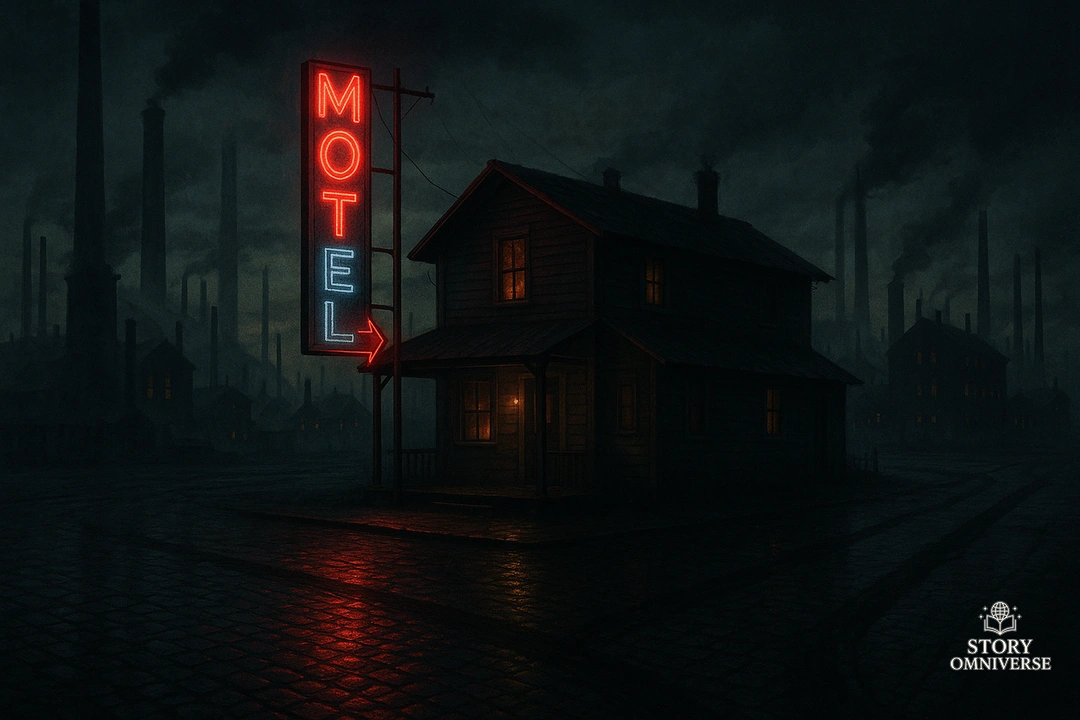
Ahead sat a roadside motel.
Not an inn, not a tavern with a stable, not a boarding house with a sign painted by hand. A motel, he called it, and he said the word like it was borrowed from someone else’s mouth. The building was long and low, boards painted a sickly cream that looked gray in the dusk. A covered walk ran along the front, doors marching in a line like soldiers who had forgotten why they were standing.
And above it, fixed to a tall post, was a sign.
He said it was glass tubing, glowing in loops and angles, blinking red and blue. Neon, he called it, but he did not know why he knew that word. Not in the 1860s, not on a country road where the only light should have been lamp and moon. He had seen mills and furnaces and the new ironworks that made night look like day, but this was not that. This was clean light, cold light, light without flame.
The sign blinked like a tired eye trying to stay open.
He stood in the road, swaying slightly. “It weren’t right,” he told me, and then he laughed, a small embarrassed sound. “I told myself it was the gin. I told myself I’d been hit too hard in the head over there.”
He looked down, and his shadow lay on the dirt like spilled ink.
Then it moved.
Not away from the light, but toward the motel, stretching long and eager, as if pulled by a hand he could not see. He took a step back, and the shadow did not shorten enough.
“You see it?” he asked the men around the table, as if they had been there too.
One of them, a dockworker with a scarred chin, muttered, “Just tell it.”
The soldier swallowed. “I walked to it anyway,” he said. “Because I didn’t know any other direction to walk.”
Chapter 2: Check-In Without Names
The lobby door stuck for a moment, then gave with a sigh like a person resigning themselves. Inside, warmth hit him, thick with damp wool drying too slowly and coal smoke that had settled into the wood. A lamp on the counter burned low behind cloudy glass.
There were chairs along the wall, their upholstery worn shiny by restless bodies. A rack of pamphlets that looked too clean, edges sharp as if they had never been thumbed. A bell on the counter that did not ring when he pressed it, only clicked faintly, as if it had forgotten its purpose.
And over all of it, threading through the smoke and wet fabric, was a sweet perfume.
Not the sharp bite of spirits. Not the medicinal stink of camphor. Something floral and pale, like crushed petals left in a pocket. It had no source. He leaned toward the counter, sniffed like a fool, and the scent retreated, then returned in a slow wave.
A clerk emerged from a back room. Thin man, hair oiled flat, sleeves rolled. His eyes did not settle on the soldier’s face so much as the space beside it, as if he expected someone else to step in.
“Room?” the clerk asked.
The soldier set a coin down. “Just the night,” he said. “And I need to send a wire. Let my people know I’m close.”
The clerk’s mouth tightened as if the word wire tasted wrong. He slid a ledger forward and a pen. The soldier bent to write his name and found the clerk’s hand on the page, not stopping him with force, only with insistence.
“No names,” the clerk said.
“What?” the soldier asked. He was tired enough that anger came slow.
The clerk drew a single line in the ledger, a mark without letters. “Here,” he said. “That’s you.”
“That’s not me,” the soldier replied. “My name is…”
The clerk’s eyes lifted, and for the first time they focused, sharp as a pin. “No names,” he repeated, softer. “Not here.”
Behind the soldier, someone cleared their throat. A woman in traveling clothes sat stiff in one of the chairs, gloved hands in her lap. She watched him like she had been waiting for him to make a mistake.
“You should take the room,” she said. “There’s nowhere else.”
He turned toward the door, toward the road. Through the lobby window he saw only dark. No carriage lanterns. No hoofbeats. No distant town glow. And when he looked for telegraph wires, he found none. No poles. No sagging lines. Just empty air above the road.
He faced the clerk again. “Where am I?”
The clerk tapped the ledger line. “Checked in,” he said, as if that answered everything.
The soldier took the key offered to him, a plain brass thing with a tag. His fingers brushed the clerk’s, and he felt cold, like touching metal left out overnight.
As he walked down the corridor, he realized something else. The motel was full, but it was quiet in the way a room is quiet when everyone is pretending to sleep.
Chapter 3: The Power Goes Out
Supper was served in a narrow dining room with long tables and benches. The soldier sat near the end, close to the wall, because old habits die hard. A pot of stew steamed in the center, and the smell was decent enough to make his stomach ache with want.
Across from him, the gloved woman ate carefully, eyes down. Beside her, a broad-shouldered man with a miner’s cough drank coffee like it might fight back. A family sat farther down, mother shushing a child who kept trying to hum.
The clerk moved among them with a practiced dullness, setting bread, refilling tin cups. No one spoke above a murmur. The soldier tried.
“Road’s empty,” he said to the miner. “No traffic at all.”
The miner’s spoon paused. “Ain’t been any,” he replied.
“That can’t be,” the soldier said. “There’s always someone. A wagon. A rider.”
The miner looked past him, toward the windows. “Not tonight.”
The soldier swallowed stew that tasted faintly of iron. He was about to ask again when the lamps dimmed.
It was subtle at first, like a tired eye blinking. The light thinned. Shadows on the walls lengthened, reaching across plates and hands. The child’s humming stopped.
Then the lamps died.
Darkness fell in a soft rush. Someone cursed. A chair scraped back. The soldier heard the clink of a spoon dropped, then the thin, fast breathing of people who had been holding their breath without knowing it.
From the kitchen, the clerk’s voice came, too calm. “Stay seated.”
A match flared. Candlelight wavered, throwing the room into a trembling amber. Faces looked wrong in it, too hollow, too near. The soldier’s own hands looked like they belonged to someone else.
“What happened?” the gloved woman asked, her voice tight.
“Power’s out,” the miner said, as if stating a fact could make it manageable.
The soldier frowned. “Power?”
The clerk returned with a candle in each hand. “The generator,” he said. “New thing. In the shed.”
“You mean a steam engine?” the soldier asked.
The clerk’s eyes flicked to him. “Generator,” he repeated, and the word landed heavy.
A man at the far end stood, anger making him brave. “Then start it.”
The clerk’s mouth twitched. “Tried,” he said. “Coughed once. Won’t take.”
In the sudden hush that followed, the soldier heard it.
Not the wind. Not settling wood. A soft scuttle in the walls, organized, paced. Many feet keeping the same rhythm, like a drill. It ran behind the plaster, along the corridor, and paused, as if listening.
The soldier leaned back, spine prickling. “You hear that?” he asked, too loudly.
The miner’s eyes widened. “Rats,” he whispered.
But the sound did not feel like rats. It felt like something counting.
Chapter 4: The Rusted Key
His room smelled of dust and damp linen. The candle he carried from the dining room made the wallpaper’s pattern swim. Flowers, faded to bruised colors, climbed the walls in repeating vines. His bed sagged in the middle like it had been slept in by too many tired bodies.
He shut the door and leaned his forehead against it. The gin in his blood made the dark friendly, but the scuttling in the walls kept time with his heartbeat.
He turned toward the washstand to splash water on his face. The basin held cold water that looked almost black in candlelight. A cracked mirror hung above it, reflecting his face in broken pieces.
On the washstand lay a key.
Not the motel key with its tag. This one was rusted, old iron, rough with pitting. Its teeth were strange, asymmetrical, like a jaw that had healed wrong. It sat on the wood as if it belonged there, as if his eyes had always been meant to find it.
He picked it up. Rust flaked onto his thumb.
“What are you?” he whispered, because war teaches you to speak to objects when there is no one safer to speak to.
He tried it in the washstand drawer. No fit. He tried the trunk at the foot of the bed. Locked, but the key did not match. He tried the door. Wrong size.
Useless.
He should have dropped it. Left it where it lay. Instead he slipped it into his pocket with the same reflex that made him keep broken buttons and spent cartridges. Useless things could still be proof of something later. Useless things could be traded. Useless things could be held when your hands needed to hold.
He sat on the edge of the bed and watched his shadow on the wallpaper.
The candle sat on the washstand behind him, and his shadow stretched forward, long and thin. It reached across the flowered vines like a black finger. When he moved his hand, the shadow moved too, but it lagged a breath behind, as if reluctant.
He stood, and the shadow stood. He took a step, and the shadow slid farther than it should have, eager to get ahead of him.
“Stop,” he told it, and then he laughed at himself, a dry sound. “Look at you,” he muttered. “Talking to your own shadow.”
There was a knock at the door.
He froze. “Who is it?”
The clerk’s voice came through the wood. “Candles are rationed,” he said. “Don’t let it burn down.”
The soldier swallowed. “What about the power?”
Silence for a moment. Then, softly, “Don’t go wandering.”
Footsteps retreated. The soldier listened until they faded, until only the organized scuttle remained, moving in the walls like a patrol.
He lay down without undressing, hand in his pocket around the rusted key, and waited for sleep to make sense of it.
Chapter 5: Vermin With Manners
He did not sleep so much as drift, waking in fragments. Each time his eyes opened, the candle had burned lower. Each time he listened, the scuttle had shifted, as if circling the building.
At some point, a sound in the corridor pulled him fully awake. Not a shout. Not a fight. A soft tapping, like tiny nails on wood.
He rose, unlatched the door, and opened it a crack.
Rats stood in the hallway.
Not one or two. A line of them, bodies low, whiskers twitching. They were not frantic. They did not scatter from the thin light spilling out. They paused, heads angled as if listening to a command too quiet for him to hear.
The soldier’s stomach clenched. He had seen rats in trenches, bold as thieves. These were different. They held themselves like soldiers.
One rat stepped forward, then another, and the line began to move. Not a scramble, not a chaotic rush. A clean procession down the corridor, hugging the wall, turning corners with a discipline that made his skin crawl.
He should have shut the door. He should have woken someone. Instead he followed, barefoot, candle in hand, coat hanging off him like a second shadow.
Half drunk, he told me. Half ashamed, because he knew curiosity was what got men killed.
The rats led him past closed doors. He heard murmurs behind some of them, the low talk of sleepless guests. No one opened their door. No one asked what he was doing.
As he walked, the sweet perfume returned.
It came in slow waves, stronger near certain doorways, weaker near others. He lifted his nose like a dog, hating himself for it, and still he did it. The scent did not cling to cloth or wood. It moved like a presence passing close by, unseen.
“Who’s there?” he whispered into the corridor.
A door latch clicked somewhere, then stopped. A woman’s voice, the gloved one, thin with warning. “Go back to bed,” she said.
“There are rats,” he replied, as if she could not see.
“I know,” she said. “That’s why you should go back.”
The rats reached the end of the corridor and paused at a stairwell leading down. They gathered there, bodies pressed close, forming a dark knot. Then, as one, they turned their heads toward him.
He stopped. Candlelight shook in his hand.
For a moment, he thought they were looking at him with something like expectation.
Then they moved again, not down the stairs, but away, flowing back along the hall in their neat line, as if the stairs were a boundary they would not cross.
The perfume swelled near the stairwell, almost chokingly sweet.
He backed away, heart thudding. “All right,” he whispered. “All right.”
Behind him, his shadow on the wall stretched toward the stairs, longer than his body, reaching as if it wanted what the rats refused.
Chapter 6: Accusations in Candlelight
Morning did not come cleanly. The motel stayed dim, as if the sun outside had forgotten this place. Candles burned everywhere, stubby and smoking. The air tasted of wax and old stew.
In the lobby, guests gathered with the restless anger of people trapped together. The clerk stood behind the counter, hands folded, face blank. The miner coughed into a rag. The gloved woman kept to the edge, watching.
A man with a stiff collar, the sort who looked like he belonged behind a desk, slammed his palm down. “This is madness,” he said. “No lamps. No wire. No road traffic. And vermin in the walls.”
The clerk’s voice stayed level. “We will have the generator running by nightfall.”
“You said that last night,” the desk man snapped.
The soldier leaned against a wall, feeling the rusted key heavy in his pocket. He had not told anyone about it. He did not know why. It felt like admitting he had touched something he should not have.
The miner pointed a thick finger at the soldier. “He’s the stranger,” he said. “Came in right before it all went dark.”
The soldier straightened. “That’s not proof.”
“It’s enough,” the desk man replied. “Soldiers are used to sabotage. Used to breaking things and calling it necessity.”
The soldier’s jaw tightened. “I fought where I was told.”
“And now you’re here,” someone else muttered.
The gloved woman spoke, calm but sharp. “We don’t know anything. Accusing him is convenient.”
The desk man turned on her. “And what would you suggest? We sit and wait while rats crawl over our beds?”
The soldier tried to keep his voice steady. “I didn’t touch your machine. I didn’t even know you had one until the lamps died.”
The clerk’s eyes flicked to him. “You asked about the wire,” the clerk said softly.
“So?” the soldier demanded. “I wanted to tell my family I was near.”
A low murmur rose. The desk man leaned forward. “What family?” he asked. “You won’t even give your name.”
The soldier blinked. “I tried. Your clerk wouldn’t write it.”
All eyes turned to the clerk. The clerk did not deny it. He only said, “We do not take names.”
“That’s nonsense,” the desk man said.
The soldier felt the room tilt. Candlelight made everyone’s shadows climb the walls. His own shadow reached toward the counter, long-armed, as if it wanted to grab the ledger and write itself in.
“I can prove I’m not lying,” the soldier said, but he heard how it sounded. Too quick. Too desperate.
The miner stepped closer. “Prove it then,” he said.
The soldier looked from face to face and saw only suspicion. In the thin light, every movement he made looked furtive. Even standing still, his shadow kept shifting, as if it could not settle into innocence.
“I’ll find your shed,” he said. “I’ll look at your generator. I’ll show you.”
The clerk’s mouth tightened. “Don’t,” he said, barely audible.
But the desk man snapped, “Let him. If he’s guilty, he’ll show it.”
And so the soldier walked out with them watching, feeling already condemned.
Chapter 7: The Town That Won’t Answer
Outside, the air was colder than it should have been. The motel’s neon sign still blinked, though the lamps inside were dead. Red, blue, red, blue. Like a pulse that did not belong to anything living.
The soldier squinted up at it. “How is that lit?” he murmured.
The miner, standing beside him, spat into the dirt. “Don’t ask,” he said. “Makes your head hurt.”
The shed sat behind the motel, a squat building with a padlock. The clerk opened it with a key from his belt, hands steady. Inside, the generator was a jumble of iron and piping, smelling of oil and soot. It looked like a steam engine’s cousin, wrong in small ways that made the soldier’s eyes slide off it. Too smooth here, too sharp there, as if it had been built by someone who knew machines but did not care for men.
The desk man pointed. “Start it.”
The clerk pulled a lever. The machine coughed once, exactly as described, then fell silent. The clerk tried again. Nothing.
The soldier stepped closer. “Let me see,” he said, and the miner grabbed his sleeve.
“Don’t,” the miner warned.
The soldier shrugged him off. He bent to inspect the piping. No obvious break. No cut line. No sabotage he could see. Only a fine dust on the floor, like pepper, gathered near the wall.
He straightened and looked beyond the shed.
Behind the motel, tucked where the road should have continued into open land, was a town.
Not a bustling mill town with smoke and noise, but a silent one. Mills stood with their wheels still. Chimneys rose like dead fingers, no smoke, no heat shimmer. Windows were dark. Doors shut. The street lay empty, cobbles wet and shining.
“No one said there was a town,” the soldier whispered.
The clerk’s voice came from behind him. “There was,” he said.
“Then why is it dead?” the desk man demanded, stepping out of the shed to look. His anger faltered at the sight. “Where are the people?”
No bells rang. No dogs barked. No cart wheels creaked. The silence was not peaceful. It was held, like a breath.
The soldier took a step toward the town. His boots crunched on gravel. He took another.
Along the gutter, something moved.
Rats. Dozens, then hundreds, flowing like a dark ribbon along the edge of the street. They moved together, turning in unison, stopping in unison. A swarm acting as one mind.
The soldier’s foot hovered over the next step. The rats shifted, forming a thicker line across the way, not attacking, not baring teeth, simply occupying the space.
“They’re blocking you,” the gloved woman said behind him. She had followed without him noticing. Her perfume, that sweet lingering scent, brushed his senses and then pulled away.
The soldier swallowed. “Why?”
The clerk’s eyes stayed on the rats. “So you don’t go too far,” he said.
The desk man scoffed, but his voice shook. “Rats don’t do that.”
The soldier watched the swarm’s synchronized movement and felt the same chill he had felt in the corridor. Not fear of bites. Fear of intention.
He stepped back. The rats loosened, the ribbon thinning, allowing him to retreat.
It felt like permission.
Chapter 8: The Scent Behind the Walls
By afternoon, the motel had turned into a place of corners and whispers. People stayed near candles. Doors stayed latched. The clerk moved like a man trying not to disturb dust.
The soldier sat on the floor outside his room, back against the wall, feeling like the hallway itself was watching him. The rusted key weighed his pocket down. He rolled it between his fingers, feeling its rough teeth.
The gloved woman approached, careful. “You’re making yourself a target,” she said.
He looked up. “I already am.”
She hesitated, then sat across from him, skirts tucked. “You truly don’t remember the last miles?” she asked.
“No,” he admitted. “I remember the taste of gin. I remember thinking I’d earned it. Then nothing until the sign.”
Her gaze flicked toward the end of the corridor, toward the stairs the rats had avoided. “And the rats?” she asked.
He lowered his voice. “They move like soldiers.”
She gave a small, humorless smile. “Then you should respect them.”
He frowned. “You’re not afraid of them?”
“I’m afraid of what makes them behave,” she replied.
A faint scratching came from within the wall behind his head. Not random. It formed a pattern, a pause, then three quick strokes, then a longer drag, as if writing.
The soldier pressed his ear to the plaster. The sound sharpened. Many tiny claws, coordinated. He could almost imagine it as speech.
“What are you doing?” the gloved woman whispered.
“Listening,” he said. “It’s… organized.”
The perfume bloomed, sudden and strong, right where his face met the wall. Sweetness filled his nose, pushing out the wax and coal. His eyes watered.
He pulled back, coughing. “God,” he muttered. “Do you smell that?”
Her eyes widened. “Yes,” she said, and her voice changed. “Move.”
He shifted away from the wall, and the perfume thinned. He leaned in again, and it surged, almost suffocating.
“It’s coming from inside,” he said, startled. “From behind the plaster.”
The gloved woman shook her head once, as if refusing a thought. “It’s not perfume,” she said. “Not really.”
He stared at her. “Then what is it?”
She looked down the corridor, toward the stairs. “A warning,” she said. “A line you should not cross.”
The soldier swallowed, throat raw. “Why warn me?”
Her gaze lifted to his face. “Because you’re the one everyone will blame,” she said quietly. “And because if you breathe the wrong air, blame won’t matter.”
From somewhere deeper in the building, the scuttling shifted, like a body turning in sleep. The shadows along the corridor lengthened, sliding over doorframes.
The soldier’s voice dropped to a hush. “There’s something in the walls,” he said.
The gloved woman did not contradict him. She only said, “Then stop pressing your ear to them.”
But his curiosity had already found its hook.
Chapter 9: The Key and the Door That Isn’t There
That night, the candle in his room burned lower than he liked. The motel held its breath. Outside, the neon blinked on, off, on, off, steady as a heartbeat that refused to stop.
He lay on the bed with his boots still on, listening. The scuttling had settled near the basement stairs. He could tell by the way the sound gathered, thickened, then held.
In his pocket, the rusted key grew warm.
He sat up, startled. He pulled it out and held it in his palm. The metal was not merely less cold. It was warm as skin after a fever.
He stood, candle in hand, and walked to the door. The key warmed further with each step into the corridor, as if it recognized a direction.
“Don’t,” the clerk had said. The miner had warned him too, in his rough way. Even the gloved woman had looked at the stairs like they were a grave.
The soldier walked anyway, because proving innocence to people who do not believe you is a kind of madness. You start thinking if you can just find the right fact, the right object, the right explanation, it will all straighten out. That is what he told himself, and then he corrected it, quieter. He told himself he needed to see what was pulling at him. He told himself he needed to know why his shadow kept leaning.
At the stairwell, the perfume rose in a thick wave, sweet enough to make his teeth ache. He coughed into his sleeve. The key in his palm was hot now, uncomfortable.
The stairs led down into darkness. No lock waited at the top. No door. Just open steps descending.
He held the candle out, peering. The light did not seem to reach far.
He turned, intending to go back, and his eyes snagged on something.
A seam in the wall beside the stairs.
It was subtle, a line in the plaster that his mind had skipped over like a word you do not want to read. Now that he saw it, he could not unsee it. The wallpaper pattern broke there, flowers misaligned by the width of a finger.
His shadow on the wall reached first.
It stretched long, finger-thin, and slid over the seam as if touching it. The soldier did not move his hand, yet the shadow’s hand lifted, pointing.
He swallowed hard. “That’s not…” he whispered, and could not finish.
Footsteps sounded behind him. He turned, candle shaking.
The gloved woman stood at the far end of the corridor, half in darkness. “You’re drawn to it,” she said softly.
He stared at her. “How long have you been watching me?”
“Long enough,” she replied. “Put the candle down. Your hands are shaking.”
He looked back at the seam. The key burned in his palm.
“There’s no door,” he said.
“Not one you want,” she answered.
His voice cracked, then steadied into something more coherent than his earlier ramble. “If there’s something hidden,” he said, “it might explain the generator. The rats. The town.”
“And your innocence,” she added.
He nodded once, harsh. “Yes.”
She hesitated, then stepped closer, perfume trailing faintly, like a line drawn in air. “If you insist,” she whispered, “then do it quickly. And do not breathe deep.”
Chapter 10: The Swarm’s Work
The seam did not open like a proper door. The soldier pressed his fingers against the plaster, and it gave with a reluctant flex, as if it had been softened by damp. He found a hidden latch, more of a hook than a mechanism, and when he pulled, the wall shifted inward with a sigh.
Dust breathed out.
The perfume surged, then steadied, like a hand held up to stop him.
Behind the false wall was a narrow service passage, choked with old cloth and soot. Strips of fabric hung like dead flags. The air was thick, tasting of ash and something faintly sweet that did not belong.
And there, packed shoulder to shoulder, were rats.
Not a scattered nest. A wall of them. They stood pressed together, bodies touching, forming a living barricade across the passage. Their eyes caught candlelight and threw it back in small dull points.
They did not flee. They did not attack.
They held.
The soldier’s breath caught. “Jesus,” he whispered.
The gloved woman stood behind him, one hand over her mouth. “Close it,” she said, voice tight.
But the soldier leaned closer, drawn by the heat of the key and the pull in his own shadow. He lifted the candle and saw beyond the rats, deeper in the passage.
Something was sealed farther in. A second barrier, older, made of boards blackened by smoke, edges stuffed with cloth. The cloth looked damp, as if it had been soaked and replaced again and again.
From behind that deeper seal came a sound.
Not scratching. Not scuttling.
A breath.
It was faint, a slow exhale that did not belong to lungs. It stirred the soot in tiny swirls. The candle flame bent toward it, as if the air itself wanted to drink light.
The soldier felt the skin on his arms tighten. “What is that?” he asked.
The rats shifted in unison, a ripple through the barricade. They pressed tighter, as if responding to the sound.
The perfume thickened, coating his throat, making each inhale feel measured, rationed. It did not soothe. It warned. It insisted.
The gloved woman’s voice was a whisper. “It carries,” she said. “In closeness. In breath. In the small spaces people think are empty.”
The soldier’s mind, even dulled by drink and exhaustion, assembled the shape of it without naming it. He only knew the feeling of a camp fever moving through tents, the way one cough became ten, the way a man could look fine at dawn and be gone by dusk.
The rats did not behave like vermin. They behaved like men holding a line in a trench, shoulder to shoulder, refusing to break even when fear made their bodies tremble.
The soldier swallowed. “They’re keeping it in,” he said.
“Yes,” the gloved woman replied. “And you’re standing at the gap you just made.”
A rat at the front lifted its head and looked directly at him. It took one step forward, not threatening, just firm. A warning.
The soldier backed away. His shadow lingered longer than he did, stretching toward the passage as if reluctant to leave.
He pulled the false wall shut, hands shaking. The latch caught. The seam vanished into wallpaper again.
The hallway seemed to exhale.
The soldier stood with candlelight trembling on his face. “They weren’t following me,” he whispered. “They were guarding.”
The gloved woman’s eyes shone. “And now you’ve seen it,” she said. “Which means you can ruin it.”
Chapter 11: Innocence, the Hard Way
He did not intend to tell them. Not at first. He meant to think, to plan, to find a way to restore the barrier without drawing attention. But morning brought the guests back into the lobby like a storm returning.
Candles had burned low. Tempers burned high.
The desk man’s voice cut through the murmurs. “The rats are everywhere now,” he said. “They’re in the corridor. In the kitchen. And they circle his door.”
The miner nodded, eyes bloodshot. “They know him,” he said. “They follow him.”
The soldier stepped forward before fear could stop him. “They’re not following me,” he said. “They’re… stationed.”
The desk man barked a laugh. “Listen to him. Stationed. Like he’s giving commands.”
The soldier’s cheeks burned. “I can prove it,” he said.
The clerk’s head lifted sharply. “No,” he said, and for the first time his calm cracked. “You cannot.”
The gloved woman moved beside the soldier, close enough that her perfume brushed him, faint and steady. “If you accuse him,” she said, “you will be wrong. And wrong might kill you.”
The desk man’s eyes narrowed. “You’re in league with him then.”
“I’m in league with staying alive,” she replied.
The soldier’s hands trembled, not from drink now but from a desperate need to be believed. Soldiers came home to accusations too often. Ruin followed them like smoke, and people blamed smoke for the fire. He thought, suddenly and sharply, of a kitchen table he had promised to return to, of a door he had imagined opening, of a voice calling his name. He had wanted to send a wire because he feared arriving as a stranger.
“Come,” he said, voice low. “If you want answers, I’ll show you.”
They followed, because suspicion is a leash. The miner came with a candle held like a weapon. The desk man came with his jaw set. The clerk came last, face pale, as if walking to an execution.
At the stairwell, the soldier pointed to the wall. “Here,” he said. “There’s a seam.”
“I see nothing,” the desk man snapped.
The soldier’s shadow stretched across the wallpaper, long-fingered, and touched the seam as if eager to reveal it. The soldier swallowed and pulled the latch.
The false wall opened.
The service passage breathed out soot and sweetness. The rats were there, packed tight, eyes reflecting candlelight. A murmur rose from the guests, disgust and fear.
“What is this?” the miner whispered.
“A barricade,” the soldier said. “They’re holding something in.”
The desk man leaned forward, face twisted. “Rats hold nothing. They spread filth.”
He thrust his candle closer, and the rats shifted, a coordinated press. The perfume that had hovered like warning thinned suddenly, as if pulled away.
The gloved woman stiffened. “No,” she whispered. “It’s gone.”
The soldier felt it too. The sweet scent vanished, leaving raw air that tasted of soot and something faintly metallic.
From deeper in the passage, that lungless breath sounded again, closer now. The candle flame bent hard, almost guttering.
Shadows lengthened along the corridor, stretching toward the open seam. The soldier’s shadow reached into the passage like a hand.
The miner coughed once, sharp. The desk man blinked rapidly, as if his eyes had been irritated.
The soldier’s voice fell to a hush. “Close it,” he said. “Close it now.”
But the desk man, stubborn and terrified, stepped forward. “This is your trick,” he spat. “Your sabotage.”
He shoved at the rats with his boot.
The rats did not bite. They did not swarm him.
They broke formation to close the gap he had made, flowing around his foot, pressing back into place with frantic discipline.
And in that brief disturbance, the deeper seal seemed to sigh, not open, but loosen, as if it had been waiting for the smallest excuse.
The soldier inhaled without meaning to.
The air felt wrong going in, like breathing someone else’s breath.
Chapter 12: What He Remembers Last
This was the point, the soldier told me, where his drunken telling turned clear. His words stopped stumbling. His eyes fixed on something far away. The gin did not make him braver. It made him honest.
“The rats didn’t attack,” he said. “Not once. They herded me like I was the stupidest sheep in the world.”
He remembered the guests shouting, but their voices sounded distant, muffled by the sudden roaring of his own blood. He remembered the clerk grabbing the desk man’s arm, trying to pull him back. He remembered the gloved woman pressing her sleeve to her mouth, eyes wide with a terror that looked like recognition.
He remembered his palm closing around the rusted key so hard it cut him.
Not deep. Not dramatic. Just enough to sting, enough for his skin to split and feel the burn of rust. Blood warmed the metal. The key warmed back, as if pleased.
He remembered the neon sign outside blinking through the lobby window.
Blinking without power.
Red, blue, red, blue.
A tired eye that would not close.
He remembered the swarm of rats flowing back into the walls, not fleeing, but repositioning, sealing cracks, filling gaps. He remembered them moving with purpose, like a regiment redeploying under fire.
And he remembered his own breath turning uncertain.
He tried to inhale and felt hesitation, like his lungs were waiting for permission. He tried again and tasted soot and something faintly sweet that was not perfume anymore. It was the absence of it. The lack of warning.
The desk man stumbled back into the corridor, coughing, face pale. “What did you do?” he rasped at the soldier, and the accusation sounded automatic, reflexive, as if blame was the only language left.
“I tried to show you,” the soldier whispered. He could not raise his voice. It felt like raising it would tear something delicate inside him.
The gloved woman grabbed his sleeve. “Don’t breathe,” she whispered, as if it were possible. “Don’t.”
But breathing is not a choice for long.
His memory broke into pieces after that. Candle flames bending. Shadows stretching unnaturally, reaching for mouths and nostrils. The clerk’s face, tight with grief. The rats pressing close, not biting, only blocking, only guiding.
He remembered, last of all, the feeling that his breath no longer belonged to him.
As if something else had learned the rhythm of it.
As if something else had been waiting to practice.
Closing Frame
I let the last words fall soft, like dust settling after a door shuts. The lantern’s light looks thinner now, and for a moment the shadows around the Circle seem to stretch the way they did in that motel room.
Someone across from me shifts, slow and careful, as if catching a perfume that is not there. Their eyes flick toward the dark beyond the stones, toward whatever listens when we speak.
No one laughs.
The lantern is passed on, and the silence that follows feels organized, like many small feet moving with one purpose.

0 Comments