
Chapter 1: After Dark, By Order
The lantern comes to me warm as a held breath, and I take it without looking at the hands that offered it. I keep my voice low, the way you speak in a hallway outside a sickroom. I tell you this is not a ghost story, not exactly, because it was filed and stamped and signed in a town that still had ration books tucked in drawers.
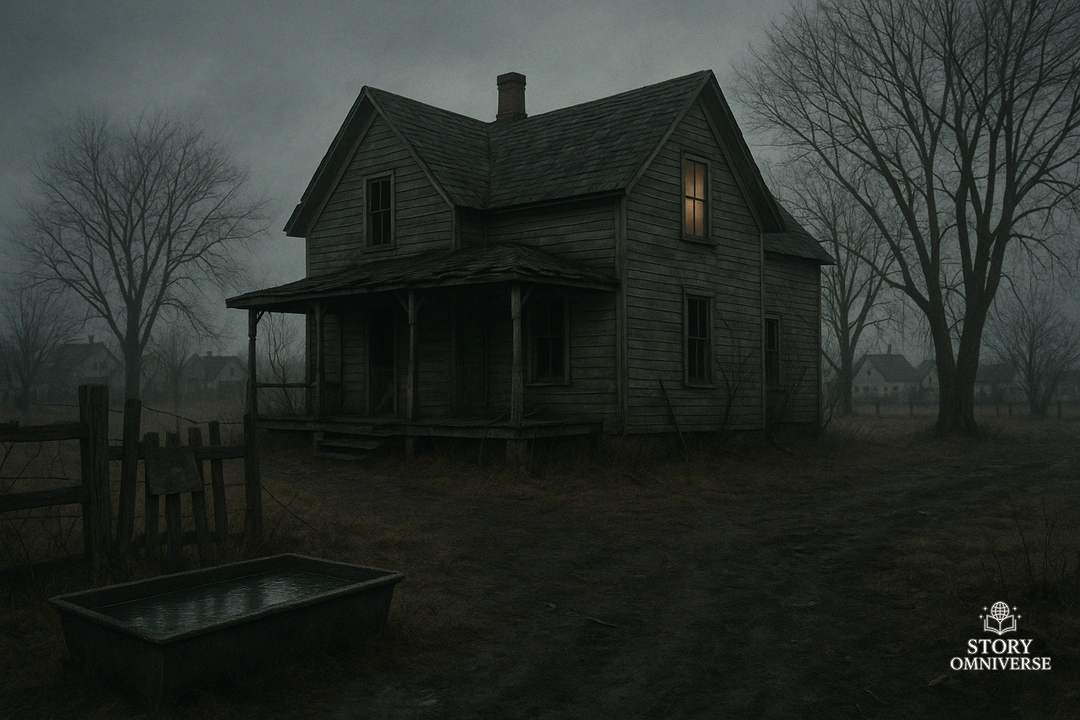
I once heard the story from a folder marked EDGE OF TOWN, FARMHOUSE, 1953, and the paper smelled like damp earth. The first line was written like a warning someone tried to make sound official: They said no one should go there after dark.
The station was a narrow building that held its breath with every footstep. A man sat on the public bench, hat in his hands, turning it as if it might become something else. A woman stood at the counter, coat buttoned wrong, eyes fixed on the desk sergeant’s mouth as if she could read mercy there.
“I saw lights,” she said, and her voice sounded like she had been practicing it in the mirror and failing. “In the upstairs window. The farmhouse. The one nobody owns anymore.”
Desk Sergeant Malloy did not reach for a blank form. He opened a drawer, pulled out a folder already softened at the corners, and set it on the blotter as if it had been waiting under his hand all day.
“You’re sure it was lights,” he said. “Not moon on glass.”
“I know the difference,” she answered, too quickly. Then quieter, bitterly amused at herself, “I know the difference between a thing that’s there and a thing you want to be there. I’m not new to that.”
Malloy glanced at the man on the bench. “You’re with her?”
The man stood. He looked older than he should have, like a face left too long in the sun. “I’m her husband. We lost our boy last spring.” He said it without decoration, as if the word lost had become an address.
Malloy’s eyes softened and then hardened again, the way an officer’s must. “Name?”
She gave it, and Malloy wrote it down on the top page of the old file, not a new one. The typewritten header already read EDGE OF TOWN, FARMHOUSE, 1953. Under it, in faint pencil, someone had once written: Do not enter after dark, by order.
“I’m not asking you to go in,” she said, though her hands were already reaching for the pen. “I’m asking you to make it stop. Those lights. That place. It’s like it’s trying to remember something.”
Malloy slid a statement across. “Sign here. You understand this is a formal complaint.”
Her fingers shook. Ink blotted where the pen hesitated.
The husband leaned close, not touching her, careful as if she were made of glass. “Martha,” he murmured, “we can still go home.”
She did not look at him. “Home is full,” she whispered. “Full of the space he isn’t in.”
Malloy stamped the page. The sound was dull and final, like a door closing on a room that still had someone inside. “We’ll take a look,” he said. “In daylight.”
Martha’s laugh came out like a cough. “Daylight,” she repeated, as if it were a joke the town told itself to sleep.
Chapter 2: Bones Where the House Moves
They went out with two deputies and a county car that smelled of cigarette ash and wet wool. The husband drove his own sedan behind them, keeping the headlights steady, as if he could hold the world in place by watching it.
At the edge of town the road thinned. Houses gave way to empty lots, then to scrub and fence posts leaning like tired men. The farmhouse sat beyond the last line of trees, a shape the land had tried to forget. Its porch sagged, and the upper windows were dark, but the darkness looked deliberate, like a curtain pulled tight.
Deputy Harlan stepped out first, boots sinking a little in the soft shoulder. “This ground’s wrong,” he said, and spoke to Malloy like a man asking permission to be uneasy.
Martha stood at the property line, hands in her coat pockets. “It’s always been wrong,” she said. “That’s why kids dared each other to touch the fence.”
The husband, John, stayed close enough to catch her if she swayed. “We don’t have to go in,” he said again.
Malloy held up a hand. “We’re not going in. Not yet. We walk the perimeter. We see what we see.”
They walked along the fence until the earth near the foundation looked as if it had been stirred by a giant spoon. A depression ran parallel to the house, fresh and raw, exposing roots and pale clay.
Deputy Reese crouched and touched the edge. “Sinkhole,” he said. “Or something starting.”
“It’s like the house is moving,” Martha whispered. She said it as if she had caught the farmhouse shifting its shoulders in sleep.
Malloy leaned over the depression. “Careful,” he warned. “Don’t get close.”
Harlan stepped anyway, testing the lip with his boot. The ground gave a little, a soft sigh. He jerked back. “That’s not stable.”
From the disturbed soil, something white showed through, curved and small. Reese reached with two fingers and lifted it gently. He held it up, and for a moment no one spoke because the shape made speaking feel like a violation.
“A bone,” Reese said finally. He tried to make it sound like a fact that could sit still on paper.
Martha’s breath hitched. “Too small,” she said. “Too small to be from the war.”
John’s hand closed around her elbow. “Don’t,” he murmured. “Martha, don’t do this to yourself.”
She stared at the bone as if it might answer her. “Too old to be last winter,” she continued, voice thin. “But bones don’t keep calendars, do they?”
Malloy took the bone from Reese and wrapped it in a handkerchief. “We’ll call county,” he said. “We’ll have it checked. There are old burials sometimes. Settlers. Animals.”
Martha turned her head slowly toward the house. The upstairs window remained dark, but she looked at it like she had seen a candle flame there moments ago. “My boy used to hide his face when he cried,” she said, low enough that only John heard. “Like if nobody saw him, it didn’t count.”
John swallowed. “He’s gone,” he said, as if repeating it could keep it true and keep it from changing.
Martha’s eyes stayed on the window. “And yet this place,” she whispered, “keeps making room.”
Reese cleared his throat. “Sergeant,” he said, “there’s more.”
He pointed. In the churned soil, more pale shapes lay half-buried, not a skeleton laid out but scattered pieces, as if the ground had been chewing and spitting.
Malloy’s jaw tightened. “Bag it,” he said. “All of it. And nobody steps closer than they have to.”
Martha’s laugh came again, bitter and small. “By order,” she said, tasting the phrase. “Like the earth listens.”
Chapter 3: Rotten Boards, Thin Promises
They waited for the county man, but the sky threatened rain and the wind kept tugging at the farmhouse as if trying to pull it down before anyone could look too hard. Malloy made a decision that sounded like duty and felt like impatience.
“We’ll check inside,” he said. “Quick. No wandering. Harlan, you watch the porch. Reese, you stay on Martha and her husband. Nobody goes alone.”
“I’m not a child,” Martha said.
Malloy looked at her, and his voice softened despite himself. “No. You’re not. That’s why I’m asking.”
The front door was swollen shut. Harlan shouldered it open with a crack that echoed through the empty rooms. The air inside smelled of rot and old smoke, like a stove left cold too long. Light fell in thin sheets through broken boards over the windows.
They stepped as thieves step, not because they meant harm but because the house accused them with every creak. The floorboards sagged under Malloy’s weight.
“Rotten,” Harlan muttered. “Watch your step.”
Martha moved carefully, eyes sweeping the walls. “He would have loved this,” she said, and her voice held a bitter irony that made John flinch. “A forbidden place. A dare.”
John’s face tightened. “Don’t make him into a story,” he said. “He was a boy.”
Martha turned to him. “And boys become stories the minute they’re gone,” she answered. “That’s what people do instead of bringing them back.”
Reese opened a door to what had been a kitchen. The sink was rusted. A mouse scuttled behind a cabinet and vanished. The sound made Martha jump, then laugh at herself. “Listen to us,” she whispered. “Like we’re the intruders.”
Malloy moved toward the back door. A nail jutted from the frame, and something caught on it, swinging slightly in the draft. A ring.
It was not gold. It looked like dull silver, worn smooth on the inside. On the outer band, initials had been carved with a sharp hand: not the neat two letters of a wedding ring, but a set of characters that did not sit right in the mind. They were almost letters, almost familiar, then wrong.
Harlan leaned in. “Anybody lose jewelry?”
Martha stared at it. “Not from town,” she said. “I know every monogram on every hand at church. Those aren’t ours.”
John shook his head. “Leave it,” he said. “It’s not evidence. It’s just… junk.”
Malloy took out a small envelope. “Everything here is evidence,” he said, but his eyes slid toward the hallway as if he had heard something.
Martha reached first. Her fingers closed around the ring, and for a second it felt like it resisted, snagged on the nail as if reluctant to be taken. Then it came free and lay cold in her palm.
“I’ll hold it,” she said.
Malloy hesitated. “Ma’am, I should log that.”
“It’ll get logged,” she replied, and the sharpness in her tone surprised even her. She tucked it into her pocket like a charm. “But if this house is making bones come up, I want something from it that comes out clean.”
Reese tested a board with his boot and it crumbled, dropping a puff of dust. “We shouldn’t be in here,” he said.
Martha looked down at the floor as if it might open. “No,” she agreed softly. “We shouldn’t. That’s what they said.”
From somewhere above, a small sound traveled down through the beams. Not a footstep. More like a scrape, as if something had turned its face against the wall.
Harlan’s hand went to his holster out of habit. “Rats,” he said, but he did not sound convinced.
Malloy spoke without raising his voice. “Out,” he ordered. “Careful. Same way.”
They backed toward the front door, each step a thin promise the boards might hold. Martha kept her hand in her pocket around the ring, gripping it like a rosary. John watched her as if she might slip away into the house the way their boy had slipped away into spring.
Chapter 4: The Legend in the Break Room
Back at the station the air was warmer, but it did not feel safer. The county man took the bones in a cardboard box and promised reports. Promises were easy in daylight. The file on Malloy’s desk thickened with new paper clipped to old.
Martha sat in the break room because Malloy told her to, because he thought coffee might anchor her. The coffee tasted of burnt grounds and resignation. John sat beside her, hands wrapped around his cup though he did not drink.
On the other side of the room two older officers played cards, their laughter too loud for the small space. They glanced at Martha and lowered their voices, then forgot and raised them again.
Malloy came in with the file and set it on the table between Martha and John as if it were a third person. “There’s more in here,” he said. “Older reports. Complaints. Trespassers. Fires that didn’t take.”
Martha’s fingers traced the folder edge. “Why was it already made?” she asked. “Why did you have it waiting?”
Malloy did not answer directly. “Some places,” he said, “get their own paperwork.”
One of the card players, Officer Dent, leaned back in his chair. He had a face like a carved apple, all sharp angles. “That old house?” he said. “We used to scare recruits with that one.”
Martha looked at him. “Scare them with bones?” she asked.
Dent shrugged. “No, no. With the mask.”
John’s cup clinked against the table. “What mask?” he demanded, too fast.
Dent grinned, enjoying himself in the safe light of the break room. “Antique thing. Kept out there, folks said. Some traveling show left it, or some foreign soldier, who knows. They say it remembers every face it meets.” He tapped his own cheek. “Put it on and it keeps you. Like a picture that won’t fade.”
The other officer, Pike, snorted. “Dent’s full of it. It’s just a story kids tell to get brave enough to drink behind the barn.”
Martha did not laugh. The bitter irony sat in her throat like a coin. “A mask that remembers faces,” she repeated, and the words sounded like cruelty. “My boy’s face is the one thing I can’t keep. And you’re telling jokes.”
Dent’s grin faltered. “Ma’am, I didn’t mean…”
Malloy cut in, voice quiet but sharp. “Enough.” He looked at Martha. “It’s nonsense. Typed up by some deputy years back who had too much time.”
Martha opened the file. Inside were typed notes, yellowed, the letters slightly uneven like an old machine. LOCAL LEGEND: ANTIQUE MASK KEPT ON PREMISES. CLAIMS: REMEMBERS EVERY FACE IT MEETS. TRESPASSERS REPORT HEARING WHISPERING. NO SUBSTANTIATION.
Beneath that, in pencil, someone had written: Do not wear it.
John leaned close. “Martha,” he whispered, “don’t read that. It’s poison.”
She turned a page. There were names, dates, small incidents written like prayers. A boy dared another boy. A man went looking for a lost dog. A woman swore she saw herself in a window when she was standing in the yard.
Martha’s mouth tightened. “They filed it,” she said. “They stamped it. They made room for it in a drawer.”
Malloy watched her hands. “We file rumors too,” he said. “So we can shut them up.”
Martha closed the folder carefully. “And does it work?” she asked.
Malloy’s eyes went to the door, to the hallway beyond, as if listening to the building settle. “Not always,” he admitted, so softly it almost did not count as speech.
Chapter 5: Polaroid That Won’t Set
The photographer arrived the next morning with a new Polaroid camera in a hard case, proud as if he had brought the future to town. His name was Lyle Benton, and he wore a tie even in the heat because he believed in appearances.
“This will settle it,” Malloy told him. “We document. We show there’s nothing.”
Martha stood by the squad car at the farmhouse fence line, arms folded. “Pictures don’t show nothing,” she said. “Pictures show what they want.”
Benton smiled politely at her, the kind of smile a man gives grief when he thinks it is a mood. “Ma’am, film doesn’t want,” he said. “Film records.”
John stayed quiet, watching the upstairs window as if expecting a curtain to move.
They entered the house again in daylight, but the daylight did not fill it. It only outlined the emptiness. Benton clicked open the camera and aimed at the front room.
“Hold still,” he said, though no one was moving. The shutter snapped. The camera hummed and spat out a square of film like a tongue.
Benton caught it and waved it, quick and practiced. “You’ll see,” he said. “Minute or two.”
The image began to form, gray shapes coalescing into the room: the doorway, the broken chair, the sheet of light on the floor. Benton frowned. He waved faster.
“It’s not setting,” he muttered.
Malloy leaned in. “Give it time.”
Benton held it up to the window light. The ink looked wet, glossy, as if the picture had been dipped in oil. Benton touched a corner and pulled his finger back with a smear. “That’s not right,” he said, annoyed. “It should dry.”
Martha reached. “Let me see.”
John caught her wrist gently. “Don’t,” he whispered, and she hated him for saying it like he could keep her safe with a word.
Martha took the photo anyway. The wet surface reflected her face faintly, layered over the forming image. She tilted it, and something in the background shifted.
“There,” she said, and her voice went very small.
In the photograph, near the hallway where the stairs began, a figure stood. Not a clear person, not a solid body, but the suggestion of shoulders, a head turned slightly toward the camera. The room itself, in real life, was empty.
Reese took the photo from her. He stared, then looked up at the hallway. “There’s nobody,” he said, and the certainty in his tone sounded like pleading.
Benton snatched the photo back, offended. “That’s a double exposure,” he said quickly. “Light leak. This camera’s new. Sometimes the rollers…”
Malloy’s eyes narrowed. “Take another,” he said.
Benton did, aiming at the same hallway. The camera spat out another wet square. He waved it. Again the ink refused to dry.
This time the figure was closer, clearer. A face shape without features, like a person seen through steamed glass.
John’s breath came in a tight sound. “That’s him,” he whispered, and Martha turned on him.
“That’s not him,” she said, bitter. “Don’t you dare give it his name just because you’re starving.”
John’s eyes filled anyway. “I saw a boy’s height,” he said. “I saw…”
Martha took the second photo and held it so close her breath fogged the wet shine. “My eyes lie to me every day,” she whispered. “Or they finally tell the truth and I can’t stand it.”
Malloy took the photo from her carefully, as if it might burn. “We’re done,” he said. “Out of the house. Now.”
As they stepped back onto the porch, the boards creaked like laughter. Benton tucked the wet photos into his case, still waving one uselessly. “It’ll dry,” he insisted. “It has to.”
Martha looked up at the dark upstairs window. “Some things,” she said to no one in particular, “don’t finish when they’re supposed to.”
Chapter 6: Evidence Locker, Listening
They found the mask because Benton, stubborn and rattled, wanted a shot of the back room. The floor there was worse, boards softened by damp, nails blooming with rust. Malloy let him go only after Harlan tested each step with a broom handle.
In the corner, beneath a loose plank, Benton’s foot caught and the board lifted. A smell rose, old oil and cloth and something like dried smoke.
“What’s that?” Reese asked.
Malloy knelt, careful, and slid his fingers under the plank. He pulled up a bundle wrapped in oilcloth, tied with twine that had gone stiff with age. The bundle felt heavier than it looked.
Martha’s hand went to her pocket, where the ring sat cold against her skin. “That’s it,” she whispered, though she did not know how she knew. “That’s your joke.”
Malloy untied the twine. The oilcloth peeled back reluctantly, like a bandage. Inside lay a mask, pale wood or bone-colored lacquer, smooth and expressionless except for shallow grooves where cheeks would be. The eye holes were narrow, the mouth a thin line that could be calm or cruel depending on how you looked at it.
Dent’s laughter from the break room seemed to echo in Martha’s memory, suddenly sour. It remembers every face it meets.
Malloy wrapped it back up at once. “Bag it,” he ordered. His voice stayed low, but something in it tightened.
Back at the station the mask was logged into evidence with a tag that looked too clean for something so old. Malloy wrote: ANTIQUE MASK, FOUND UNDER FLOORBOARD, FARMHOUSE. HANDLE WITH CARE. He hesitated, then added in smaller letters: DO NOT WEAR.
Martha watched him write, then said, “You can lock it up, but you can’t make it stop being what it is.”
Malloy slid the wrapped bundle into the evidence locker and shut the metal door. The latch clicked. “It’s a thing,” he said. “Things don’t do anything unless people do.”
Martha’s smile was thin. “People do plenty,” she said.
Night came early in the station, the hallway lights buzzing faintly. Martha returned under the excuse of paperwork, Malloy letting her in because grief makes a person look official if you let it.
She sat at a desk with a blank form in front of her and did not write. John waited at home, she had promised. She told herself she would go soon.
Footsteps sounded in the corridor. Malloy appeared, coat on. “You should go,” he said gently. “Nothing more you can do tonight.”
“I can sign,” Martha said, tapping the blank form. “You like signatures. Make it real.”
Malloy’s mouth twitched, not quite a smile. “Go home,” he repeated, and his voice was the same hush he used for delivering bad news.
He left. The station settled. The clock ticked. Martha sat alone with the smell of ink and old paper.
Then, from behind the evidence locker door, a sound came. Soft. A scrape, like cloth against metal. Like a face turning toward a voice.
Martha held her breath. The scrape came again, slow, deliberate.
“Hello?” she whispered, hating herself for it.
Silence answered, then a faint, patient sound, as if something inside the locker had shifted to listen better.
Martha stood. Her chair legs whispered on the floor. She walked down the corridor, each step careful, as if the tiles might give way like the farmhouse boards.
At the locker door she pressed her ear to the cool metal. “If you remember,” she murmured, “then remember him. Remember my boy.”
For a moment there was nothing. Then, so faint she could have imagined it, a sound like breath through a narrow mouth. Not words. Not quite. But the shape of attention.
Martha’s hand rose to the latch.
Chapter 7: The Face It Chooses
The case file changes here. You can see it in the handwriting, in the way the sentences stop pretending to be official. It becomes an unbroken confession, written as if the writer could not stop without something catching up.
Martha opened the evidence locker. The wrapped mask lay where Malloy had placed it, neat as a sleeping animal. She told herself she only wanted to check the tag, to make sure it was logged right, to make sure nothing could be dismissed later as error. Grief makes excuses the way a clerk stamps forms.
Her fingers untied the twine. The oilcloth unfolded. The mask’s blank face looked up at her from her hands, and for a moment she felt nothing. Then she felt everything, all at once, like a room full of people turning to stare.
“This is foolish,” she whispered, and the whisper sounded like permission.
She heard footsteps behind her and turned, heart hammering, but it was only Reese coming down the hall with a cigarette unlit between his fingers.
“Mrs. Hale?” he said, surprised. “What are you doing here?”
Martha’s hands froze. “Paperwork,” she lied, holding the mask half-hidden against her coat.
Reese’s eyes dropped to it. His face went pale. “Put that back,” he said, and the fear in him was raw, not joking. “Sergeant said don’t.”
Martha looked at him with a bitterness that tasted like pennies. “You all said don’t,” she replied. “And you all still went in. You all still looked.”
Reese took a step closer. “Ma’am, listen. We can call Malloy. We can…”
“No,” she said, and her voice stayed low because she could not afford to wake whatever part of her still had sense. “I just need one thing.”
Reese’s hands lifted, palms out. “One thing turns into another,” he warned. “That’s how it goes.”
Martha raised the mask. For a second she held it in front of her face without touching, like a photograph frame. The eye holes were narrow. The inside smelled of old oilcloth and something sweeter, like dust warmed by sunlight.
Reese’s voice cracked. “Don’t put it on.”
Martha did anyway.
The wood touched her skin cold, then warmed fast, like a hand. The world narrowed to the two thin eye slits. She expected darkness. She expected her son. She expected a trick.
Instead she saw faces.
Not in front of her, not in the corridor, but layered over everything like wet ink that would not dry. A man with a lantern on a winter road. A woman in a church hat, lips moving in prayer. A boy with a bruise under one eye, laughing too loudly. Malloy younger, without the lines around his mouth, standing at the farmhouse fence line with his hat in his hands.
Martha gasped, and the mask held her breath against her own mouth.
“Mrs. Hale,” Reese whispered, and his voice sounded far away, as if he were speaking from inside a photograph. “Take it off. Please.”
Martha’s hands rose, but the mask felt heavy now, not with weight but with insistence. Faces kept coming, not dead faces, not ghosts. Faces of searchers. Faces of people who had looked for something and not found it.
She saw herself, months ago, standing in the rain outside her own house, staring at the road as if it might return her child like a parcel. She saw John at the kitchen table, head in his hands, not praying because he had no words left.
Her own face, multiplied, watched her from every angle. She could not tell which one was now.
“Where is he?” she whispered into the mask.
The answer was not a voice. It was a sensation, like a ledger opening. Like a pen poised.
Reese stepped forward and grabbed her wrists. His touch felt wrong, like someone touching a photograph and smearing it. “You’re shaking,” he said. “You’re not breathing.”
Martha tried to speak, but her words came out as a thin sound, almost laughter. “It doesn’t show him,” she managed. “It shows everyone who ever looked.”
Reese’s eyes filled with tears he did not want. “Then it’s just cruelty,” he whispered.
Martha’s fingers finally found the edge and tore the mask away. Air rushed in, harsh and bright. The corridor snapped back into place, but the afterimage of faces stayed on the walls like stains.
She stared at Reese as if seeing him for the first time. “How many?” she asked, voice hollow. “How many people signed themselves into it?”
Reese swallowed. “Too many,” he said. “And now so did you.”
Chapter 8: Figures That Multiply
They tried to make it ordinary again. That is what the file says, in the officer’s careful handwriting that returns for a few pages like a uniform put back on.
Malloy questioned Martha in his office, voice low, not angry, just tired. “You understand,” he said, “that interfering with evidence is a charge.”
Martha sat straight-backed, hands folded, the ring heavy in her pocket. “Charge me,” she replied. “Put it on paper. Stamp it. Maybe that will keep it from spreading.”
Malloy’s eyes flicked to the evidence locker. “You heard something,” he said. It was not a question.
Reese stood behind her, looking at the floor. “We both did,” he admitted.
Malloy exhaled slowly. “We’ll document the farmhouse again,” he said. “We’ll document the mask. We’ll prove to ourselves this is stress and grief and suggestion. We’ll put it to bed.”
Benton came back with his camera, less proud now. He laid fresh film on the desk like a man laying out bandages. “I checked the rollers,” he said. “I checked the chemicals. Everything’s fine.”
Martha watched his hands. “And if it isn’t,” she murmured, “you’ll still call it fine.”
They returned to the farmhouse with Malloy, Reese, Harlan, Benton, and Martha. John came too, against Malloy’s advice, because John had learned the worst thing about grief is being left behind while it walks elsewhere.
“I’m not letting her go alone,” John told Malloy, jaw set.
Malloy nodded once. “Stay close,” he said. “Watch your step. This house is a liar.”
Inside, Benton took photographs in every room. The camera hummed and spat. Each picture came out glossy, ink wet and stubborn.
Benton waved them until his arm ached. “It’s not drying,” he said, voice tight. “It’s not drying at all.”
Harlan took one photo and held it at an angle. “What’s that?” he asked.
In the picture, behind the empty stove, a figure stood in a doorway that did not exist. Its outline was clearer than before, shoulders squared, head tilted as if listening.
John leaned in, face drained of color. “That’s a man,” he whispered. “That’s not… that’s grown.”
Martha took the photo. The ink smeared slightly under her thumb, and the figure seemed to shift with the smear, as if it liked being touched.
“Take another,” Malloy ordered, though his voice had gone flatter.
Benton did. Another wet square. Another figure, now behind a curtain that was not there, in a window that had no glass. The figures multiplied, not crowding but appearing in places the house could not hold.
Martha’s mind began to tilt. She felt watched from angles she could not face. “It’s not summoning the dead,” she whispered to John, and he looked at her sharply.
“What is it then?” he asked.
Martha’s laugh was bitter, almost tender. “It’s spreading attention,” she said. “Teaching the town to be watched. Teaching us to stand still so it can remember us.”
Reese’s voice came from behind her. “Mrs. Hale,” he said softly, “your hands are shaking again.”
Martha looked down. The ring in her pocket seemed to pulse with cold, like a small heartbeat. She pulled it out and stared at the strange initials. They looked more like scratches now, less like letters, as if the longer she looked the less human they became.
Malloy stepped closer. “We’re leaving,” he said. “Now. We condemn the property. We put up boards. We keep kids out.”
Martha looked at the wet photographs in Benton’s hands. Figures in doorways, figures behind curtains, figures where no one stood. “You can board up windows,” she whispered. “Can you board up a look?”
John took her elbow. “Come on,” he said, and his voice broke. “Please. Come on.”
Martha let him lead her out, but she did not stop staring at the upstairs window as they crossed the yard. She could not tell if the darkness there was empty or simply waiting for a face to turn toward it.
Chapter 9: The Farmhouse Wants a Witness
The second sinkhole opened two days later, after a night of mild weather that should have left the ground unchanged. The call came in before dawn. Harlan’s voice on the phone was tight.
“Porch is going,” he said. “Foundation shifted. You can see under the house now.”
Malloy gathered them fast, as if speed could beat whatever was happening. Martha came without being asked. John tried to stop her at the station door.
“Martha,” he pleaded, hands on her shoulders, “this is not ours to fix.”
“It became ours,” she whispered back. “The minute it learned my face.”
At the farmhouse the porch sagged like a jaw unhinging. The new depression ran under it, a dark mouth in the earth. Boards creaked under Harlan’s boots as he tested the edge.
“Don’t go on that,” Reese warned.
Harlan nodded, but his eyes were on the gap. “There’s something under there,” he said. “Scratches on the beam.”
Malloy held up a hand. “Nobody on the porch. We look from the side.”
They moved toward the back, where the well trough sat. Overnight, a skin of ice had formed across the water, thin and cloudy. It should not have been there. The air was cold but not that cold.
Benton, pale and stubborn, lifted his camera. “I need a picture of the ice,” he said, as if proof could keep it from being real.
“Don’t step close,” Malloy told him.
Benton stepped anyway, boots crunching on frost. The ice made a faint singing sound, a tight vibration. Martha felt it in her teeth.
John touched her sleeve. “You hear that?” he whispered.
Martha nodded. “Like a wire,” she said. “Like a line being pulled tight.”
Benton crouched for a better angle. The ground near the trough was soft, deceptively firm on top. His foot slid. He flailed, caught himself on the trough edge, and the thin ice cracked with a sharp report.
Reese lunged forward to grab him, but his own boot hit a rotten board near the back door, and the board gave way with a sound like a sigh. Reese dropped, one leg plunging through, the wood splintering around his thigh.
“Reese!” Malloy shouted, and his voice rose for the first time, then fell back into control.
Reese clenched his teeth, gripping the doorframe. “I’m stuck,” he hissed. “It’s got me.”
Martha’s eyes flicked to Benton’s dropped photograph. It lay face up in the dirt, ink wet, shining. In it, near the porch, a figure stood on the sagging boards, holding something that glowed.
A lantern shape.
Her stomach turned cold. She took a step toward the porch without thinking.
John grabbed her arm hard. “No,” he said, fierce and desperate. “You’re not going after a picture.”
Martha wrenched, but John held. “He’s in there,” she whispered, not sure if she meant Reese or her son or the part of herself that had gone missing.
Malloy knelt by Reese, bracing the broken board. “Harlan,” he ordered, “get a plank. Now.”
Harlan ran to the car. Benton scrambled up, face white with shame. “I’m sorry,” he stammered. “I didn’t…”
“Help him,” Malloy snapped, then softened. “Help him, Benton. Hold his shoulders.”
Martha stood torn, eyes on the wet photograph, the lantern figure in the image seeming to lean closer. The porch creaked, and the earth under it shifted, a slow settling like a breath being taken in.
Reese groaned. “It’s pulling,” he said. “Like the floor wants me.”
John’s voice was in Martha’s ear. “Choose,” he whispered. “Choose the living.”
The bitter irony of it struck her. All this time she had been choosing the dead, chasing a face that would not come back. Now the house offered her a witness, a fresh name for its ledger.
Martha dropped to her knees beside Reese. “Look at me,” she told him, voice low and steady. “Don’t look at the hole. Look at me.”
Reese’s eyes met hers, wide with pain. “Don’t let it remember me,” he whispered.
Martha swallowed. “I can’t stop it remembering,” she said. “But I can stop it taking you.”
Harlan returned with a plank. They slid it under Reese’s thigh, Malloy and Benton lifting, Martha bracing the board with her hands. Reese screamed once, then bit it back. The rotten wood splintered more, but the plank held.
They hauled Reese free. He collapsed onto solid ground, shaking.
Martha’s gaze went back to the porch. The photograph lay in the dirt, ink still wet, and the lantern figure in it looked almost satisfied.
Chapter 10: Initials in a Circle
Reese was sent home with his leg wrapped and his pride bruised worse than his skin. Malloy stayed late at the station, file open, cigarette burning down untouched in the tray. Martha sat across from him because neither of them knew where else to put the night.
John waited in the hallway, refusing the chair offered, listening like a man outside a sickroom again.
Malloy flipped through the old pages until he found a report from decades earlier, brittle with age. “We had scratches recorded,” he murmured. “Under the house. Dismissed as vandalism.”
Martha pulled the ring from her pocket and set it on the desk. Under the lamp the carved initials looked sharper, as if the light fed them. “These,” she whispered. “They’re not from town.”
Malloy leaned closer, eyes narrowing. “Where’d you get that?”
“Back door nail,” she said. “You let me keep it.”
Malloy’s jaw tightened, but he did not scold. He only looked tired. “We need to compare,” he said.
They drove back to the farmhouse with only Harlan, because Malloy wanted fewer eyes, fewer faces. The night air was damp. The house loomed like a thought you cannot stop thinking.
Malloy kept his flashlight low. “We don’t go inside,” he said. “We go under. Quick.”
Harlan crawled first, sliding into the gap where the porch had sagged away. “Beam’s here,” he whispered. His voice echoed strangely, swallowed by the earth.
Martha lay on her stomach at the edge, watching Malloy’s flashlight beam sweep under the house. Dust floated like slow snow.
“There,” Harlan said. “Scratches.”
Malloy angled the light. On the beam, carved deep enough to catch shadow, were the same strange initials as on the ring. Not just once, but repeated, arranged in a rough circle, as if someone had tried to make a boundary out of letters.
Martha’s breath came shallow. “It’s a pattern,” she whispered.
Malloy’s voice stayed low. “A signature,” he said. “Or a warning.”
Martha pressed the ring into Malloy’s palm. “It matches,” she said. “So it’s not just a story. It’s been here long enough to be recorded and forgotten and recorded again.”
Harlan backed out, dirt on his sleeves. “What do we do with that?” he asked. His eyes flicked to the dark windows. “You can’t arrest a beam.”
Martha’s bitter laugh came, thin as paper. “You can’t arrest a memory either,” she said, then looked at Malloy. “But you can stop feeding it.”
Malloy stared at the carved circle under the house. “Wearing the mask,” he murmured, “is like signing your name into something.”
Martha nodded. The sensation returned, that ledger opening, the pen poised. “It remembers faces,” she said. “But it remembers patterns too. It remembers who looks, who searches, who comes back.”
John’s voice came from behind them, tight. “Martha,” he called softly. “Come away from there.”
She turned and saw him standing by the car, hands clenched, eyes shining in the flashlight spill. He looked like a man watching his wife step toward water that had already taken one child.
Martha held the ring up so John could see it. “It’s not ours,” she said. “But it wants to make it ours.”
John shook his head. “Then don’t give it anything,” he begged. “Not your face. Not your hands. Not your name.”
Malloy closed his fingers around the ring. “We seal it,” he said, as if speaking the words could make them a plan. “We put the mask back where it was. We bury it under what’s shifting. We condemn. We keep the town from turning its head toward it.”
Martha looked at the farmhouse, at the upstairs window that had held lights. “And if it keeps calling?” she whispered.
Malloy’s answer was quiet and bitter. “Then we keep not answering,” he said. “That’s the only protection I know that doesn’t make more paperwork.”
Chapter 11: A Door Closed, A Town Spared
They chose a morning with clear weather, because superstition likes rain and Malloy refused to give it the satisfaction. The plan was simple on paper. Return the mask. Seal the loose plank. Nail boards. Mark the property condemned. Make it official enough that even curious boys would hesitate.
Martha came with the mask wrapped in oilcloth, held against her chest like a parcel. The ring sat inside the wrap, pressed into the cloth so hard its shape showed through.
John walked beside her, close enough to steady her without touching. “You don’t have to do this,” he whispered, though they both knew she did. Grief demands rituals. It demands endings even when endings do not exist.
Malloy carried nails and a hammer. Harlan carried boards. Benton did not come. Reese did not come. They had seen enough wet ink.
Inside the farmhouse the air felt expectant, not haunted, just attentive. The rotten floorboards creaked under their careful steps, and each creak sounded like a clerk stamping a form.
At the back room Malloy tested the boards with the broom handle. “Same spot,” he said.
Martha knelt and lifted the loose plank. The darkness beneath seemed deeper than it should, as if the house had made a pocket for the bundle.
John’s voice trembled. “Martha,” he said, “look at me.”
She did. His eyes were red-rimmed, tired. “If this is surrender,” he whispered, “I hate it.”
Martha’s smile was bitter and soft. “So do I,” she replied. “But protection looks like surrender when you’re used to fighting ghosts.”
Malloy crouched beside her. “You ready?” he asked.
Martha nodded. She slid the wrapped mask into the space beneath the floor. The oilcloth made a faint whisper against the wood, like a hush in a courtroom.
Before she let go, she pressed the ring into the wrap, hard. “If it’s a ledger,” she whispered, “then take this signature back. Take whoever started it. Take your own initials. Leave my town out of it.”
Malloy watched her carefully. “You don’t know what you’re bargaining with,” he said.
“I know,” Martha answered. “That’s the point.”
She lowered the plank. Malloy nailed it down, each hammer strike a dull heartbeat. Harlan boarded the back door. John stood in the doorway of the front room, staring up the stairs as if expecting a small footstep.
When the last nail was driven, Malloy exhaled. “Property condemned,” he said, and wrote it on a sign in block letters. He nailed it to the fence post.
Martha stood at the edge of the yard, looking back at the farmhouse. The upstairs window was dark. No lights. No movement. Just a house pretending to be empty.
John touched her shoulder. “Come home,” he said.
Martha turned away. The act felt like tearing cloth. “Survival,” she whispered, “still looks like loss.”
Malloy walked with them to the car. “Final report will say sealed under shifting foundation,” he said. “No further action.”
Martha looked at him. “And if the photographs?” she asked.
Malloy’s mouth tightened. “We lock them up,” he said. “We stop looking. We stop waving them like they’ll dry.”
John opened the car door for Martha. She slid in, hands in her lap, staring at her palms as if expecting ink.
As they drove away, the farmhouse shrank behind them, but the sense of being watched did not. Martha kept her eyes on the road and did not look back, because she had learned the hardest lesson of all. Sometimes walking away is the only redemption you get, and it still leaves scars.
Chapter 12: The First Line, Written Again
Months passed. Winter came properly, with honest ice that formed where it should and melted when it should. The condemned sign weathered. Boys still told stories, but they told them at a distance, as if words could catch.
The case file was refiled in a different drawer, then brought back, then moved again, as paperwork does when a town cannot decide where to keep its unease. A clerk clipped a new Polaroid to the front because Malloy had requested it, because the file wanted a face.
The photograph’s ink was still wet.
Malloy stood at his desk under the buzzing light, staring at the glossy square. Reese stood beside him, leaning on his healed leg, trying to look casual and failing. Martha sat in the chair across from them because Malloy had called her in, voice careful on the phone.
John waited outside the office door, as always now, like a man guarding a threshold.
Malloy slid the photo across the desk. “It came in the mail,” he said. “No return address.”
Martha did not touch it at first. She looked at it the way you look at a wound you have stopped picking at, afraid to start again.
“What is it?” she asked.
Malloy’s voice stayed low. “The farmhouse,” he said.
In the picture the abandoned house stood at the edge of town under a gray sky. The condemned sign was visible, crooked. The porch sagged. The upstairs window, the one Martha had watched for lights, held a figure.
A figure holding a lantern.
The lantern glow in the photograph looked like the very one in this Circle, pale and stubborn. The ink around it shone wet, refusing to dry, as if time itself would not finish the moment.
Reese swallowed hard. “Nobody was out there,” he said. “We checked after the mail came. No tracks. Nothing.”
Martha finally touched the photo’s edge. The wetness smeared faintly onto her fingertip. Her skin prickled as if the ink carried cold.
Malloy opened the file. On the top page, freshly typed, a caption had been added beneath the clipped photograph, the words aligned with bureaucratic neatness:
They said no one should go there after dark.
Martha’s bitter laugh came out like a sob. “It wrote itself again,” she whispered.
Malloy’s eyes flicked to her finger, to the smear of ink. “Or someone typed it,” he said, but his voice lacked conviction.
Martha looked up at him. “You sealed it,” she said. “You condemned it. You walked away.”
Malloy’s gaze did not leave the wet photograph. “And yet,” he murmured, “it keeps a record.”
Reese’s voice was small. “Maybe it’s just someone playing a joke,” he offered, but he sounded like Dent in the break room, and he hated himself for it.
Martha stared at the lantern in the upstairs window. The figure holding it was only an outline, but it seemed turned toward the camera, as if it knew it was being watched. As if it had been waiting for the watcher to return.
John’s voice came from the doorway. “Martha,” he said softly, “come on.”
Martha did not move. She could smell damp earth again, right there in the office. She could feel the ring’s absence like a missing tooth. She could feel the mask’s attention without seeing it.
Malloy closed the file gently, as if not to wake it. “Go home,” he told her, and this time it sounded like a plea.
Martha stood, hands empty, and walked out without touching the photograph again. But the smear of wet ink remained on her fingertip, shining under the hallway light, refusing to dry.
The first line had been written again. And somewhere, in a place the town had tried to seal, a lantern waited to be lifted.
My voice stays low as I set the folder down in my mind and let the last page curl shut. The lantern light makes every face around me look like a photograph that might not dry, and for a moment I cannot tell if the figures are only shadows or something leaning closer to be remembered.
Someone in the Circle shifts, just once, the sound small as a rotten board deciding whether to hold. I pass the lantern on, and the silence that follows feels like a case file waiting for another signature.

0 Comments