
Rorgak Ironjaw
Give me stone to break and sky to burn.
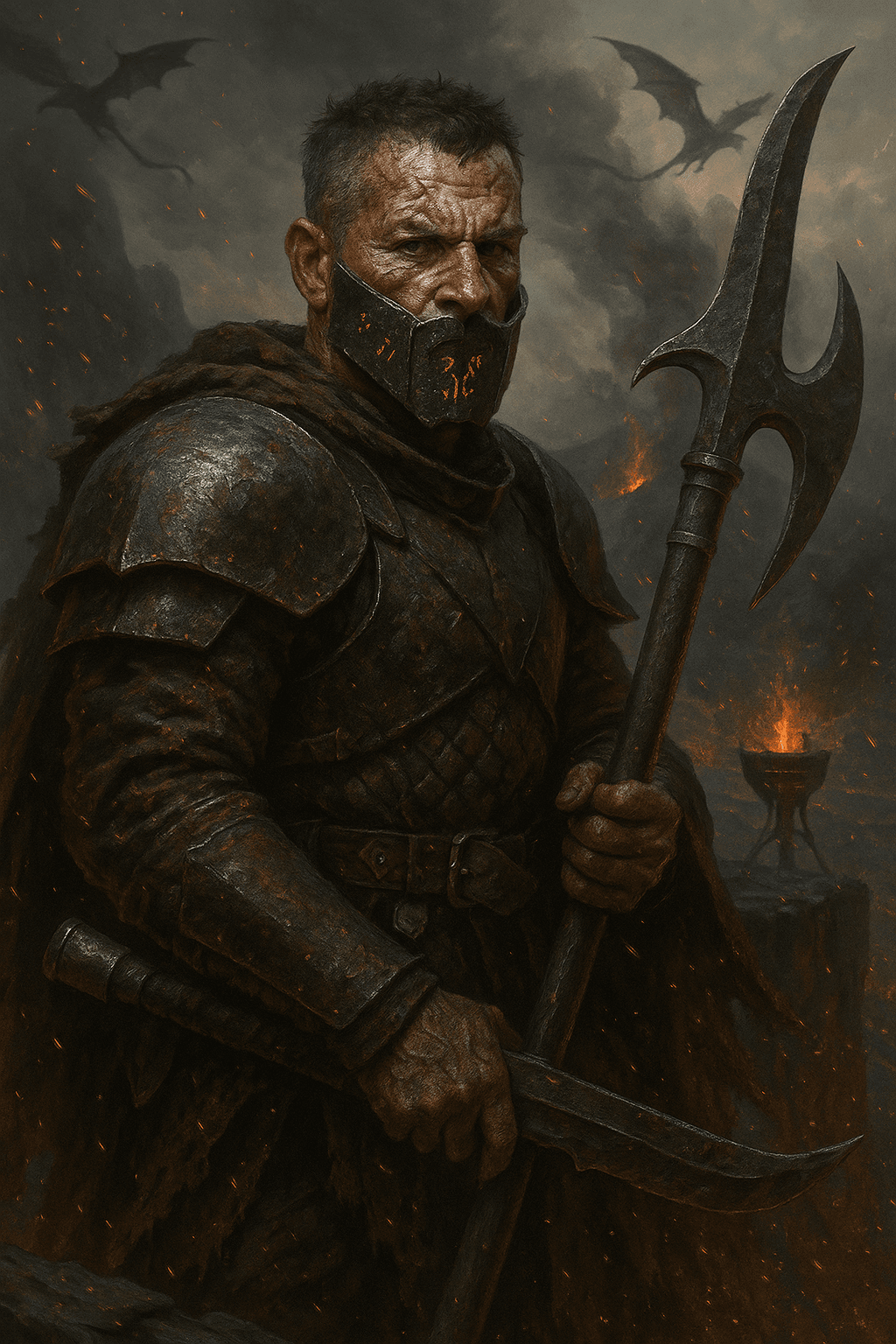
They say you can hear Rorgak Ironjaw before you see him—the clatter of ashplate, the barked cadence of drills, the roar of lava-fed forges answering his voice like drums. In Thar Zûl’s dominion, where zeal is a currency and failure is fed to the fire, Rorgak rose by a simpler rule: win. He is the Choir of Ember’s war-leader not because he is the cruelest (though cruelty is an easy tool in his kit), but because he understands how to turn volcanic terrain, volatile beasts, and volatile people into a single moving edge.
Fracture.
When the world broke and fire-mountains woke, Rorgak found his moment. Ashen cities were still cooling, magma pools still birthing drakes, and discipline was a rumor. Inferna Prophet Kalzeth spoke of gods in the fissures and conquest on the horizon; Rorgak made those words into logistics. He carved parade grounds into black mesas and taught the first Ashwing flights to work as claws, not chaos: one pair harry, one pair blind, the third strike. He turned molten vents into signal towers and obsidian slag into shields. Border fortresses of Itharûn dotted the ridgelines like teeth; Rorgak’s raiders learned to pry them out one by one, flying low in the heat shimmer where arrows faltered and stormcraft sputtered.
Breeding programs began under his oversight—nothing mystical, all brutal efficiency. Ashwings that survived three sorties bred; those that balked became offerings to the Choir’s rites. He hand-picked handlers with burns on both hands (proof of nerve) and gave them a single command: “Teach them hunger with a leash; teach them discipline with your breath.” In those early campaigns he earned Kalzeth’s trust the hard way—by delivering ash and prisoners on schedule. The Prophet promised flame-made destiny; Rorgak, grinning behind a jaw guard hammered from black iron and bone, delivered schedules that made destiny possible.
Twilight.
Then came the long wars and the cost of zeal. The Last Sky War set dragon against drake above a world already cracked. Itharûn’s veterans fought like mountain weather—sudden, punishing, weirdly principled. Rorgak adapted. He shifted raids to night, read the wind for Stormrider tells, and drilled his flights to cut through lightning cones instead of fleeing them—counterintuitive, suicidal, sometimes brilliant. Forces bled on both sides. Thar Zûl’s borders shrank, citadels fell, and Rorgak traded expansion for survival: scorched-earth retreats, ambush ravines primed with oil and prayer, and a grim insistence that panic is just breath spent wrong.
Inside the Choir, pressure did what it always does—split rock. Ritual power flowed toward Ash-Priestess Vhalra and her Ember Communion; martial power coalesced around Rorgak. They were allies until they weren’t. He respected her focus and cold patience; she mistrusted his appetite for command. When zealots called for sacrificial sorties to “paint the sky in vow-flame,” Rorgak cut the losses where he could and lied about the numbers when he had to. “Dead soldiers don’t win me fortresses,” he told his officers. “They only win me funerals.” In the low years after the war, he rebuilt with what remained: scarred Ashwings, rider cadres who could read a thermal with their eyes closed, and a new generation of ground troops trained to move like smoke through basalt canyons. His sights never left the ridges of Itharûn, but the angle changed—from conquest to leverage.
Anatomy & arms.
The “Ironjaw” is more than a name. A shard of falling rampart tore his face in the Fracture years; the black iron plate he wears is riveted to scar and oath, etched with heat-sigils that vent his breath as a hiss when he shouts orders. He dresses for function: ash-lacquered leather, obsidian pauldrons, a cloak singed at the hem from too many cliff-edge briefings. His favored weapon is a hook-bladed glaive balanced for sweeping riders from saddles; the counterweight is a hammerhead for cracking shields and, failing that, jawbones. Up close, he smells of smoke, oil, and the sour herbal paste Thar Zûl uses to numb the old burns when the weather turns.
Tactics & beasts.
Rorgak loves a triangulated sky. He breaks fortified lines by coordinating three elements: Ashwing flights to blind and disperse, Magma-Drakes to terrorize and tear, infantry to hold the ground gained. His signature play, the “Cinder Net,” uses ashstorms kicked by circling Ashwings to smother visibility while signal braziers pulse orders through the gloom. It is ugly, effective, and hateful to enemies who prefer gallant clarity. He breeds not just for strength but for temper; Ashwings under his banner wheel on a shouted number, not a whim.
Rivals & oaths.
He served Kalzeth with the devotion of a soldier to a flame that pays its debts. Later, as Vhalra’s star rose, he learned to count his victories twice—once on the map, once at the altar. He keeps his promises with the zeal of a convert who doesn’t like religion. To Itharûn’s officers he is a curse traded over campfires; to Thar Zûl’s soldiers he is the reason they are alive to curse anyone at all.
Rorgak Ironjaw is not a prophet, philosopher, or poet of fire. He is the man you put in charge when the sky is already burning and you intend to win something from the blaze.