
Moorglow
Where the mist breathes, I listen—and the little dragons answer.
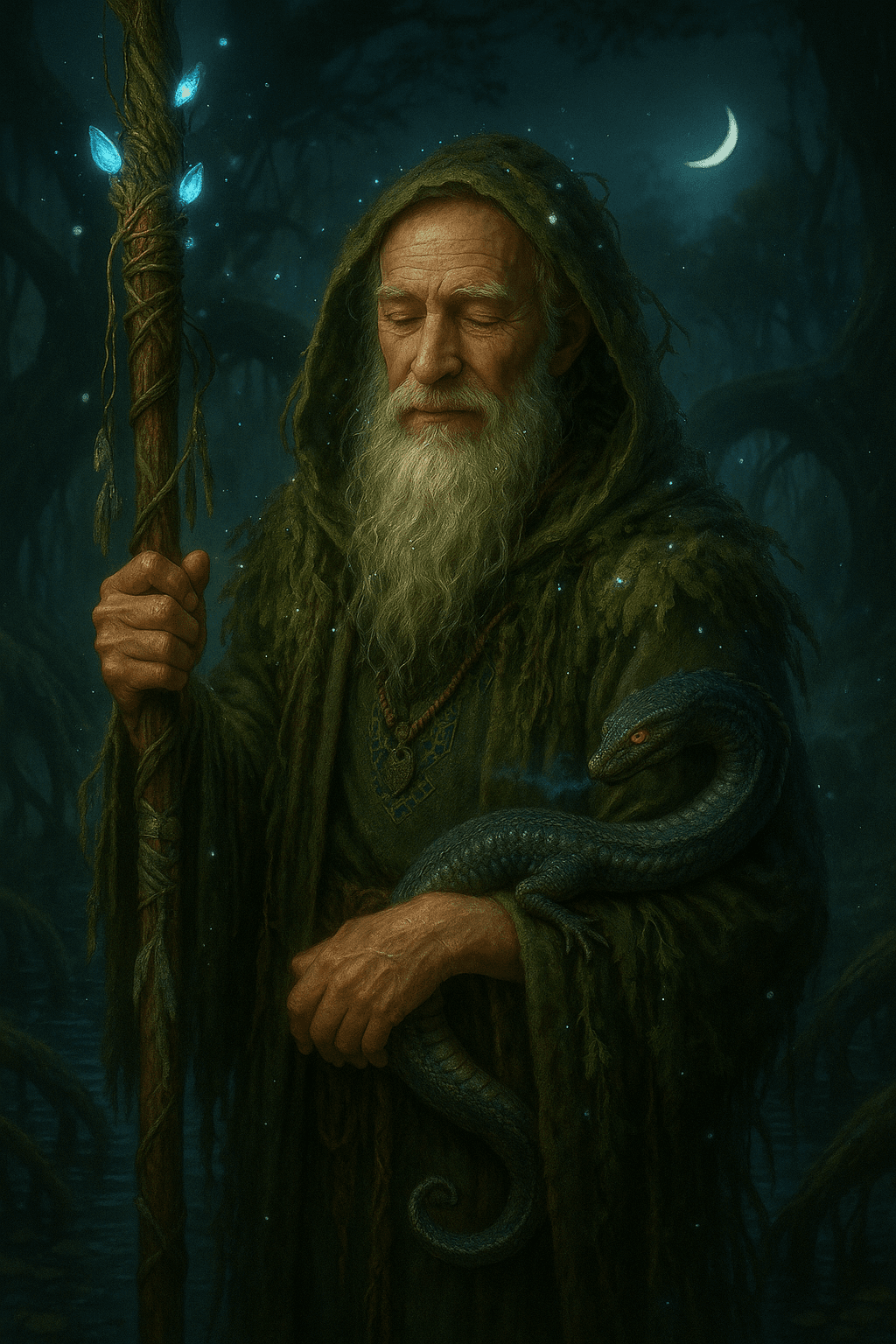
Before Hollowroot had a name, there were only the mists, the hush of black water, and the careful hands of a vinebound caretaker who called himself Moorglow. He was not a priest then, not a scholar, not even a speaker for the nascent Whispering Bloom. He was a watcher of eggs.
The Duskwyrms of that first age were skittish things, more lizard than legend—sleek, lamp-eyed, and uncertain of their place in a world still deciding what it would be. They nested in warm silt near gas vents and beneath root-arches where the night pooled deepest. Many feared them. Moorglow did not. He would stand knee-deep in the mud so the hatchlings would learn the weight of a steady presence, and he sang to them in the old, vowel-soft cadences of the Mire, a melody that did not cross the water so much as seep through it.
Moorglow believed the Duskwyrms were divine, though by “divine” he meant something close to “necessary.” In the hush between breaths, the swamp listened for its own heartbeat. The wyrmlings were how it heard itself—a trembling, clever rhythm threading shadow to shadow. If the young survived, the Mire would remember what it was trying to become.
He learned their habits the way a root learns the curve of buried stone. Hatchlings loved heat but feared flame; they navigated by the faint magnetic shiver of leylines as much as by scent; and they calmed when given something to coil around—a wrist, a cane, a patient ankle. So Moorglow braided a tender’s staff from reed and ghost-vine, studded the knots with dull crystals the swamp spat up after storms, and let the young wind themselves along its length as he hummed. He fed them river eels and the soft white mushrooms that sprouted from drowned logs, careful to leach the bitterness that would sicken their thin bellies. When a little one sneezed a ribbon of mist, he only laughed and wiped the condensation from its nose with a strip of dreamweave he carried for that sacred, silly purpose.
Word spread through the vinebound of a gentle caretaker whose patience turned fear into the kind of reverence that has no need of altars. Vineheart, then only the first among whispers, visited Moorglow at the edge of a fogbound channel. “You speak to them as if they are elders,” Vineheart observed.
“They are,” Moorglow said. “Just small.”
It was a season of beginnings. The Seeding of Hollowroot stirred intelligence in every tangled length of vine; the Mire itself seemed to lean toward purpose, and Moorglow felt it like warmth in the water. When scouts brought rumors of a forest folk beyond the lightless fen—beastkin and druids who called down the green will of the world—Moorglow did not bristle. He packed a basket of glowcaps and set a tiny, drowsing wyrm atop them. At the neutral Swale Glade, where Elder Mossbeard met Vineheart without blades or blight, Moorglow stood at the back, letting the hatchling’s slow breath mist his hands. No alliance was struck that day, but an understanding was: there were lives too new to gamble.
Then came the Withering Skies. The moon yellowed; the stars blurred as if seen through wet glass. Magic thinned until even the swamp gas faltered. The eggs cooled. The hatchlings’ shadows grew too long for their bodies, and they cried—the softest, most unbearable sound in all the Mire.
Moorglow moved like necessity. He mapped the warmest vents and repositioned nests one finger-width at a time so the young would not panic. He heated stones by whispering to old, patient fire deep beneath the mud, then carried them in reed slings to line the nurseries. His songs changed key; he sang lower, slower, a kindness that made even adults breathe deeper without knowing why. He told the wyrmlings stories about the way the swamp would feel when the sky remembered itself, and though they did not understand the words, they believed the voice.
Dangers crept in the dim. Carrion-gnats gathered in black storms. A greedy swamp-cat learned the smell of the nests and came three nights running. Moorglow met it with a hiss and a flare of blue spores shaken from his staff, letting them bloom around his shoulders like a false, terrible halo. The cat fled. He did not rejoice—prey had only sought its hunger—but he kept watch thereafter with a vigilance that married gentleness to iron.
Some vinebound whispered that Moorglow’s devotions were misplaced. Dragons, they argued, would grow teeth enough to rule without anyone’s hymns. Moorglow only smiled. “Devotion isn’t for them,” he said quietly, smoothing a hatchling’s slick crest. “It’s for us. So we remember how to hold without owning.”
In time, the skies eased. The swamp steadied. The Duskwyrms grew—still cunning, still shadows, but stamped with a trust that surprised everyone who expected only malice from night-born things. When the Whispering Bloom began to fashion itself into a faction, it folded Moorglow’s practices into its earliest rites: the Lull of Reed and Rune; the Warm-Stone Vigil; the promise that knowledge is clearest when you protect what it describes.
Moorglow never took a title larger than “tender.” He kept his staff. He walked the night canals with a trail of drowsy juveniles tucked around his calves like living parentheses. If you asked him for wisdom, he would offer a reed flute he’d carved for the little ones and say, “Play slowly. If they sleep, you’ve told the truth.”
He is remembered, in the Mire’s oldest stories, as a man who made room—for breath, for patience, for the possibility that a soft hand in a hard world could be divine enough.