
Lilt
Mist is a road if you learn its turns.
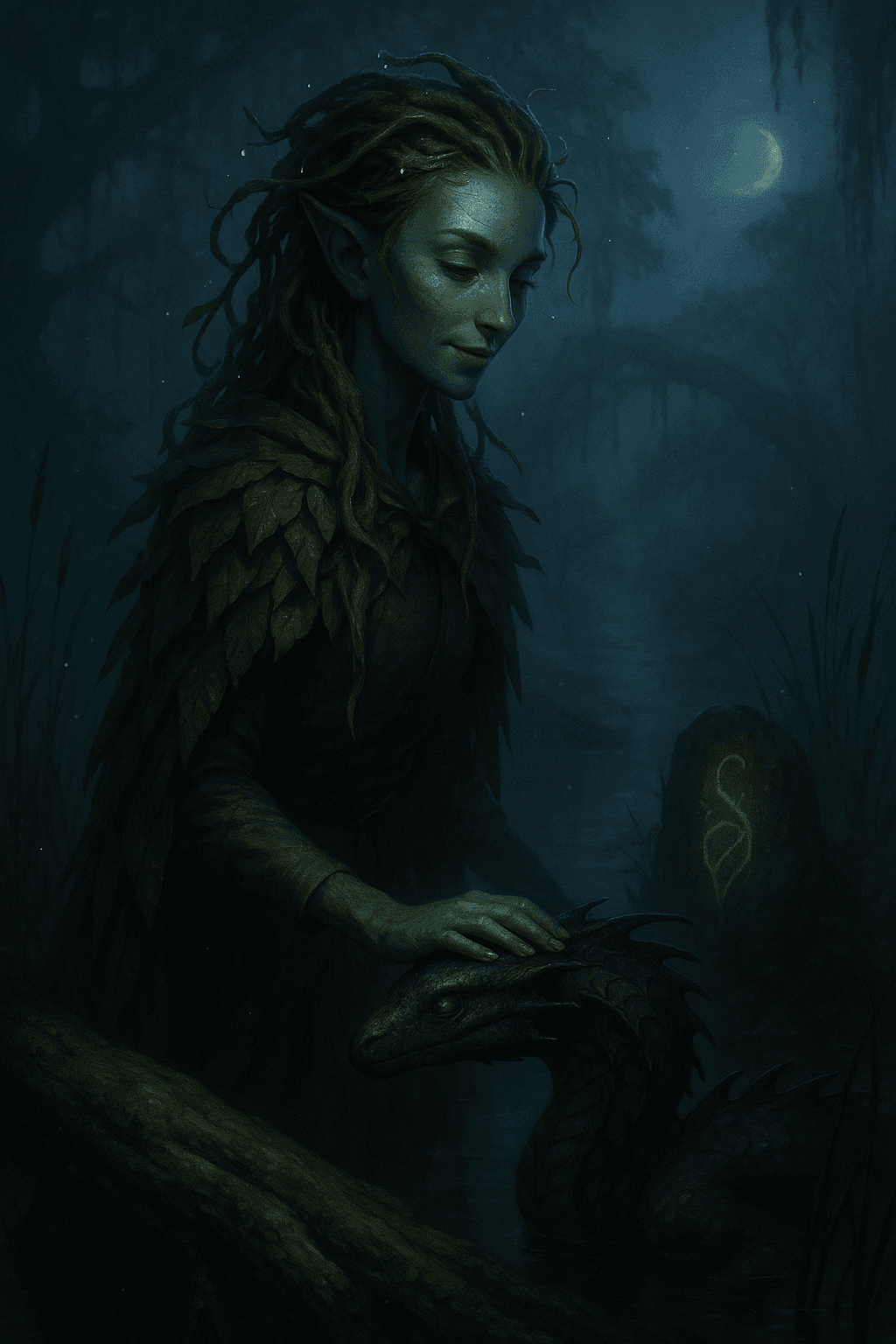
There is a way to move through Duskfall without leaving a ripple. The trick, Lilt says, is to listen for where the swamp already intends to remember you, and step where it doesn’t. She learned this young, when the Vinebound were still finding words for themselves and Hollowroot was more hush than city. Limber as a switch and quiet as moss, Lilt ran the black-water margins and mapped the breathing of the fog.
Origins.
The Whispering Bloom was only a rumor then—a gathering of minds around a single will that called itself Vineheart. Lilt did not sit at councils; she scouted for them. She moved along root-arches at night, counting lantern-moths and the rhythm of distant reeds. Where the mire pooled into mirror-dark canals, she pressed her palm to the water and felt the pull of slow currents, the simplest way to mark a safe path without chalk or blade. She wore no metal and carried no torch. Her cloak was a net of creepers stitched with dew, and her steps left prints that looked like the swamp’s own handwriting.
Across the treeline, Galdrowen breathed a different kind of hush. Druids tended newborn rituals; Beastkin marked trails with sap and whistle. Lilt learned their edges the way a musician learns a new instrument—first by imitation, then by understanding, never by arrogance. She knew the places where their wardens stopped humming and their birds started again, the exact height of a spindle-root that made a perfect lookout, the scent of a Thornhall glade when rain came from the east instead of the south. She did not cut living wood in those borders. She borrowed it: reeds bent and sprang back, vines unlooped and re-looped, the land always as it had been—except for what she now knew.
On a gray morning, she saw a young Beastkin from the grove-wilds doing exactly what she was doing. The girl—Thalia, though Lilt didn’t learn the name then—stood at the edge of a half-fallen trunk, watching the swamp with eyes like new leaves. For a long breath the two scouts were mirrors across the boundary, each measuring the other’s patience. Lilt lifted one finger and drew a circle in the fog. A promise of return, not an invitation to chase. Thalia nodded once, as if agreeing that the day did not yet want trouble, and vanished into fernlight. Lilt carried that respect back to Hollowroot like a well-folded map.
When Elder Mossbeard and Vineheart held their tentative parley in Swale Glade, Lilt made it possible without being seen. She cleared a path of whisper-nettles, persuaded a juvenile Duskwyrm to coil asleep around a stone instead of a trail, and left small, harmless snares that would tattle if anyone tried to interrupt the meeting from the shadows. Later, when the parley yielded no alliance but also no blood, Vineheart asked how many watchers had been needed to keep the grove honest. “None,” Lilt said. “We kept ourselves honest first.” Vineheart’s slow smile was approval enough.
Her reports were not lists of distances and threats. They were stories of currents and intentions—“The forest’s scent is steady,” “Their wardens heal before they harden,” “The quilts of thorns are a promise not to step where they sing.” Tarn the Murkborn sometimes teased that her notes read like poetry. She replied that they were recipes: a pinch of patience, a measured silence, a path salted against panic. The Mire learned to trust the kinds of knowledge that could not be weighed but could be walked.
Lilt’s craft was not only stealth. She trained runners to move with a swamp’s heartbeat, to taste which fog meant cover and which meant getting lost. She taught hand-signs that used the curve of a leaf or the tilt of a cattail as syntax so no outsider would guess there was language in the landscape. When Duskwyrm hatchlings first began to shadow her patrols, she used a reed-flute to set a winding pace, letting their natural caution turn into discipline. She left no scratches on bark, no cairns on trails—only patterns the mire would have made on its own if it had been thinking a little faster.
People say scouts are lonely; Lilt would disagree. She kept company with small things: the click of seed-pods, the way moonlight paints a root-arch, the soft change in the air when an old vow is being kept nearby. She was present at the beginning of an identity—the Mire discovering that it could be cunning without cruelty, patient without passivity. If you asked what she did for the Whispering Bloom, she would answer: “I kept the dark from getting noisy.”
What remains of her early maps are not paper but pathways. If you walk a quiet curve between reed and stone and feel your feet choose the surest place without thinking, that is her lesson still at work. The Mire remembers those who moved like it meant to move already. Lilt was the first to make remembering a method.