
Elarin Wildbloom
Open the paths; keep the roots.
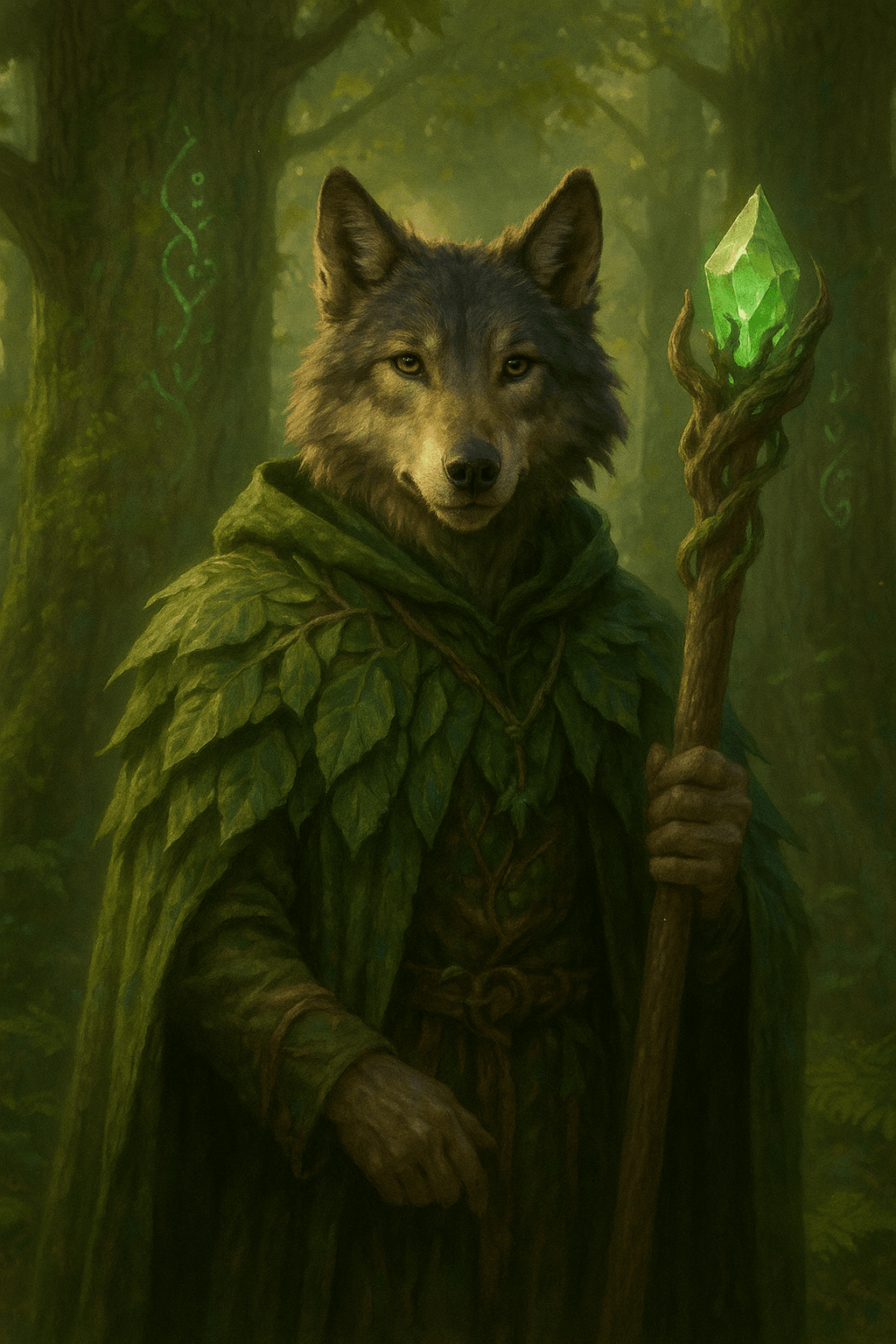
Elarin Wildbloom did not inherit Galdrowen so much as ask it a question and listen long enough for the forest to answer. Wolf-beastkin by blood and disposition, he moves with the alert patience of a trail-scout who knows every twig has two stories: what broke it, and what grew it in the first place. In the Era of Echoes—when patience itself began to sprout—Galdrowen chose him to wear the Verdant Circle’s mantle.
He came from the outer groves, where Thornspine quilts hum in a tone that keeps the Mire’s shadows at the border and children learn to read weather from fern posture. There Tharavos Mossfang mentored him in the old ways: hold the line, speak seldom, prize the grove’s silence over any distant diplomacy. Elarin absorbed every lesson, then started asking the kind of questions that make elders sigh: If the leylines are mending, should our paths not open, too? If the forest is strong, why must we answer the future with a closed fist?
When the Circle’s staff passed to him, he announced no revolution. Instead, he began a practice of “path-opening.” He sent listening bands—young wardens paired with Sylvan spirits—to map where the leys ran truer than they had in generations. Where the music of the quilts softened from warning to welcome, he marked greenways: narrow, living corridors that would admit traders, scholars, and the occasional Skyreach envoy willing to swear an oath in living wood. Not every elder approved. Tharavos called it risk made polite; Kaern Thistlebite, the blunt captain of the border runs, demanded proof these corridors would not become wounds.
Elarin’s proof was work. He established dawn courts beneath the council-tree where grievances were planted, not merely spoken. Each promise was pressed by palm to root, recorded by Virellia Rootwhisper’s gentle magic in the tree’s own memory. A trespasser who returned to make amends found the bark warm to the touch; a cheat found it rasping cold. In time, even the skeptical admitted that the greenways made the borders quieter, not thinner.
The dragons answered, too. Young Grove-Wyrms began to stir in the deep glades with the calm of an old song remembered. Thornspine packs, once hair-triggered by the world’s warps, grew deliberate again—flanking, herding, standing down when a raised hand and a steady tone said friend. And from the ley-bright hollows came the Verdant Embers: small, fierce hybrids whose green fire cauterized corruption and coaxed new shoots from ash. Elarin took this as a sign that renewal and defense were no longer enemies. He paired Ember handlers with border drakes, so warmth could set resin quilts faster and quilts could teach fire to move like a forest, not a blaze.
None of this gentled the Mire. Duskfall’s Whispering Bloom sent operatives into the softened places, and once—just once—a Memory Drake’s dream tried to drown an entire patrol in borrowed sorrow. Elarin met that incursion in person. He stood on the wet edge of Hollowroot’s influence with only a staff and a ring of seedlings cupped in bark bowls. “Return what you have taken,” he told the mist, “and we will return what we have closed.” The fog folded, and when it opened again, the patrol’s memories lay on the ground like dew. He gathered them as if they were eggs. Kaern said later he had never seen a leader make a threat so softly that it sounded like mercy.
Beyond the borders, Elarin cultivated quiet friendships. With Skyreach’s scholars—scarred, careful, rekindled by the Prism Star’s return—he traded root-maps for star-charts, just as his forebears had, but with firmer terms: no isle’s shadow shall drift over the heart-groves; no experiment shall be staged within a song’s distance of a nesting wyrm. With Itharûn he exchanged riders’ courtesies: the Wardens of the Flame escorted caravans along high ridges while Galdrowen’s runners kept the valley paths clear of ambush. Even Vaelorien’s mourners found room on his greenways; he set lanterns among the reeds to honor those who walked half in water.
At night he writes. Not proclamations, but field notes—how a quilt’s tone lowers when a Verdant Ember warms it; what lies a Memory Drake tells and what truths it cannot hide; where the old scars of the Fracture still ache when wind comes from the east. He leaves space for disagreement and often fills it with Tharavos’s counter-arguments, written fair and exact. “The forest loves a good conversation,” he says, and his wolfish smile admits that he does, too.
Elarin Wildbloom’s gift is not spectacle. It is steadiness in motion: the wisdom to open without surrendering, to welcome without forgetting how to warn. Under his hand, Galdrowen is learning to breathe again—roots deep, paths clear, eyes forward. The border still bristles when it must; the heartwood still keeps its secrets. But the wind through Thornhall carries more birdsong now, and the young whisper—in a tone that sounds suspiciously like hope—that the forest is listening back.