
Aurelion Flameheart
Hope rises on wings of flame.
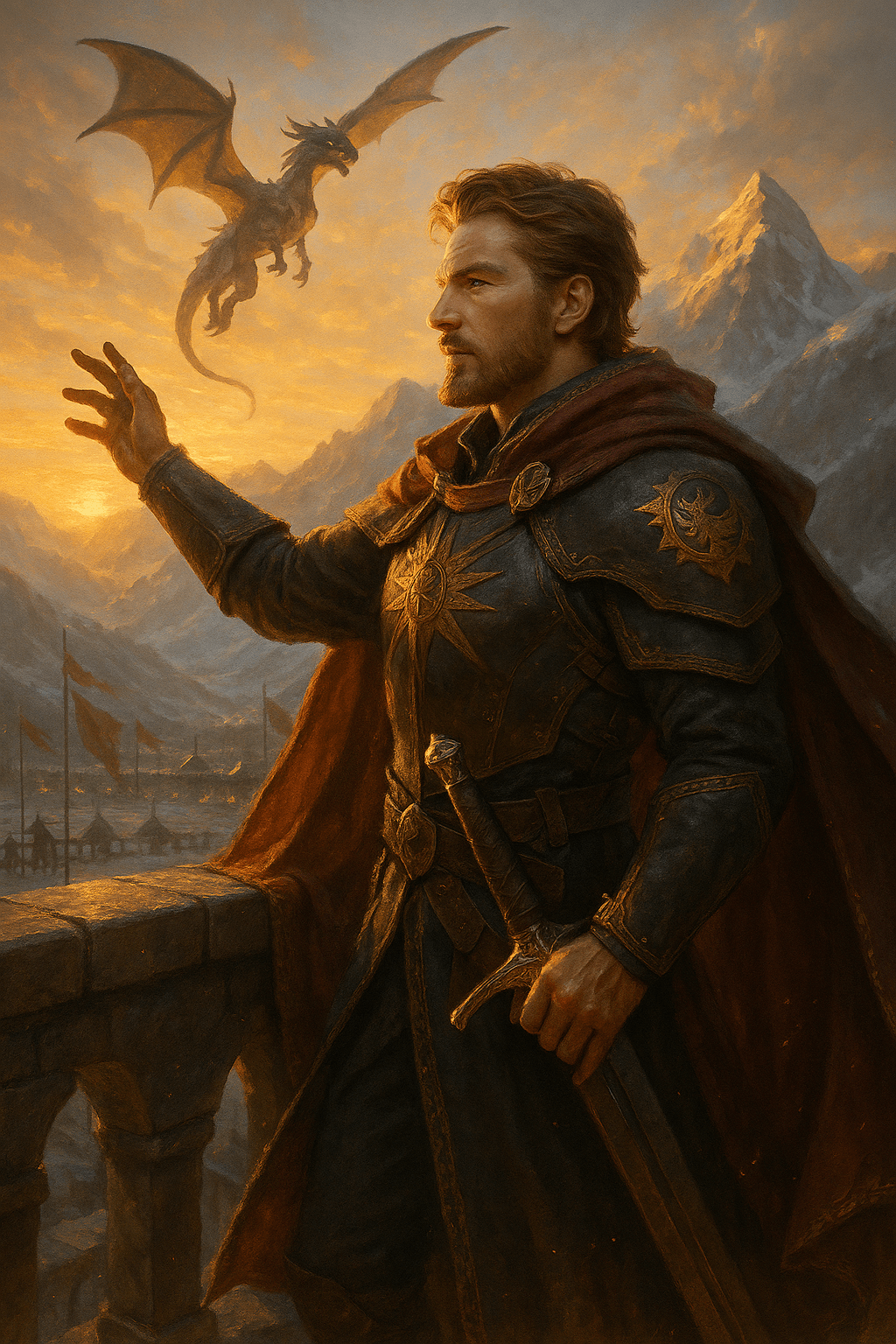
At first light the training ring at Highspire Citadel kindles with breath and brass. Young riders run the perimeter, instructors call out corrections that cut like clean blades, and dragons wheel above the ridge until sunrise gilds the world. From the eastern parapet Aurelion Flameheart watches it all—the measured rituals, the sudden laughter, the twin wakes of two Sky-Dragons crossing—and weighs how much of the realm’s future now fits between his hands.
This is the Era of Echoes, and Aurelion is the Warden who decided that echoes do not have to be endings. He inherited a brotherhood of veterans and a generation of hopefuls, a library of burn-edged chronicles, and a bond-craft grown brittle from long grief. He answered by rewriting the Wardens’ day in three parts: discipline at dawn, service at noon, reflection at dusk. “If the flame is to lead,” he told his captains, “we must teach it to listen.” The words felt simple in his mouth. Making them true would take the rest of his life.
He began with the bonds. Dragons had started to answer again—cautiously, like old friends testing a door they once used daily. Aurelion ordered the hush restored to the bonding halls: no banners, no spectacle, only vows, palms, and breath. He paired repentant veterans with green riders so that memory and hunger could temper each other. When the first Embermanes returned—dragons whose fires mirror the rider’s heart—he took it as a lesson written in flame: lead with honesty or be burned by pretense. Nyra Flamebond and her companion Ignivar became the emblem of that truth. Aurelion trained them personally in the high thermals, teaching the difficult art of cooling an Embermane with a whisper rather than a shout, and sent them on missions where empathy mattered more than steel.
The work of a Warden, however, is more than flight. Aurelion walked Highspire’s forges and libraries as often as its walls. He reopened the hall of flame-tempered relics and required each relic bearer to present the story of their blade alongside its edge. He convened a council where smiths, healers, and lorekeepers shared failures before successes. And he asked Ser Kaelen Duskveil—friend, skeptic, and the steadiest sword in Itharûn—to be the council’s counterweight. “You will save us from our slogans,” Aurelion said, and Kaelen, who still carries the weather of hard years in his shoulders, agreed.
Beyond the ridge, the world was moving. The Oath of Reclamation—sworn with House Elavorn—became Aurelion’s compass. He rode the sea-roads to Elavorn’s Rest to stand beside Tidecaller Aeliryn as divers raised a waterlogged crate of pre-war rider ledgers. He sent envoys north with gifts for Skyreach scholars—dragon-sung timings to help them calibrate their instruments—and answered Galdrowen’s letters with timber and hands for mending storm-bent watchtowers. Alliances do not keep the sky from tearing, but they give it places to be stitched.
There were darker errands. Reports from the volcanic dominion spoke of the Embercore and of Cindermaws born wrong. Aurelion refused the easy answer of grand crusades. He sketched containment rings on campaign maps, deployed Stormriders to shear sparks from ash-storms, and taught his captains to measure victory in lives steadied rather than foes slain. When he must ride to the red horizon, he rides last—after the young have launched and the elders have chosen their stations—so that whoever falters knows that their commander is behind them, not above them.
The hardest conversation of Aurelion’s year took place at midnight in a wind-cut aerie with a dragon who no longer trusted any human promise. Daranor, called the Unmoored, settled on the ledge with thunder in his chest and refusal in his old eyes. Aurelion did not argue. He spoke of the pact as a river that had run dry and could be dug again, of mistakes he would not excuse, of children who should never inherit only smoke. He placed his sword on the stone between them and offered a vow with empty hands. When dawn came, Daranor had not agreed—but he had not flown, either. Some nights later, a winged shadow kept pace above Aurelion’s patrol at a distance that said nothing and meant everything. Patience is a kind of courage. Aurelion keeps enough of it for both of them.
Leadership, for him, is a craft practiced in small precisions. He is the commander who knots a trainee’s sling with his own fingers and the statesman who writes his letters longhand so the ink slows his temper. He insists that every fallen rider’s name be spoken at the evening meal and that every new hatchling’s first flight be witnessed by the entire ring. “We will not become numbers again,” he tells the quartermasters. “Count arrows if you must. Count hearts with care.”
Hope is not the same as optimism. Aurelion knows the sky can still darken without warning. He keeps a traveling kit packed by the door: a map case scarred by rain, a coil of line, three polished river stones taken from a shrine where a child once asked him if dragons dream. (They do. He dreams with them.) When the alarm bells roll like distant surf, he does not hesitate. The Wardens follow because he has already done the work of making the path worth following.
If the Era of Echoes has a face in Itharûn, it is Aurelion Flameheart—jaw set against old storms, eyes alight with the difficult mercy of a second chance. He does not promise an age of triumph. He promises an age of repair, of bonds reforged in honest fire, of riders who know why they fly. And on the mornings when the sun catches the eyries and turns every scale to a page of gold, the realm believes him.