
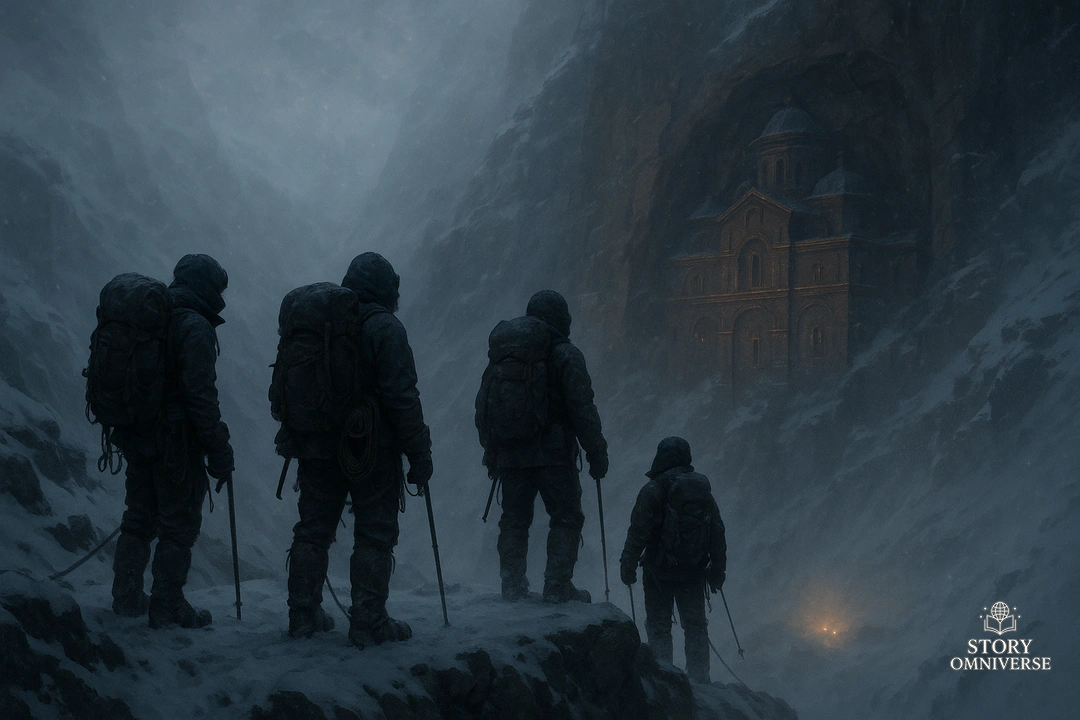
Chapter 1: Ash on the Switchbacks
Kaelen Dross crouched beside the switchback like a man listening for a heartbeat in stone. The mountain track was no road at all, just a scar of gravel and hard-packed clay rising into cloud. A thin dusting of ash lay in the ruts, the kind left by cheap diesel and a campfire that had burned too hot.
“Fresh,” he said, brushing the grit with two fingers. “Hours, not days.”
Marcus Renn shifted his pack higher, hiding how his breath came short in the thinning air. “Then we keep moving. Museum mandate is protection, not pursuit. We intercept, we prevent removal, we document. We do not escalate.”
Tamsin Vale kicked at a broken plastic seal tag half-buried in grit. A barcode flashed, then vanished under her glove. “Supply tag. The rival wants us reading their trail like scripture.”
Isolde Maren took it, eyes narrowing. “Or like a children’s tale. Breadcrumbs are for leading you somewhere.”
Kaelen pointed upslope. A bootprint, crisp as if pressed into wet ash and then frozen. Too crisp. Too neat. “Staged,” he murmured. “They want us to see it.”
Marcus glanced at the ridge line, where wind combed snow into pale banners. “Fine. We see it. We still follow, but we follow like we expect a knife.”
Isolde leaned close so her words would carry over the gusts. “If this is staged, it is staged for a reason. Delay. Injury. Or to frame us as looters when they arrive with cameras.”
Tamsin snorted. “Or all three. Efficient.”
They climbed. Cold bit through layers. Boots scraped shale that slid away in little avalanches. Every few turns another “clue” appeared: a torn ration wrapper, a strip of reflective tape, a scrap of paper with a number scrawled in blocky ink.
Tamsin held up the paper. “Coordinates. They are not even pretending.”
Kaelen’s jaw tightened. “Or they are pretending too hard.”
Marcus took the scrap and folded it carefully, as if respecting the lie. “We do not step where they want us stepping. Kaelen, you read the ground. Tamsin, you read their habits. Isolde, you keep your eyes on what matters.”
Isolde’s scarf snapped in the gust. “And what matters is a carved mask tied to Bronze Age boundary rites. If they remove it, the villagers lose more than an object.”
A gust hit hard enough to make them all lean into it. For a moment the mountain swallowed every sound except wind and their breathing.
Kaelen rose, scanning the slope like a hawk. “Stop treating their gifts like guidance,” he said. “Up here, gifts come with strings.”
Marcus looked toward the next switchback, where the trail vanished into fog. “Then we cut the strings,” he said. “And we keep moving.”
They pushed on anyway, ash and cold clinging to them as the mountain tightened its grip.
Chapter 2: The Villagers Who Refuse Maps
By late afternoon the storm arrived with no warning, as if the sky had been waiting for them to commit. Snow came sideways, stinging like grit. Visibility collapsed to a few meters. Kaelen led them off the exposed track and down into a tight valley where smoke rose from low roofs of slate and turf.
A hamlet clung to the riverbank, half-hidden by pine. No signposts. No road markers. Just a cluster of homes and a stone meeting hall with a bell that did not ring.
A woman in a wool cloak stepped into their path, holding a lantern high. Her face was weathered, eyes sharp. “No travelers,” she said in clipped Cartarran mountain dialect. “Storm takes them.”
Marcus raised both hands, palms open. “We need shelter. One night. We pay in trade.”
Behind her, villagers watched from doorways, silent as if silence itself was a rule. When Tamsin shifted her pack, a child flinched and vanished behind a wall.
Isolde stepped forward, voice gentle. “We are searching for an old monastery.”
At the word monastery, the lantern woman’s expression tightened. “No monastery. Only rock.”
Kaelen muttered, “They know.”
Inside the meeting hall, heat from a peat fire fought the cold. Elders sat in a semicircle, hands wrapped around cups. Marcus offered dried tea bricks and a small tin of salt. It was not much, but it was something.
An elder with a braided beard stared at Marcus. “Maps bring strangers. Strangers bring claims.”
“We are not here to claim,” Marcus said. “We protect history.”
The elder’s mouth twisted. “All outsiders say that. Even the ones with uniforms.”
Isolde opened her notebook, revealing careful sketches. “A carved mask,” she said. “Linked to Bronze Age kings.”
Silence fell heavy. The elders exchanged glances that were not quite fear, not quite anger. The braided-beard elder leaned forward. “Masks are for the dead,” he said. “Not for foreign halls.”
Isolde’s fingers tightened on her pencil. “Then tell us the legend,” she said softly. “The one you do not put on maps.”
The lantern woman’s throat worked. The braided-beard elder spoke, voice low, as if the fire might overhear. “The Face of Silence,” he said. “A king wore it when the mountain opened. He spoke through it and the world listened, then burned. So the monks took the face and sealed it where breath should not go. The mountain remembers with fire if the face travels.”
Tamsin’s eyes flicked to Marcus. “That is not a metaphor.”
Isolde swallowed. “My mother wrote a phrase,” she said, and spoke it in an old cadence: “Stone remembers, but the mouth must not.”
The room changed. A few elders lowered their eyes. The lantern woman exhaled as if she had been holding her breath for years.
“How do you know that?” the braided-beard elder asked.
“My mother,” Isolde said, voice unsteady. “She learned it here, long ago, from someone who would not give her a map.”
The elder studied Isolde’s face, then nodded once. “There is a route,” he said. “Safe only if you pass as guests, not hunters.”
Tamsin leaned in. “Define ‘pass.’”
The elder’s gaze flicked to her tools. “No iron in sacred places. No digging. No taking.”
Kaelen asked, “And the rival convoy?”
A ripple went through the elders. The lantern woman’s jaw set. “They came,” she admitted. “They demanded roads. We refused. They left gifts.” Her mouth twisted. “Gifts that smelled like threats.”
Marcus felt the cold even near the fire. “Point us,” he said. “We will keep them off your mountain.”
The elder drew a line on the dirt floor with a stick, tracing a path that curved away from the obvious passes. “Follow the river until it disappears,” he said. “Then follow the sound that is not water.”
Isolde whispered, “A test.”
The elder met her eyes. “Everything up there is a test,” he said. “Even your Museum, if it sent you.”
Marcus stiffened. “The Archivian Museum sends us to preserve.”
“Then prove it,” the elder said. “Leave what must stay.”
Chapter 3: The First False Gate
Morning broke gray and sharp. The storm eased but left the world buried in new snow that hid cracks and drop-offs. The elder’s route followed a river that ran under ice, its voice muffled. Kaelen moved ahead, probing with a pole, marking stable ground with small stone stacks.
Hours later, the river vanished into a boulder field. Wind funneled through the rocks, making a low whistle that could have been water if you wanted it to be.
Tamsin pulled out the rival’s discarded paper from Marcus’s pocket. “Their coordinates match this line,” she said. “They wanted us here.”
Kaelen’s eyes narrowed. “Which means it is either a shortcut or a snare.”
They rounded a spur of cliff and found a shrine wedged into the rock face. A small alcove, stacked stones, a bronze bowl blackened by old soot. Prayer ribbons fluttered, too new, their knots neat.
Isolde stepped closer, reverent despite herself. “Not village work,” she murmured. “The bowl is cast, not hammered. Older style.”
Marcus crouched, scanning. “No footprints,” he said. “Not in snow, not in dust. Yet the ribbons are fresh.”
Tamsin grinned, already reaching for a handhold. “Maybe the wind tied bows.”
“Don’t,” Kaelen snapped. “The stone is wrong.”
Too late. Tamsin’s boot found a ledge. The rock shifted under her weight with a dry, hollow crack.
“Down!” Marcus shouted.
The shrine face gave way like rotten wood. Stones slumped outward. The bronze bowl clanged and vanished into a sudden opening. Snow and gravel poured after it.
Tamsin dropped backward, catching herself on Marcus’s arm. Kaelen lunged, grabbing her pack strap, and the three of them skidded as the ground under the alcove crumbled.
Isolde cried out as the edge broke near her boots. Kaelen caught her sleeve and yanked her away from the collapse. They hit the snow hard, sliding until a boulder stopped them.
For a moment there was only ragged breathing and the sound of stones settling into a new, ugly silence.
Tamsin sat up, hands scraped raw through her gloves. “That was shored,” she said, voice tight. “Someone packed it to look stable.”
Marcus stared at the broken shrine. Fresh wood splinters showed where supports had been wedged. “Recently.”
Kaelen’s face was pale with anger. “They wanted a collapse,” he said. “Not to kill. To slow, to injure, to make us waste daylight.”
Isolde’s hands trembled as she checked her notebook, making sure it was intact. “They chose a sacred-looking place,” she whispered. “So we would trust it.”
Marcus’s jaw worked as if he were chewing the cold. “Not just misdirection,” he said. “They want us compromised.”
Tamsin flexed her scraped fingers, wincing. “Consortium crews do not get their hands dirty. They hire hands that can disappear.”
Marcus stood, forcing steadiness into his voice. “We stop reading their trail like truth. Kaelen, new line. Ignore their papers.”
Kaelen nodded once, but his eyes stayed on the broken shrine like he wanted to burn it down with a look. “They are ahead,” he said. “And they are laughing.”
Marcus pulled the rival coordinates from his pocket and tore them in half. The scraps fluttered into the snow like dead leaves.
“Let them laugh,” he said. “We climb anyway.”
Chapter 4: Black Glass in the Snow
The next ridge was a knife edge, exposed to wind that never seemed to rest. Kaelen went alone for a while, moving with the careful speed of a man who knew the mountain could kill without malice. He returned with a motion that meant come, but quietly.
“What?” Marcus asked, voice hoarse.
Kaelen led them to a shallow saddle where the snow thinned. Dark stones lay scattered across the ground, not natural basalt, not slate. They were glossy, sharp-edged, as if the mountain had bled glass.
Tamsin crouched, tapping one with a tool. “Vitrified,” she said. “Heat did this. Not a campfire.”
Isolde knelt, ignoring the cold soaking into her knees, and began arranging the stones with her gloved hands. “It is a pattern,” she murmured. “Not random scatter.”
Marcus frowned. “Isolde, eyes up. This ridge is exposed.”
“I know,” she said, and there was a sharpness that made Kaelen glance at Marcus. “But this is deliberate. A boundary mark.”
Kaelen touched a stone and pulled his hand back fast. “Warmer than it should be.”
The wind rose, and with it came a low vibration underfoot. At first Marcus thought it was his own pulse. Then he saw the snow shiver in tiny ripples, as if something beneath was humming in answer to the air.
Tamsin swallowed. “Do you feel that?”
Isolde’s voice quickened, excitement edged with fear. “Bronze Age fire rites,” she said. “Mountain cultures called lightning the king’s breath. They struck ridges with bronze rods, made glass from stone, marked where you do not cross with greed.”
The humming deepened. Kaelen’s eyes darted to the ridge crest. “Wind is funneling,” he said. “Building charge.”
A gust hit hard enough to stagger them. The stones clicked against each other, making brittle music. Marcus felt the ground vibrate more strongly, like a distant engine.
“Back,” Kaelen ordered. “Now.”
Isolde resisted, leaning toward the pattern. “One rubbing,” she pleaded. “Just one. This could prove the legend is older than the village.”
Marcus grabbed her arm, guilt flaring at the desperation in her voice. He forced himself to be firm. “You can prove it alive,” he said. “Move.”
Tamsin shoved Isolde’s notebook into her chest. “Write later,” she snapped. “Freeze now.”
They retreated downwind, boots slipping on hard snow. The humming followed them, then faded as they crossed an invisible line. Marcus looked back. The black stones sat calm again, glossy and indifferent.
Isolde’s cheeks were flushed with cold and frustration. “You dragged me away from evidence.”
“I dragged you away from a ridge that wanted to throw us into the sky,” Marcus said.
Kaelen’s voice was low. “Those stones are a warning,” he said. “Not for monks. For anyone who thinks the mountain is theirs.”
Isolde hugged her notebook tighter, eyes still on the glass scatter. “Or a warning about what the mask seals,” she whispered.
Marcus did not answer. The thought sat in his throat like ice, and the air up here was already hard enough to swallow.
Chapter 5: The Monastery That Hides Its Door
Dusk made the world a study in blue shadow. They climbed into a fold of rock where the wind abruptly softened, as if the mountain itself had decided to speak quietly. Kaelen halted and raised a hand.
There, half-swallowed by stone, were roofs. Not the proud roofs of a fortress, but low, slanted planes of slate that mimicked the mountain’s own angles. They would have been invisible if the last light had not caught something embedded in the walls: thin lines of bronze inlay that flashed like old coins.
Tamsin exhaled. “That is hidden on purpose.”
Isolde’s voice went soft. “A monastery that does not want to be found.”
A narrow stairway climbed to a blank rock face. No door. No gate. Just stone.
Marcus stepped forward, searching for seams. “We announce ourselves,” he said. “Respect first.”
He raised his voice into the darkening air. “We are travelers seeking shelter and counsel. We come in peace.”
Silence.
Then, from somewhere in the rock, a panel shifted. A slit opened, and an eye appeared. Calm. Assessing.
A voice followed, measured and unhurried. “Names.”
“Marcus Renn,” Marcus said. “Archivian Museum of Lost Histories. With my team.”
The eye did not widen at the Museum’s name. If anything, it cooled. “Purpose.”
“Protection,” Marcus said. “A rival group is on this mountain. We believe they seek something sacred.”
A pause. The panel slid wider, revealing a monk in dark wool, face lined but serene. Behind him, a corridor lit by oil lamps.
“You followed them,” the monk said. It was not a question.
Kaelen spoke before Marcus could. “They left false clues. Tried to break us.”
The monk’s gaze flicked to their scraped hands, their frost-stiff gear. “The mountain tests,” he said.
“And you?” Tamsin asked, half-defiant. “Do you test too?”
The monk’s expression did not change. “We guard what we were given to guard.”
More monks appeared, not armed, but positioned like a wall. Their calm certainty was its own weapon.
An older man stepped forward, head shaved, eyes clear as winter water. The abbot. Marcus felt it in the way the others shifted subtly around him.
“You may enter,” the abbot said, “if you vow.”
Marcus hesitated. “Vow what?”
“That nothing sacred leaves this mountain,” the abbot replied. “Not in pack, not in pocket, not in memory turned to profit.”
Isolde’s breath caught. “You ask us to come blind.”
“I ask you to come honest,” the abbot said.
Marcus looked at his team. Kaelen’s posture said he would accept any vow if it kept them alive. Tamsin’s jaw worked, calculating exits. Isolde looked torn, as if the vow were a blade pressed to her ambition.
Marcus heard his own words from the hamlet: we protect history. Protection had weight. It demanded cost.
“We vow,” Marcus said, and felt the words settle into him like a stone. “Nothing sacred leaves the mountain.”
The abbot studied him for a long moment. “Then step inside,” he said. “And understand what you have promised.”
Warmth and the smell of incense drifted out. As they crossed the threshold, Marcus glanced back at the dark ridge behind them. Somewhere out there, the rival convoy was still climbing.
Inside, the monastery swallowed the sound of the wind, and in that sudden quiet Marcus felt, for the first time, that the real danger might not be the cold.
Chapter 6: The Rival’s Flag on Holy Ground
The monastery’s interior was spare, stone corridors softened by woven rugs and the steady glow of lamps. The monks gave them hot broth without ceremony. It tasted of salt and herbs, and it felt like life returning to numb fingers.
Tamsin warmed her hands over the bowl. “They do not do small talk,” she whispered.
Kaelen listened to the building the way he listened to terrain. “They do not need it,” he murmured back. “They built silence into the walls.”
Marcus sat with the abbot in a small chamber off the prayer hall. The abbot’s hands rested on his knees, still as carved wood. “You have rivals,” he said. “They are louder than you.”
“They have vehicles,” Marcus replied. “And papers. Sometimes papers are louder than engines.”
The abbot’s eyes sharpened. “Papers have brought trouble before.”
A bell rang once, not from the hamlet but from within the monastery. A monk entered quickly, speaking low in the abbot’s ear. The abbot rose.
“They have arrived,” he said.
Marcus followed him to a narrow balcony overlooking the outer approach. Headlights cut through the dusk below. Snow churned under tires. Men and women in insulated uniforms moved with practiced urgency, setting portable flood lamps that turned the mountain slope into a harsh stage.
A tall woman in a white helmet stepped forward, holding a folder. She raised it toward the monastery as if it were a flag.
“By order of the Aster Vale Cultural Safeguards Consortium,” she called, voice amplified, “acting under emergency heritage protection contract, this site is now under consortium oversight. Open your doors and present all holdings for safeguarding.”
Tamsin hissed, “Aster Vale. Of course. Corporate with a government stamp rented by the hour.”
Isolde’s face had gone pale. “They sound official.”
Marcus leaned close to the abbot. “Let me see the document,” he said. “Do not answer their volume with fear.”
The abbot gestured, and the door panel opened just enough for Marcus to step into the cold. He walked down the stairway to meet them, Kaelen shadowing him a few steps behind.
The woman smiled without warmth. “Marcus Renn,” she said, as if reading from a dossier. “Archivian Museum. You are out of your jurisdiction.”
“Jurisdiction does not climb mountains,” Marcus replied. “Show me the authority.”
She handed it over. The paper was thick, the seal embossed. But the language was wrong. Not careful law, but pressure: must comply, obstruction, seizure.
Marcus looked up. “This is coercion,” he said. “Not lawful custody.”
A man behind her shifted, hand near his jacket where a weapon might be hidden. “We have transport,” the woman said smoothly. “We have funding. We have mandate to prevent looting.”
Kaelen’s voice was low. “You are the looters.”
The woman’s smile tightened. “We are protection. Unlike your Museum, which hoards.”
Behind Marcus, the monks stood in a line at the threshold, unarmed, their calm now strained. Supplies were finite. Marcus could feel it in the way the cold pressed in and the monastery’s warmth felt precious.
Tamsin whispered from the doorway, “They can camp. Starve us out. Or force a breach and call it rescue.”
The woman raised her voice again. “Open the monastery. Or we will open it for you.”
Marcus handed the paper back, keeping his tone even. “You will not touch this place,” he said. “Not tonight.”
Her gaze flicked past him to the monks. “Then you are obstructing contracted cultural protection,” she said. “That is a charge.”
Floodlights buzzed. Snow drifted in slow spirals. The standoff settled like ice between them.
The abbot stepped forward, voice calm but carrying. “This mountain is not yours,” he said.
The woman’s eyes hardened. “Everything can be made ours,” she replied.
Marcus turned slightly, speaking to his team without looking away from the lights below. “Stay warm. Count supplies. Assume a long night.”
Kaelen answered, “And assume they will try a short, violent one.”
Chapter 7: A Museum Order That Does Not Sound Like Preservation
Night dragged in, heavy and breathless. The consortium camp below glowed like an infection on the snow, floodlights and heated tents. The monastery’s lamps were small by comparison, but steadier.
Marcus sat in a side corridor with the Museum field radio cradled in his hands. The signal was weak, bouncing off rock. He waited for the scheduled check-in window, watching the indicator flicker.
Isolde paced nearby, unable to settle. “If Aster Vale brought that much gear,” she said, “they intend to stay until they get what they want.”
Tamsin leaned against the wall, fingers worrying a bent hinge she had found. “People with that much gear do not leave empty-handed. They leave with a crate.”
Kaelen stood at a narrow window slit, watching the slope. “They are probing,” he said. “Two on the left ledge. One keeps circling like he is counting doors.”
The radio crackled. A coded burst came through, then a voice, clipped and familiar in its restraint.
“Northstar,” the voice said. “Confirm status.”
Marcus recognized Captain Rhys Calder’s cadence even through distortion. Museum Security Liaison, not a curator, not a scholar. The chain of command tightened in Marcus’s mind: field teams reported up, security interpreted risk, directors signed off. In theory.
“Field Core is at the monastery,” Marcus replied. “Aster Vale Consortium present. Standoff ongoing. Monks refuse entry. We are sheltering with them under vow.”
A pause, then a string of code words Marcus translated automatically: threat classification, exposure risk, containment priority.
Finally, the message came plain enough to chill him more than the wind outside.
“Secure the mask by any means,” Calder said. “Avoid local negotiation. Artifact must not remain accessible.”
Isolde stopped pacing. “By any means?” she echoed, voice thin.
Marcus swallowed. “Confirm,” he said into the radio, buying time. “You are ordering retrieval from the site?”
Another pause. “Do not delay,” Calder replied. “This is preservation protocol. If consortium removes it, consequences are unacceptable.”
Tamsin’s eyes narrowed. “That is not Director Veyra’s voice. That is security making a decision and calling it protocol.”
Kaelen turned from the window. “Museum wants it,” he said. “Consortium wants it. Monks want it to stay. Who is lying, and who is afraid?”
Isolde’s voice was strained. “If the Museum fears the mask, they might want it locked away where no one can ask questions.”
Marcus thought of the Archivian Museum’s marble pillars, its public galleries full of replicas, its hidden archives that hummed with sealed doors and restricted ledgers. He had always told himself the Museum kept dangerous things safe. Calder’s phrasing sounded less like safekeeping and more like seizure.
The abbot appeared silently at the corridor’s end, as if summoned by the tension. He looked at Marcus’s radio. “Your distant masters speak,” he said.
Marcus met his gaze. “They want the mask secured,” he admitted. “They want negotiation avoided.”
“And you?” the abbot asked.
Marcus hesitated, and in that hesitation he felt his old weakness: fear of choosing wrong and losing someone. “I want my team alive,” he said finally. “And I want this place unstripped.”
The abbot nodded slowly. “Then you must decide who you serve,” he said. “Your Museum, your vow, or your fear.”
Outside, the consortium’s floodlights shifted, sweeping the monastery walls like searching eyes.
Kaelen spoke quietly. “They will come tonight,” he said. “Orders or no orders.”
Marcus looked down at the radio, then at his team. “We hold,” he said. “But we do not become thieves.”
The words sounded brave. He was not sure yet if they were enough.
Chapter 8: The Sanctum Below the Prayer Hall
Just before midnight, a monk led Marcus and Isolde through a side passage that sloped downward. Kaelen insisted on coming, but the abbot raised a hand. “Too many feet,” he said. “Too much noise. You guard the living above.”
Kaelen’s eyes flashed, but he stepped back, jaw tight. “If you do not return,” he warned Marcus, “I come anyway.”
Marcus clasped his shoulder once. “You will,” he said. “But give us minutes, not seconds.”
The passage ended at a stone door carved with worn symbols: spirals, sunbursts, and faces without faces, each head covered by the same stylized mask. The monk pressed his palm to a hidden notch, and the door shifted with a soft grind.
Cold air breathed out, older than the storm. Oil lamps lit the chamber beyond, revealing walls etched with Bronze Age carvings. Figures marched in lines, bodies rendered in simple strokes, heads always masked. Above them, a crowned figure raised a mask like a standard.
Isolde’s voice trembled with awe. “This culture was erased,” she whispered. “Not lost. Erased.”
Marcus kept his eyes moving, scanning corners, floors, seams. “Read,” he urged. “Fast. Tell me what changes our choices.”
Isolde moved to an inscription band, fingers hovering without touching. “The script is early,” she said. “Hybrid. Border language.”
The monk watched her carefully. “Speak only what you understand,” he said.
Isolde translated aloud, halting at first, then gaining certainty. “It says… ‘The kings wore the face of silence. The face bound the breath below.’” She looked up, eyes wide. “Bound the breath below.”
Marcus felt a slow tightening in his chest. “A seal,” he said.
Isolde nodded. “Not a trophy. A boundary marker. A lock.”
Marcus’s boot brushed something pale on the floor near the far wall. He crouched. Fine powder clung to the stone, gritty between his fingers.
Drill dust.
His stomach dropped. “They have been here,” he whispered.
Isolde followed his gaze. “No,” she said, horrified. “The monks would have known.”
The monk’s calm cracked for the first time. “We sealed this,” he said, voice tight. “No one enters without us.”
Marcus stood, scanning the chamber’s edges. “Then they did not enter through the door.”
He found it: a hairline fracture in the corner where wall met floor, dust gathered like flour. A hidden breach, small but fresh. Someone had drilled, pried, and reseated stone to hide the wound.
Isolde pressed a hand to her mouth. “They are ahead of us,” she whispered. “They found another way in.”
Marcus looked at the carvings again, at the repeated masked faces. “If the mask is a seal,” he said, “and they take it…”
The monk’s voice was a rasp. “Then the boundary breaks.”
Above them, faintly, came a dull thud. Not stone settling. Not wind.
A boot on wood.
Marcus’s radio crackled once, and Kaelen’s voice hissed through, strained. “They are at the upper wall,” Kaelen said. “Service ledge. They have a cutter. Marcus, they are coming in.”
Marcus met Isolde’s eyes. “We have minutes,” he said. “Tell me what matters most.”
Isolde looked at the inscription, then at Marcus. Her obsession warred visibly with fear. “That it must stay,” she said. “And that the Museum might already know it must stay.”
Marcus felt the vow tighten around his ribs. Above, the monastery creaked as if listening.
Chapter 9: Betrayal by Necessity
They returned to the upper halls to find Tamsin waiting in a shadowed alcove, face pinched, hands clenched around a coil of wire she was not using. Kaelen stood nearby, snow in his hair, eyes hard.
Marcus took one look at them and knew something had shifted. “What happened?”
Tamsin swallowed. “Before you say anything,” she began, voice brittle, “I did something stupid. Or practical. Depends if we are alive tomorrow.”
Kaelen’s stare could have cut stone. “Tell him,” he said.
Tamsin’s shoulders rose and fell. “I have debts,” she said quietly. “Old ones. A fixer named Joryn Sable. He runs comms and favors for Aster Vale subcontractors and anyone desperate enough to pay. I sent a ping earlier. No location, no artifact. Just that we were pinned and needed an exit option.”
Marcus’s face went cold. “You contacted an outside network without telling me.”
“I was trying to keep us alive,” Tamsin snapped, then her voice cracked. “I thought he could stir up a distraction, pull a vehicle, cut a line. Anything. I did not give him the monastery.”
Isolde stepped forward, anger sharp. “He did not need the monastery. He needed confirmation we were here.”
Tamsin nodded, eyes shining with shame. “He always sells,” she whispered. “I forgot that when I was scared.”
A shout echoed from outside, amplified by the cold. Lights swung. The consortium’s camp erupted into motion.
Kaelen peered through the slit window. “They are moving now,” he said. “Up the approach. More people than before. They have shields and a ram.”
The abbot appeared, monks gathering behind him like a tide of dark wool. “They have come to take,” he said. His calm was still there, but it had turned to iron. “You brought them.”
Tamsin flinched as if struck. “I did not mean to,” she said to the abbot. “I swear.”
The abbot’s gaze held no cruelty, only disappointment. “Meaning does not change consequence,” he replied.
Marcus felt leadership press down, heavy as the mountain. He wanted to shout, to blame, to vent fear. Instead he forced his voice steady. “We made a vow,” he said. “We keep it. We protect this place.”
Kaelen’s eyes flicked to Marcus. “How?” he asked. “Fight them here? On sacred ground?”
Isolde’s hands trembled. “If we fight inside the sanctum, we risk the carvings and the seal. If we do nothing, they overrun the monks.”
Tamsin looked up, desperate. “I can rig barriers,” she said. “Non-lethal. Slow them. Make it too costly.”
Marcus’s mind raced through options, each one ugly. Calder’s order echoed: secure by any means. Avoid negotiation. It sounded suddenly like the Museum expected violence, maybe even wanted it, so the mask could be taken under cover of chaos.
He looked at the abbot. “Do you have hidden ways?” he asked.
The abbot’s eyes narrowed. “We have passages,” he admitted. “For times when the mountain itself is enemy.”
“Then we use them,” Marcus said. “We do not meet force with force in your holiest place.”
Outside, boots crunched on snow. A voice called up, impatient. “Open the doors. Last warning.”
Kaelen checked his climbing knife, then deliberately left it sheathed. “They want blood,” he said. “So they can call it necessity.”
Marcus nodded. “Then we deny them that story,” he said.
Tamsin wiped her face with the back of her glove. “I will fix this,” she whispered.
Marcus met her gaze, anger still there, but tempered by the immediate threat. “You will help us survive,” he said. “After that, we talk about trust.”
The monastery’s door shuddered under the first heavy удар from outside.
Chapter 10: The Night of Thin Air
The blizzard returned as if summoned by conflict. Wind slammed into the monastery walls, driving snow into every crack. The consortium’s floodlights turned the storm into a swirling white curtain. Their shouts came muffled, distorted by the gale.
In the outer corridor, Marcus crouched with Kaelen and Tamsin over a scatter of monastery supplies: old wooden benches, rope, clay jars of lamp oil, and a sack of dried herbs that smelled sharp enough to sting.
“No maiming,” Marcus said, voice hard. “No blades. No fire that spreads.”
Tamsin nodded, already threading wire through bench legs. “Trip lines at knee height,” she said. “They hit benches, benches slide, they go down. Bruised pride, not broken bones.”
Kaelen tested a rope knot with gloved hands. “We can make them think the main hall is open,” he said. “Funnel them into the wrong corridor. The monastery is a maze if you do not know which rugs hide steps.”
Isolde stood with the abbot near a carved pillar, her face pale in lamplight. “They will not stop,” she said. “They believe their contract makes them righteous.”
The abbot’s jaw tightened. “Authority is a word,” he said. “The mountain is real.”
A crash shook dust from the ceiling. The outer door groaned. Tamsin’s eyes flicked up. “That will not hold.”
Marcus keyed his radio to Kaelen’s earpiece frequency. “Positions,” he said. “Kaelen, guide. Tamsin, traps. Isolde, with me. Abbot, move your people now.”
The door finally gave with a crack like splitting ice. Cold air roared in. Shapes appeared in the storm, headlamps bobbing. Consortium boots stamped onto monastery stone.
“Move!” Marcus shouted, and stepped back into shadow, letting the monks vanish into side passages as rehearsed.
Kaelen pulled a hanging tapestry aside, revealing a corridor that looked like a main route. He tossed a small clay jar, and it shattered, spilling dried herbs that the wind carried into the intruders’ faces. Coughs erupted.
“Contact!” someone yelled.
Tamsin’s trip line snapped taut. Two figures stumbled, hit the bench barrier, and went down in a clatter. No screams, just angry grunts and curses.
The consortium pushed forward, regrouping. They were trained, not panicked. A woman barked orders, and two people took positions at the doorway, controlling the choke point while others advanced in pairs.
“They are securing a foothold,” Kaelen muttered. “They will hold the entrance and sweep room by room.”
A man raised a battering tool, aiming for another door. Marcus stepped back, drawing them deeper into the wrong corridor, letting the monastery’s turns do the work. He kept his breathing slow, thin air burning his lungs.
Isolde grabbed his sleeve. “If they reach the seal…”
“We keep them from reaching it,” Marcus said. “We make them chase ghosts.”
The abbot appeared at a side arch, motioning. “Here,” he said.
They slipped into a narrow passage behind the prayer hall, stone close on both sides. The air inside was colder, older, making every breath a conscious act. Behind them, the consortium shouted in frustration as they found false corridors and sliding benches.
Tamsin, last in line, paused long enough to pull a wire free and let a final bench collapse with a loud crash. It sounded like a wall giving way.
“Make them think they are winning,” she whispered.
Marcus nodded grimly. “And make them waste their strength,” he replied.
In the hidden passage, the monastery swallowed them, and the storm outside became a distant, furious animal. Above, the consortium held the entrance, but they did not hold the heart.
Chapter 11: The Mask Stays, and the Story Changes
Dawn came as a weak gray seep through cracks in stone. The blizzard had spent itself. In the monastery’s hidden lower passage, the Field Core moved with stiff limbs and dry throats. Every breath tasted of cold dust and lamp smoke.
The abbot led them to a chamber deeper than the sanctum they had seen before. This door had no carvings, only a smooth slab of stone with a single bronze inlay shaped like a closed eye.
“You vowed,” the abbot said quietly. “Now you see why.”
He pressed his palm to the bronze. The stone slid aside with a sound like a long exhale.
Inside, the mask waited.
It was carved from dark wood that had somehow endured centuries without rotting. Bronze studs traced the brow and cheekbones. The eyeholes were narrow slits, the mouth a sealed line. It was not ornate like a prize. It was purposeful, like a lock made into a face.
Isolde stepped forward, voice barely more than air. “It matches the carvings,” she whispered. “The same silence.”
Marcus kept himself back, forcing distance. He felt the pull anyway, not of beauty but of consequence. The mask seemed to drink warmth.
Beneath the pedestal, a final inscription was carved into stone. Isolde crouched, reading aloud, her voice shaking.
“‘Do not unmake the face. The face binds the breath that is not ours. If the face travels, the boundary breaks. If the boundary breaks, the mountain remembers with fire.’”
Kaelen, who had insisted on joining them at first light after the breach, cursed under his breath. “The black glass,” he said. “Fire remembering.”
Tamsin swallowed hard. “So Aster Vale taking it is not just theft. It is a disaster.”
Marcus heard Calder’s order again: secure by any means. Avoid local negotiation. Artifact must not remain accessible. The Museum’s motive shifted in his mind, from acquisition to containment, and that was not comfort. It was another kind of fear.
Isolde looked up at Marcus, eyes wet but fierce. “We cannot take it,” she said. “Not if this is true.”
Marcus nodded slowly. “We leave it,” he said, and felt the decision cut a clean line through his dread. “We protect it by not moving it.”
Tamsin let out a shaky breath. “The Museum will recall us. Sanction us. Calder will call it insubordination.”
“Let him,” Kaelen said. “At least the mountain will not.”
The abbot stepped closer, and for the first time his expression softened. “Then help us,” he said. “Reseal. Renew.”
Marcus and Kaelen lifted a stone plate from the floor, heavy and cold. Tamsin aligned bronze pins with hands steady despite exhaustion, locking the cover without scraping the pedestal. Isolde took rubbings of the inscription with charcoal and cloth, gentle as an apology, and then stopped herself from taking more.
As they worked, distant voices echoed faintly above. Consortium shouts, frustrated, thinning. Their foothold had gained them nothing but cold and bruises, and the monastery’s design had bled their momentum away.
When the final stone slid into place, the chamber’s air changed, as if a held breath had been released safely back into silence.
Marcus stood with the abbot at the sealed door. “We will leave with notes,” Marcus said. “No mask. No proof they can display. I will file a report that the artifact is immovable due to sanctity and safety risk. I will omit the access path and the chamber depth.”
“And if your Museum demands more?” the abbot asked.
Marcus thought of Calder’s voice, of the chain of command that could tighten like a noose. “Then they can send another team,” he said. “But they will not have my map.”
Isolde tucked the rubbings into her coat, eyes haunted and resolute. “My mother wanted truth,” she said. “Not disaster.”
They climbed back toward the surface, carrying only paper and the weight of a story that had changed them. Behind them, the mask stayed where it had always been, binding a boundary no map dared to mark.

0 Comments