
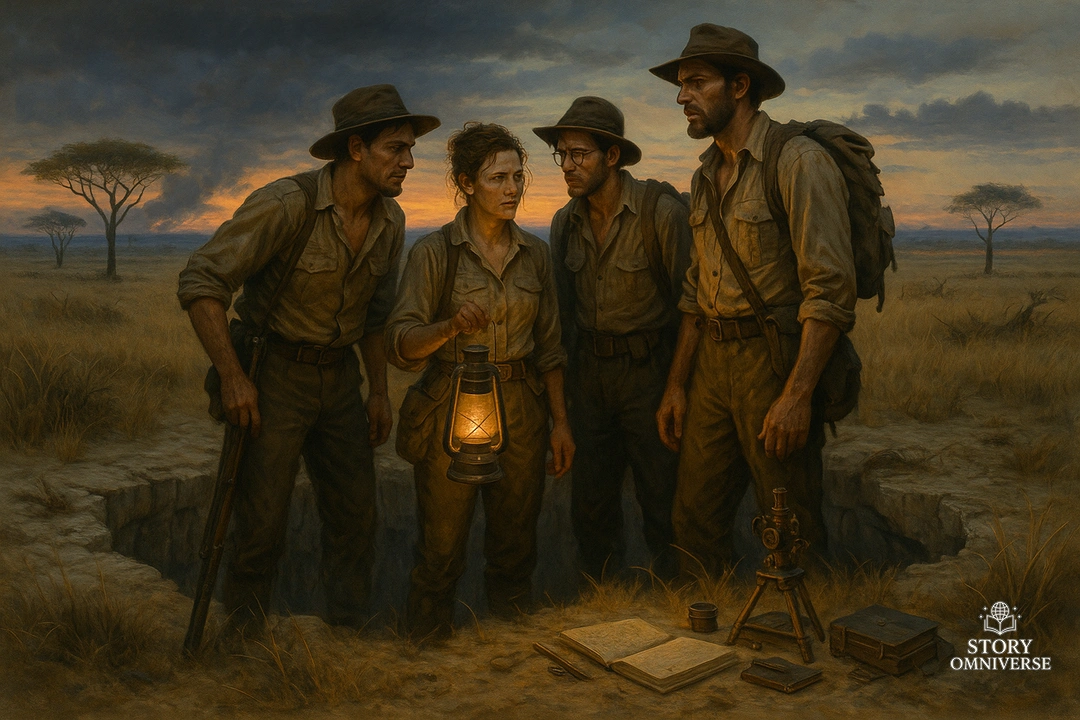
Chapter 1: The Rival’s Footprints in Sun-Bleached Grass
The steppe rolled like a pale ocean beneath a hard noon sky. Grass bowed under a wind that offered no mercy, only motion. Marcus Renn rode at the front, eyes narrowed at the ground where a party’s passage had pressed order into chaos.
“Neat,” Kaelen Dross muttered from the left flank, leaning low from his saddle. “Too neat. See how they kept to firmer soil? Whoever came through hated surprises.”
Isolde Maren’s mare kept close to Marcus’s horse. Isolde held a notebook against her thigh with one gloved hand, the other steadying herself as the terrain bucked. “Educated habits,” she said. “And educated fear. If they were here for what I think they were, they would not wander.”
Tamsin Vale rode behind, a brass spyglass bouncing against her chest. “If this is an Archivian survey party, why have they gone quiet? People with grants usually send letters.”
Marcus watched the horizon where heat-haze blurred the world into wavering glass. Far off, a bruise of thunderclouds pressed down like a lid.
“They stopped sending signals three days ago,” Marcus said. “Either they found what they wanted and don’t want company, or something found them.”
Isolde’s voice softened, almost swallowed by wind. “Or they found proof.”
Marcus glanced sideways. “Proof of your mother’s pattern.”
Isolde’s jaw set, but her eyes stayed fixed on the faint line of tracks. “Not a pattern,” she said. “A continuity. She saw the same motifs in objects separated by centuries and coastlines. The academy laughed because it would mean the steppe held an older culture than anyone admits.”
Kaelen clicked his tongue. “Land does not care what the academy admits.”
Ahead, the tracks crossed a shallow runnel, then rose onto a ridge of baked earth. Marcus slowed and raised a hand. The team reined in, horses breathing hard.
“Listen,” Marcus said.
At first there was only wind. Then, beneath it, a distant rumble. Not thunder. Hooves.
Tamsin’s grin was quick and nervous. “That sounds like a lot of something.”
Kaelen’s gaze swept the grass sea. “Herd. Big.”
Marcus tightened his reins. “We keep moving. If the herd shifts, we go wide.”
Isolde leaned closer to Marcus, the scent of dust and sun on her scarf. “Marcus,” she said quietly, “if we lose their trail now…”
“We won’t,” he replied, and tried to make it sound like certainty rather than prayer.
They rode on, chasing footprints that looked like reason itself stamped into sun-bleached grass, while the steppe gathered thunder at its edges.
Chapter 2: A Camp Without Voices
The camp appeared in a shallow basin, a small island of canvas and order in the unending grass. Marcus approached with his hand hovering near the holster at his hip, though he hated the gesture. Guns felt like an admission that knowledge was not enough.
“Tents still pegged,” Kaelen whispered. “No wind damage. They left in a hurry.”
Isolde slid down from her saddle and walked into the camp as if entering a lecture hall. A folding table stood under an awning. On it lay an open star chart, ink bottles uncorked, a brass sextant angled toward a sky it could no longer measure.
Tamsin stepped closer, careful not to touch. “It’s like someone paused time.”
Marcus lifted the flap of the nearest tent. Inside were bedrolls, a half-packed trunk, and a pair of boots set neatly side by side. No blood. No struggle. Just absence.
Kaelen circled the perimeter, crouching near a patch of trampled ground. “Drag marks,” he called. “Two sets. Something heavy, or someone who couldn’t walk.”
Isolde’s fingers hovered over the table’s papers. “Don’t,” Marcus warned gently.
“I won’t,” she said, though her eyes devoured every line.
Tamsin wandered toward a crate marked with careful stenciling. “Specimen case,” she said. “Was.”
The crate’s lid had been pried open. Splinters littered the grass. Inside, straw packing remained, but the shaped hollow where something had rested was empty.
Kaelen returned, holding a broken leather strap. “Whatever they took, they secured it. Then something went wrong.”
Tamsin knelt near the fire pit and brushed ash aside with a stick. “No cooking. No last meal. Just… gone.” Her voice lost its usual brightness. “I don’t like quiet camps.”
Isolde moved to a collapsed stool and spotted something half-buried in dust. She hesitated, then looked to Tamsin. “Can you lift that? Without touching anything else.”
Tamsin used the tip of a knife to lever it free. A brass caliper, delicate and precise, caught the light. On one arm was a stamp, small enough to miss unless you expected it.
Marcus’s expression tightened. “Let me see.”
Tamsin held it out on her open palm. The seal was a circle enclosing a stylized eye and a laurel sprig.
Kaelen’s eyes flicked to Marcus, then away. “I’ve seen that before,” he said, too quickly.
Isolde’s voice went controlled, almost brittle. “So have I.”
Marcus took the caliper, careful as if it might burn. “No one says it,” he said, low. “Not out here.”
Tamsin frowned. “Says what? That it belongs to some fancy club of skull-measurers?”
Isolde looked at Tamsin, and for a moment her composure slipped, revealing fear behind scholarship. “It belongs to people who decide what history is allowed to be,” she said.
The wind tugged at the tents, making them sigh like sleeping lungs. Marcus closed his fingers around the caliper and felt the cold of it through his glove.
“Pack up what we can,” he ordered. “We follow the trail from here. Whatever took them, or whatever they found, we do not let it decide the story.”
Tamsin swallowed. “And if it decides us?”
Marcus met her gaze. “Then we argue back.”
Chapter 3: The Curiosity Cabinet in the Grass Sea
Two hours beyond the abandoned camp, Kaelen found a line of stakes driven into the ground, each tied with twine and tiny numbered tags. “Survey grid,” he said. “They were measuring something. Not just passing through.”
The field station rose out of the grass like a strange mechanical flower. A tripod supported a telescope aimed at the afternoon sky. A brass armillary sphere sat on a crate, rings etched with constellations. Nearby, calipers, compasses, and glass jars were arranged with obsessive symmetry. Even a portable phrenology board leaned against a case, its labeled bumps promising to classify the human soul.
Tamsin whistled. “Enlightenment fever dream. Who brings skull charts to a steppe?”
“People who think the world is a cabinet,” Isolde said, stepping between instruments with reverence and disdain braided together. “They measure because they fear what cannot be measured.”
Marcus watched her. “Find something useful.”
Isolde went straight to a stack of notebooks weighted by stones. “Field journals,” she murmured. “They wrote fast.”
Kaelen scanned the grass beyond the station. “No bodies. No tracks leaving except the ones we followed.”
Tamsin crouched by a glass prism mounted on a stand. “They were splitting light,” she said. “Why would you do that here?”
“To align sky and ground,” Isolde replied absently. Her finger traced a line of cramped handwriting. Then she stopped. “Marcus.”
He came to her side. “What is it?”
Isolde turned the notebook so he could see. The margins were filled with tiny marks, not letters. Dots, hooks, and slashes arranged like a private music.
“A code?” Marcus asked.
“A cipher,” Isolde said, breath quickening. “My mother used something similar to keep her notes from colleagues who would steal them, then ridicule her for it.” Her eyes lifted, shining with something like grief. “They copied it.”
Kaelen moved closer. “Can you read it?”
Isolde nodded once, as if afraid the motion would break her. She took a pencil and began to whisper as she decoded. “Not a ruin. Not a tomb. ‘The face under the earth.’ ‘Mask.’” She swallowed. “And coordinates. But not in degrees. In star positions.”
Tamsin leaned in. “So they used this contraption circus to point at the right patch of dirt.”
Isolde’s pencil hovered. “There’s more.” Her voice lowered. “They claim the culture that made it predates the accepted steppe kingdoms by centuries. That would place everything earlier.”
Marcus felt a chill that had nothing to do with temperature. “That threatens the timeline the universities teach.”
“It threatens the timeline the Museum has had to negotiate with,” Isolde said. “If this mask exists, then my mother was not chasing ghosts. She was chasing a truth people buried.”
Kaelen tapped the notebook’s edge. “Then why leave this here?”
Isolde’s gaze sharpened. “Because they were interrupted.”
Tamsin stood, wiping dust from her hands. “Or because someone wanted us to find it.”
Marcus looked over the instruments, the careful arrangement, the coded margins. The steppe wind threaded through brass rings and glass lenses, making a faint, eerie hum.
“Pack the notebooks,” Marcus said. “We take what we can. Kaelen, plot those star positions. Tamsin, secure anything useful.”
Isolde closed the journal as if sealing a vow. “We are closer,” she whispered.
Thunder muttered again on the horizon, and the field station’s polished brass gleamed like a warning.
Chapter 4: Lions in the Tallgrass
The herd hit them at late afternoon, when the sun turned the grass into blades of copper. Kaelen saw it first, a ripple in the distance that became a wall of moving bodies.
“Downwind,” he shouted. “They’re coming across our line!”
Marcus yanked his horse around. “To the rocks!” He pointed toward a low kopje rising from the plain like a broken tooth.
Tamsin’s mare squealed as the ground began to tremble. Isolde clutched her satchel to her chest, notebooks thumping against her ribs.
“They’ll trample our kit!” Tamsin cried, glancing back at the packed bundles tied to their spare mule.
Marcus’s mind snagged on the thought of their instruments, the Museum’s precious field kit, the means to prove what they found. Then the herd came closer and the air filled with dust and the sound of panic made flesh.
“Marcus!” Kaelen shouted. “Decide!”
Marcus’s hesitation lasted only a heartbeat. “Save the people,” he snapped at himself, and then aloud, “Leave the bundles. Move!”
They rode hard for the kopje. The herd surged past, a river of horn and muscle. Behind them, the mule brayed in terror as its lead rope snapped. Supplies scattered. A case bounced, cracked, and vanished under hooves.
They reached the rocks and scrambled up the slope, horses slipping on gravel. The herd thundered around the kopje’s base, dust swallowing the world. For a moment, Marcus could see nothing but brown air and the white flash of eyes.
Then, through the dust, a different shape moved. Low. Silent. A lioness, drawn by chaos.
Kaelen drew his rifle, breath steady. “Predators follow herds. We’re trapped on a dinner plate.”
Tamsin’s voice went thin. “I thought lions were a story people told to scare city scholars.”
Isolde pressed her back to the rock, eyes wide. “Not a story,” she whispered.
Marcus forced his lungs to work. “No sudden movements,” he said. “Kaelen, watch the flank. Tamsin, keep Isolde behind you.”
Isolde bristled. “I can watch myself.”
Marcus looked at her, dust streaking his face. “Not right now.”
The lioness prowled closer, ears forward, assessing. Another shape appeared, then another. A pride, opportunistic and calm amid the stampede’s madness.
Kaelen’s finger tightened on the trigger. “If they climb, I shoot.”
“And if you miss?” Tamsin asked, trying to sound flippant and failing.
Kaelen did not answer. His eyes were fixed, predatory in return.
The herd began to thin, the thunder of hooves fading into distance. Dust settled in slow sheets. The lions lingered, disappointed that the easy kill was not offered.
Marcus’s throat burned. He looked down at the plain. Their supplies were scattered across trampled grass. A water skin lay burst, darkening the earth. Their spare mule was gone.
Tamsin’s voice cracked. “We lost water.”
Marcus closed his eyes for a second, guilt rising like bile. He opened them again to Isolde watching him.
“Knowledge is weight,” Kaelen said quietly. “Out here it drags you down.”
Isolde stepped closer to Marcus, her hand briefly brushing his sleeve. “We can still do this,” she said, soft but firm. “My mother did not spend her life being laughed at for me to turn back because of spilled water.”
Marcus swallowed and nodded once. “We ration. We move at dawn. And we do not hesitate again.”
Above them, the kopje’s rocks held the last warmth of day, while on the plain the lions paced like living punctuation at the end of a sentence.
Chapter 5: The False Ridge Map
Morning came sharp and bright, offering no apology for yesterday’s losses. Kaelen led them along a ridge line that rose like a spine across the steppe. He moved with confidence, reading the land as if it spoke directly to him.
“The notes point here,” Isolde insisted, riding beside him. “The star positions align with that ridge. It is not instinct. It is math.”
Kaelen’s jaw tightened. “Math does not smell a storm before it arrives. Or see where grass has been brushed the wrong way.”
Marcus rode between them, feeling the tension like a rope pulled taut. “We follow the best lead,” he said. “Which is both of you, if you stop trying to win.”
Tamsin, trailing behind, called out, “I vote we follow whoever complains less.”
Isolde ignored her, flipping through the journal. “Here,” she said, pointing. “A sketch of the ridge profile. It matches.”
Kaelen halted his horse and leaned down, scooping a handful of soil. He let it fall. “Wrong color. Too much clay. The collapse we’re looking for should be limestone country.”
Isolde’s cheeks flushed. “You are assuming the mask is underground. The notes say ‘face under the earth’ but that could be metaphor.”
Kaelen looked at her then, eyes sharp. “And you are assuming the notes are honest.”
Marcus raised a hand. “Enough. We go to the ridge. If it fails, we pivot.”
They spent hours climbing and skirting the ridge, only to find it ended in a shallow escarpment with nothing but wind-carved stone. No sinkhole. No ruin. No cool breath of hidden air. Just emptiness and the mocking cry of a distant bird.
Isolde dismounted, staring at the horizon as if she could force it to rearrange. “This cannot be it.”
Kaelen crouched near a cairn of stones and pulled one aside. Beneath it lay a scrap of paper, weighted carefully, protected from wind. He unfolded it and held it up.
Tamsin leaned in. “That’s… a map.”
Isolde took it, eyes scanning. Her lips parted in anger. “It is wrong. Deliberately wrong. Whoever left this wanted anyone following to waste time.”
Marcus’s stomach sank. Water was already low. Time was a currency they could not afford.
They turned back toward their previous path, riding fast, eyes searching for signs they had missed. When they reached the spot where they had camped the night before, Kaelen’s shoulders stiffened.
“Our backtrail,” he said. “Disturbed.”
Marcus slid from his saddle. The grass was pressed in new patterns. Not hoofprints. Boot marks, careful and light.
Tamsin spotted something on a flat rock near the ashes of their fire. “Token,” she said, voice subdued.
It was a small coin-like disc of ivory, polished smooth. On one side was the same stylized eye and laurel sprig.
Isolde’s fingers trembled as she picked it up. “A polite warning,” she said. “They are close enough to watch us sleep.”
Marcus took the ivory token from her and closed his fist around it. “No rivals,” he said, more to himself than them. “Not in the open. Just pressure.”
Kaelen’s gaze swept the grass. “A society that prefers scholars lost rather than enlightened.”
Tamsin forced a laugh that did not convince anyone. “Well, that’s rude.”
Isolde met Marcus’s eyes. “They are guiding the story,” she whispered. “If we follow their false ridge, we die slowly. If we find the truth, we vanish.”
Marcus’s anger cooled into focus. “Then we do not follow,” he said. “We hunt.”
Kaelen nodded once, grim approval. “Now you’re speaking my language.”
Isolde’s voice softened, almost intimate. “And mine.”
Chapter 6: The Singing Sinkhole
They found it at dusk, when the steppe cooled and shadows lengthened into long, deceptive pools. Kaelen raised his hand and signaled silence. Ahead, the grass dipped into a shallow depression ringed by pale stone.
Tamsin slid off her horse and crept forward. “Limestone,” she murmured, tapping the rock with a knuckle. “Hollow underneath.”
Isolde stepped beside her, eyes fixed on the opening in the earth. It was not a neat cave mouth but a collapsed bowl of broken stone leading into darkness. From it came a breath of cold air that felt like a hand on the face.
Then they heard it. A faint rhythm, like distant chanting carried through a pipe. Not words. Not quite melody. A pulse of sound that made the hair on Marcus’s arms lift.
“Wind?” Marcus asked, though he did not believe it.
Kaelen shook his head. “Too regular.”
Isolde’s voice was barely audible. “Singing sinkhole,” she said, as if naming it made it real.
Tamsin’s eyes gleamed with the reckless excitement that always preceded trouble. “We go down.”
Marcus looked at their remaining gear. “We do not have proper rope for a deep descent.”
Tamsin was already unpacking. “We have enough,” she said, pulling out cord, harness straps, and a metal piton. “Improvised is my specialty.”
Kaelen frowned. “Improvised kills people.”
Tamsin shot him a look. “So does waiting until the steppe decides for us.”
Isolde knelt at the edge, holding a lantern out. The light fell into mist. Mineral fog, pale and swirling, rose from below as if the earth exhaled secrets.
Marcus crouched beside Isolde. “Lexicon,” he said softly, using her callsign like a tether. “We go together. No heroics.”
Isolde’s eyes stayed on the dark. “My mother dreamed of a door under the steppe,” she whispered. “If this is it, I cannot stand on the threshold and pretend I do not hear it calling.”
Marcus’s throat tightened at the rawness in her voice. “You are not alone,” he said.
Tamsin hammered a piton into a crack with a rock, then tested it with her weight. “Anchor’s good enough,” she declared. “Kaelen, you’re light. You go first.”
Kaelen clipped in, jaw set. “If this fails, I haunt you,” he told her.
“Get in line,” Tamsin replied.
Kaelen descended, boots scraping stone. His lantern bobbed, swallowed by fog. “Ten feet,” he called. “Twenty. Ledge here. Stable.”
Marcus went next, then Isolde, then Tamsin. The air grew colder, dampness clinging to skin. The singing sound grew louder, echoing off unseen walls. It was not threatening, yet it pressed on the mind like a question that demanded an answer.
Isolde’s breathing quickened. “Do you feel it?” she asked Marcus. “Like logic slipping.”
Marcus did feel it. Thoughts slid, refusing to settle. “Focus on my voice,” he said. “Count your steps.”
Isolde nodded, but her gaze drifted toward the fog as if it held shapes. “One,” she whispered. “Two. Three.” Then her voice changed, becoming hungry. “It is close. I can tell.”
Tamsin landed beside them, face pale in lantern light. “Mineral fog,” she said, trying to sound casual. “Probably affects the senses. Or we’re cursed.”
Kaelen’s voice echoed from ahead. “Path opens into a chamber. And I don’t like the sound of it.”
Marcus tightened his grip on the rope. Above them, the steppe’s last light vanished, and below, the earth sang them deeper into its throat.
Chapter 7: The Forgotten Face
The passage widened into a chamber that stole Marcus’s breath. Painted stone walls curved upward, covered in faded ochres and deep blues that somehow survived the damp. Figures marched across the rock in procession, their heads crowned with shapes like horns and stars.
Kaelen stood near the entrance, lantern raised. “No catalog,” he said quietly. “No known style.”
Tamsin walked in a slow circle, boots crunching on mineral grit. “Someone spent a long time down here,” she murmured. “And they wanted it to last.”
At the chamber’s center rose an altar of pale stone, carved so smoothly it looked like bone. Surrounding it were carvings, white against darker rock, depicting faces. Dozens of faces. Some human, some almost, all serene in a way that felt rehearsed.
Isolde stepped forward as if pulled by a thread. “The script,” she whispered.
Around the altar’s base ran a band of symbols, precise and elegant. Not the crude scratches of a desperate tribe, but the confident hand of a literate culture.
Marcus moved to Isolde’s side. “Can you read it?”
Isolde’s fingers hovered above the carvings, not touching. “Not fully,” she said, voice trembling with excitement and fear. “But I recognize patterns. It is related to coastal inscriptions my mother studied. Related, but older.”
Kaelen’s eyes narrowed. “Older than the steppe kingdoms?”
Isolde swallowed. “If my reading is right, yes.”
On the altar rested the mask.
It was carved from dark wood or perhaps petrified fiber, polished to a soft sheen. The face was calm, eyes half-lidded, mouth curved in a faint smile. Yet the proportions were wrong. The cheekbones too high, the brow too smooth, the symmetry too perfect. It looked like an idealized human, drawn by someone who had only watched people from a distance.
Tamsin breathed, “That should not exist.”
Marcus felt the chamber’s air change, as if the mask altered the pressure. “No one touches it,” he said.
Isolde did not argue. She only stared, tears gathering without falling. “It is the forgotten culture,” she whispered. “Proof carved into a face.”
Kaelen crouched near the altar’s edge. “There are bone-white carvings here,” he said. “Not bone, though. Stone. But they shaped it like bone.”
Tamsin leaned closer, eyes wide. “Why do I feel like it’s looking at me?”
“It isn’t,” Marcus said, though the words sounded thin.
Isolde began to translate aloud, voice gaining steadiness with each line. “It speaks of ‘the First Riders,’” she said. “‘Before the crowns. Before the treaties. Before the counting of years.’” She looked at Marcus, and in her eyes he saw the magnitude of it. “This places them centuries earlier than accepted history. It makes the steppe a cradle, not a backwater.”
Marcus exhaled slowly. “Every respectable lecture hall would call this forgery.”
Isolde’s mouth tightened. “They will call it forgery because it threatens their published careers.”
Kaelen’s gaze flicked to the passage behind them. “And because we are not alone.”
A faint scuff echoed from the tunnel, then silence.
Tamsin’s whisper was sharp. “We’re being followed.”
Isolde looked back to the mask, voice almost reverent. “Then we must be quick,” she said. “Before the world decides it cannot be true.”
Marcus nodded, feeling the weight of choice settle on his shoulders. “We document,” he said. “We take what we can. And we get out.”
The mask sat serenely on its altar, as if it had waited centuries for this argument to begin.
Chapter 8: The Mask’s Argument
Lantern light did not behave in the chamber. Marcus noticed it first when Tamsin adjusted the wick and the flame should have steadied, but instead it fluttered as if breathing.
“Draft?” Tamsin asked, turning in place. “There’s no draft.”
Isolde had positioned her notebook on a flat stone and was copying the script with meticulous speed. “The light is bending,” she murmured. “Like heat-haze, but cold.”
Kaelen stood near the tunnel, listening. “I heard something earlier,” he said. “Not footsteps. Like whispers. But there’s no one.”
Marcus approached the altar, stopping a careful distance from the mask. Even without touching it, he felt a pull, like standing too close to a cliff edge. “We take photographs,” he said to Tamsin. “If the Museum’s plates survive the trip.”
Tamsin lifted a small field camera, hands uncharacteristically cautious. “Hold still, ancient horror,” she muttered, then clicked.
The flash powder flared, and for an instant the chamber brightened like day. In that brightness, something else appeared. Not a figure, not solid, but a drifting shape like smoke. It formed the outline of a rider, then dissolved.
Isolde froze, pencil hovering. “Did you see that?”
Marcus’s mouth went dry. “Yes.”
The lantern flames guttered, then steadied. The singing sound returned, faint but insistent, as if the chamber itself hummed with memory.
Tamsin swallowed. “That’s not mineral fog.”
Isolde’s voice sharpened, scholarly instinct fighting fear. “It reacts to scrutiny,” she said. “Like it is responding to observation. An argument, not an object.”
Marcus felt a sudden memory rise unbidden. His brother’s face, sunburned and laughing, then the moment of collapse, the shouted orders Marcus had given too late. The memory hung in the air like smoke, visible, undeniable.
He staggered back a step. “No,” he whispered.
Isolde turned, alarmed. “Marcus?”
He forced himself to breathe. “It’s pulling thoughts out,” he said. “Like testimony.”
Kaelen’s voice came tense. “And it’s showing them. I just saw my sister’s scarf. The one she wore when she vanished.”
Tamsin’s laugh was brittle. “Great. Haunted artifact. Exactly what I needed.”
Isolde stepped toward Marcus, close enough that he could feel the warmth of her despite the cavern’s chill. She placed her hand lightly on his forearm. “Look at me,” she said. “Not at what it offers.”
Marcus met her eyes, steady and bright. The memory-smoke thinned. The lantern steadied.
“You’re anchoring him,” Tamsin said, quieter now.
Isolde did not look away from Marcus. “We anchor each other,” she replied.
A silence settled that was not empty. Marcus realized how close they stood, how the danger had stripped away the polite distance they kept in museum corridors. He could smell ink on her gloves, dust in her hair. His voice came softer than he intended. “Isolde… if this is true, it will ruin reputations.”
“It will ruin lies,” she corrected, but her fingers tightened on his sleeve. “And it will ruin me if I walk away again.”
Kaelen shifted near the tunnel. “We’re being watched,” he said. “Not by the mask. By something that wants us to carry it into the open.”
Tamsin glanced between them. “Romantic revelations later,” she snapped, then softened. “Sorry. Plan. The case is ready.”
Marcus nodded, reluctant to break the moment. “We take it,” he said. “Quickly. No more flashes.”
Isolde’s hand slipped from his arm, but the contact lingered like a promise. She tore a page from her notebook with a decisive motion. “If we lose everything else,” she said, “we keep this translation.”
The mask sat serene, lantern light wavering around it. The past swirled in the air, trying to speak. The Field Core, hearts tightened and minds strained, prepared to carry that speech into a world that might refuse to listen.
Chapter 9: The Polite Betrayal
They emerged from the sinkhole at dawn on Day Five, blinking into pale light. The steppe greeted them with wind and the distant mutter of thunder, as if the sky had been thinking all night.
Tamsin hauled the mask’s padded case up last, grunting. “If this thing starts singing in my pack, I’m throwing it back in.”
Marcus helped Isolde up the final ledge. Their hands clasped longer than necessary, then separated when Kaelen cleared his throat.
“We move,” Kaelen said. “Someone was near the tunnel. I smelled smoke that wasn’t ours.”
They had gone only a mile when they saw riders approaching. Not raiders, not hunters. Orderly, with spare mounts and a wagon drawn by a patient ox. At their front rode a man Marcus recognized with a sinking feeling.
“Joryn Pell,” Tamsin muttered. “Field contact. Fixer. Smiles too much.”
Pell raised a hand in greeting, his coat dusted but his cuffs oddly clean. “Northstar!” he called, using Marcus’s callsign like an old friendship. “Archivian Museum sends its regards.”
Marcus did not lower his guard. “How did you find us?”
Pell smiled as if the question were charming. “The steppe is full of talk if you know who to pay. I bring fresh mounts, water, and papers.” He patted a leather satchel at his side. “Official ones. The kind that smooths borders and silences questions.”
Isolde stepped forward, eyes narrowed. “From Dr. Veyra?”
Pell’s smile did not falter. “From the Museum’s interests,” he said carefully. “Signed and sealed. You will want to leave quickly. There are pressures.”
Kaelen’s gaze flicked to the wagon. “Why the wagon?”
“For your equipment,” Pell said smoothly. “And for anything delicate you may have acquired.”
Tamsin’s hand tightened on the strap of the mask case. “We’re fine carrying our own ‘delicate.’”
Pell chuckled. “Of course. But you are tired. And the savanna is unkind.”
Marcus stepped closer, lowering his voice. “Show me the seal.”
Pell produced the papers. The wax seal was convincing, but Marcus noticed the impression was too crisp, as if pressed in a room without wind or grit.
Isolde leaned in, lips tightening. “This is not Dr. Veyra’s hand,” she whispered. “The flourish is wrong.”
Pell’s eyes flicked to her, polite and cold. “Dr. Veyra delegates.”
Kaelen moved behind Marcus, voice low. “He’s steering us.”
Marcus felt anger flare. “Where does this route lead?”
Pell gestured toward a shallow valley. “There is a safer track there. Less exposed. The land remains dangerous.”
Isolde’s voice went sharp. “The missing party. Where are they?”
Pell’s smile thinned. “Lost, I’m afraid. The steppe keeps what it wants.”
Tamsin took a step forward, eyes bright with accusation. “You know more than you’re saying.”
Pell sighed, as if burdened by their suspicion. “I know that certain learned circles prefer certain truths to remain unpublished.”
Marcus’s stomach tightened. “The eye and laurel,” he said.
Pell spread his hands. “Labels are crude. Think of them as patrons of stability.”
Kaelen’s rifle rose a fraction. “And you are their courier.”
Pell met Kaelen’s gaze without fear. “I am a man who survives,” he said. “And I suggest you do the same. Follow me.”
Marcus looked at his team. Isolde’s face was pale but resolute. Tamsin’s jaw was set, anger fighting fear. Kaelen’s eyes were hard, ready for flight or fight.
Marcus nodded once, not in trust but in calculation. “We follow,” he said. “For now.”
Pell’s smile returned, satisfied. “Wise,” he said, and turned his horse toward the valley.
Behind him, the steppe wind whispered through grass like a warning spoken too late.
Chapter 10: Fire on the Savanna Night
They traveled through late morning into afternoon under a sky that darkened too early, clouds stacking like bruises. Pell led them toward the valley, insisting it was safer. Marcus kept the Field Core close together, the mask case strapped tight across Tamsin’s saddle.
Kaelen rode near Marcus, voice low. “He’s taking us somewhere open,” he said. “A funnel. If anyone wants to intercept, it’s perfect.”
Marcus nodded slightly. “We wait for the moment to break away.”
Isolde rode on Marcus’s other side, her gaze fixed on the horizon. “If we lose the mask,” she said quietly, “we lose the argument.”
Marcus glanced at her. “We won’t.”
Thunder cracked, closer now. A jagged line of lightning split the sky and struck somewhere ahead, beyond the valley. For a heartbeat, the world went white.
Then came the smell. Smoke.
Tamsin’s head snapped up. “Fire.”
A line of flame rose in the grass, thin at first, then racing, driven by wind that turned it into a living thing. The savanna ignited with terrifying speed, fire running low and fast, licking at the ground like a predator.
Pell swore, his polished calm cracking. “Ride!” he shouted. “To the bare patch by the stones!”
Marcus’s horse reared as heat surged. “Everyone together!” Marcus yelled. “Do not split!”
Kaelen scanned for escape routes. “Wind’s pushing it toward us,” he shouted. “We can’t outrun it in tallgrass.”
Isolde’s voice was tight. “Marcus!”
He grabbed her reins and pulled her closer. “Stay with me,” he said.
Tamsin’s eyes darted, calculating. “Backburn,” she said suddenly. “We make our own firebreak.”
Kaelen stared at her like she’d gone mad. “You’ll burn us.”
“Or we burn anyway,” Tamsin snapped. She yanked a flask of spirits from her pack and splashed it in a rough line across a patch of shorter grass near scattered stones. “Marcus, trust me!”
Marcus hesitated, the old paralysis trying to seize him. Then he saw Isolde’s face, the mask case, the oncoming wall of flame. He forced the decision out of himself like a blade pulled free. “Do it,” he said.
Tamsin struck flint. A small flame caught, then crawled along the spirits line, eating grass quickly but controllably, leaving blackened earth behind.
“Get the animals onto the burned patch!” Marcus shouted.
They drove the mounts forward. Horses screamed, eyes rolling, but Kaelen and Marcus forced them through. Pell’s riders followed, panicked now, their neat order gone.
The main fire hit the backburn’s edge and faltered, starved of fuel. Heat roared around them, but the blackened patch held.
For a moment, they were safe. Then chaos returned. A frightened pack animal bolted, dragging a bundle. Another horse kicked free and ran into smoke. Pell’s wagon lurched, ox bellowing, and one of Pell’s men abandoned it.
Tamsin clutched the mask case as her saddle jerked. “It’s humming!” she shouted.
Marcus looked. The case had cracked at the corner, and from within came a faint vibration, like the chamber’s singing carried into daylight.
Isolde reached toward it, then pulled back, eyes wide. “It’s awake,” she whispered.
The fire passed, leaving a smoking world. They remained alive, but their animals were scattered, supplies reduced, and the mask’s case was damaged and humming like a warning bell.
Kaelen coughed, soot streaking his face. “This isn’t just nature,” he said hoarsely. “This is pressure.”
Pell wiped ash from his sleeve, trying to reclaim composure. “The steppe is unpredictable,” he said.
Marcus stared at him, anger cold. “So are lies,” he replied.
Chapter 11: The Academic Thieves in Clean Gloves
Morning after the fire was a gray hush. The steppe smelled of char and wet ash where the lightning storm had finally broken. The Field Core moved on foot for stretches, leading exhausted mounts they had managed to recover. Pell stayed close, too close, offering suggestions that sounded like kindness.
Near midday, a convoy appeared on the horizon. Not riders like Pell’s, but wagons with canvas covers, escorted by men in tidy coats and brimmed hats. Their horses were well-fed. Their boots were polished. They looked wrong against the burned savanna.
Kaelen spat into the ash. “Academic money,” he muttered.
The convoy halted at a respectful distance. A woman stepped forward, hair pinned neatly under a travel hat. She carried a leather folder and wore gloves as white as if she had never touched dirt.
“Mr. Renn,” she called, voice smooth with practiced authority. “Dr. Isolde Maren. We are relieved to find you alive.”
Marcus’s hand tightened on his strap. “Who are you?”
She smiled. “Dr. Celestine Harrow, representing a consortium of academic patrons concerned with preservation. We received word that an object of significance was recovered. We are here to ensure proper custody.”
Isolde’s eyes flashed. “Proper custody meaning yours.”
Dr. Harrow’s smile remained. “Meaning safe custody. Your Museum is admirable, but controversial. There are committees. There are concerns.”
Tamsin shifted the mask case higher on her shoulder. The humming had not stopped since the fire. “We’re not handing it over,” she said.
Dr. Harrow tilted her head, as if indulging a child. “You are tired, under-supplied, and without formal escort. We have sealed letters authorizing transfer.” She opened the folder and held up documents stamped with wax and signatures.
Marcus recognized the language of institutions that spoke softly while taking everything. “Those letters aren’t from the Museum,” he said.
“They do not need to be,” Harrow replied. “They are from authorities who recognize the danger of unvetted dissemination.”
Isolde stepped forward, voice trembling with fury. “You mean the danger of being wrong.”
Harrow’s gaze sharpened. “I mean the danger of destabilizing accepted history with an artifact whose provenance cannot be independently verified.”
Kaelen moved to Marcus’s side, whispering, “Outnumbered. Ten at least, armed. And Pell’s riders are with them now.”
Marcus saw it. Pell had drifted toward the convoy, speaking quietly with one of Harrow’s men. Pell did not look back.
Tamsin’s face went pale. “He sold us.”
Marcus felt the old guilt try to rise, but he crushed it. “We leave,” he said to his team, low. “Now.”
Harrow lifted a gloved hand. Two men stepped forward, not rough, not violent, but firm. “Mr. Renn,” Harrow said, still polite, “do not make this a scene. You will be credited in due course.”
Isolde laughed once, bitter. “Credited. As footnotes to theft.”
The men reached for the case. Tamsin tried to pull back, but Kaelen caught her elbow, stopping her from doing something suicidal.
Marcus met Isolde’s eyes. “Give me the translation page,” he whispered.
Isolde’s hand slipped into her coat. She pressed the torn page into Marcus’s palm. Their fingers touched, and for a moment the steppe fell away, leaving only the weight of what they were losing.
Harrow nodded to her men. The mask case was taken with careful hands, as if handling a fragile specimen. The humming deepened, almost satisfied.
Marcus watched, helpless, as the convoy secured the case in a padded crate. Harrow closed the lid and sealed it with wax.
“You will be escorted to a safe route back,” Harrow said. “Consider this an act of mercy.”
Kaelen’s voice was quiet and lethal. “Mercy with clean gloves.”
Pell finally looked back, his smile apologetic. “Survival,” he mouthed.
Marcus did not answer. He only clenched the translation page until the paper creased, and tasted ash and defeat as history was carried away in someone else’s wagon.
Chapter 12: Footnotes That Would Not Burn
They did not fight. Not because they lacked the will, but because the savanna had already taken their water, their animals, and their margin for error. Kaelen counted rifles and distances with the same calm he used to read weather. Marcus listened, then nodded once.
“Not today,” Marcus said. “We live to publish.”
Harrow’s convoy moved off at a measured pace, as if leaving a lecture early. Pell rode with them, head slightly bowed, a man who had chosen breath over honor. The crate rode cushioned between canvas bundles. The mask’s humming faded into the rattle of wheels, then into wind.
By late afternoon, the escort Harrow left behind guided the Field Core to a shallow spring and a line of stones that marked a safer track. The men spoke little, avoided eye contact, and treated the Field Core like inconvenient evidence.
When the escort finally turned back, the steppe felt wider, emptier. Marcus sat with his back against a rock, the translation page spread across his knee. Soot smudged the paper. Isolde sat close enough that their shoulders touched when the wind shifted.
Tamsin broke the silence first. “So that’s it,” she said. “We found the impossible and handed it to people with better stationery.”
Kaelen checked the horizon out of habit. “We didn’t hand it,” he said. “It was seized. There’s a difference.”
“A difference that won’t matter in the archives,” Tamsin replied, then looked at Marcus. “What do we tell the Museum?”
Marcus held up the page. “We tell them we have a translation, partial but real. We tell them we have plates from the chamber, if the camera survived.” He glanced at Tamsin’s pack, where the field camera sat wrapped in cloth like a wounded bird. “We tell them the mask exists, and that someone inside academic circles wants it quiet.”
Isolde’s voice was steady now, steadier than it had been underground. “And we tell them the script is older than the steppe kingdoms. Older than the dates the committees defend.” She tapped the page with one finger. “This is enough to start a war of footnotes.”
Kaelen snorted. “Footnotes don’t stop wagons.”
“No,” Isolde said. “But they stop certainty.”
Marcus looked at her, then away, as if the steppe itself might overhear. “Harrow will keep it in a private cabinet,” he said. “A curiosity for patrons. A truth locked behind invitations.”
“Academic circles only,” Tamsin muttered. “How generous.”
Isolde turned her head toward Marcus. “You saved me from the mask,” she said quietly. “You pulled me back when it tried to make my grief into proof.”
Marcus swallowed. “You pulled me back first.”
The words sat between them, warm against the cold day. Isolde’s hand found his, not dramatic, not declared, just there. A promise made in dust and smoke.
Kaelen stood, shouldering his pack. “Romance later,” he said, but his voice had softened. “We move before dark.”
They walked until the sky reddened, then camped in the lee of a low rise. Marcus wrote by lantern, copying Isolde’s translation into his own hand, duplicating it until his fingers cramped. Tamsin sketched the chamber from memory, adding measurements where she could. Kaelen marked their route and the sinkhole’s position with careful, stubborn precision.
The mask was gone. The steppe had not given it back. But the argument it started had lodged in their notebooks like a thorn.
And thorns, Marcus knew, had a way of drawing blood from even the cleanest gloves.

0 Comments