
Aetheria
If reality is cracked, learn its language.
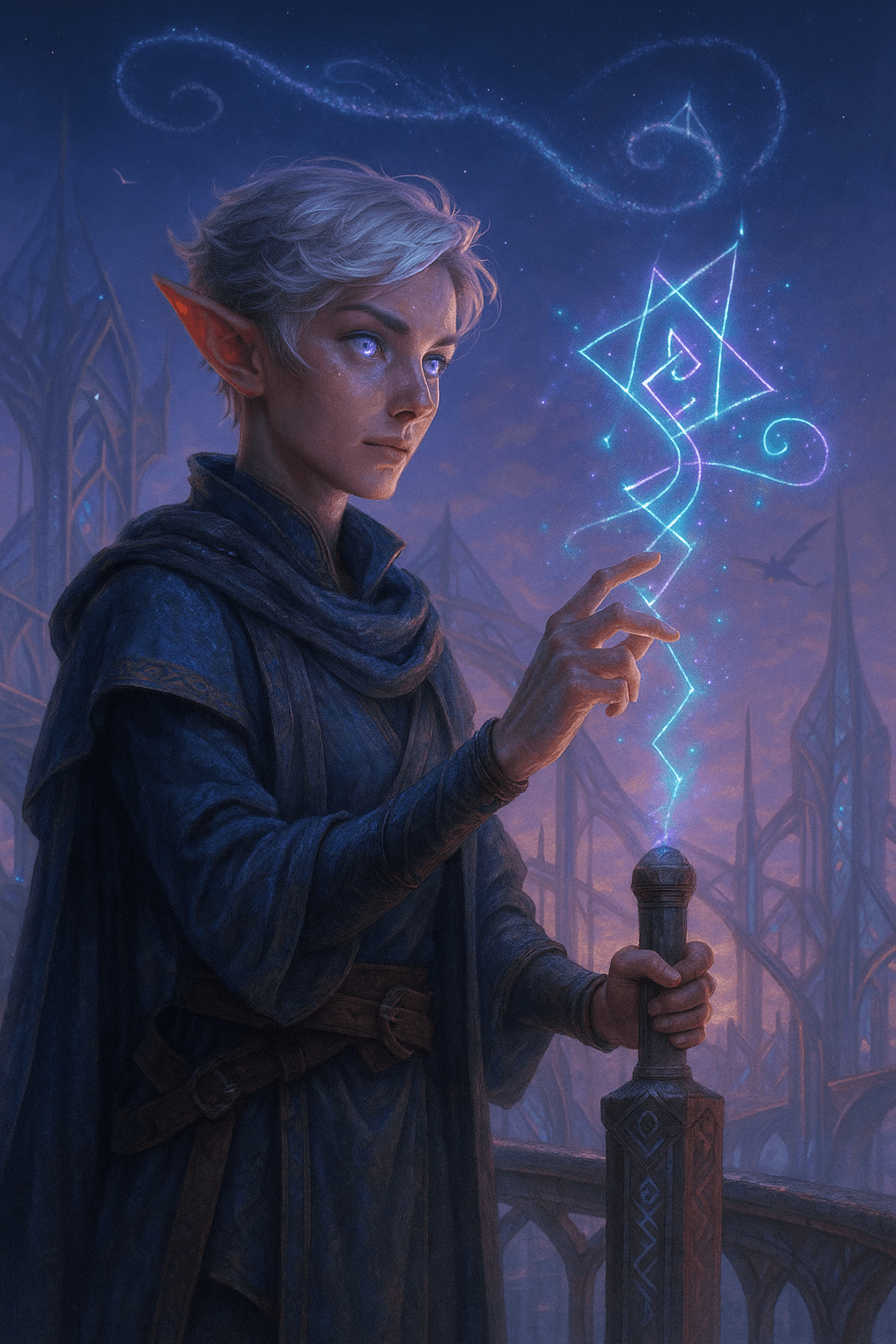
They call me reckless because I ask the question that frightens careful people: what if the break is not a wound, but a grammar? What if the world isn’t shattering—it’s conjugating.
I speak from the terraces of the Aether Crown where dusk lays its violet hand across glass bridges and the air tastes faintly of tin and starlight. Since the Return of the Prism Star, the Spires hum again—not the old chorus, not yet, but a bright, uncertain drone that promises music if we dare the melody. Starseer Elyndor has set the Order on a measured course: catalog the returning harmonics, seal what wobbles, open only what can bear weight. I respect him. I also walk past the tape when no one is looking.
Call me Rift-Splinter if you must. I prefer Inventor.
Every morning begins with calibration. Nalia Skyborn tunes the residual leylines with voice and glass, coaxing a clean note from the Crown’s cracked heart—her optimism is an instrument no instrument can match. Torren Vox arrives next, precise as a metronome, to inscribe the day’s limits in wards that smell of old vellum and new frost. Then comes my part: I take the limits and bend them until they sing.
The method is simple to say and dangerous to do. The Prism Star doesn’t just brighten the sky; it throws a lattice of angles across everything it touches. If you write in that light—truly write, with thought steady as a held breath—your script reaches into the places between what is and what was allowed. I call the technique prism-script. Others call it “please stop before you kill us.” Elyndor sometimes calls it “show me.”
With prism-script we have rebuilt a lift that refused to remember weight. We have stitched two quarrelling isles with a ribbon of light that flexes but does not fail. We have called a Glimmerdrake out of the lower stacks and taught it to carry a message along the edge of a closed door. When it works, the world smiles; when it doesn’t, the air goes thin and the floor turns to questions. We keep ropes at our waists and oaths on our tongues.
Not all light is welcome. Shadow gathers in any lattice worth the name, and the Shadow loves a clever girl who thinks she is safer than she is. Duskfall’s agents are quieter these days, but quiet does not mean gone. More than once I’ve found moon-runes where my anchors should be. Torren’s fingers hover over them, stingy with approval, generous with concern. “You can’t bargain with a riddle,” he says. “You can,” I answer, “if you learn the riddle’s hunger.” We compromise: I test with three anchors instead of one; he writes seals that flex instead of shatter. That is what the Spires are now—arguments turning into architecture.
The week the second Aetherwing appeared will be the week I remember when I am old. It phased through a scar in the air above the plaza and left a wake like a hymn. People stopped in mid-sentence as if someone had put a hand to their mouths. Elyndor removed his spectacles—a small, private gesture—and for a moment looked not burdened, but young. I followed the dragon’s wake with a prism-scripted tether and felt reality lift like a gate that wanted to be a door. I did not step through. Not then. The doctrine is three lines long these days, and I honor them: Light without humility blinds. Humility without courage dims. Together, they focus.
You should know that I keep a ledger of my mistakes. No one asked me to. It is a book wrapped in starcloth, and inside you will find the vibrating corridor that almost became a noose, the time-wheel that thought my heartbeat was a gear, the library that fell eight breaths and learned to fall like a feather. I write the lesson under each entry. “Check anchor drift at breath seven.” “Use three singers, not one.” “Do not confuse devotion with proof.” When apprentices come to me with bright, terrified eyes, I let them read the ledger and count it as first credit.
Why push? Because the sky will not hold itself together out of nostalgia. Because the Spires are more than their ruins. Because our neighbors have long memories of our arrogance, and only a restored, generous craft will be apology enough. We send working bridges to Galdrowen without signatures. We share star-charts with Vaelorien as if the sea were a page and the tide a pen. We build warning lanterns that flare when Thar Zûl’s Embercore experiments make the horizon seize. We guard what must be guarded—but not with hoarders’ hands.
Tonight’s experiment is a small one: a rift-chord to temper turbulence along a supply path. The prism-script is already sketched in light along the bridge’s spine, waiting for the right tone. Nalia will sing; I will shape; Torren will watch with that look that says he cares too much to approve easily. If it works, the bridge will hum like a cello when the storm comes and the wind will nod and go around us. If it fails, the wards will harden and we will try again, because the work deserves our patience and our courage together.
I am not the end of the Order, nor the savior of it. I am a hand on the lens. The world is returning its light in pieces; my task is to learn their angles until they meet clean.
Call me reckless. I will take it as a compliment shaped like a warning.