
Torren Vox
Some doors are kept closed not from fear—but from care.
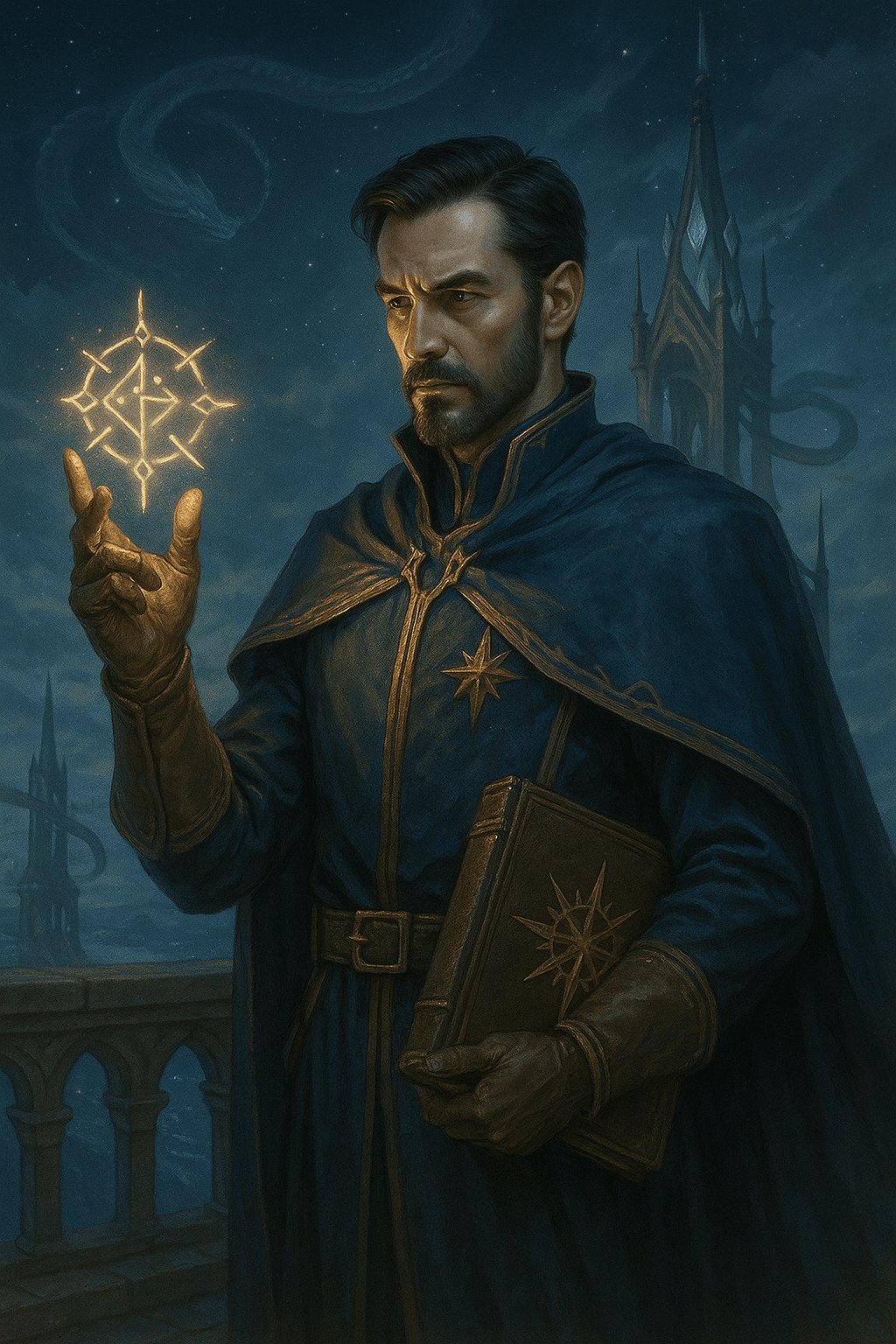
In the high corridors of the Aether Crown, there are two kinds of scholars: those who sprint toward the unknown and those who stand at the threshold, measuring the door. Torren Vox is the latter—the warded hand at the latch, the voice that asks who pays when wonder goes wrong. If the Luminari Order is a lighthouse, Torren is the lens that refuses to let the beam flare wild.
Ascendance.
When Skyreach first lifted crystal from the mountains and named ambition virtue, Torren rose under Lumarch Velian Thalos. He shared Velian’s brilliance but not his hunger. While others courted Star-Serpents for whispered formulae, Torren charted costs: the sleep lost to time-sick laboratories, the students singed by Aether wakes, the islands whose shadows unsettled villages below. In those days his caution read as courtesy. He copied every theorem twice, one ink for proof and one for consequence; he asked mages to document what they broke as carefully as what they made. Aliseth Veilbloom called his ledgers “the Order’s conscience.” Velian, smiling, called them “brakes.” Torren kept writing.
Fracture.
Then the Shattering made everyone a believer in brakes. Isles fell. Lab hours slipped loose of clocks. Star-Serpents forgot the middle of sentences. Velian doubled down—if the light was failing, he would burn hotter—and Torren became his loudest rival. He sealed three unstable vaults while stones were still falling and dragged apprentices from a corridor where an Aetherwing had blinked halfway through reality. In the bitter aftermath, he faced the Council and argued that survival must be the Order’s new experiment. “If we cannot bind the harm,” he said, “we do not deserve the knowledge.” Preservationists rallied to him. Velian’s loyalists sneered “coward” in the stacks until Torren posted the recovery rolls of those he had saved. The columns ended the jeers. They didn’t end the divide.
Twilight.
With the Dimming of the Crown, when the proudest isle sank and the Luminari retreated into secrecy, Torren hardened into necessity. He built seals like hymns—precise, repeated, unapologetic—and taught apprentices the litany of refusal: identify, isolate, interdict. While the Last Sky War raged far away, he fought smaller, quieter battles: chasing a rogue equation out of a student’s notes before it seeded a rift; bracing collapsing lifts with sigil-strings until the frightened could get clear; keeping the Order’s memory intact when grief made everyone else forget to eat. The Rift-splinters called him a jailer. He called himself a steward and slept on the floor of the Map Hall so that if another isle buckled, he would be at the door when it happened.
Echoes.
The Return of the Prism Star brought hope—and fresh conflict. Starseer Elyndor invited measured risk back into the halls, and Torren, ever the realist, returned to collaboration with narrowed eyes and unshaken standards. He partnered with Nalia Skyborn to tune stabilizing chords through torn ley-threads and, for a time, one could see him almost smile, listening as broken instruments remembered how to sing. But when Aetheria and the resurgent Rift-Splinter pressed to “speak reality’s dialect,” he drew his line in bright, careful ink. He drafted the Seal of Three Considerations—Harm, Horizon, Heir—demanding: who can be hurt now, what long tail can we not see, and who inherits this if we’re wrong? Elyndor called the framework “stern and responsible.” Aetheria called it “a leash” and worked around it. Torren answered with audits and alarms no apprentice could ignore.
He is not a romantic. Yet those who study under him tell a quieter story than the one his critics repeat. They speak of a mentor who reads every page, who returns experiments with margin-notes that begin, “Good question—let us make it safer to ask,” who remembers names after disasters and writes letters to families himself. They speak of the night a Star-Serpent, mid-forgetting, looped around the tower and pressed its cool brow to the window; Torren dimmed the lamps, laid a steadying hand on the glass, and sang the creature back into its own timeline with the old Skyreach scale. “We are not here to possess wonders,” he tells his pupils. “We are here to deserve them.”
Across Ascendance, Fracture, Twilight, and Echoes, the silhouette remains the same: a tall Celestial with a warded glove, a ledger under one arm, and the patience to be disliked if that is the price for keeping the rest of them alive. Velian Thalos called him an obstacle; Torren calls himself ballast. Perhaps both are true. The Aether Crown still creaks like a ship in star-tide. It stays aloft because some refuse to abandon the weight that keeps it from capsizing.
If Skyreach learns to live with courage and humility in equal measure, it will be in no small part because Torren Vox refused to choose between them.