
Fahl the Hollow-Eyed
Where silence dreams, I listen.
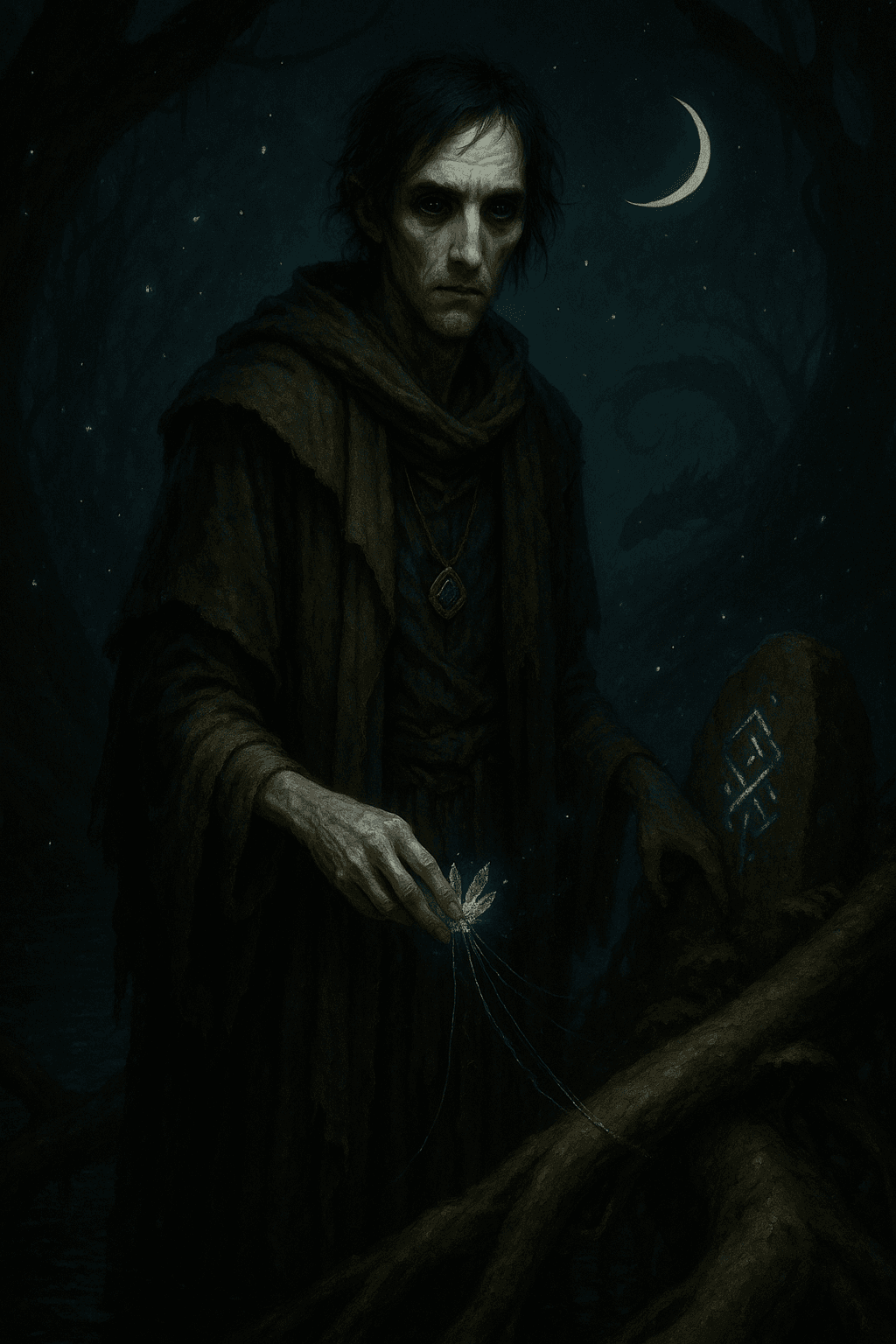
They call him a Lost One because names slip off him like mist off black water. Fahl is easier—one syllable you can hold in your mouth if the night gets thin. The “Hollow-Eyed” came later, the first time someone noticed that his pupils don’t catch lantern light. Stare long enough and you realize there’s a depth where reflections should be, a patient dark the Mire itself might use to see.
In the Era of Echoes, when the world’s fractures begin to knit and old powers test their voices, Fahl walks the root-arches of Hollowroot with bare feet and a pocket full of quiet. He serves the Whispering Bloom without oath or rank, a tolerated anomaly who is at once apprentice, liability, and necessary heretic. The inner circles whisper that he wandered out of a dream-root thicket one midnight with spores in his hair and a Memory Drake’s shadow riding just behind his shoulder. He never confirms this. He simply asks questions that sound like doors.
His haunt is the Dream-Root Archive, a cavern where tangles of phosphorescent roots grow through shelves of damp stone. Every so often the roots exhale a blue breath that tastes like rain and deja vu. There Fahl threads thin strands of dreamweave between crystal nodes shed by elder Memory Drakes, tying recollection to recollection until a lattice hums with someone else’s yesterday. He is careful with the hum. Push too hard and the lattice shivers into madness. Treat it like a lullaby and it offers a usable truth: who passed the canal before dawn, where a Duskwyrm tasted fear, which rune-carved plank in a bridge remembers a betrayal. Knowledge in the Mire arrives this way—through inference, patience, and the soft tools of thieves who refuse to call themselves thieves.
Fahl’s doctrine—if he can be said to have one—rides two currents he’s trying to braid: dream and shadow. Shadow is the domain of the Duskwyrms and the Shadekin handlers who run with them, a power of absence and angle. Dream is the province of Memory Drakes and their crystal-studded scales, which carry echo after echo in neat rows like arguments. Bound carelessly, they smother each other. Bound with care, they become a sharper instrument than either alone. Fahl calls that instrument the Quiet Tongue. With it, he can blur a lantern’s authority, turn a pursuit into a forgetting, or tune a quilt of Thornspine quills on a distant border so its warning hum misses one breath in four. He does not often use the last trick; he dislikes the taste of guilt.
On a night of high water he crosses a slick bridge and pauses beside an old rune-stone. In the reflection pooling at his feet, a Mind-Drake—Whisperwind, the elder—uncoils across the dark like constellations of memory. Fahl inclines his head. The drake’s crystal nodes glint; something like a sigh drifts through the spores. It is not conversation, not exactly. It’s more like two instruments settling on a key. Later, when he writes his notes in moss-ink, he titles the page: “On Consent Between Dreaming Things.”
He is not trusted. Nightshade Weaver, the unseen hand that guides the Bloom in Echoes, tolerates him because results accumulate wherever he walks. Sleeper cells wake when he taps on eel-skin drums no one else can hear. Missing messages reappear in the archive, wrapped in thread that was never spun. Enemies act as if they remember a conversation they never had with him—conversations in which they confided just enough to become predictable. And yet Nightshade has eyes near his workbench. Fahl understands; he keeps his notes legible, his experiments small, and his exits mapped.
The rumor that he wants to “awaken the sleeping minds beneath the Mire” is not rumor. There are thoughts under Hollowroot deep as stalactites, slow as earth, old as drowned vows. Fahl has found three of them by following a peculiar rhythm in the canal fog—the way it lifts in even measures, as if something below were breathing through it. He kneels, presses dreamweave against wet stone, and sings barely at all. That is his talent: almost-songs, almost-spells, things so close to silence they can pass for it. Sometimes the breath answers. When it does, he feels a pressure against his bones like a large creature choosing not to crush him. He believes these are minds worth waking—carefully, with the right questions—because old witnesses make for better futures.
He has enemies he refuses to name. Poachers who traffic in stolen memories hate him because his work re-threads what they’ve unraveled. Foreign agents who come seeking the Bloom’s secrets fear how easily he steps out of notice. Even allies mutter that he is a fault line waiting to open. Fahl accepts the discomfort as tax. “If no one is uneasy,” he says, “then I am only making echoes louder, not truer.”
And the hollow eyes? They are not empty. When the lanterns gutter and the canal water takes a little more of the night into itself, you might glimpse what moves there: reflected constellations of other people’s yesterdays, stitched into a net he carries behind his gaze. He uses it like a fisherman uses tide—never fighting, always leaning.
In Echoes, when the Mire grows bolder and the world listens for new harmonies, Fahl walks the line between what happened and what might be persuaded to happen again. He is not a hero. He is an instrument tuning the dark so that those who wield shadow do so with memory, and those who guard memory remember to leave room for forgetting. If the sleeping minds wake and speak, he wants them to find the Mire mid-sentence, honest about what it has become.