
Vell of the Mire
Secrets are safest when their keepers are unseen.
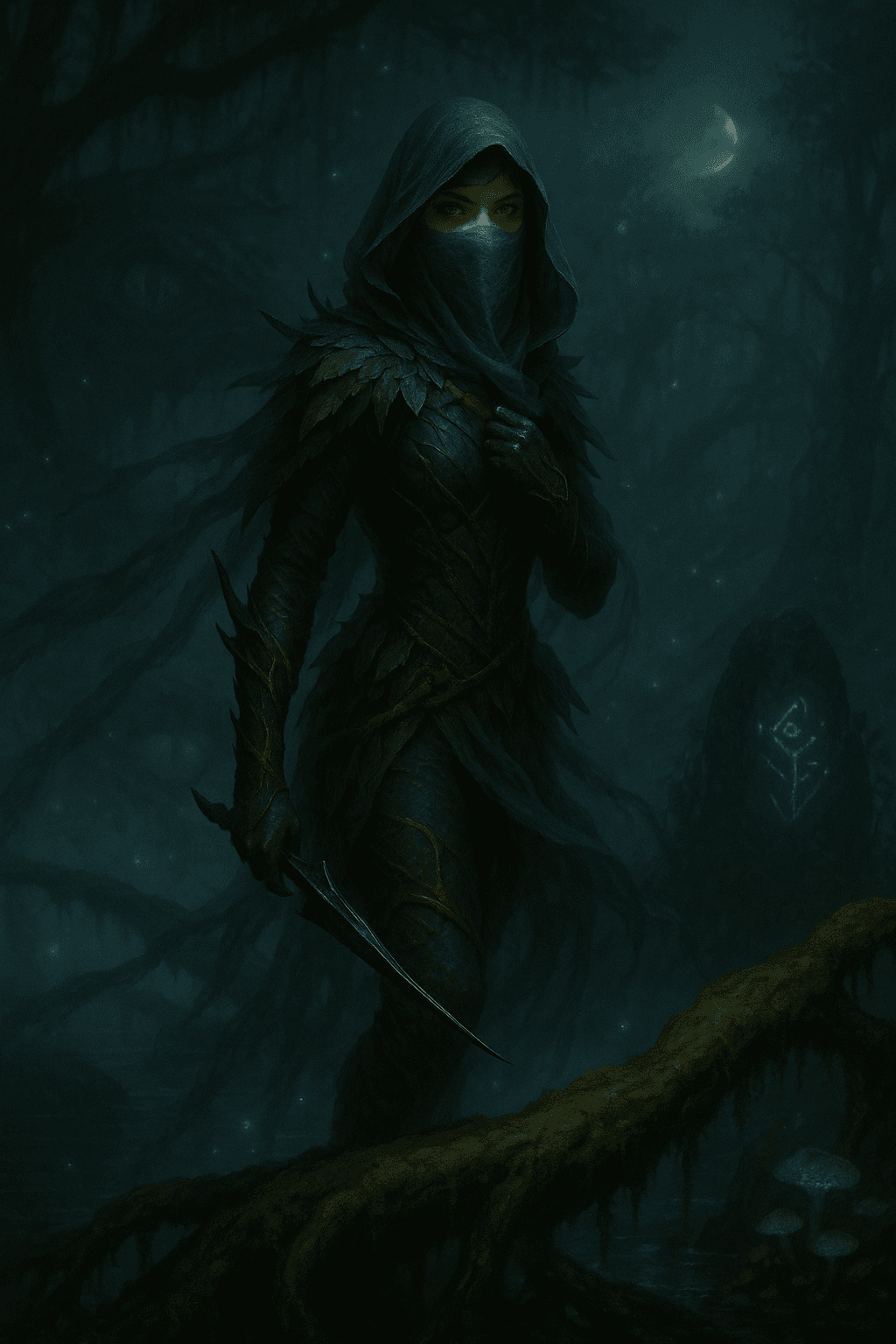
There are guardians who stand at gates and guardians who make sure no one ever finds the gate. Vell of the Mire belongs to the second kind. A vinebound operative whose steps leave only a rearrangement of reeds, Vell has long been the Whispering Bloom’s quiet perimeter—the blade of silence that keeps Hollowroot’s truths from growing where they shouldn’t.
Ascendance.
When the Whispering Bloom first learned to braid shadow with root, power came faster than discipline. Mistcaller Nyvra gathered minds and mists into a fledgling order; Vell learned to keep that order from being noticed. She walked the black-water margins of Hollowroot, masking approach paths with drifting mats of lilies and training Memory Drakes to circle like forgetful moths around dangerous conversations. Her loyalty was simple and unsentimental: the Mire protects its own; the Mire survives. Where other vinebound showed their cleverness in laboratories of venom and spores, Vell perfected misdirection—lanterns that dimmed when an intruder’s pulse quickened, footbridges that unspooled into harmless fronds, dreamweave strands that tickled a sentry’s thoughts just enough to make them turn around and choose another road.
Among the Shadekin and vinebound, she gained a reputation for quiet precision. If a courier vanished from a border trail, their message later arrived on Nyvra’s desk, still sealed—but now wrapped in reed-twine knotted in Vell’s pattern. When Galdrowen’s first Thornspine patrols tested the edges, Vell mapped the hum of their quill-quilts from a mile away and taught Duskwyrm handlers to veil their passages beneath that music. She thought of guardianship as horticulture: pruning rumors, grafting alliances, and planting misapprehensions in hostile minds so that the Mire’s roots could thicken unseen.
Fracture.
Then the Shattering warped the world’s leylines, and quiet work became crisis triage. The mists around Hollowroot grew sentient in pockets, whispering too much to ears unready. Memory Drakes began to hoard knowledge with a child’s greed, and some Bloom adepts listened too long to the new voices and lost themselves. Vell’s mandate changed with a single sentence from Nyvra: “Our secrets must not devour us.” She became the Bloom’s internal shadow, tasked with finding and ending the spirals of madness before they tore the faction apart.
It was brutal work, and she carried it without theatrics. Vell tracked defectors by the way their breath troubled the spores, by the tremor in a rune’s reflection on black water. She laced calming draughts into canteen reeds where a rescue was still possible; when it wasn’t, she folded the Mire’s mercy over the lost like a night-blooming shroud. Her knives were grown, not forged—obsidian-dark thorns coaxed from her own arm-branches, then shed and regrown after each mission as if the plant itself yearned to forget. The Whispering Bloom did not speak of her assignments. They spoke, in low rooms, of stability returned, of archives unburned, of Memory Drakes settling again onto their runestones to hum the safer past.
Vell never confused loyalty with certainty. She argued, quietly, when Nyvra’s ambitions risked drawing Galdrowen’s wrath too soon; she brokered cease-breaths with Shadekin cells whose zeal outran strategy; she made a habit of leaving the last nightflower by a fallen operative’s mark-stone, because remembrance is also a kind of perimeter. Still, she understood the arithmetic of survival. The Mire could not afford a civil war of whispers while Thornhall’s quilts thrummed and Skyreach’s fallen light-stones washed up on nameless banks.
To opponents, Vell is a rumor that arrives just before the lantern goes out. To allies, she is the hand on a shoulder that guides you three steps left so the trap never springs. She has no taste for spectacle, no interest in titles. In a place where even the fog has opinions, Vell’s discipline is a rare stillness: act, adjust, vanish; leave the pattern stronger than you found it.
If the Whispering Bloom endures, it is partly because it has gardeners like Vell—those who tend the negative space, who make a home for silence so that knowledge can be stored without spilling. The Mire, after all, does not win by being seen. It wins by being inevitable.