
Tarn the Murkborn
Rot is a lesson—if you listen while you brew.
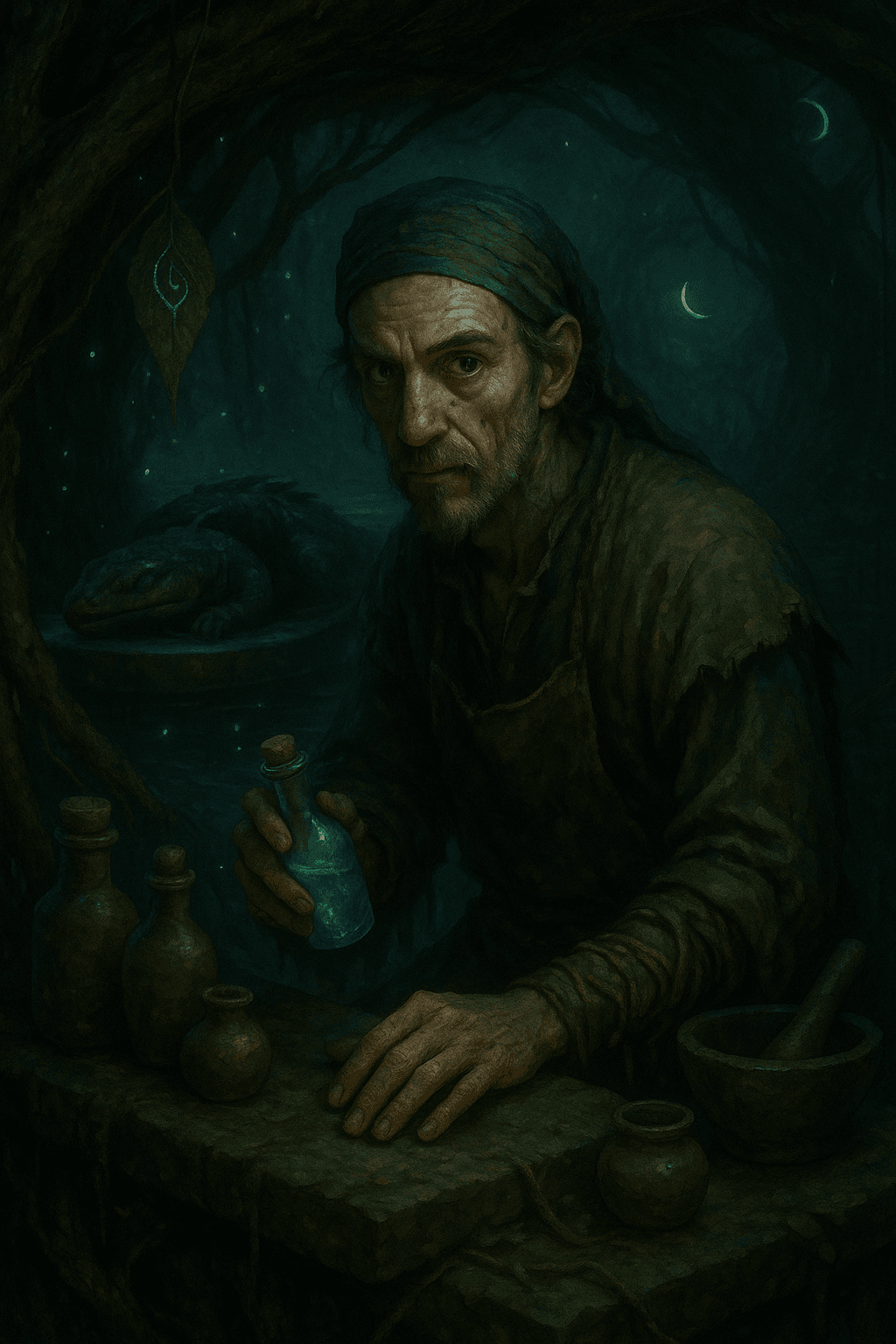
The Mire did not begin with walls or banners. It began with breath—wet, fungal, and patient—rising from black water through root-arches that had only just learned to think. Tarn was born to that breath and named for it: murk in his lungs, marsh on his tongue, a boy who learned directions by taste—iron for the old creek, bitter for the peat bed, sweet for the places you did not go unless you wanted to forget your own name.
By the time Hollowroot had a path worth calling a street, Tarn kept a bench there. Not a shop—shops imply customers, prices, daylight. A bench under a veiling of vine-threads, stone mortars sunk in cool mud, and shelves of stoppered clay that sweated like living skin. He called himself an alchemist because “swamp-tinkerer” made apprentices laugh. The work was simple in shape and perilous in consequence: press, distill, reduce; breathe slow around the volatile things; never trust a still pool that reflects too well.
Origins.
When the sentient vines first stirred—the Seeding of Hollowroot—the Mire’s people learned quickly that growth could be opinionated. Vinebound voices thrummed through the roots with moods, sometimes hunger, sometimes holy contemplation, sometimes a wordless recoil from anything metal-bright. Tarn listened with the same attention he gave to kettles: ear to the bark, breath held, counting pulses. He discovered a powder in the gill-frills of a mooncap fungus that, when simmered with swamp salt, quieted the vine-hum to a tolerable murmur for those who could not sleep. He bottled it as Dream-Silt and marked the cork with three scratches. “Two sips for silence,” he warned, “a third if your nightmares are eloquent.”
Vineheart, First Speaker of the Whispering Bloom, visited the bench only twice that first season. The First Speaker watched Tarn’s hands, then the vials, then the slow exhale of a Duskwyrm juvenile drowsing in a stone trough nearby. “The Mire grows,” Vineheart said. “What you make must grow with it.” Tarn heard the compliment and the caution inside the same breath. He began keeping ledgers—not of coin, but of cause and consequence. Each recipe had two columns: relief and risk. He was clever enough to know the columns could not be made equal; he was honest enough to write the failures where anyone could read them.
There were successes. From the blue-vein leaves of chokefern he drew a resin that clung to blade edges without odor. From the stingers of a bog wasp—harvested at twilight with hands wrapped in reeds—he made a paste that turned fever aside without dulling the mind. When Withering Skies dimmed magic and Duskwyrm nests shivered, Tarn went knee-deep into the black pools and found heat in the silt. He crafted warmstone poultices that held a low, safe ember; Moorglow, tender of the Duskwyrms, used them to keep hatchlings breathing through that mean, thin cold.
There were lines as well. Tarn believed ethics should be stirred like tea: often, deliberately, with room to cool. He tested venoms on his own skin first, on leeches second, and only then—after long argument with himself and the Mire—on volunteers who had chosen their risk with open eyes. “All medicine is a negotiated truce,” he wrote in the ledger, “and some truces are shorter than others.” The Mire called him morally gray; Tarn called himself accurate.
When First Contact came—Mossbeard’s druids stepping careful into Swale Glade with hands open and weapons wrapped—the Whispering Bloom sent scouts to watch and one alchemist to listen. Tarn carried no banner, only a tray of vials. He offered the druids a mild breath-tonic distilled from reed-pith and night mint. “Takes the swamp out of your mouth,” he said, and the joke turned tension into a shared smile. He traded the tonic recipe for a list of roots that Galdrowen considered sacred to leave untouched. Later, alone under the glade’s edge, he collected a drop of dew from a Grove-Wyrm scale fallen in sleep and sealed it in glass. He did not use it. He only held it to the light when he doubted his work and let the green-gold shimmer remind him that power does not always need to be poured.
The Whispering Spores were his most dangerous curiosity. The mists carried them; dreams carried them further. Tarn learned to condense their drift into a translucent liquor that sharpened recall for a single hour and then left the mind raw as scraped bark. He labeled the bottle with a knot of string that meant “not for ordinary days” and kept it under woven vine. He used it once to help a grieving Vinebound remember the shape of a vanished grove-path long enough to guide a rescue. He used it once more, on himself, to recall a recipe his frightened hands had forgotten in the middle of a fever; the clarity was exquisite, the after-silence terrible. He wrote in the ledger: Only where forgetting would kill.
He wasn’t a hero, not in the songs. He brewed. He bargained. He argued with mist and with himself. But in a nascent society where the difference between poison and cure was often the width of a breath, Tarn gave the Mire a language for risk that did not sound like apology. And when night fell and Hollowroot’s black water folded the stars into itself, a slim lamplight glowed where his bench was, and the Mire—newborn, growing, not yet cruel—breathed easier for knowing someone was awake to catch the drip before it burned through the table.