
Chapter 1: Shadows Before the Guns
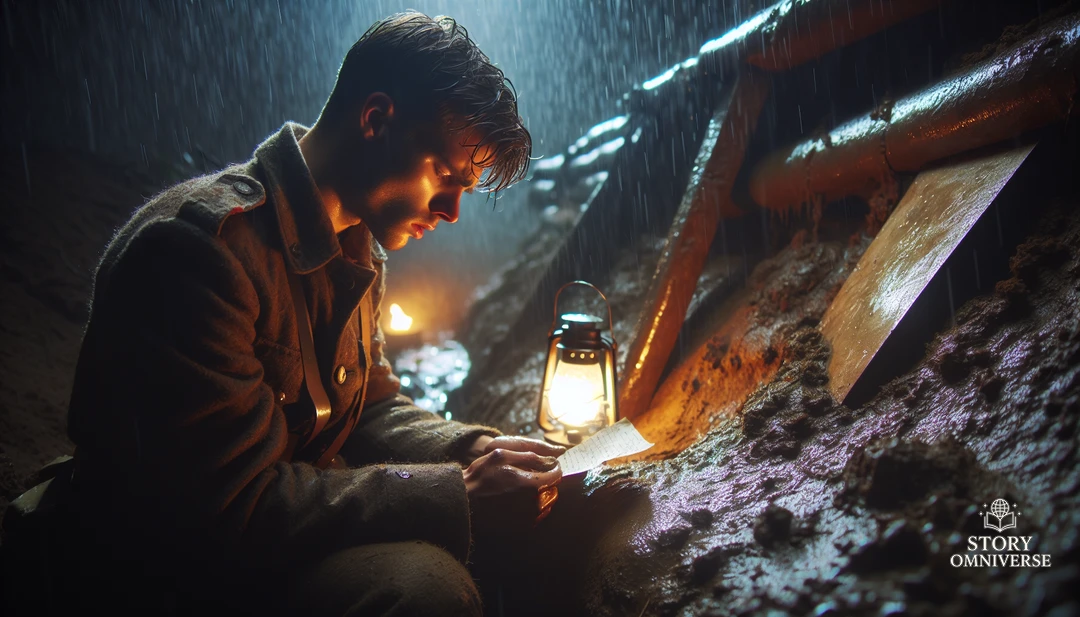
January 1916 swept across northeastern France with biting winds, turning the ground around Verdun into a frozen, mud-caked wasteland. Private Julien Mercier, uniform hanging loose on his narrow frame, pressed into the trench wall as icy drizzle pelted the ranks. The landscape was a latticework of wire, shell holes, and wooden planks slick with filth.
The men whispered of German troop movements across the Meuse, their eyes drawn to the horizon where flashes of distant artillery painted the sky. “They’re bringing up heavy guns,” muttered Corporal Lefevre, his moustache flecked with frost. “The big ones from Krupp.”
Julien shivered—not just from the cold, but at the realization that Verdun, rumored untouched for decades, was now the fulcrum of the war. The French command had ordered every able-bodied man to bolster its defenses. For most, like Julien, it was their first winter in the trenches.
Beside him, Émile Dumas—a broad-shouldered farmhand from the Auvergne—shared a hunk of hard bread. “Eat, petit,” Émile said, pressing the crust into Julien’s hand. “Tomorrow there may be none.” They had met on the march from Bar-le-Duc, Émile’s easy laughter and homespun tales a comfort amid the endless mud.
A chaplain passed, eyes tired, offering blessings in hushed Latin. The scent of boiled coffee mingled with the stink of unwashed wool and cordite. Julien’s thoughts wandered to Paris: the chatter of cafés, the ring of tram bells, and his sister Sophie, whose letters had become a thread of sanity.
As darkness pressed in, a messenger clattered down the duckboards, distributing slips of orders. The men gathered in small circles, reading by candle stubs or lantern glow. “Reinforcements to Fort Douaumont by morning,” their sergeant barked. “No one sleeps tonight.”
Julien stared up into the drizzling sky, caught between dread and duty. As Émile adjusted a tarpaulin over their dugout, he squeezed Julien’s shoulder. “Hold fast, lad. We’ll see the spring yet.” The words, simple and sturdy, settled Julien’s nerves. In the haunted quiet before the guns, friendship was their only shield against the shadows.
Chapter 2: Rumors and Reverie
By dawn, the trench bustled with anxious preparation. Helmets were checked, bayonets fixed, and gas masks hung ready. Packs were lighter now; most men had left personal trinkets behind in a bid for speed. Julien’s only keepsake was Sophie’s latest letter, folded neat in his breast pocket.
As the men filed toward the front, snatches of song rose and fell—an old marching tune, half-hearted but defiant. Mud sucked at their boots, and now and then a rat would dart between sandbags. Émile nudged Julien, grinning. “If the Boches don’t get you, the lice will.”
At the forward position, the men huddled against the parapet, scanning the shattered fields. A few kilometers away, the spires of Verdun’s cathedral bent in mist. “Any word from home?” Émile asked, lighting a cigarette with hands blackened by grime.
Julien nodded, extracting the letter. “Sophie says rationing’s gotten worse. Bread lines by dawn. She volunteers at a Red Cross depot—patching uniforms, rolling bandages.” His voice caught on the name Claire, Sophie’s friend. “Claire sends a ribbon of hers—blue, for luck.”
Émile chuckled, elbowing him. “That’s a promise, not luck. When you’re back, buy her a proper dress.”
Before Julien could reply, the distant thunder of artillery rolled over the trench. Men ducked instinctively. The barrage was a dull prelude, more warning than assault—but the tension was like wire drawn taut.
Between shells, the men played cards on a crate, swapping coins and cigarettes. Julien watched, thinking of Sophie’s stories: the rumors of a bread riot at the Place de la République, of wounded men streaming into Paris from the Marne. The world seemed both impossibly vast and terrifyingly small.
When night fell, Julien found a quiet corner and wrote a reply by candlelight. “I think of you both,” he scribbled, “and the river Seine, and the laughter at our old window. Keep faith, ma petite. I will come home.”
He tucked the letter inside his tunic as Émile dozed beside him, and for a moment, the war receded. The night air was thick with the promise of battle and the ache of longing.
Chapter 3: Verdun Erupts
On February 21, the world ended with a sound like the sky tearing in half. German artillery, more than a thousand guns, unleashed hell across the French lines. Shells shrieked overhead, bursting trees and earth into black fountains. The ground trembled; men pressed their faces into the muck, hands over ears.
Julien’s heart hammered as earth rained down, choking the trench in dust. “Hold!” the sergeant roared, as splinters whined past. All order vanished; there was only survival—duck, breathe, pray.
For hours, the barrage continued. At last, when the guns paused, whistles blew and men scrambled to firing positions. German stormtroopers advanced in waves—helmets low, bayonets fixed.
Julien fired, the recoil jarring his shoulder. The air was thick with smoke and screams. Men fell, some cursing, others silent. Mud splattered his face; his rifle jammed, and Émile was at his side, wrenching it clear.
“Stay with me!” Émile bellowed, dragging him behind a collapsed sandbag wall as bullets chewed the timber overhead. “We give no ground!”
Wave after wave pressed against them. At the height of the assault, a runner staggered into their trench, face bloodied. “Fort Douaumont is lost!” he gasped. “Retreat toward Fleury! Hold as long as you can!”
Julien’s mind reeled. Fort Douaumont—impregnable, or so they’d been told—had fallen in a day. The significance settled in their bones. France would bleed to keep Verdun.
In the chaos, Émile rallied the men. “We’re all that stands between Verdun and the Germans! For our homes—fight!” His voice cut through fear, drawing the survivors together.
When darkness fell, the attack relented. The trench was a ruin, shell holes filling with rain. Of the thirty men who’d held their line at dawn, barely a dozen remained.
Julien slumped, trembling, beside Émile. Tears stung his eyes, but Émile, battered and bloody, clasped his hand. “Still with me, lad?” he asked, voice gentle.
Julien nodded, unable to speak. In the flickering lantern light, the two sat in silence—brothers in arms, bound by fire.
Chapter 4: Between Shells
The days that followed blurred into a rhythm of exhaustion and vigilance. The lines shifted by meters, then yards. New faces replaced the lost; names faded almost as quickly as they were learned. Yet, in the short lulls, life pressed stubbornly on.
One gray morning, as drizzle softened the churned soil, Julien sat with Émile, sharing the last of their tobacco. “Tell me about your village,” Julien asked, voice raw from smoke and shouting.
Émile’s eyes softened. “Saint-Flour. Cows on the hillside, bells ringing in the church. My wife, Lucienne, makes a stew with lentils and pork that could bring a man back from the grave. I promised her I’d teach our boy to fish when this is over.”
Julien smiled, picturing a life beyond barbed wire. “I miss the booksellers along the Seine. Sophie and I would watch the barges. She always said I had a poet’s heart, not a soldier’s.”
“Poetry and bullets both save lives, in their way,” Émile said. “But poetry gives them back.”
A lull in the shelling allowed them to stretch, darning socks and writing letters. A Red Cross nurse passed along the line, handing out clean water and bread. “Merci, mademoiselle,” Julien said, remembering Sophie’s stories of service.
A distant explosion marked yet another German push. The men braced themselves, but the attack never came. Instead, a rumble of rumors filtered down: “British have launched an offensive at the Somme,” one corporal reported. “Maybe this will end soon.”
Julien doubted it, but hope, however faint, was precious currency.
That night, as lanterns flickered and rats scurried in the shadows, Julien wrote to Claire. “I carry your ribbon every day. When the guns are loudest, I think of your laugh, of Paris in the rain. Wait for me.”
He sealed the letter with a clumsy wax stamp, hands shaking not from fear but from longing. The world outside the trenches—its music, its light—felt impossibly far, but letters bridged the gap.
Chapter 5: The Fallen’s Secret
March brought a bitter wind and a new rotation into the battered front. After a shelling, Julien was dispatched with a burial party. They moved through cratered ground, collecting what dog tags and letters they could.
As he sorted through a fallen soldier’s effects, Julien found an envelope—addressed, simply, “Marguerite, Reims.” The handwriting was careful, the paper scented faintly of lavender. The man’s name, Caporal Bernard Rousseau, became another line in the company ledger.
Back at the dugout, Julien hesitated before opening the letter. He knew it was forbidden, but the war had eroded so many boundaries.
Inside were words of aching tenderness. “Dearest Marguerite, if you read this, I am far from you, but I carry your love as my shield. Forgive my pride, and know that I dream only of your arms. When peace returns, I will never leave your side again.”
Julien’s throat tightened. He placed the letter carefully in his satchel, vowing to deliver it if he survived. It was, he realized, not just a soldier’s farewell, but a promise to the living.
That night, he confessed his find to Émile. “He deserved more,” Julien said. “If I make it out, I’ll find her. She should know he loved her till the end.”
Émile nodded, eyes misty. “The dead leave us many burdens, lad. The best we can do is carry them with care.”
In the cold glow of a lantern, with the world quieted for a moment, Julien felt a strange peace. The promise he made was a small rebellion against the senselessness of war—a thread of meaning spun from loss.
Chapter 6: Wounds and Waiting
Spring’s promise was faint—a few green shoots poking through the churned earth as April arrived. The fighting at Verdun only intensified; men spoke of “the mill”—la machine—a place that ground up battalions in days.
During a night raid, Émile was wounded by shrapnel to the leg. Julien and another private hauled him back through the shattered trench, dodging fire as medics waved them onward.
The field hospital was chaos: men groaned on cots, nurses moved briskly, and the air reeked of carbolic. Julien sat beside Émile, dabbing sweat from his brow. “You’ll be fishing again by autumn,” he promised, voice wavering.
Émile grimaced but gripped Julien’s hand. “You’re the poet, remember? Make sure Lucienne gets my medal if I don’t make it.”
Julien refused to consider it. He spent days ferrying water, writing letters for the wounded, and pressing news clippings from home into Émile’s hands. Sophie’s latest mentioned a Zeppelin raid over Paris—a sobering reminder that no place was safe.
The days crawled. Julien’s squad was rotated to a quieter sector near Fort Souville, tasked with digging new lines and repairing wire by night. He wrote often, describing Émile’s humor and the small mercies of a warm meal. “We survive,” he wrote to Sophie, “and that is reason enough to hope.”
One evening, as dusk bled into night, a chaplain read letters aloud for the illiterate. The words—of love, regret, forgiveness—hung in the air, more powerful than any prayer.
Julien listened, thinking of Caporal Rousseau’s letter. He pulled it from his pack and read it silently, vowing again to find Marguerite.
In the war’s waiting spaces, duty and love became intertwined—a reason to endure, and, perhaps, to forgive the world its cruelties.
Chapter 7: The Taste of Morning
By June, the Battle of Verdun dominated every headline. The French held, but every inch cost dearly. Reports of new German gas attacks reached the trenches; men slept with masks at hand, nightmares thick behind their eyelids.
Julien was promoted to lance corporal after leading a patrol that rescued two wounded men under fire. “You’ve got steel, Paris,” his lieutenant said, clapping him on the back. “You and your friend—good stock.”
Émile, recovering but still limping, remained at a rear post, helping with supplies. Their friendship deepened through stolen moments—shared bread, a bottle of brandy smuggled from a departing ambulance, and stories of home.
One morning, the men received extra rations: a wedge of cheese and tinned peaches, a small feast. “To survival!” Julien toasted, raising his mess tin.
A new batch of conscripts arrived—faces pale and eyes wide. Julien showed them how to keep their rifles dry and hoard matches, passing on the tricks Émile had taught him. “Keep your socks dry,” he told a trembling boy from Lyon. “And write home. Your voice matters.”
Paris filtered into the trenches in snatches—a rumor of a new dance, the latest poem by Apollinaire, news of women’s protests against food shortages. Sophie’s letters were filled with resolve: “We endure, as you do. The city waits for you.”
Late in the month, news arrived: the British had launched the great Somme offensive. “Perhaps the end is near,” one man said. But the lines at Verdun barely shifted.
Yet, in the half-light of dawn, with birdsong tentative in the battered trees, Julien felt—if not hope—then at least a stubborn refusal to yield. “We hold,” he whispered, and knew it for a victory.
Chapter 8: Nightfall’s Promise
July’s storms battered the trenches, turning them to rivers of mud. Amidst the monotony of shelling, a brief armistice was called to collect the dead from no-man’s-land. Julien volunteered, boots squelching through sodden earth as he searched for fallen comrades.
Under the white flag, enemies became men again—working side by side, exchanging wary glances, a nod of respect. Julien retrieved a Frenchman’s cap, returning it to his sobbing friend. “We’ll tell his mother he was brave,” he promised.
Back in the dugout, Julien found a battered harmonica and played a tune Émile remembered from his village. Men gathered, humming softly, the music a fragile shield against despair.
In a rare moment of privacy, Julien composed another letter to Claire. “Someday, I will sit with you by the Seine, and these guns will be only a distant echo. Until then, I hold your ribbon close.”
A Red Cross nurse from Brittany, Mademoiselle Le Goff, distributed wool socks and news from Paris. “The bread lines grow longer,” she said softly. “But the spirit of France remains.”
As darkness fell, Julien sat with Émile, watching lightning flicker far to the west. “When this is over,” Émile mused, “I’ll build a house with a garden. You’ll visit, yes?”
Julien nodded, the promise anchoring him. “And you’ll teach me to fish.”
Thunder rumbled, but for a moment, the war felt far away. In the company of friends, even nightfall could hold the promise of dawn.
Chapter 9: The Burden Carried
August brought relentless heat and the stench of decay, but the French lines endured. Verdun had become not just a battle, but a symbol—a word etched in every heart.
With Émile’s wound healed, they worked side by side repairing the trench. “If only the generals knew how much mud we shift,” Émile joked, hauling sandbags.
Julien confided his secret mission: “When the war ends, I will go to Reims. Marguerite deserves to read Rousseau’s words.”
Émile squeezed his shoulder. “You carry the hopes of the dead. That is no small burden.”
A patrol brought news of victory—Fort Vaux, retaken at last. The men cheered, though the price was steep. “Still, the Germans bleed as we do,” their sergeant said. “We make them pay for every step.”
Julien’s letter from Sophie was tinged with worry. “The city is restless. Food grows scarce. But Claire still visits, waiting for your return. She sends a pressed violet—her favorite.”
He pressed the violet into his diary, beside Rousseau’s letter. Two tokens: one of love, one of duty.
That night, as stars blinked overhead, Julien prayed silently—not for victory, but for the strength to bear witness. The war demanded everything, but memory, he realized, was a bridge for the living and the lost.
Chapter 10: Home’s Distant Bells
A temporary leave in September brought Julien, mud-stained and gaunt, back to Paris. The city was changed—scarred by rationing, but alive with resilience. Children played in the shadow of sandbagged monuments; flower sellers hawked wilted bouquets near the Métro.
Sophie met him at the Gare de l’Est, flinging her arms around him. “You’re changed,” she whispered, tears in her eyes.
He spent days wandering familiar streets, marveling at the survival of shops and cafés. The war was everywhere: in black crepe on doorways, in the quiet courage of women queuing for bread, in the hush of evening air raid warnings.
He visited Claire, finding her in the Red Cross depot. Her smile was shy but luminous. They walked the river at dusk, the city’s wounds softened by the golden light.
“I think of you every day,” Julien confessed, producing her blue ribbon. “It brought me luck.”
She squeezed his hand. “Come home safe, Julien. That will be luck enough for me.”
His leave ended too soon. At the station, Sophie pressed a small package into his hand. “For Marguerite,” she said. “A handkerchief embroidered with violets. From all of us who wait.”
Julien left Paris carrying not just letters, but the promise of return—a promise that felt, for the first time, within reach.
Chapter 11: Deliverance
Returning to the front, Julien felt the weight of fate press upon him. With Fort Douaumont recaptured and the German lines faltering, rumors of an end to the battle swirled through the trenches.
In December, Julien’s captain granted him a brief pass. With Émile’s blessing, he set out for Reims, Rousseau’s letter and Sophie’s gift wrapped carefully in his pack.
Reims stood battered but proud, its cathedral a skeleton of stone and glass. Marguerite lived above a shuttered bakery. Julien knocked, heart thudding.
She opened the door—pale, expectant. “Yes?” she asked, her voice trembling.
“I come from Verdun,” Julien managed. “Bernard Rousseau… I served with him. He wanted you to have this.”
He handed her the letter and the handkerchief. Marguerite pressed the paper to her heart, tears slipping down her cheeks. “He… he wrote every week, but I feared the silence meant—” Her voice broke.
Julien stayed while she read, offering quiet companionship. “He loved you,” he said simply. “He fought bravely. He spoke of home, of the life you planned together.”
Marguerite offered him tea in her tiny kitchen, and for a while, the war retreated. “Thank you,” she whispered at last. “You have given me peace.”
When Julien departed, she pressed a small locket into his hand. “For courage—and for the memory of all who do not return.”
He returned to his unit, the locket warm against his chest, carrying with him the knowledge that hope and duty could intersect—and that some promises could be kept.
Chapter 12: Through the Smoke, Light
The year’s end found the French holding Verdun. The battle had changed everything—maps, minds, and hearts. The cost was incalculable, but the line had not broken.
Julien and Émile, both changed by what they had seen, stood at the edge of a battered trench, watching a sunrise suffused with mist. “We made it, lad,” Émile murmured. “Not unscathed, but still here.”
Julien fingered the locket at his throat, thinking of Sophie, Claire, Marguerite, Bernard Rousseau, and the millions whose fates had knotted together in that year of fire and mud.
They walked the line, sharing coffee and bread with new recruits, passing on the lessons learned at such cost. Letters from home still arrived, sometimes tattered, always cherished. Each word was a thread connecting them to a world that, against all reason, had endured.
When orders came to rotate out for rest, Julien packed his few belongings and paused to write one last letter to Sophie.
“We survived Verdun,” he wrote. “We kept faith—with each other, with the fallen, with home. If the world can endure this, perhaps it can heal. I carry you with me, always.”
As the train rattled away from the front, Julien watched the battered countryside recede. The guns still thundered in the distance, but hope—fragile, flickering—traveled with him.
In the end, what remained were not just scars, but the bonds forged in hardship: friendship, duty, and the stubborn, enduring power of love.

0 Comments