
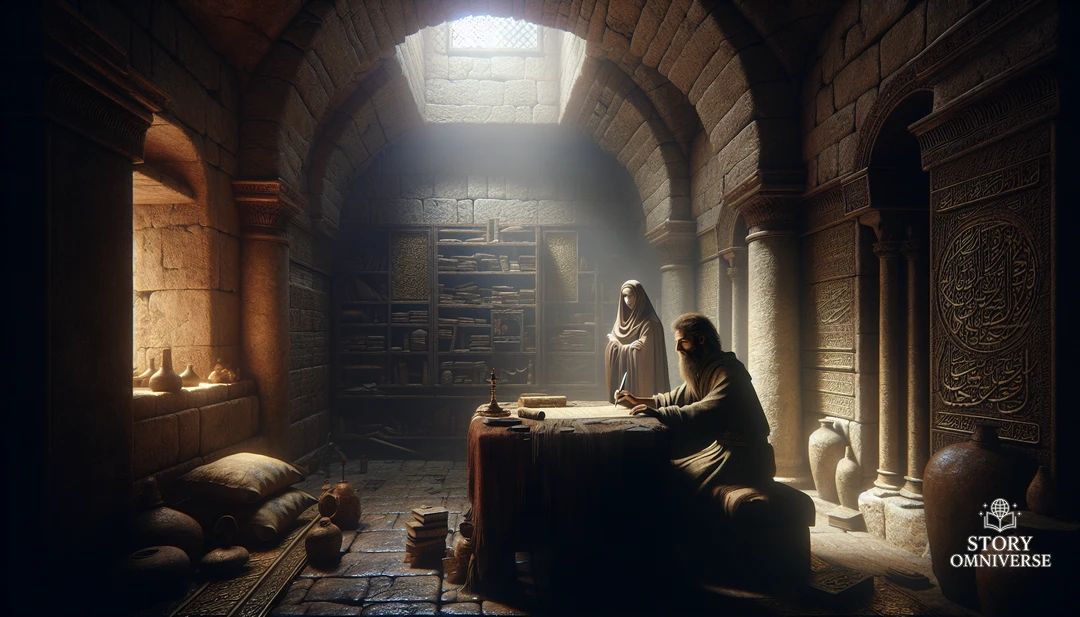
Chapter 1: The Chill in the Air
In the spring of 710 AD, Damascus swelled with prosperity beneath the rule of Caliph Al-Walid I. Its streets were alive with the scents of cumin and fresh bread, the clamor of coppersmiths, and the song of water flowing in the city’s famed canals. But beneath the hum of daily life, a deeper, colder current ran. Whispers seeped through the markets and palace alike: an illness was spreading, one that defied the skills of even the most revered healers.
Khalid ibn Umar, a diligent scribe in employ of the Diwan, worked in the palace’s grand library. He was a young man with keen eyes and a mind sharpened by curiosity. Each evening, after copying decrees and letters, he grew more distracted. His dreams were troubled—haunted by formless shadows, chilling winds, and the sound of many voices speaking in a tongue older than Arabic. At dawn, he woke shivering, the darkness clinging to him.
One afternoon, as Khalid gathered scrolls, he overheard two senior courtiers debating in agitated tones. “It is not an illness,” one said, his voice taut. “It is a curse. The wrath of those our forebears wronged.” The other scoffed, but both men glanced nervously about, as if the walls themselves listened.
These rumors echoed what Khalid had heard in the suqs: that the afflicted suffered not only fevers but visions—waking nightmares of ancient places and shadowy figures. Some whispered it was God’s punishment for hidden sins. Others, more quietly, muttered of older, nameless forces.
That evening, as the muezzin’s call shimmered through the dusk, Khalid lingered in the library, fingers running along shelves crowded with centuries of learning. He wondered if, among these scrolls, there might be an answer. He resolved to learn more, even if it meant risking the ire of those who preferred certain truths remain buried.
Khalid’s quest had begun, though he sensed only a fraction of the darkness he was about to unveil.
Chapter 2: In the House of Healing
The next dawn, the city’s famed bimaristan, or hospital, overflowed with the sick. Aisha bint Salih, a healer of repute, worked with relentless focus, her hands stained with the green of crushed rue and the red of spilled blood. She had treated all manner of fevers—pestilence from the Tigris, agues from the Orontes—but never had she seen such an affliction.
Those brought to her beds suffered terrible chills, their skin clammy and grey, eyes wide and haunted. They spoke of shadowed halls and voices from the grave. Some woke screaming, clutching at their chests as if something were clawing from within.
Aisha consulted her mentor, an old Persian physician who had served in the Sasanian court. He shook his head, muttering, “This is not a malady of the body, but of the spirit.” The words unsettled her, but she pressed on, seeking remedies in the ancient texts of Galen and Dioscorides.
After tending to her patients, Aisha made her way to the palace library, granted entry as an honored healer. There she encountered Khalid, hunched over a manuscript. Their eyes met—hers dark and resolute, his wary and searching.
“I have seen many illnesses,” Aisha said quietly, “but never one like this. The patients see things that are not there. Some claim to see ancient temples buried beneath the city.”
Khalid nodded, voice low. “The courtiers speak of a curse. I have found hints in the old records—stories of a forgotten people exiled by force, who swore revenge.”
Aisha hesitated. “If knowledge can save them, we must find it—no matter the risk.”
Together, they began to pore through the oldest tomes, seeking the root of the city’s darkness.
Chapter 3: The Manuscript of Shadows
By lamplight, Khalid and Aisha studied a brittle parchment with script so ancient it strained their eyes. The text, in a dialect of Syriac, spoke of an accursed place buried deep beneath the foundations of Damascus—a temple raised by a vanished tribe, whose rites had brought ruin upon themselves and all who supplanted them.
The manuscript warned: “When the signs appear—sleep without rest, chill that no fire can thaw, and tongues of the dead speaking in dreams—the curse has awakened. Only through purification, confession, and the breaking of pride can the darkness be turned aside.”
Aisha’s pulse quickened. “The symptoms match those of the afflicted. And the mention of confession—do you suppose the curse seeks to punish hidden guilt?”
Khalid frowned in thought. “Many of the first victims were men of power, rumored to have profited from misdeeds. But now, the illness spreads to the innocent as well.”
Their investigation was interrupted by the distant sound of a bronze bell—summoning Aisha to the palace’s sick chamber. She pressed Khalid’s hand. “Do not stop searching. The answers must be here.”
As night deepened, Khalid remained among the stacks, his candle guttering. He wondered if the city’s grandeur was built upon forgotten bones—and if those bones now demanded payment.
Chapter 4: The Silent Sufferers
Aisha moved through the palace’s infirmary, which now housed not just courtiers but servants and guards. She spoke gently to each patient, listening to their fevered ramblings.
One young woman, a laundress, clung to Aisha’s wrist. “They come at night,” the girl wept. “They whisper in the old tongue, telling me to confess. I know not what I have done.”
Aisha comforted her, heart heavy. The illness, once confined to the powerful, now touched the lowliest of the city’s folk. By lamp and moonlight, Aisha gathered herbs—myrrh for cleansing, wormwood for fever—but nothing eased the patients’ dread or dispelled their dreams.
In a rare quiet moment, she joined Khalid on the palace terrace overlooking the city. The moon was a pale crescent, the streets below unusually silent.
“Whatever the ancient text intended,” she said, “it is no longer justice. The innocent now suffer alongside the guilty. We must find the original site mentioned—the temple beneath the city.”
Khalid nodded, recalling a cryptic map he’d glimpsed in a palace record—markings beneath the Umayyad Mosque, built only a decade ago atop foundations that predated Islam itself.
“We must go below,” he said, “before the illness claims more lives.”
Chapter 5: Beneath the Stones
Late one night, cloaked in the anonymity of darkness, Khalid and Aisha made their way to the Umayyad Mosque. The great courtyard, usually bustling with scholars and worshippers, was empty save for a pair of drowsy guards whom Khalid distracted with a tale of a lost caliphal seal.
Aisha slipped through a side door, the cool stone beneath her sandals. In the mosque’s shadowed corner, she found the entrance Khalid had described: a narrow stair, ancient and crumbling, leading down to a chamber no longer used.
The air grew colder with each step, thick with the scent of old incense and dust. At the bottom, the walls bore faded carvings—geometric patterns, but also strange figures, their faces obscured. In the center stood a broken altar, its surface stained and pitted by time.
Khalid joined Aisha, holding a flickering oil lamp aloft. “This must be it—the temple beneath the city. The place of the curse.”
Aisha examined the altar, her fingers tracing a groove filled with blackened wax. “There are words here,” she whispered, deciphering the script. “‘Only those who confess may pass unscathed.’”
As they explored, a chill swept through the chamber, and the shadows seemed to pulse with hidden life. Khalid shuddered, his dreams returning to him in fragments—faces, voices, promises of vengeance.
They realized the truth: the city’s sin was its forgetting, its pride in erasing the past. Now, memory itself had become a weapon.
Chapter 6: The Caliph’s Command
News of Khalid and Aisha’s clandestine investigations reached the palace. The chamberlain, alarmed by reports of unrest and unorthodox inquiries, brought the matter to Caliph Al-Walid. The caliph, though a patron of learning, feared the spread of panic.
He issued a decree: “Let no one speak of curses or shadowy rites. The illness is but a test from Allah, and it shall be met with prayer and discipline.”
Aisha and Khalid, summoned before the council, spoke carefully, omitting mention of supernatural causes. Instead, they petitioned for the city’s wells to be cleansed, for the sick to be isolated, and for penance and charity to be encouraged.
Though the caliph approved these measures, he warned them: “The city stands at the crossroads of empires. Let not rumor bring shame upon Damascus. Seek the cure, but do so in the light of reason.”
Outside the council chamber, Khalid whispered, “We must act in secret. The city’s leaders will not face what they cannot see.”
Aisha agreed, her resolve hardening. “If old wounds have summoned this curse, then it falls to us to atone where others will not.”
They gathered what they needed: sacred water, incense, and the confessions of those willing to face the truth, and prepared to return to the buried temple.
Chapter 7: Night of Reckoning
On a night when storm clouds gathered over the city, Khalid and Aisha descended once more into the hidden chamber beneath the mosque. With them came three others: a penitent courtier, a servant who had seen the curse’s effects firsthand, and a young scholar who had lost his father to the plague.
They placed offerings—bread, dates, and water—upon the ancient altar. Aisha led prayers, reciting verses of repentance and humility. Khalid read aloud the confessions offered by their companions: admissions of pride, envy, and forgotten misdeeds.
As their voices rose, the chamber darkened, the flickering lamp casting monstrous shadows on the walls. A wind, inexplicable and cold, swept through the room, carrying voices that did not belong to the living.
Aisha’s heart pounded, but she did not falter. “We confess the sins of forgetting,” she called out, “and ask forgiveness for what was buried, for those exiled and wronged. Let the darkness be sated.”
The wind howled, then ebbed. The shadows pulled back. For a moment, the silence was so deep it ached. Khalid saw, in the corner of his eye, pale faces fading into nothing—faces he recognized from his dreams.
When it was done, the air felt lighter. The chill abated. The group hurried from the chamber, hearts wild with relief and exhaustion.
Chapter 8: Dawn Over Damascus
In the days that followed, the grip of the plague loosened. The afflicted woke from their nightmares, their fevers breaking. The city, sensing the change, began to stir with cautious hope.
Aisha returned to the bimaristan, tending to patients who, though weak, now improved. Word spread quietly of a “miracle,” though none could say precisely what had happened. Khalid resumed his duties, careful to record only what could be safely spoken, but he kept a private chronicle—a faithful account of the ancient rites and the city’s atonement.
The caliph, observing the city’s recovery, ordered a day of thanksgiving and charity. He never asked about the events beneath the mosque, perhaps sensing that some truths were best left in the shadows.
Khalid and Aisha met in the garden behind the hospital, beneath a blossoming fig tree. “We have bought the city peace,” Khalid said softly. “But the past is never truly erased.”
Aisha smiled, weary but content. “Let us remember, then, and teach others to remember. Only in remembrance can healing be complete.”
Chapter 9: Of Memory and Mercy
Life in Damascus slowly returned to its rhythms—traders haggling in the suqs, children playing by the aqueducts, scribes penning decrees in the palace. Yet the memory of the plague lingered, a faint unease in the eyes of those who had survived.
Aisha continued her work, but now she also taught apprentices, sharing not just medicine but stories of humility, forgiveness, and the dangers of pride. She urged her students to treat every patient as a bearer of history, every ailment as a possible echo of forgotten pain.
Khalid, too, found his voice changed. His writings in the palace annals became more measured, more attuned to the lessons of the past. In secret, he and Aisha compiled their account of the curse—a record not just of horror, but of the city’s resilience and the peril of burying uncomfortable truths.
Their manuscript found its way into the palace library, hidden among the codices, a silent warning to those who might one day disturb the city’s ancient foundations.
Chapter 10: The Light Beyond the Shadows
As the year wore on, news arrived from Ifriqiya—Arab forces, under Musa ibn Nusayr, had begun the campaign that would change the western world, crossing the sea to the Visigothic kingdom. In the palace, people spoke of conquest and glory, but Khalid and Aisha knew that no future could be built without reckoning with the past.
One night, as the crescent moon hung over Damascus, Khalid and Aisha stood in the courtyard of the bimaristan, listening to the city’s distant songs. The air was cool, sweet with the scent of jasmine.
“We did not banish the shadows forever,” Khalid mused, “but we learned to face them.”
Aisha nodded. “And perhaps that is enough. For each new generation, there will be old wrongs to confront—and new light to kindle.”
Their story, a testament of horror and hope, lingered in the city’s stones, in the river’s song, in the hush of the midnight wind. And as Damascus thrived, it did so not in ignorance, but in the hard-won knowledge that even beneath the greatest cities, shadows wait to be remembered.

0 Comments