
Pulse Protocol: Visual Guidance
When the braid awakens, every sense is your lifeline.
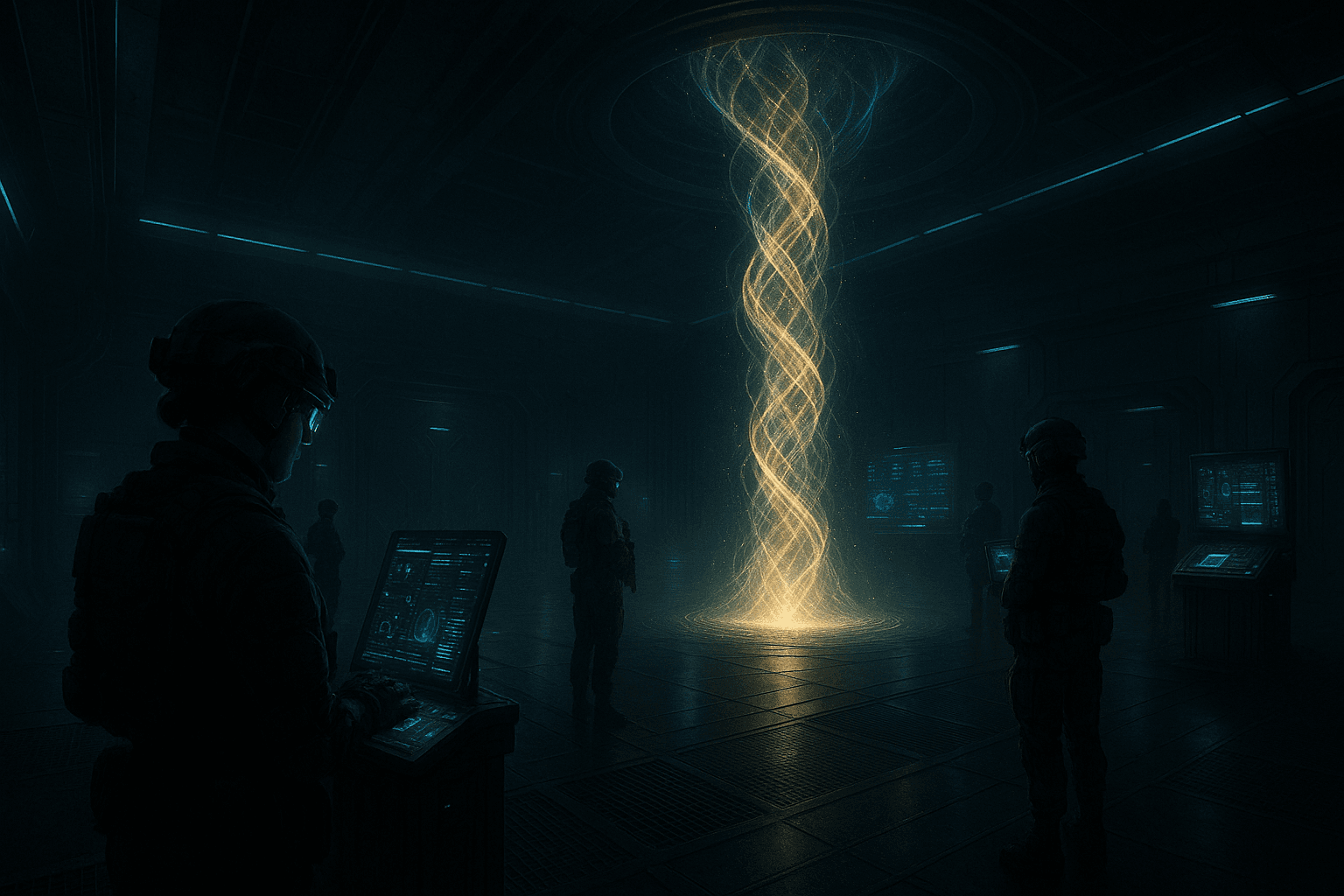
The Pulse Protocol’s visual guidance procedures were developed not as a luxury, but as a matter of survival. In the confined, high-security depths of Fort Resonance, the moment a Leyweb corridor stabilizes, every operative within the Resonant Convergence Chamber must be acutely aware of what they’re seeing, hearing, and even feeling. Misreading these signs — or missing them entirely — can be the difference between a successful traversal and being trapped in the void.
When inactive, a resonance corridor is nothing more than an idea suspended in potential. Operators and observers will see nothing but the sterile floor grates, feel the static of environmental systems, and hear the low hum of harmonic shielding. But the instant a valid dual-pulse key is injected, the environment begins to change.
First comes the acoustic shift — a sub-bass tremor that vibrates through bone and teeth. Trained personnel know this sensation as the “bone chord,” a subtle warning that the Leyweb is beginning to notice the oscillation. Within seconds, the ambient temperature drops by approximately two degrees Celsius, the air becomes drier, and a faint charge prickles across exposed skin. Operators refer to this stage as “the prickle,” and it is the first tangible sign that the braid is forming.
Next are presence phenomena. Some operatives report a pressure in the inner ear, a sense of spatial narrowing, or the fleeting impression of a figure just out of sight. Psychological profiles have confirmed that these sensations are not hallucinations — rather, they are byproducts of the Leyweb’s phase alignment brushing against the human sensory system.
At precisely ninety seconds into a stable oscillation, the 432 Hz chime sounds — an unmistakable auditory cue that the braid is visible. This moment is when the corridor’s appearance changes from nothing to a breathtaking structure: a braided gravity tunnel of golden–cyan filaments, suspended in mid-air, twisting subtly with the oscillation pattern. The surrounding air lens-warps, bending light just enough to give the impression that space is folding inward toward the braid.
From here, visual guidance protocols take over. Tech-aids like spectral visors allow operators to monitor filament tension in real time, mapping the energy’s cohesion across its full length. Mission tablets display live resonance health, phase variance, and decay rate. Even so, experienced personnel are taught to trust their eyes and instincts — a filament that flickers or “breathes” unevenly is a filament that may collapse without warning.
Entry into the corridor is permitted only after both AI and human confirmation. Teams move in tight formation, avoiding unnecessary contact with the filament walls. These walls, while visually delicate, are under immense harmonic stress; even a brief disruption in their oscillation can ripple through the entire braid.
Once inside, the visual cues shift dramatically — the golden–cyan braids stretch endlessly in both directions, and the floor beneath seems to be composed of semi-solid light. For all its beauty, this is not a place to linger. The 900-second operational window is immutable, and the countdown begins the moment the chime sounds.
The visual guidance manual for the Pulse Protocol is more than a checklist. It is a living record of every successful traversal, every close call, and every hard lesson learned by those who walk between worlds. As General Ayla Serrin once told a rookie TRU member: “The braid doesn’t care if you’re ready. It only cares if you’re fast.”