
Chapter 1: A Seal in the Snow
Snow had fallen in the night and kept falling, soft as sifted flour. It dulled the sound of hooves in Stonegate and gentled the sharp lines of York’s roofs, as if the city had forgotten its own edges. Thomas atte Bridge did not forget. He kept his head down and his satchel tight beneath his cloak, feeling the hard shape of the sealed letter through the leather.
The clerk who gave it to him had been a thin man with ink-stained fingers and a voice like a file. “To be delivered by hand,” he said, and pressed the wax with a signet showing a sunburst and a rose. Thomas watched the wax cool to a deep red and thought it looked like a wound.
This was no ordinary winter. Since Michaelmas there had been talk in every alehouse and under every eave: the Earl of Warwick had turned, Edward had fled, and Henry of Lancaster had been brought back to the throne. Yet talk did not move as fast as proclamations, and proclamations did not always reach the same corners at the same hour. In York, rumor ran ahead of certainty, and certainty arrived with cudgels.
Now the street was full of noise even under snow. People leaned from doorways and called to one another. A boy ran past Thomas, shouting, “King Henry! King Henry’s come again!” and nearly slid into a puddle of slush. Two men in wool caps stood by a fishmonger’s stall and argued in low voices. One made the sign of the cross, as if to ward off bad luck rather than bless good fortune.
Thomas slowed near the Minster close, where the bells began to ring, not for a feast day, but in a hurried, uneven peal. At the corner by a tavern stood soldiers with patched coats and steaming breath. One wore a badge pinned to his chest: a red rose, crude and newly stitched, the sort of thing a man might fix on in a hurry to look safe.
The satchel grew heavy, as if it had filled with stones. The wrong seal could kill him. In York, seals were not mere wax. They were a lord’s mark, a hint of allegiance, and the city had a way of turning on boys who carried such hints.
A woman selling candles looked up at him. “You there,” she said, eyes narrowed. “Where are you bound?”
“Home,” Thomas lied at once.
She sniffed. “Home is changing. Best keep your mouth shut.”
Thomas nodded and moved on, trying to look like a boy with errands. But his heart had begun to beat too fast, and he could not stop thinking of the sunburst in wax. If Henry sat again in London by Warwick’s will, then a Yorkist seal was not a simple mark. It was a hook for any man eager to prove himself loyal.
At the end of the street, a man in a fur-trimmed hood pushed through the crowd, reading from a parchment. “By order of the king,” he cried, “all good men are to keep the peace and show obedience to His Grace Henry!”
Some listened, some muttered, some stared at their boots. Thomas turned his face away and walked, snow melting on his lashes. He had been paid to carry a letter, not to choose a king. Yet the city was choosing for him, and he could feel it closing like a fist.
Chapter 2: The City Changes Its Face
By midday, York had put on a new face like a mask. Banners on guildhalls were changed, or taken down and replaced with plain cloth until someone dared decide what was safest. In the market, a man with a drum beat out a rhythm while another read new orders. The words were swallowed by wind, but the meaning sat plain in the way people listened with stiff shoulders and careful eyes.
Thomas stood near a stall of winter apples, small and wrinkled, and watched. Master Haxby the butcher had once spoken loudly of Edward’s strength and how the north would not be ruled by weak men. Today the butcher kept his gaze on his cleaver and nodded at every mention of King Henry, as if his neck depended on it.
Thomas’s friend Will, an apprentice to a cordwainer, slipped close and caught his sleeve. Will’s cheeks were red from cold and worry. “Have you heard?” he whispered. “They say Warwick has brought the king back for true. They say Edward’s gone over sea.”
Thomas kept his voice low. “I heard. Keep your tongue.”
Will glanced at Thomas’s satchel. “You still running letters?”
Thomas did not answer. A courier’s work was meant to be unseen, but the city was hunting for signs. Will swallowed. “My master says we should hang a red rose at the door. Just till we know which way the wind holds.”
“For safety,” Thomas said, and tasted the bitterness of it.
A shout rose near the Shambles. Thomas pushed forward with the crowd and saw a man pinned against a post, his cap knocked into the slush. Two soldiers held him while another struck him with the flat of a sword.
“I said Edward is king,” the man choked out, stubborn even as blood ran.
The soldier hit him again. “Say Henry, you dog.”
The man’s eyes flicked over the faces watching. Some looked away. Some watched as they watched bear-baiting, hungry for the next blow. Thomas felt his stomach twist. This was how a city taught itself what to say.
A woman cried, “Leave him!” and was shoved back by her husband, who hissed, “Do you want us all hauled?”
Thomas backed away, heart thudding. The letter in his satchel might not even need to be read. The seal alone could bring a sword down on him in the street, and no one would stop it. Men wore badges now as much to shield themselves as to show devotion, and those badges changed as quickly as talk.
He slipped into a narrow lane where the snow lay undisturbed. Behind him, the bells kept ringing, as if noise could make a king real in every man’s mind. He pressed his back to a wall and breathed, tasting smoke and cold iron.
He thought of his mother, dead two winters now, and of his father’s empty place by the Ouse. He had no household to shelter him if trouble came. His only protection was speed and the way he could vanish into crowds.
Thomas looked toward the western roads, where the city’s stone teeth bit at the horizon. If he stayed, he would be searched sooner or later, and searched boys did not always come home. If he left, he might be stopped. But on the road he could choose his steps, and choosing was a kind of power.
He tightened his cloak, pulled his cap lower, and made his decision. York could change its face without him. He would not wait for it to decide his fate.
Chapter 3: A Gate at Dusk
Thomas waited until dusk, when the light thinned and the snow turned blue in shadow. He moved through back streets, avoiding the main ways where proclamations were shouted and men gathered to argue loyalty. Smoke rose from chimneys, smelling of peat and damp wood. Somewhere a dog barked and was answered by another farther off, as if the city itself were uneasy.
Micklegate Bar loomed ahead, heavy and black against the pale sky. The gate was a mouth, and tonight it had teeth. Torches flared on either side, their light catching on wet stone. Guards stood with spears and short swords, and a table had been set near the arch where travelers were made to stop.
Thomas slowed, letting a group of drovers drift around him. They smelled of sheep and wet wool, leading a small herd that bleated miserably in the cold. A woman with a basket of eggs argued with a guard, her voice sharp. “They’ll freeze if I stand here,” she said, nodding at her basket.
“Then you should have come earlier,” the guard replied, bored. He reached into her basket anyway, as if expecting to find a knife among eggs.
Thomas watched, measuring. The guards were not merely counting heads. They were looking for tokens, badges, papers, any scrap that could be made into a charge. A man ahead was made to open his cloak. A small white rose pinned inside was torn away and thrown into the snow.
“Who gave you that?” the guard demanded.
“I found it,” the man stammered. “In the street.”
“Liar,” the guard said, and shoved him aside to be held by another.
Thomas’s throat went dry. He could not hide the satchel itself, but he could hide what mattered most. He stepped behind a drover and crouched as if to tighten his shoe. His fingers, numb with cold, fumbled at the laces. He drew the letter out, the wax seal hard as a coin, and slid it into his boot against his ankle. The paper crinkled softly. He winced, as if the sound would carry to the table.
“Move on,” the drover muttered, thinking Thomas was slowing the herd.
Thomas rose and let himself be pushed forward with the animals. The guard’s eyes flicked over him. “Boy,” he said. “What’s in the bag?”
“Bread,” Thomas answered, lifting the satchel a little. “And a shirt. Going to my uncle at Tadcaster.”
The guard held out a hand. Thomas gave him the satchel, keeping his face calm by force. The guard opened it, pawed through the cloth bundle Thomas had packed on purpose, and found only a heel of bread and a worn tunic.
“No papers?” the guard asked.
Thomas shook his head. “No, sir.”
The guard grunted and tossed the satchel back. “Be quick, then. And keep away from trouble.”
Thomas nodded, ducked under the arch, and stepped out of the city’s shadow. The road beyond was a pale strip between hedges, half-buried in snow. The wind hit harder outside the walls, carrying the smell of open fields and distant dung fires.
He walked fast, not daring to look back. Yet he felt eyes on him all the same. Near the gate, mounted men sat their horses, dark shapes against the snow. They were speaking to travelers one by one, leaning down to ask questions. One rider’s cloak showed a red badge at the shoulder, stitched rough as if done in haste.
Thomas kept his pace steady, like a boy with nothing to hide. But the letter in his boot pressed against his ankle with every step, and he could not stop thinking of hoofbeats behind him. The city had let him out. It might still reach for him.
Chapter 4: The Moor Road
Thomas left the main road as soon as he dared. He took a rough track that bent away toward the moorland, where the ground rose and the hedges thinned. Snow lay in drifts against stones and stunted bushes. The wind had teeth here, cutting through his cloak and finding every gap.
His stomach gnawed at him. He had eaten only a crust since morning, saving what little he had. He chewed a bit now, the bread dry and gritty, and swallowed with difficulty. The cold made his jaw ache.
He listened for hoofbeats. The moor carried sound strangely. Sometimes the wind itself sounded like distant riders. He stopped twice, holding his breath, until he realized it was only the creak of branches and the far cry of a crow.
Near a low stand of trees, he saw smoke. For a moment fear tightened his chest. Smoke meant people, and people meant questions. But the track narrowed there, and his feet were already numb. He could not keep wandering in circles until night took him.
He came upon a small mill pond, half-frozen, and beyond it a mill with a sagging roof. A girl stood outside, struggling with a bundle wrapped in cloth. She was about his age, perhaps a year older. Her hair was covered by a kerchief, but loose strands whipped in the wind. Her cheeks were chapped red, and her eyes were sharp.
She saw him and did not smile. “You lost?” she called.
Thomas raised his hands slightly, showing he held no weapon. “Just passing. Is the road to Tadcaster this way?”
She snorted. “If you want to be seen, take the main road. This track goes where it goes.”
He stepped closer, wary. “Why are you out here alone?”
The girl’s mouth tightened. “I’m not staying to feed soldiers.” She hitched the bundle higher. “They came yesterday, four of them, saying they had warrant. Ate our flour and took our hens. Father said no more. Then they said they’d quarter more men tonight.”
Thomas understood. Forced billeting was not new, but in a year like this it grew worse, as men used the king’s name like a cudgel, whichever king they chose to shout for. “So you’re running,” he said.
“I’m going to my aunt near Ferrybridge,” she replied. “I’m Alice of the mill by Healaugh.” She looked him up and down. “And you’re a boy with a satchel who walks like he’s being hunted.”
Thomas felt heat rise in his face despite the cold. “I’m Thomas. I carry messages.”
“Messages for which lord?” Alice asked, blunt as a stone.
Thomas hesitated, then chose a half-truth. “For a clerk. It’s work.”
Alice’s eyes narrowed, but she did not press. She glanced at the open moor behind him. “If you’ve sense, you won’t walk alone. Men are stopping folk on the roads. They ask questions that have no safe answer.”
Thomas looked at her bundle. “If we go together, we look less like prey.”
Alice considered, then nodded once. “Fine. But if you bring trouble to me, I’ll leave you in a ditch.”
They set off side by side, the wind pushing at their backs. The track was rutted and half-hidden under snow. Alice walked with purpose, as if anger kept her warm. Thomas matched her pace, grateful for another set of eyes and ears.
As the light faded, the moor turned into a wide, empty gray, and their footprints were the only marks on it. Thomas felt the letter in his boot, a secret weight between him and safety. He did not tell Alice what seal it bore. Not yet. For now, survival meant silence and steady steps on the winter road.
Chapter 5: Bread, Salt, and a Price
Night came early, thick with cloud. The snow eased, but the cold sharpened. Thomas and Alice followed the track down toward lower fields where hedges grew taller and the land smelled faintly of manure and damp straw. A single lantern glimmered ahead, hanging from a byre door.
“A farm,” Alice said, voice tight with hope and caution. “Maybe we can buy bread.”
Thomas’s stomach answered with a hollow twist. They approached slowly, making sure they were seen before they reached the door. A dog barked, deep and angry, and a man’s voice shouted, “Hold there!”
A farmer stepped out, holding a staff. He was broad, with a gray beard and wary eyes. Behind him, a woman peered from the doorway, clutching her shawl. The dog strained at a rope.
“We mean no harm,” Alice said quickly. “We’ve coin. We want bread and a bit of salt, if you can spare it.”
The farmer’s gaze flicked to Thomas’s satchel, then to their boots crusted with snow. “Coin means little if I’ve nothing left,” he said. “Armed men came through two days past. Ate like locusts. Said it was for the king.”
Thomas kept his voice careful. “Which king did they name?”
The farmer’s mouth twisted. “The one they say is king today.” He jerked his chin toward the house. “Come in, then. Quick. I don’t want neighbors thinking I’m harboring strangers.”
Inside, the room was low-ceilinged and smoky. A small fire burned, more ash than flame. The air smelled of turnips and wet wool. The farmer’s wife set a heel of oat bread on the table and a small dish of salt, as if laying out treasure. Thomas’s hands shook as he broke off a piece.
“Slow,” the woman warned. “It sits hard if you wolf it.”
Alice ate with her eyes down, but Thomas saw the way she watched the door, ready to bolt. The farmer sat opposite them, rubbing his hands. “You two are walking at the worst time,” he said. “Warwick’s men are bold in some places. In others it’s the old sort, men who take what they want and call it service. They stop folk, ask who you favor. If you answer wrong, they find reason to strip you.”
Thomas swallowed, throat tight. “We’re bound for Ferrybridge way,” he said.
The farmer nodded slowly. “Then you’ll cross paths with men who think they own every road. If you’re wise, you’ll hide till morning.”
Alice’s shoulders tensed. “Hide where?”
The farmer jerked his thumb toward the byre. “Barn’s cold but it’s dry. I’ll not keep you in the house. If soldiers come, they’ll search here first.”
Thomas looked at the dim fire, longing to stay close to it. But he pictured torches at the door, hands grabbing his satchel, a boot pulled off to reveal wax. He forced himself to think like a survivor, not a child.
“We’ll take the barn,” he said.
Alice shot him a look, half anger, half relief. The farmer’s wife wrapped two small pieces of bread in cloth and pressed them into Alice’s hands. “For the road,” she murmured. “Don’t tell anyone you got it here.”
Outside, the barn smelled of hay and animals. Their breath made clouds in the dark. Thomas found a corner behind stacked hurdles, and they crouched close, sharing what warmth they could without touching.
“You chose the barn quick,” Alice whispered.
Thomas stared into the darkness. “Because men with swords don’t ask politely.”
From the house, faint voices rose and fell. Thomas listened for hoofbeats, every creak of wood sounding like a step. The bread sat heavy in his belly, but it was warmth, and warmth was life.
Alice shifted and whispered, “We leave before first light.”
Thomas nodded, though she could not see it. He did not sleep much. He lay with his hand on his boot, feeling the hard edge of the letter through leather, and wondered what price a seal could demand on a winter night.
Chapter 6: The River Crossing
They left while the sky was still a dark slate and the fields lay silent. Frost crusted the hedges, and the snow underfoot squeaked with each step. Alice led them along narrow paths between farms, avoiding the wider road. Thomas’s toes were numb, and the letter in his boot felt like ice against his ankle.
By midmorning they heard water before they saw it. The river, swollen with melt and winter rain, ran fast and brown, chewing at its banks. A bridge stood ahead, stone arches slick with frost. It should have been a comfort. Instead it was a trap.
Men stood at the bridgehead, three of them, with cudgels and short blades. A fourth leaned against the parapet, watching the road like a cat watches a mouse hole. Their cloaks were damp, and one wore a red rose badge pinned carelessly, as if daring anyone to question it.
Alice stopped behind a hedge and crouched. Thomas followed, his breath loud in his ears.
“They’re stopping folk,” Alice whispered. “Look.”
A cart approached the bridge, piled with sacks. The driver pulled up, hat in hand. One of the men stepped forward and spoke, gesturing toward the sacks. The driver lifted a sack mouth to show grain. The man plunged his hand in anyway, then laughed and took a handful, letting it fall back like sand.
“King’s need,” the man said, and slapped the cart’s side. The driver’s shoulders sagged as he was waved through lighter than before.
Thomas’s mouth went dry. “If they search us…”
Alice’s eyes flicked to his satchel. “We don’t go near them,” she said. “There’s a ford downriver. Father used it when the bridge toll was too dear.”
Thomas looked at the river. It moved like a living thing, angry and cold. “In this weather?”
“Better cold than questioned,” Alice snapped, then softened. “Come on. Stay close.”
They followed the bank, boots slipping in mud under snow. The ford was a shallow spread where stones broke the surface, but today the water covered most of them. Ice fringed the edges like broken glass.
Alice tested with a stick she found, poking the current. “It’s fast,” she said. “Hold my sleeve.”
Thomas nodded and gripped her cloak. They stepped in. The cold hit like a blow, driving up through his legs. Water surged around his knees, then his thighs. His breath caught.
Halfway across, his boot struck a hidden stone and slid. He tightened his grip on Alice, but the current yanked him sideways. His fingers tore at cloth, then slipped. He went down hard, water filling his mouth, roaring in his ears.
For a moment there was only brown water and the weight of his own clothes dragging him. He kicked, frantic, and his foot caught nothing. The letter in his boot felt absurdly important, as if it were the cause of his sinking.
His hand brushed something solid: a root, thick as a wrist, exposed by the river’s bite. He clawed it and held on. The current tried to peel him away. He wrapped both arms around it and coughed, choking out river water. His lungs burned.
“Thomas!” Alice’s voice, distant and sharp.
He could not answer. He pulled, inch by inch, toward the bank, scraping his knees on stones. When his chest hit mud, he rolled onto his side and lay gasping, shaking so hard his teeth clicked.
Alice appeared above him, soaked to the waist, her face pale. She grabbed his collar and hauled. “You stupid fool,” she hissed, but her eyes were bright with fear. “Get up. Move.”
They crawled into the reeds and collapsed behind them, hidden from the bridge by a bend and low trees. Thomas’s hands were purple, his cloak heavy with water. He tried to stand and nearly fell.
Alice tore a strip from her bundle cloth and shoved it at him. “Wrap your foot. If it freezes, you’ll lose it.”
Thomas’s fingers fumbled at his boot. The leather was soaked. He felt the letter inside, damp but still there. He wrapped his ankle and boot tight, pain shooting up his leg.
Behind them, the river rushed on, uncaring. Ahead, the road waited, and the men at the bridge still watched for travelers who chose warmth over risk. Thomas shivered and understood that survival was not heroic. It was stubborn, ugly, and cold.
Chapter 7: The Letter’s Weight
They found shelter in a ruined sheepfold on higher ground, its stone walls broken in places and its roof half gone. It was not much, but it cut the wind. Inside, old straw lay flattened and smelled of damp lanolin. Thomas and Alice crouched close to the wall, trying to wring water from their hems.
Thomas’s hands would not stop shaking. Alice’s anger had gone quiet, replaced by a hard watchfulness. She tore the oat bread into small pieces and handed him one without looking at him.
“Eat,” she said. “You’ll fail on your feet if you don’t.”
He chewed, though his mouth was too cold to taste much. The bread stuck to his teeth. He swallowed and felt it sit like a stone.
Alice stared at his boot, at the way he kept adjusting it. “What’s in there?” she demanded. “You’ve been guarding that foot like it’s a relic.”
Thomas hesitated. The wind whistled through a gap in the wall. Far off, a church bell rang once, thin as a thread. He thought of the farmer’s warning, of the bridge men, of the beating in York.
“It’s a letter,” he said at last. “Sealed.”
Alice’s eyes narrowed. “I know that. Who’s it for?”
He could lie again, but the river had stripped some lying out of him. “A Yorkist contact near Pontefract,” he admitted. “A man who pays for news. I was sent by a clerk in York.”
Alice’s face went still. “Yorkist,” she repeated, as if tasting poison. “So that’s why you ran when the bells rang for Henry.”
Thomas flinched. “I ran because boys get killed for less than a seal.”
“And you brought that danger to me,” Alice said, voice rising. “You let me walk with you, share bread with you, cross a river with you, and all the while you carried a thing that could hang us both.”
Thomas’s hands clenched in the straw. “I didn’t ask you to come.”
Alice’s laugh was sharp. “No, you just let me. Because it was safer for you.”
He looked at her then, really looked. She was soaked, hair escaping her kerchief, lips cracked from cold. She had hauled him from the river. Shame burned under his skin.
“I’m sorry,” he said, and the words came small. “But it’s my work. It’s all I have. If I deliver it, I get paid. Maybe I get a roof for a while. If I don’t, I go back to being nothing.”
Alice’s eyes flashed. “Burn it,” she said, sudden and fierce. “Throw it in the first fire we find. Then you’re only a wet boy, not a traitor with proof.”
Thomas’s heart hammered. He pictured the wax seal, the clerk’s thin face, the promise of coin. He also pictured the bridge men’s hands pulling at his boot.
“I can’t,” he said. “It’s my token. If I reach the man and he asks who sent me, the seal answers. Without it, I’m a liar to everyone.”
Alice stood, pacing the small space like a caged thing. “Service,” she spat. “To men who change badges and send boys into snow.”
Thomas rose too, unsteady. “I didn’t choose the war,” he said, voice cracking. “But it’s here. And I have to live in it.”
They stared at each other, breath steaming. Outside, the sky was a dull white, promising more cold. At last Alice sank back down, pulling her cloak tight.
“I won’t die for your letter,” she said, quieter.
Thomas nodded, swallowing fear. “And I won’t ask you to.”
But he knew the road would ask anyway. The letter’s weight was not only in his boot. It was between them now, a third traveler in the sheepfold, silent and dangerous.
Chapter 8: Riders in the Mist
Dawn came wrapped in mist. It lay low over the fields, turning hedges into dark smudges and making every sound seem nearer than it was. Thomas and Alice moved carefully, keeping to the edges of fields where the ground was firmer. Their clothes had dried only enough to stop dripping. The cold still lived in the seams.
They had not spoken much since the sheepfold. Words felt like sparks that could catch and burn. Thomas kept his eyes on the track ahead, but his mind returned again and again to the seal in his boot and the way men’s faces had changed in York when they smelled danger.
A faint clop reached them, then another. Hooves on frozen ground, muffled by mist. Alice froze and grabbed Thomas’s sleeve, dragging him down behind a hedge thick with briars.
They crouched in wet grass. The mist carried the smell of horses, warm and sour. Shapes emerged: riders in cloaks, heads bowed against cold. There were four, maybe five. They rode slowly, scanning the fields, as if expecting someone to rise out of the earth.
Thomas’s heart pounded so hard he feared they would hear it. Alice pressed her face into her cloak, breathing shallowly. Thomas tried to do the same, but his lungs wanted air.
The riders halted near the hedge line. One dismounted, boots crunching. He walked a few paces into the field, peering into the mist. “Tracks,” he called back. “Two sets. Fresh.”
Thomas’s stomach dropped. Their footprints, half-filled with drifting frost, still showed where they had crossed open ground.
“Spread,” another rider said. “No messages slipping through. Not now.”
Alice’s fingers dug into Thomas’s arm, painful. Her eyes were wide. She mouthed, Go.
But where? The hedge was thick, but not endless. If the men walked the line, they would find them breathing like frightened hares.
Thomas’s mind raced. If they were caught together, Alice would be taken with him. She had kin to reach. She had done nothing but flee hungry soldiers. Thomas felt the letter press against his ankle like a brand.
He leaned close to Alice’s ear. “If I run, they’ll follow me,” he whispered.
Her head jerked. She shook it hard, eyes shining with anger and fear.
“They’ve our tracks,” he murmured. “If we stay, they find us. If I draw them off, you can slip away along the hedge to the east. Toward the mills.”
Alice’s lips trembled. She wanted to argue, but a man’s voice came closer, boots snapping twigs. Thomas could see the outline of a cudgel in his hand.
Thomas took a breath that tasted of wet earth. He rose suddenly from the hedge, stumbling into the open as if he had been spotted. “Hoy!” he shouted, forcing his voice to carry.
The nearest rider turned, startled. “There! Boy!”
Thomas ran. His boots slapped frozen mud. The mist swallowed him and then spat him out again as he crossed into another field. Behind him, he heard the rush of men mounting, the sharp command, “After him!”
Hoofbeats thundered, close enough to feel in his ribs. Thomas ran harder, lungs burning, the letter in his boot thumping with each stride. He did not look back. Looking back would slow him, and slowing meant hands on his shoulders, a knife at his belt, a boot ripped off.
He aimed for a line of low trees ahead, a darker patch in the gray. Branches whipped his face as he plunged into them. He heard riders curse as they followed, horses reluctant among roots and brush.
Thomas ducked, veered, and burst out the far side, sliding down a small bank into a ditch half-filled with icy water. He did not stop. He climbed out, soaked again to the knee, and ran toward the faint shape of rooftops in the distance.
Somewhere behind him, the riders shouted, but the mist tangled their voices. Thomas kept going, not for glory, but for breath, for life, and for the hope that Alice, hidden in the hedge, was already moving away.
Chapter 9: The Turning at Ferrybridge
The village near Ferrybridge appeared like a smudge that became real: low houses, a church tower, smoke rising from chimneys into the mist. Thomas stumbled into the first lane, chest heaving, legs shaking. People turned to stare at the sight of a breathless boy with mud to his knees and panic in his eyes.
He forced himself to slow. Running in a village drew attention. Attention drew questions. He pulled his cap lower and tried to walk as if he belonged, though his heart still raced.
A woman carrying a pail frowned at him. “You look half-drowned,” she said.
“Fell in a ditch,” Thomas muttered, voice rough.
He aimed for the churchyard, thinking of shelter, of crowds. But as he passed a smithy, a voice behind him barked, “You! Stop!”
Thomas’s blood turned to ice. He turned his head slightly and saw two men at the lane’s mouth, not villagers. One had the same hard face as a guard at Micklegate Bar, a face Thomas remembered from torchlight. The man’s eyes narrowed with recognition.
“It’s him,” the man said to his companion. “The messenger boy from York gate.”
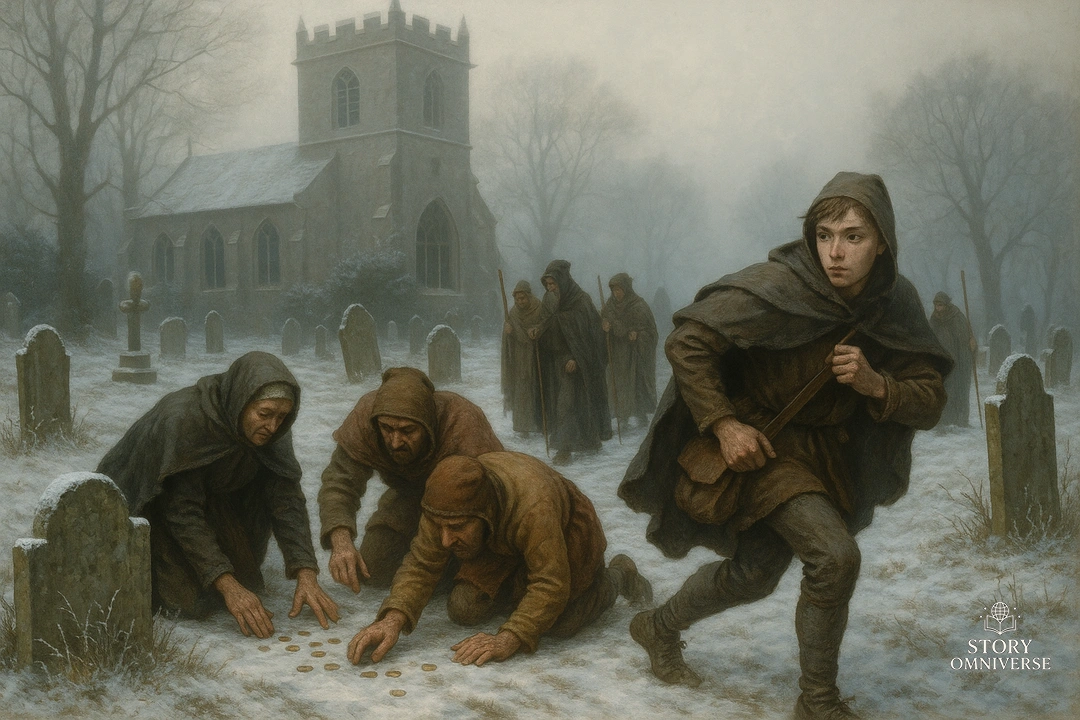
Thomas’s feet moved before his mind finished thinking. He pushed into the churchyard, where a small knot of people stood near the porch. A few carried staffs and wore badges of saints sewn to their caps. Pilgrims, perhaps, traveling on vow or need. They looked tired and wary, like everyone on the roads.
“Hold!” the man shouted, following. “In the king’s name!”
Heads turned. Murmurs rose. Thomas’s mouth went dry. If these men cried “Yorkist” in the churchyard, the village might join the hunt just to prove itself obedient.
He darted between two pilgrims, murmuring, “Pardon,” and tried to blend. A hand seized his elbow. He twisted free, but another man stepped into his path, blocking him with a cudgel.
“Nowhere to go,” the York gate man said, closing in, breath steaming. “We’ll have that satchel and whatever you’ve tucked away.”
Thomas’s mind flashed to the letter in his boot. He backed toward the graves, stones slick with frost. The pilgrims pressed away from him, not wanting trouble. He was alone again.
Then a shout rose from the far side of the churchyard. A girl’s voice, sharp as a thrown stone. “Thief! He took my bread!”
Alice burst through the gate, hair loose, cheeks flushed from running. She charged straight at the cudgel man and slammed into him shoulder-first. He staggered, startled. Alice snatched at his belt pouch with quick fingers, then tossed it high into the air.
Coins spilled, flashing dull silver and copper as they fell into the snow. People lunged without thinking. A pilgrim cried out. A child darted forward. The crowd surged, sudden and greedy, and in that heartbeat the men’s attention broke.
“Stop them!” the York gate man yelled, but his voice was swallowed by the scramble.
Alice grabbed Thomas’s sleeve. “Move!” she hissed.
They shoved into the press of bodies. Thomas ducked behind a tall pilgrim with a staff and slipped around the porch. Alice veered away, drawing eyes with her wild hair and bold face. She shouted again, “He’s there!” pointing not at Thomas but at a random man fleeing with a coin clenched in his fist.
The cudgel man cursed and ran after the wrong target. Thomas seized the moment. He pulled his cap low, hunched his shoulders, and walked fast among the pilgrims as if he belonged to their weary line. He heard Alice’s voice behind him, still loud, still dangerous.
At the edge of the churchyard, Thomas did not look back. If he looked back, he might stop. He might run to her and both of them would be caught. He slipped onto the road leading toward Pontefract, merging with a small group of travelers moving out of the village.
Mist closed around him again. Behind, shouts faded into the muffled noise of a winter morning. Thomas’s throat burned with more than cold. Alice had returned when she could have fled. She had thrown herself into danger so he could vanish.
He walked until his legs steadied, until the village was only a memory in the fog, and then he let himself breathe.
Chapter 10: The Castle Shadow
Pontefract Castle rose from the land like a dark thought. Even from a distance, Thomas could see its walls, heavy and watchful, the stone damp with winter. The town below it seemed to huddle, smoke clinging low, people moving with heads down. In a year when kings changed and great lords made and broke oaths, castles were not just fortresses. They were questions, and men answered them with silence.
Thomas entered cautiously, keeping to side streets where refuse lay frozen and dogs nosed at it. He asked directions in a low voice, careful not to sound like a stranger with business. At last a washerwoman, her hands red raw, pointed him toward a cluster of outbuildings near a large house that served the castle’s needs.
“Servants’ way,” she said. “Don’t go waving papers. Men get taken for less.”
Thomas thanked her and moved on, feeling the letter’s edge bite his ankle with each step. He found the place: a long, low building where servants carried baskets and drew water, their faces closed. A boy no older than Thomas stood by the door, splitting kindling.
Thomas approached and spoke the words the York clerk had taught him, a phrase that sounded like nonsense. “The Ouse runs dark in winter.”
The boy paused, axe raised, and studied him. “And the Aire runs colder,” he replied after a moment. He jerked his chin. “Back door. Wait.”
Thomas’s pulse quickened. He slipped around to the back, where a narrow passage smelled of ash and sour ale. He waited, stamping his feet softly to keep feeling in them. After a time, a man emerged, not grand, not armed, just a middle-aged servant in a plain wool coat. But his eyes were quick and wary.
“You’re from York,” the man said.
Thomas nodded. “Thomas atte Bridge. I have a letter. Sealed.”
The man’s gaze flicked to the street behind Thomas. “Inside,” he said, and pulled him into a small pantry where sacks of grain were stacked. The air was dry and dusty, making Thomas cough.
“Show it,” the man demanded.
Thomas knelt and tugged off his boot with stiff fingers. The paper came out damp and creased, but the wax seal still held. The man took it like it might bite him. He turned it, thumb hovering over the sunburst and rose, then broke it with a quick snap.
He read fast, lips moving slightly. Thomas watched his face for any sign of relief or triumph. Instead the man’s mouth tightened.
“This is folly,” he said at last, voice low. “Whoever sent you thinks we can act openly now? With Henry set up again and Warwick’s men riding hard? Pontefract has seen masters come and go. Men here keep their thoughts behind their teeth.”
Thomas swallowed. “Will you answer? Will you send word back?”
The man gave a short laugh without mirth. “Send word, and have it found on some poor soul? No.” He folded the letter and held it a moment as if weighing whether to keep it. Then he shoved it into the coals of a small brazier. The paper curled, blackened, and vanished into ash.
Thomas’s stomach dropped. “My token,” he whispered.
“Your token would hang you,” the man snapped. Then, softer, as if he remembered Thomas was only a boy: “Listen. Those who shout loudest for Henry today may shout for Edward when he comes again. Or for another. You do not want to be remembered by any of them.”
He reached into his pouch and tossed Thomas a small coin, a groat perhaps, dull with wear. It clinked softly on the floor.
“That’s all?” Thomas asked, shame and anger rising. He thought of the river, the riders, Alice in the churchyard.
“That’s mercy,” the man said. “Go. Don’t return to York with talk of seals and clerks. Don’t linger near the castle. Find work that needs no questions. War turns, and it crushes those who stand in its path.”
Thomas closed his fist around the coin. It felt too small for what it had cost him, yet it was real, and he needed real things to live.
The servant opened the door a crack and peered out. “Go now,” he said. “And if anyone asks, you were never here.”
Thomas stepped back into the cold, the castle’s shadow falling across the street like a warning. The letter was gone, turned to ash, and with it the last thread tying him to the errand that had driven him from York. He walked away with empty hands except for one small coin and the hard knowledge that survival meant being forgettable.
Chapter 11: A Hearth Without Banners
Thomas found Alice at the edge of town near the mills, just as the light began to fade again. He had asked quietly, following hints: a girl with wild hair, a kerchief lost, a bold mouth. Some frowned, some laughed, but one old man pointed with his chin. “By the water,” he said. “If she’s not been taken.”
Alice stood by a sluice gate, watching the churn of water as if it could answer her thoughts. She turned when Thomas approached, her face guarded. A bruise darkened along her forearm where someone had grabbed her, or where she had struck something hard.
“You’re alive,” she said flatly.
“So are you,” Thomas replied. He held up his hands, showing no letter. “It’s done. Burned.”
Alice’s shoulders sagged a little, the tension easing like a rope cut. “Good,” she said, then looked away. “I thought you’d be caught. Those men in the churchyard, they were everywhere. I ran till my lungs tore.”
“You came back,” Thomas said. “You didn’t have to.”
Alice’s mouth tightened. “I didn’t do it for your seal. I did it because I won’t be hunted like a rabbit. Not by them, not by anyone.” She glanced at him. “And because you near drowned. That makes it hard to leave you.”
Thomas let out a breath he had been holding for days. He dug into his pouch and showed her the single coin. “This is what I got,” he said. “A groat and a warning to keep my head down.”
Alice gave a short laugh. “A warning is dearer than silver, in times like these.”
They walked along the water, the air smelling of wet wood and grain. The mill wheel creaked, steady as a heartbeat. For a moment, the world felt almost ordinary, as if kings and earls were far away and the only rule was the turning of water into flour.
“What will you do?” Alice asked.
Thomas looked south, where the road ran beyond fields and villages into a wider world he had never seen. “I can’t go back to York,” he said. “Not with men remembering my face at the gate. If Edward comes again, the same men will swear they always loved him. If Henry holds, they’ll keep hunting. Either way, I’m safer if no one knows my name.” He swallowed. “I’ll find a carter. Someone hauling barrels or wool who needs a boy to help. Work that asks only if I can lift and keep pace.”
Alice nodded slowly. “My aunt is near here,” she said. “By the mills. She’ll take me in, if she can. I can work. I know flour and water, and I can reckon better than my father thinks.”
They stopped where the path split. The sky was a bruised purple, and the first star trembled faintly behind cloud. Thomas felt the ache of parting, sharp and unexpected. He had known Alice only days, yet she had become the difference between life and death, and the memory of her shout in the churchyard would follow him longer than any seal.
He held out his hand, awkward. After a moment, Alice took it, her grip firm. Her palm was rough, like someone used to work.
“Thank you,” Thomas said, plain words made heavy by what they carried.
Alice squeezed once and let go. “Don’t hide wax in your boot again,” she said. “Hide bread.”
Thomas managed a small smile. “I’ll try.”
They turned away from each other, each choosing a different road. Thomas found a carter the next morning, a man hauling barrels south who needed help with horses and wheels. The pay was small, but it came with a place by the fire and no questions beyond whether Thomas could lift, mend, and run when told.
As the cart creaked forward, Thomas looked back once at the mills by the water. Smoke rose from chimneys, and somewhere Alice would be inside a warm room, safe for now. York was behind him, banners changing in the snow, men shouting for one king today and readying their tongues for another tomorrow. Ahead was uncertainty, but also the simple promise of a hearth that did not ask for badges.
He pulled his cloak tighter and walked beside the cart, one step at a time, alive.

0 Comments