
Chapter 1: The Letter on the Table
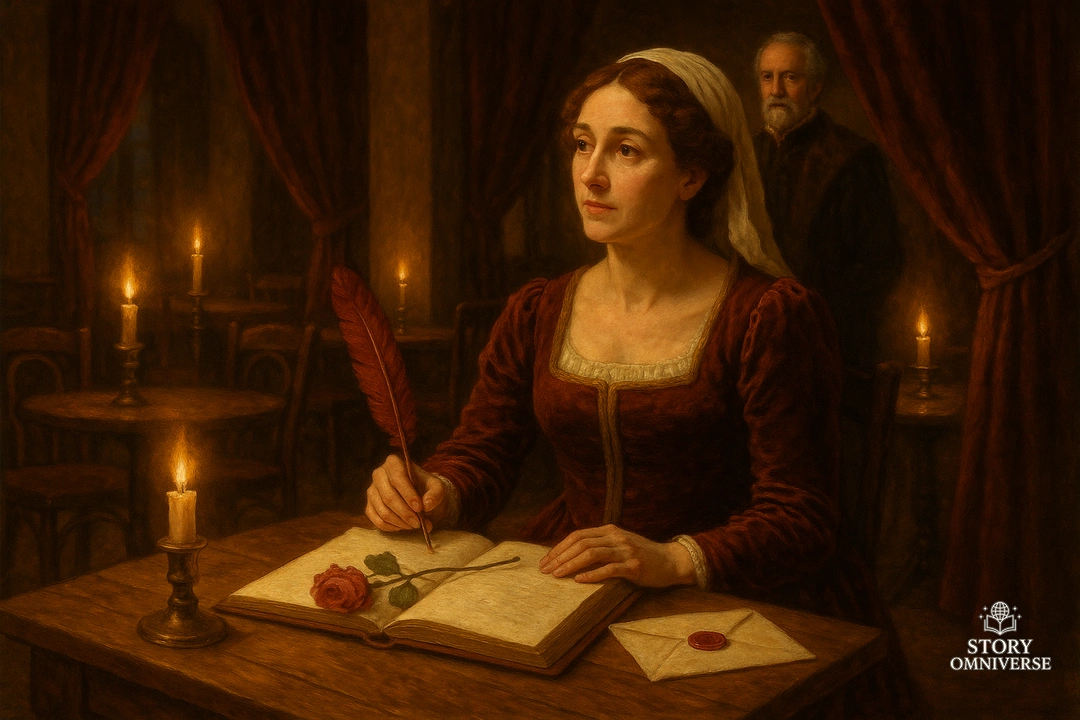
The Velvet Quill Café holds me the way a stage holds a dancer, with quiet corners that feel like wings and candlelight that flatters every scar. The central table waits as it always does, polished to a soft shine, the communal journal open as if it has been breathing for me. A rose is pressed between its pages, pale as a memory.
I sit, smoothing my skirts by habit. My fingers hover over the velvet quill. I do not take it yet. I listen first, the way I once listened for the first note before a performance.
They sat at my table as if they belonged.
A chair scraped softly. Two travelers, cloaked in twilight-colored wool, settled as if they had been invited. One of them smiled at me, not with familiarity, but with the gentle certainty of someone who knows this room welcomes the burdened.
“Forgive us,” the woman said. “Every other table is full of stories.”
“And this one?” I asked.
“This one felt like it was waiting,” the man replied. He set down a cup of rose-steeped tea, and the scent rose between us like a confession.
I looked at the wood beside my saucer and saw it. An envelope, thick parchment, its wax seal unbroken. The stamp was a small device, a fleur carved into it, the edges worn from use. My breath caught as if a hand had closed around my ribs.
“That is yours?” the woman asked, already drawing back as if the letter might burn.
“I do not know,” I lied.
But my fingers knew. They trembled the way they used to tremble before a leap. I touched the envelope. Cool, shaded, patient.
The man’s gaze softened. “Sometimes things find the right table.”
“Sometimes,” I said, and my voice sounded like paper being folded.
I held it to the candlelight. No name. Only the fleur, and the faintest trace of lavender, the perfume of a garden at twilight.
“You will open it?” the woman asked.
Not yet. Not here. Not with the room listening.
I slid it into my journal, between blank pages that suddenly felt too white, too eager. Then I took up the velvet quill at last.
“Tell us,” the man said, and the Café’s murmurs seemed to hush in agreement.
I dipped the quill. Ink gathered like a dark promise.
“Some stories,” I said, “only tell the truth when written in fragments.”
And I began.
Chapter 2: Twilight in the Garden of Ferrara
Entry, Ferrara, late spring. Written in a hand younger than mine. A corner torn, as if removed from a longer page:
Ferrara smells of orange blossoms at dusk. The court garden blooms as if it knows it is being watched. Lanterns hang in the trees, their light caught in leaves and in the jewels at noble throats. I am called to dance, and I do, because my body is the one honest thing I own.
The musicians begin. A small circle forms, careful smiles arranged like masks. I keep my chin lifted. I do not look for approval. I look for space.
My slippers whisper over the stone bordering the roses. My arms rise, and with them the old ache in my shoulders, the one that comes from carrying more than a dancer should.
On the second phrase, my foot slips. Not much, only a breath of imbalance, but enough that the court’s attention sharpens. A stumble is a crack in the illusion, and they love cracks.
I catch myself, forcing a smile, but my heart begins to race in a way the music did not ask for.
Then I see him.
Not a duke, not a cousin heavy with rings. A young envoy, standing just beyond the nearest lantern, as if he has chosen shadow out of courtesy. His clothes are fine but unshowy. His hands are clasped behind his back. He watches me as if I am not entertainment, but a person attempting something difficult.
When my foot finds the stone again, his expression changes, only slightly. Relief, quiet and sincere. As if my steadiness matters to him.
It steadies me in return.
After the final bow, applause ripples like polite rain. I lower my gaze because that is what a dancer does when she is not allowed to be proud.
A lady with a fan leans toward another. I hear the word scandal like a needle sliding under skin. I keep walking, breath controlled. I will not let them see the bruise.
Near the fountain, the envoy steps forward. He does not block my path. He inclines his head.
“Madonna,” he says, voice careful. “Your courage is visible, even when the music tries to hide it.”
“My courage?” I repeat, because I do not know how to accept it.
“You recovered without punishing yourself,” he says. “Most people do not know how.”
A laugh threatens, small and bitter. “Most people have never been punished for a misstep.”
His eyes lift, meeting mine in the lanternlight. “Then I am sorry for the people who taught you that.”
Behind him, the roses seem to deepen in color, as if the garden itself has been listening.
“I am Luca d’Este,” he adds, and the name lands like a coin. Valuable. Dangerous.
I curtsy because I must. “I am Elisabetta.”
He does not ask whose daughter I am, or whose widow, or what stain follows my name. He only says, “When you turned, the air changed. It was like watching twilight become night.”
My throat tightens. “You speak like a poet.”
“I speak like a man who has traveled too far without kindness,” he answers. “And then saw it in motion.”
I should leave. I should retreat to my chamber and my son and the safety of walls.
Instead, I find myself saying, “Thank you.”
And the garden, blooming at twilight, holds the words between us as if they are something that might grow.
Chapter 3: A Rose Under My Door
Entry, Ferrara, two nights later. Ink smudged, as if touched while still wet. Marginal note in a later hand: “I remember my knees on the cold stone.”
Tonight my chamber feels smaller than usual. The tapestries are meant to warm the stone, but they only make the air heavy. My son sleeps on a pallet near my trunk, one hand curled around a carved wooden horse whose leg is missing.
A soft scrape at the door makes my spine go rigid.
I cross the room without lighting more candles. I press my ear to the wood. Silence. Then, a whisper of paper against stone.
I open the door a finger’s width.
No one.
Only a folded letter on the threshold, and beside it, a rose, freshly cut, its petals darkened by the night air. I snatch both as if they are stolen goods and close the door quickly.
My hands shake. I break no seal, because there is none. The letter is folded simply, like someone who does not want ceremony to stand between intention and truth.
Inside, the handwriting is neat, slanted slightly as if written in haste but controlled.
Madonna Elisabetta,
I have seen many dancers. I have not seen many who continue after the world tries to make them small.
Tonight you did not bow to their cruelty. You bowed only to the music. That is courage. I hope you will allow yourself to keep it.
If you ever need a quiet ally in a loud court, you have one.
No signature. Yet I know. Kindness has a particular shape when it comes from the same hand twice.
I press the rose to my face. It smells like the garden at twilight, like damp earth and sweetness held back. My eyes burn.
“What is it, Mama?” my son murmurs, stirring.
I go to him at once, kneeling. “Nothing, little star. Sleep.”
He blinks up at me, hair a dark tangle. “You are crying.”
“I am not,” I lie, wiping my cheek with the back of my hand.
He reaches up, touches my face with small fingers. “Did someone hurt you?”
“No.” I swallow. “No one hurt me.”
That is not true. Many have. But not tonight.
I tuck the blanket around him. “It is only… I remembered something.”
“What?”
How do you explain tenderness to a child who has mostly seen you barter strength? “I remembered that there are people who can be gentle.”
He yawns. “Like you.”
I laugh softly, though it breaks. “Like me, yes.”
When he sleeps again, I read the letter once more. The words do not praise my beauty. They do not ask for anything. They simply see me.
I fold it carefully and slip it beneath the lining of my bodice chest, where I keep my small treasures. Contraband, all of it.
The rose I set in a cup of water by my son’s pallet.
If anyone asks tomorrow, I will say it was left by an admirer. That is the lie they understand.
But in my heart, I will hold the truth: someone saw my courage and called it by its name.
Chapter 4: Kindness in Small Gestures
Entry, Ferrara, days later. A strip of blue silk is stitched to the page edge, as if used as a marker.
In the days that follow, Luca does not corner me with declarations. He does not send jewelry or demand meetings. His kindness arrives the way sunlight arrives through shutters, in thin, steady stripes.
The first time, it is a ribbon.
I find it tied to my son’s broken wooden horse, a strip of blue silk that makes the toy look almost noble. My son squeals, delighted.
“Who did it?” he asks, holding the horse up like a banner.
“A helpful spirit,” I say, glancing at the servants’ corridor. I know how messages move here. I know who can send them unseen.
Later, in the kitchen, old Marietta presses a warm loaf into my hands. “It was left for you,” she says, eyes bright with gossip.
“From whom?”
She shrugs, but her mouth twitches. “A gentleman who knows hunger is not romantic.”
I bite into the bread on my way back to my chamber, and the simple warmth nearly makes me weep. My son eats with both hands, crumbs on his chin. We laugh, and it feels like a small rebellion.
At court, the gossip sharpens as it always does. A lady with pearls like teeth says loudly, “Some women dance to distract from their past.”
I keep my face smooth, but my stomach twists. My past is a chain that rattles even when I stand still.
Before I can respond, Luca steps into the circle as if he belongs there, though he keeps his voice mild.
“Madonna,” he says to the pearl-toothed lady, “you speak of distraction. Yet you cannot look away from her. Perhaps the dance reveals more about the watcher than the dancer.”
The lady flushes. The circle ripples with uneasy laughter. Luca turns to me, not triumphant, only attentive.
“Are you well?” he asks quietly.
“I am used to it,” I say, and hate myself for the resignation in my tone.
He shakes his head once, as if refusing to accept that as fate. “You should not have had to become used to it.”
That night, I find another note slipped under my door, carried by Marietta’s hand as if it were nothing more than a spoon.
You do not owe them your shame.
I press the paper to my lips before I can stop myself.
The next afternoon, in the garden, he does not ask me to meet him. He simply walks the same path I walk with my son, keeping a respectful distance until my boy, fearless, runs toward him.
“You are the man who fixes toys,” my son announces.
Luca crouches, smiling. “I have been accused.”
“Can you fix Mama too?” my son asks, earnest as prayer.
Heat rises in my face. “Hush.”
Luca’s smile fades into something tender and careful. He looks at me, not at my body, not at my reputation, but at the tired places behind my eyes.
“I cannot fix what I did not break,” he says to my son. Then, to me, softly, “But I can stand near you while you heal.”
The words settle into me like balm. Old wounds, the ones I have carried like hidden bruises, ache as if they recognize the possibility of closing.
I should be wary. Mercy is rare, and rare things are often traps.
Yet when Luca offers my son a small fig pastry from his pocket, and my boy takes it with sticky gratitude, I feel something loosen in my chest.
I begin to fall in love not with grand gestures, but with the quiet way he makes room for my dignity.
It is the most dangerous kind of love, because it feels like safety.
Chapter 5: The Court’s Disapproval
Entry, Ferrara, the week the roses began to fade at the edges. The strokes pressed hard, as if the page resisted.
My brother finds me in the gallery where portraits of our ancestors stare down like judges. He does not greet me. He does not ask after my son. He only closes the door behind him with a sound that feels final.
“Elisabetta,” he says, “you are being spoken of.”
“I have always been spoken of,” I reply, forcing lightness.
“This is different.” He steps closer, lowering his voice. “The envoy. Luca d’Este. His name carries politics, alliances, treaties. Your name carries… complications.”
“Say the word,” I challenge, because I am tired of being handled with gloves.
He exhales sharply. “Scandal. Widow too young, mother too soon, dancer too visible. Do you think the court will allow you to entangle yourself with him?”
“I am not entangling anyone,” I say, though my heart betrays me with its quickened beat.
My brother’s eyes harden. “You do not get to decide how they see you. You only get to decide whether you survive it.”
That evening, my mother does not speak to me at supper. Her silence is a blade laid neatly beside her plate. When I address her, she lifts her cup and drinks as if my voice is smoke.
Afterward, in the corridor, I catch up to her.
“Mother,” I say, “look at me.”
She pauses, turning her head the smallest amount, as if granting a servant attention. “You are determined to ruin what little remains of our name.”
“Our name did not feed my son,” I say, bitterness sharp. “Our name did not hold me when I was alone.”
Her gaze flickers, a crack in the marble. “You chose your path.”
“I chose survival,” I whisper. “There is a difference.”
She steps closer, voice low enough to be intimate. “Luca d’Este is not for you. Men like him do not marry women like you. They use them, and then they leave them to rot with the gossip.”
“I know what men do,” I say. “That is why I notice when one does not.”
Her mouth tightens. “Kindness is a costume at court.”
“Not his,” I insist, and I hate how pleading I sound.
My mother turns away. “Do not force me to watch you fall again.”
That night, Luca meets me in the garden, in the fading light where the roses look almost black. He stands near the fountain, hands clasped, as if holding himself back out of respect.
“You have been avoiding me,” he says.
“My family has been warning me,” I answer, and the words taste like iron.
He nods once, as if he expected it. “They are not wrong to fear for you.”
“And you?” I ask. “Do you fear for yourself?”
His gaze lifts to mine. “I fear for what distance can do to love.”
The word love is not spoken like a weapon. It is spoken like a truth he has been carrying carefully.
My throat tightens. “Distance is already between us. Your world and mine.”
He steps closer, not touching. “Then let us prove it can be crossed.”
“With what?” I ask, a laugh caught in my throat. “Letters? Glances in gardens?”
“With patience,” he says. “With promises kept even when no one applauds.”
“I cannot give you a simple life,” I warn.
“I do not want simple,” he replies. “I want you, as you are. With your son, with your scars, with your dance.”
My eyes sting. “They will tighten around us.”
“Then we will breathe together,” he says, and finally he reaches for my hand. His fingers brush mine, barely contact, but it is enough to send a tremor through me.
In the garden’s fading light, we promise without ceremony. We promise to write, and to be careful, and to endure.
Even as the court draws its net, even as my mother’s silence grows colder, I let myself believe.
For a moment, twilight feels like mercy.
Chapter 6: The Other Promise
Entry, Ferrara, after midnight. The page is marked by a tear that dried crooked. A later note in the margin: “This was the night my feet forgot the music.”
The patron who has kept me fed, clothed, tolerated, calls me to his chambers as if summoning a servant. Lord Bartolomeo does not rise when I enter. He sits with a ledger open on his desk, counting my life the way he counts his accounts.
“My lady dancer,” he says, “you have been distracted.”
“My performances have not suffered,” I manage.
“Your reputation has,” he replies, tapping the ledger. “And your son’s future is tied to your usefulness.”
My stomach clenches. “What do you want?”
He smiles as if amused by my directness. “Stability. A lawful arrangement. You will marry my cousin, Girolamo. He is not a romantic man, which is fortunate. He will accept your child as his own, and you will have protection.”
The room tilts. “I do not want him.”
Lord Bartolomeo’s gaze sharpens. “Want is for girls with fathers who can defend them. You are a mother. You will do what keeps the boy safe.”
“My son is safe,” I say, though I know it is a fragile lie.
“Not if the court decides to make an example of you,” he answers. “Not if your brother disowns you. Not if your mother’s silence becomes public rejection. You are one whisper away from losing everything.”
I think of my son’s small hand on my cheek. I think of Luca’s voice: You do not owe them your shame.
Lord Bartolomeo leans back. “You will give me your answer by the week’s end.”
I leave with my throat burning, the corridor spinning with tapestries and torchlight. In my chamber, my son sleeps, unaware of the bargain being made with his life.
I take out paper and ink. I write to Luca with hands that feel detached from my body.
Luca,
They are binding me to another. Not from desire. From survival.
If I refuse, they will take my son’s safety as payment. If I accept, I will be alive, but I will be a liar when I look at you.
I stop. The ink blots. How do I explain that I am choosing betrayal as protection?
I fold the letter. I cannot deliver it. If it is intercepted, it becomes a weapon. If Luca receives it, it becomes a wound.
Before dawn, another letter arrives, carried by Marietta’s nephew, a boy who runs messages for coin and never asks questions. He slips it into my hand as if passing bread.
This one bears a simple seal, pressed hastily, as if the sender could not wait.
Elisabetta,
I heard rumors. I do not know what is true. I know only this: you have never been selfish. If you are forced into a promise, I will not call you faithless.
Tell me what you need. If it is distance, I will endure it. If it is help, I will find it. If it is silence, I will keep it.
I ask nothing but your honesty, and even that only if it does not endanger you.
My breath breaks on a sob I do not want to make. Tenderness like this makes my choice feel like betrayal even when it is meant as protection.
My son stirs. “Mama?”
I wipe my face quickly and go to him. “I am here.”
He reaches for me in his sleep, and I hold his hand as if it is an anchor.
In the dim light, I whisper to the darkness, to Luca, to God, to the garden at twilight.
“I am trying to save him,” I say. “Please forgive me for what it costs.”
Chapter 7: The Unopened Envelope
Entry, Ferrara, the night before the announcement. The handwriting tight, as if the writer is holding her breath.
The week ends like a blade falling. The patron’s cousin is introduced to me with a smile that does not reach his eyes. Girolamo speaks of duty as if it is a prayer, and perhaps for him it is. He is not cruel. That is the best I can say. He looks at my son as if measuring him, then nods as if satisfied with the bargain.
I nod back, because my son’s future sits on the table between us like a coin.
The night before the formal announcement, a final envelope reaches me.
It is delivered not by a servant but by a boy I do not recognize, barefoot, eyes wide. He holds it out as if it is holy.
“For you,” he whispers, then runs.
The wax seal is unbroken. The stamp is the fleur again, pressed so deeply it seems to bruise the parchment. My hands go cold.
I carry it to the window where moonlight spills in. I turn it over. No name. No message outside. Only that seal, perfect and intact.
My heart argues with itself. Open it, it says. Do not open it, it begs.
If it is farewell, I will not survive the sound of it. If it is a plan, a way out, I am too afraid to follow. Courage is easier in dance, where the music tells you when to leap. In life, the silence is endless.
My son wakes, rubbing his eyes. “Mama, why are you awake?”
I hide the envelope behind my back too quickly. “Go back to sleep.”
He looks at me with the blunt honesty of children. “You are sad.”
“I am thinking,” I correct, kneeling to his level.
“Is it about the new man?” he asks, and my throat tightens. He has heard more than I wished.
“It is about keeping you safe,” I say.
He frowns. “I want you safe too.”
His small arms go around my neck. I hold him fiercely, breathing in the smell of his hair, of soap and childhood.
When he sleeps again, I take out my costumes. Silk and linen, ribbons, the mask I wore once in a masquerade when I pretended I was someone unburdened. I slide the envelope among them, between the bodice embroidered with moonflowers and the shawl that smells faintly of rose.
I press my palm over the hidden shape. “Stay,” I whisper to it, as if it is a living thing. “Not because I refuse you, but because I cannot bear you.”
The next evening, in the garden, I dance at twilight as if nothing has changed. The lanterns glow. The roses bloom. The court watches, hungry for spectacle.
My feet move through the steps Luca praised. My arms lift. My spine arches. Every turn is a prayer that time will soften what duty has broken.
Afterward, as I leave the path, I feel eyes on me. I glance toward the shadows where Luca once stood.
He is not there.
Only the fountain, murmuring like an old secret.
I return to my chamber and touch the place where the envelope sleeps among my costumes. I do not open it.
I keep dancing.
And each night, I wait for a kindness that might be too late.
Chapter 8: Decades in the Footfalls
Entries stitched together, years skipping like a needle through cloth. Different inks, different papers. Some lines copied from scraps and re-pinned here.

0 Comments