
Chapter 1: Smoke Over the Isthmus
The morning wind came off the Isthmus with salt and dust. Kleon carried two fresh jugs, one on each shoulder, the clay still warm from the kiln. His father had tied the handles with reed cord and warned him not to hurry. “A cracked jar is a hungry day,” he said, eyes red from stoking the fire through the night.
Corinth was already awake. Donkeys clopped over the stones. Fish sellers shouted, and the smell of brine fought with the sharp scent of pine resin from the shipyards. From the road that ran down toward Lechaion, carts creaked under amphorae bound for ships. Men spoke of tolls and porters and the narrow track across the Isthmus where goods could be hauled between seas. The city lived on that passage, on hands that lifted and backs that bent.
Near the Lechaion road, men with clean cloaks stood in a knot, talking as if the whole city belonged to them. Their rings flashed when they gestured.
“Another ship to the west,” one said. “There is land beyond the sea, and men who will pay for Corinthian jars.”
“A colony is honor,” another replied. “And profit. Do not pretend you only love glory.”
Kleon slowed, pretending to adjust his cords so he could listen. He had heard such talk before, louder lately, as if the sea itself were calling. Traders spoke of new settlements and new markets, and of the city’s ships pushing farther each season. Even boys at the fountain repeated the names they heard, as if saying them could make their lives larger.
A runner pushed through the crowd, panting. His hair was matted with sweat and ash. “Fire,” he cried. “Apollo’s house has burned.”
The talk stopped as if a hand had closed around the air. A woman near Kleon spat to the side and touched a small amulet at her throat, murmuring a quick prayer. The richer men’s faces tightened, not with grief alone but with calculation.
“Which Apollo?” a potter asked.
“The one above the city,” the runner said. “The sanctuary. The roof took flame before dawn. They say the storeroom is ruined.”
Kleon’s stomach went cold. The temple was not only a place of prayer. It was a store of gifts, a sign that Corinth stood under a god’s eye. If Apollo’s house could burn, what else could be taken?
He delivered the jugs to a baker, but the man barely counted the coins. “Go,” the baker said, glancing toward the hill. “Everyone will go. If the god is angered, we all pay.”
When Kleon reached his father’s workshop, the old man was already wiping his hands, clay under his nails like dark crescents. “We will close,” his father said. “We will see what has happened.”
They joined the stream of people moving uphill. Smoke smeared the sky above the sanctuary. It did not look like the clean smoke of a hearth. It looked like a wound.
At the edge of the precinct, Kleon heard the first hungry question, spoken softly but carrying far. “Who did it?”
Chapter 2: The Broken Roof of Apollo
The stones of the precinct were still warm under Kleon’s sandals. The air tasted of wet ash and burned cedar. Where the temple roof had been, black beams jutted like broken ribs. A few priests moved among the ruins with faces streaked by soot, their white garments turned gray. They stepped carefully, as if the ground itself might accuse them.
People pressed close. Some brought small offerings anyway, placing figs or a pinch of barley on a surviving altar stone, as if they could patch a hole in the world with food. Others held their hands up briefly toward the ruined cella, then dropped them, ashamed of needing the god when the god’s house lay open to the sky.
Near the steps, two priests argued in sharp whispers that were not whispers at all.
“The treasury is defiled,” one said, voice tight. “We cannot accept offerings until purification.”
“And how do we purify without offerings?” another snapped. “The roof must be repaired. The god must be honored. The city will not look weak.”
A third priest, older and thin, raised his hands. “We speak as merchants,” he said. “First we must know how the fire began.”
Kleon edged along the side, near the storeroom door that led to the temple’s back rooms. He had come close to this place only during festivals, when the crowd surged and music filled the air. Now it was quiet except for murmurs and the occasional crack as a beam settled and broke. A priest’s assistant carried a bucket of water and scattered it in small arcs, as if dampness could soothe the god.
He saw the storeroom threshold. Soot lay thick, but in one place the ash was disturbed. A line of darker marks ran along the stone, like something had dripped and been smeared by hurried feet. He crouched as if to tie his sandal, fingers fumbling at the thong.
The smell there was different. Not only burned wood. It was sharp, like pitch on a ship’s hull when the sun heats it. Kleon swallowed. Pitch belonged at the docks, where men sealed planks and smeared seams. It did not belong at Apollo’s storeroom.
A man’s voice rose behind him. “Accident,” someone insisted. “A lamp tipped. A careless slave.”
“Or a god’s anger,” another answered. “Someone has stolen. Someone has lied.”
Kleon stood and backed away. He kept his face smooth, as his father had taught him when dealing with customers. Do not show what you notice. People will use it.
A group of older men pushed forward, their belts heavy with bronze. One pointed toward the edge of the precinct where a few shepherds and laborers stood, eyes wide. “Look at them,” he said. “They sleep in the open. They carry fire to cook. They do not fear the gods.”
A priest tried to speak, but the crowd rolled over him like surf. Names were thrown like stones. The need was plain: fear wanted a target, a body to carry blame away from the city.
Kleon found his father near a fallen column. The old man’s jaw was clenched. “Keep close,” he murmured. “When people are afraid, they want a body to blame. Better it is not ours.”
Kleon looked back at the storeroom door. The dark drips on the stone seemed to glisten even in the dull light. He felt a strange pull, like a hand at his shoulder. Speak, it said. Or remember.
He did neither. He kept quiet, and the smoke above Apollo’s house curled into the sky as if carrying his silence with it.
Chapter 3: Debt Marks on the Clay
That evening, the workshop felt smaller. The kiln sat like a sleeping beast, its mouth dark, the last heat fading. Kleon’s mother kneaded dough in a shallow bowl, her fingers moving without pause. No one sang. Even the neighbor’s children were quiet, as if the fire had burned sound away.
Kleon’s father took him behind the stacks of finished jars, where the walls were stained with years of smoke. He held a small tablet of wood rubbed with wax. Lines were scratched into it with a stylus, the marks deep from a heavy hand.
“Look,” his father said.
Kleon could read enough to count. He traced the marks with his eyes. Numbers. Dates. A name he recognized, spoken in the market with caution: Menalkes, a lender who kept a stall near the magistrates’ hall and smiled as if he were doing the gods a favor. Men like Menalkes did not dig clay or turn a wheel. They sat in shade and made other men’s sweat into obligation.
“We borrowed,” his father said. “Clay from the riverbank is not enough for the orders. The good clay costs. So does fuel. I thought the spring sales would cover it.”
Kleon’s throat tightened. “And now?”
“And now the city will spend on the temple,” his father said. “People will hold their coins. They will say, ‘Apollo first.’ Menalkes will not wait. He never waits.”
Kleon stared at the kiln. It was their life. The wheel, the ash, the water jars that kept them fed. If the kiln was taken, what would they be? Laborers? Porters? Men who stood at the edge of richer men’s talk and listened like dogs.
His mother set the dough aside and wiped her hands on her skirt. “Your father did not borrow for wine,” she said to Kleon, as if he might judge. “He borrowed to keep us standing.”
“I know,” Kleon said quickly. He felt shame that she even had to say it.
His father’s voice softened. “There is work by the merchants,” he said. “They move goods between the harbors. The Isthmus traffic does not stop, even when gods burn. A boy with strong legs can earn a few extra coins.”
Kleon nodded. He had carried jars since he could lift them. He could run messages. He could haul rope. He could endure the sharp words of men who thought a potter’s son was made to be ordered.
“Tomorrow,” his father said, “you will go to the warehouses near the road. Ask for work. Speak politely. Do not argue. Coins do not fall into proud hands.”
Kleon wanted to tell him about the pitch smell at the storeroom. He wanted to say, It was not a lamp. Something was poured. But his father’s face looked older than yesterday, lined by smoke and worry. What would truth do for them? Would it pay Menalkes? Would it keep the kiln from seizure?
Outside, Corinth’s streets carried a restless murmur. People talked of the fire as if it were a living thing that might return. Kleon lay on his mat and listened, hearing in the distance the creak of carts and the late calls of men at the harbor.
He thought of Apollo’s broken roof. He thought of the dark drips on the stone. He thought of debt marks on wax, sharper than any knife.
In the dark, his coming adulthood did not feel like freedom. It felt like a weight set on his chest, heavy as a kiln stone.
Chapter 4: A Shepherd Accused
Two days after the fire, the magistrates called for order. Word spread through the market like spilled oil. “They have the one who did it,” people said. “A man who slept near the sanctuary.”
Kleon was carrying a bundle of reeds to a warehouse when he heard shouting near the hall. He set the bundle down and pushed through bodies. The smell of sweat and unwashed wool rose in the heat. Vendors leaned out from their stalls, eager for the spectacle. Even men who had no time for prayer had time for blame.
A poor herdsman stood in the open space, wrists tied with rope. His tunic was patched. His hair was tangled as if he had slept in the dirt, which he likely had. A guard held him by the elbow, not gently.
“Name,” a magistrate demanded from the steps.
“Doros,” the man said, voice hoarse. His eyes darted over the crowd, searching for a face that might be kind.
“Where were you before dawn on the day of the fire?” the magistrate asked.
“Near the precinct wall,” Doros said. “I keep goats on the slope. I slept there. I always sleep there when the weather is fair.”
A man in the crowd shouted, “And you cook your meat with stolen fire!”
Laughter burst, sharp and cruel. Another voice yelled, “He wanted the bronze! He wanted the offerings!”
Kleon’s stomach turned. Doros. He recognized him. Not as a stranger, but as the man he had seen near the storeroom door, hunched and wary, as if he did not belong among temple stones. But Doros’s hands were rough with work, not stained with pitch. And his eyes now held the look of an animal cornered.
A priest stepped forward, face grim. “The god has been insulted,” he said. “If we do not cleanse this stain, sickness will come. Crops will fail. The sea will turn against our ships.”
The crowd hummed agreement. Fear made them one creature with many mouths. Some women muttered prayers to Hestia under their breath, as if the hearth itself might be threatened. Men spoke of impurity as if it were smoke that could seep into every house.
Kleon felt his own mouth go dry. He saw again the dark drips at the threshold, smelled the sharp pitch. Doros had no money for pitch. Doros had no reason to burn Apollo’s house. But the city needed a simple story. A poor man was easy.
Doros lifted his bound hands. “I did not do it,” he said. “By the gods, I did not. I heard shouting and saw smoke. I ran like everyone. I tried to help carry water.”
“Lies,” someone spat.
Kleon’s feet shifted. He could step forward. He could say, I saw something. I smelled something. But his father’s warning rang in his head. When people are afraid, they want a body to blame. Better it is not ours.
A guard tightened the rope, making Doros wince. The magistrate raised a hand. “We will decide punishment after the council,” he announced. “Until then, the man is held.”
As Doros was dragged away, his gaze swept the crowd again. For a moment it landed on Kleon, not with accusation but with a raw plea, as if Doros could smell doubt on him.
Kleon turned his head, pretending to watch the magistrate. The shame came fast, hot behind his eyes. His silence did not feel like safety now. It felt like swallowing ash.
He picked up his bundle of reeds and walked away, but the shouts followed him down the street, and Doros’s bound hands stayed in his mind like a brand.
Chapter 5: The Merchant’s Ledger
Kleon’s new work took him to the warehouses near the road that led to the harbors. Men shouted measurements. Slaves rolled barrels. The air was thick with the smell of grain, tar, and fish. He delivered jars of oil and wine for his father when he could, earning small coins that he hid in a pouch under his tunic. Each coin felt light, and yet it carried the weight of Menalkes’s tablet.
He learned the rhythms of commerce: the way a foreman’s voice could make a line of men move like oxen; the way a merchant’s glance could dismiss a laborer as if he were a tool. He heard talk of ships bound for Sicily and Italy, and of the old Corinthian foundation at Syracuse, still spoken of with pride as proof that the city’s reach could cross the sea. The men who spoke loudest of honor were often the ones who counted profit first.
On the fifth day after the fire, a foreman sent him with three sealed jars to a trader named Philon, a man said to have friends among the shipowners. Philon’s house stood close to the market, with a courtyard shaded by a fig tree. The door was guarded by a thick-armed servant who looked Kleon up and down as if measuring his worth in copper.
Inside, Philon sat on a low stool with a wax tablet on his knee. He had a neat beard and clean fingers. His eyes flicked to the jars. “Set them there,” he said.
Kleon did, careful not to clink clay against stone. As he straightened, his gaze caught the tablet. Rows of marks. Names. Sums. He did not mean to stare, but one line held a word he knew from the docks: pitch. Another line: lamp oil. The dates were close to the night of the fire, written with the calm certainty of a man who expected no questions.
Kleon’s heart beat harder. Pitch and lamp oil were common, but why in such amounts? Why just before Apollo’s roof burned?
Philon noticed his gaze. He smiled, but it was not warm. “A boy who reads,” he said. “That is rare among potters.”
Kleon bowed his head. “I only saw by accident, lord.”
Philon rose and stepped close enough that Kleon smelled costly perfume under the sweat. “Accidents are dangerous,” Philon said softly. “A jar can fall. A tongue can slip. And then a family finds its kiln seized for debt, or its orders canceled, or its son without work.”
Kleon’s mouth went numb. “I do not understand,” he said, though he did.
Philon’s eyes narrowed. “You are not stupid. You are young. That is different.” He tapped the tablet with his stylus. “Men who move goods across the Isthmus have many friends. Magistrates. Lenders. Priests who like new roofs. A boy should look at his feet and carry jars, not look at ledgers.”
Kleon felt anger rise, but it had nowhere safe to go. He thought of Menalkes and the wax tablet of debt. He thought of Doros in ropes.
“I will go,” Kleon said, voice tight.
Philon nodded as if granting a favor. “Good. Tell your father his jars are fine. Tell him to keep making them. The city will need many vessels once rebuilding begins.”
Kleon backed toward the door. The servant opened it without expression. Outside, the sun hit his face like a slap. He walked fast, then faster, until he reached a fountain where women filled water jugs.
He leaned against the stone and breathed. The ledger marks burned in his mind. Unusual payments. Pitch. Lamp oil. If the fire was planned, it was planned by someone with money and confidence.
And Philon had made sure Kleon understood the price of curiosity. It was not only his own skin at risk. It was his father’s kiln, his mother’s bread, everything fragile and hard-won.
Kleon watched the water pour from the spout, clear and steady. He wished truth were like that, something you could catch in a jar and carry home without spilling.
Chapter 6: Counsel at the Fountain
Kleon returned to the fountain near the sanctuary at dusk, when the heat eased and the stones gave back the day’s warmth. He had asked around quietly, and someone told him Thaleia often came there to draw water for the household where she served. He had seen her before during festival days, moving with purpose among older women, her hair tied back, her eyes alert.
She arrived with two clay jars balanced on a yoke across her shoulders. When she saw Kleon waiting, she frowned. “You look like you have swallowed a thorn,” she said.
Kleon glanced around. People passed, but no one seemed to listen. Still, he kept his voice low. “I need to speak with you,” he said. “About the fire.”
Thaleia set the jars down and began filling them, watching the stream as if it could tell her secrets. “Everyone speaks about the fire,” she said. “They speak until their mouths are dry. Then they blame the nearest poor man and call it piety.”
“You know the temple routines,” Kleon said. “You serve near there. You know who comes and goes. You know which doors are watched and which are ignored.”
Thaleia’s hands paused. “I know enough to know what I should not say,” she replied. Her tone was not fearful, but careful. “A servant hears much. A servant is also easy to strike.”
Kleon told her what he had seen at the storeroom threshold, the smell of pitch. He told her about Doros being accused, and about Philon’s ledger with payments for pitch and lamp oil. He told her too about Philon’s warning, the way it had landed like a hand on his throat. As he spoke, his shame loosened a little, as if sharing it made it lighter.
Thaleia listened without interrupting. When he finished, she tied the jar stoppers with practiced fingers. “In Corinth,” she said, “the powerful hide behind piety like a shield. They give a handful of barley to Apollo and take a wagon of profit for themselves.”
Kleon stared at the water rippling in the basin. “Then what do I do? If I speak, Philon will ruin my father.”
“If you stay silent, Doros may die,” Thaleia said simply. “And the men who did it will learn they can burn a god’s roof and buy new tiles with other people’s fear.”
Kleon swallowed. “Who will listen to me? I am sixteen. I carry jars.”
Thaleia lifted her chin toward the ruined precinct visible above the rooftops. “Not all priests are the same,” she said. “Some love offerings more than the god. But there is one, the thin old priest, who still speaks of impurity as if it can cling to a city. He fears the god more than the crowd.”
“The one who tried to stop the shouting,” Kleon said, remembering the older priest’s raised hands.
“Yes,” Thaleia said. “His name is Lykos. He comes to the fountain sometimes, because he says the water is clean and the temple’s cistern tastes of smoke. If you want to speak, speak to him first. A priest’s ear is safer than the crowd’s, and his word carries farther.”
Kleon hesitated. “Philon warned me.”
Thaleia’s eyes hardened. “Men like Philon warn because they are afraid of one thing,” she said. “Not the gods. Not fairness. They are afraid of being named.”
She lifted the yoke and settled it across her shoulders. “You are standing at a door,” she added. “One side is boyhood, where you hide behind your father. The other side is harder. But it is yours.”
Kleon watched her walk away, steady under the weight of water. He realized he wanted that steadiness. Not because it was easy, but because it was true.
He stayed by the fountain until the first stars appeared, waiting for a thin old priest who might still fear Apollo enough to hear a potter’s son.
Chapter 7: The Night Watch
The magistrates announced a night watch at the ruined precinct. Too many hands had begun to pry at the ashes, looking for bronze, for half-melted gifts, for anything that could be sold. The fire had made the sanctuary weak, and weakness invited teeth. Men muttered that if the god’s house could be robbed, then no storeroom in Corinth was safe.
Kleon volunteered before he could talk himself out of it. His father frowned but did not forbid him. “Do not fight,” he warned. “A jar can be remade. A son cannot.”
At dusk, Kleon climbed to the precinct with a small group of men and older boys. They carried spears and clubs, nothing grand. A guard captain assigned corners and told them to shout if they saw movement. “We are not heroes,” he said. “We are eyes. If you see trouble, you call. You do not chase glory.”
The ruins looked different at night. Moonlight silvered the broken stones. The burned beams made long shadows that seemed to twist when the wind stirred. The smell of ash still lingered, but cooler now, mixed with damp earth. Somewhere below, from the city, came the faint sound of a flute, thin and lonely.
Kleon took position near the storeroom area, where he had first noticed the pitch. He could not stop himself. His gaze kept returning to the threshold, to the dark smear that daylight had made plain.
A man beside him, broad-shouldered and older, spat into the dirt. “All this for a roof,” the man muttered. “My wife says the god will curse our bread. I say the only curse is the levy they will demand.”
“Do you believe Doros did it?” Kleon asked.
The man shrugged. “Someone did. If not him, then who? A god does not strike his own house for nothing. And a poor man is always near a fire.”
Kleon held his tongue. He listened to the night: distant dogs, the soft hiss of wind through grass. Hours passed. His legs ached from standing, and his hands grew stiff around his club. He thought of Doros in a cell, of the rope biting skin, of how quickly a city could decide a life was worth less than its comfort.
Near midnight, a faint scrape came from the far side of the precinct. Kleon stiffened. He saw a flicker, not fire but a covered lamp, a moving glow. Two figures slipped between columns, keeping low. They carried something that caught moonlight, metal.
Kleon’s breath caught. Looters. Not desperate villagers picking at ash, but men with tools. One knelt by a fallen stone and wedged an iron bar under a bronze fitting. The other kept watch, lamp shielded with his cloak.
Kleon glanced toward the guard captain, but the captain was on the other side, talking with someone. If Kleon shouted, the looters might flee and he would have nothing but a boy’s claim. If he stayed silent, the theft would continue, and the same hands that burned the roof might strip the god’s bones.
He stepped back into shadow and followed at a distance, heart pounding. The men moved with familiarity, as if they had been here before. One murmured, “Quick. Before the priest comes at dawn.”
They pried loose a bronze piece and wrapped it in cloth. Then, to Kleon’s shock, one man lifted a small bundle from a niche and tucked it into his belt. It looked like a charred offering, maybe gold leaf stuck to burned wood.
Kleon’s hands trembled. The fire was not only a wound. It had become an opportunity. The same kind of men who could buy pitch and lamp oil could also profit from the ruin afterward.
A stone rolled under Kleon’s heel. The sound was small, but in the quiet it was loud. The looter froze and turned his head. Moonlight caught his profile. Kleon did not know his name, but he recognized the cut of his cloak. A merchant’s cloak, not a shepherd’s rag.
The man’s eyes narrowed into the darkness where Kleon stood. For a heartbeat, they stared at each other.
Then the man hissed, “Move,” and the two slipped away, lamp smothered.
Kleon stood shaking, the night suddenly colder. He understood now. The fire was part of a larger hunger. And it was not Doros’s hunger.
Chapter 8: The Turning of the Assembly
The assembly gathered in the open space near the magistrates’ hall, where citizens could hear plans and shout approval or anger. The sun beat down, and the crowd smelled of sweat, olive oil, and impatience. Kleon stood near the edge with his father, who had insisted on coming. “If you speak,” his father had said, “I will not let you stand alone.”
Men jostled for a view of the steps. Some were landholders with sun-darkened necks; others were craftsmen with clay under their nails like Kleon’s father. Merchants stood in small groups, cloaks clean, eyes measuring. Even those without a voice in decisions came to watch, because the city’s choices always reached into the poorest houses first.
On the steps, a magistrate lifted his staff. “Corinth has suffered insult,” he declared. “Apollo’s house must be restored. We will raise funds. Each household will give according to means. Merchants will contribute, as is fitting for those who profit under the god’s protection.”
Murmurs rolled. Some nodded, already thinking of new contracts. Others groaned, thinking of empty cupboards and the price of barley. Kleon saw his father’s jaw tighten. A levy could break them as surely as Menalkes’s demand.
“And,” the magistrate continued, “to calm the god and restore order, the accused herdsman will be punished. We cannot let lawlessness stand.”
A shout rose, fierce and eager. “Yes! Make an example!”
Kleon’s mouth filled with dryness. Doros’s face flashed in his mind, the bound hands, the pleading eyes. Thaleia’s words echoed: men like Philon fear being named. The night looters’ whisper returned too, sharp as a knife: Before the priest comes at dawn.
The magistrate raised his hand for silence. “At dawn tomorrow, the sentence will be carried out unless new evidence is brought before the council.”
The words “new evidence” struck Kleon like a bell. His father’s hand tightened on his shoulder. “Kleon,” he murmured, warning and support tangled together.
Kleon stepped forward. The crowd’s noise seemed to swell, then hush in pockets as people noticed a boy pushing through.
“Speak,” someone scoffed. “Let the child tell us how the roof burned.”
Kleon swallowed. His voice came out steadier than he expected. “I went to the sanctuary after the fire,” he said. “Near the storeroom door, I smelled pitch. Not only burned wood. Pitch, like what ships use.”
Laughter broke out, but not as loud as before. Some faces sharpened with interest. Pitch meant money. Pitch meant planning.
A man in a fine cloak called, “A boy’s nose is not proof.”
Kleon lifted his chin. “I also delivered jars to a trader,” he said, careful not to name too soon. “I saw a ledger with unusual payments for pitch and lamp oil just before the fire.”
The crowd shifted. Even those who mocked leaned forward now. Merchants watched each other with narrowed eyes, suddenly alert to the danger of being suspected.
The magistrate’s face tightened. “Do you accuse a citizen?” he demanded.
“I accuse no one without hearing,” Kleon said, surprising himself with the formality. “But Doros is poor. He cannot buy pitch in quantity. He cannot buy lamp oil in quantity. Someone else can.”
A few people muttered agreement. Others hissed. A man near the front shouted, “He lies to save a friend!”
“I do not know Doros,” Kleon said, voice rising. “I only know what I saw and smelled. And last night, on watch, I saw men stealing bronze from the ruins.”
That caused a true stir. The guard captain turned sharply. “Who?” he barked.
Kleon hesitated, seeing again the looter’s merchant cloak and the way he moved like he belonged. If he named wrong, he would be crushed. If he stayed vague, he would be ignored.
“I could not see names in the dark,” Kleon admitted. “But they were not shepherds. They had tools. They said, ‘Before the priest comes at dawn.’”
The magistrate exchanged glances with others on the steps. The crowd’s certainty wavered. Fear shifted shape, from hunger for a convenient culprit to suspicion of hidden hands.
The magistrate lifted his staff again. “This boy will be heard by the council,” he announced, voice forced. “And the sentence on the herdsman is delayed until we examine these claims.”
A roar rose, mixed anger and relief. Kleon’s legs went weak. His father’s hand steadied him.
Behind them, someone muttered a threat, low and close. “A potter’s son should remember his place.”
Kleon did remember. That was why his heart hammered. He had stepped out of it.
Chapter 9: A Trial of Names
The council chamber smelled of old wood and sweat trapped under stone. Kleon stood before a line of seated men, magistrates and elders, their faces stern as if carved. A scribe sat to one side with a tablet, stylus poised. The room was not grand, but it carried the weight of decisions that could seize land, bind men to labor, or strip a household of its tools.
Kleon’s father waited behind him, silent, hands clasped. Kleon could feel his presence like a wall at his back. He had never been so grateful for another man’s quiet.
“Repeat what you said in the assembly,” the chief magistrate ordered.
Kleon spoke carefully. The pitch smell. The disturbed ash near the storeroom. The ledger he glimpsed. The looters at night with tools. Each sentence felt like placing a jar on a narrow ledge. One wrong move and it would shatter, and the shards would cut his family.
The chief magistrate leaned forward. “Name the trader.”
Kleon’s tongue stuck. If he named Philon, Philon would strike back. If he did not, the council would dismiss him as a boy spinning smoke.
He forced the word out. “Philon.”
A rustle went through the chamber. One elder’s eyebrows lifted. Another’s mouth tightened in a way that looked like recognition. Kleon realized then that the council did not sit above the city like gods. They sat inside it, tangled in favors and grudges.
A second magistrate spoke, voice cool. “Philon is known to this council. He has contributed to public works. He has friends among shipowners. Do you understand the weight of your claim?”
“I understand the weight of silence too,” Kleon said, then steadied himself. “I saw payments in his ledger for pitch and lamp oil just before the fire. He warned me not to look. He said men like him can ruin a family.”
The scribe’s stylus scratched quickly.
A door opened. A man entered, escorted, not bound but watched. Philon. He looked as neat as ever, beard combed, cloak draped perfectly. He smiled as if he had come to settle a small misunderstanding.
“This is a child’s tale,” Philon said before anyone asked. “My ledger holds many purchases. Pitch is used for ships, for sealing jars, for repairs. Lamp oil is used for lamps. Does the council now punish trade because a boy smelled something?”
The chief magistrate’s gaze shifted to Kleon. “Do you have more than smell and a glance?”
Kleon’s hands curled into fists. He thought of Thaleia, of Lykos the priest. Allies. Truth alone was not enough without someone whose word carried weight.
Before he could speak, another man entered, breathless, holding a small tablet. It was Menalkes, the lender. Kleon’s stomach dropped. Menalkes bowed to the council. “I bring notice,” he said smoothly. “The potter who owes me has missed a payment. By right, I may seize his kiln and stock.”
Kleon’s father flinched as if struck. Philon’s smile widened by a hair.
Kleon understood. This was pressure, timed like a sailor’s knot. Speak and your family loses everything. Stay silent and perhaps you keep the kiln, but Doros pays.
The chief magistrate frowned. “This is not the matter before us,” he said, but his voice lacked force.
Kleon stepped forward, voice shaking now with anger. “This is the matter,” he said. “A man can burn a god’s roof, then use debt to choke anyone who saw. If my father’s kiln is seized today, you will know why.”
Philon’s eyes hardened. “Careful,” he murmured.
Kleon met his gaze. He felt fear, yes, but also something new, like clay taking shape under firm hands. “Call the priest Lykos,” Kleon said to the council. “He saw the storeroom after the fire. He knows what pitch smells like. And question the night watch. There were looters. Find the bronze they stole. It will lead you to the hands that took it.”
The chamber went still. The chief magistrate studied Kleon, then Philon, then Menalkes. “We will call witnesses,” he said at last. “And no kiln will be seized until this inquiry ends. If any man uses threats to twist testimony, he answers to the council.”
Menalkes’s smile faltered. Philon’s did too.
Kleon exhaled, barely. The fight was not over. But for the first time, the men who had seemed untouchable looked as if they had heard the crack of clay before it breaks.
Chapter 10: Oath Before the Altar Stones
They returned to the sanctuary at dawn, not as a mob chasing a convenient culprit but as a procession pulled by tension. The ruins lay quiet under pale light. Birds hopped among blackened beams, pecking at insects in ash. The air still carried the sharp memory of smoke, and the ground held the imprint of many feet.
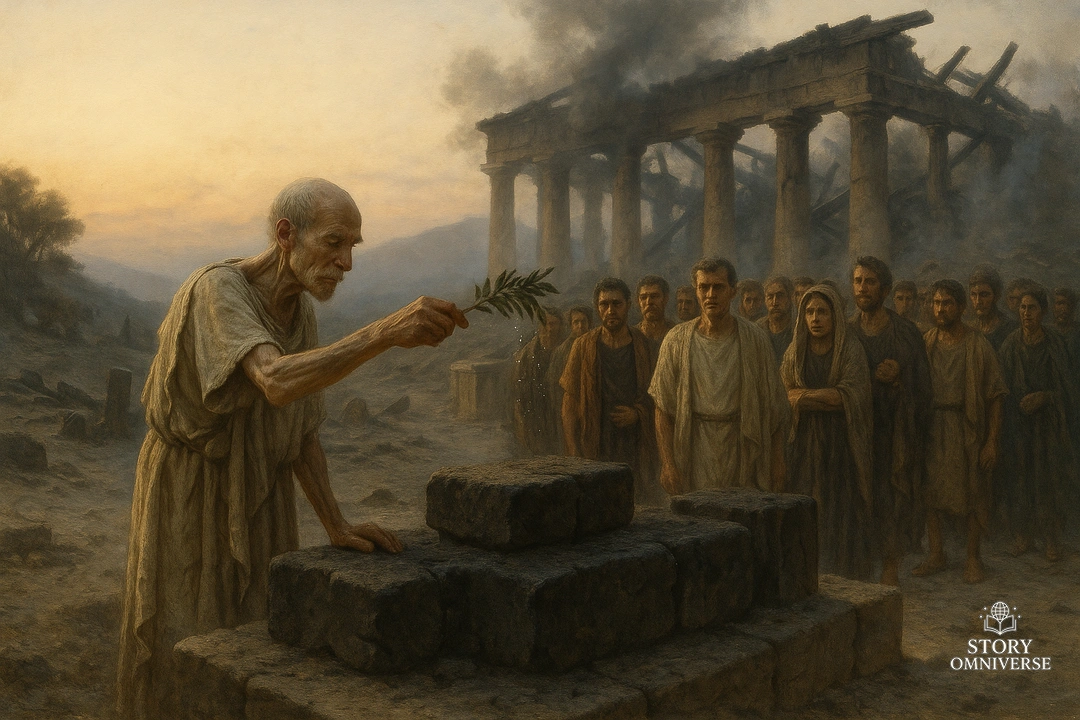
Priest Lykos stood near the broken altar stones, thin as a reed, his eyes bright with sleeplessness. He held a bowl of water and a branch of laurel. “This place is unclean,” he said, voice carrying. “Not only by fire, but by lies.”
The magistrates stood with their attendants. Philon stood among them, cloak clean, face controlled. Menalkes lingered at the edge, watching like a man at a game. Doros was brought too, wrists still tied, eyes sunken but alert. When he saw the altar stones, he swallowed hard, as if the god’s presence made his throat close.
Lykos dipped the laurel in water and sprinkled the stones. “We will not settle this in the market,” he said. “We will settle it before the god. If Apollo’s house burned by human hands, those hands must be named, or the stain remains.”
He turned to the magistrates. “Require an oath,” he demanded. “Not a casual oath. An oath on these stones, where the god’s presence still bites.”
A murmur rose. Oaths were common, but an oath at a ruined altar carried weight. Men who lied under such a vow risked more than shame. They risked being marked as tainted, avoided in trade, refused at hearths, whispered about in doorways.
The chief magistrate nodded reluctantly. “So be it. We will hear witnesses here.”
The guard captain stepped forward first and spoke of the night watch, of movement among the columns, of tools and a covered lamp. Another watcher described the cut of a merchant’s cloak. Then Lykos himself knelt by the storeroom threshold and scraped the stone with a knife. He held the blade up. A dark residue clung to it.
“Pitch,” Lykos said. He let the word hang like smoke.
Philon’s jaw tightened. “Pitch can be anywhere,” he said.
“Then swear,” Lykos replied, stepping close. “Swear before Apollo that you did not supply materials for this fire, that you did not profit from the burning, that you did not take temple goods afterward.”
Philon’s eyes flicked to the crowd gathering beyond the magistrates. People watched with hungry attention, not for a poor man to carry their fear, but for a powerful man to be tested. Thaleia stood among them, face pale, hands clenched around a water jug.
Philon lifted his chin. “I swear,” he began.
Lykos raised a hand. “Not with easy words. Place your hand on the altar stone.”
Philon hesitated, just a breath. In that breath, something cracked. A man who feared nothing would not hesitate. Kleon felt the crowd sense it too, the way dogs sense weakness.
The chief magistrate’s voice sharpened. “Do it.”
Philon placed his hand on the stone. His fingers looked suddenly less clean against the soot-stained surface. His lips parted, but no sound came. His throat worked as if the oath had turned to grit.
A shout rang from the side. One of Philon’s servants, a young man with a bruised cheek, pushed forward. “He told us,” the servant blurted, voice breaking. “He told us to carry pitch jars at night. He said the fire would bring contracts. He said the temple bronze would be easy after.”
Philon spun, face white. “Silence,” he hissed.
The servant fell to his knees. “I cannot swear,” he sobbed. “I cannot. The god will see. He said if I spoke, I would be beaten and sold away.”
The crowd erupted, not with joy but with a hard, grim sound. The scheme stood naked now: burn, rebuild, profit, steal. Lykos lifted the laurel again, eyes fierce. “The god has heard,” he said.
Doros sagged as if a rope had been cut. Kleon’s father gripped Kleon’s shoulder so hard it hurt, but it was not anger. It was relief, fierce and shaking.
Kleon looked at the altar stones, blackened yet solid. He felt as if he had spoken not only to men, but into the hollow space where a god’s house had been, and something had answered with truth.
Chapter 11: New Clay, New Name
Doros’s ropes were cut in the open, where everyone could see. His wrists were raw, but when he flexed his hands, he did it slowly, as if savoring the simple fact of being unbound. He looked at Kleon once, eyes wet. “I will not forget,” he said, voice rough. He did not offer grand thanks. He offered something better: a promise carried in plain words.
Philon was taken away under guard, no longer smiling. Menalkes vanished into the crowd before anyone could turn their anger toward him, but his power had been checked, at least for now. The magistrates announced restitution tied to the temple. Goods stolen from the sanctuary would be reclaimed where possible. Those who had profited would pay. The rebuilding fund would be overseen under priestly scrutiny, and the council warned lenders against using the turmoil to seize workshops by intimidation.
It did not feel like righteousness descending from the sky. It felt like hard bargaining forced by public shame, by fear of the god’s displeasure, and by the simple fact that too many eyes had seen too much. Still, it was something, and in Corinth even “something” could mean a family kept its roof.
A week later, Menalkes came to the potter’s workshop with a different face. He did not smile. He held a tablet and spoke as if each word cost him. “A settlement,” he said. “Reduced payments until the temple work begins. The council advises cooperation.”
His eyes slid to Kleon, then away. He could not threaten openly now. He could only resent, and resentment was a quieter weapon.
After Menalkes left, Kleon’s father sat heavily on a stool. He stared at the wheel as if seeing it for the first time. “You risked everything,” he said.
Kleon’s hands were stained with clay. He had been kneading it, working it, trying to feel normal again. “I know,” he answered.
His father’s voice softened. “When I was your age, I thought being a man meant never bending,” he said. “But clay that never bends breaks in the kiln.” He looked up, eyes shining. “You bent where you had to, and you did not break.”
Kleon swallowed against a sudden tightness in his throat. “I was afraid,” he admitted.
“Good,” his father said. “Fear is a sign you understand the cost. Courage is paying it anyway.”
Outside, the city’s sounds returned to ordinary rhythms. Builders carried stone toward the sanctuary. Donkeys brayed. Merchants argued. Life did not pause for lessons. It moved on, dragging everyone with it, as it always had along the Isthmus road.
Kleon sat at the wheel and set a lump of new clay at the center. He wet his hands, pressed his palms in, and felt the spin catch. The clay rose under his fingers, smooth and responsive. His hands were steadier than before, not because he was older by years, but because he had crossed a line and lived.
Thaleia passed by the doorway with her water yoke and paused. “You have a new look,” she said quietly.
Kleon glanced up. “What look is that?”
“The look of someone who knows his own name,” she replied, then continued on.
Kleon returned to the turning clay. In the distance, above the rooftops, the ruined sanctuary stood open to the sky. Soon it would have beams again, tiles, smoke from offerings. But Kleon would remember the ash, and the oath spoken on blackened stones.
He shaped the jar’s mouth carefully. A vessel meant to hold water without leaking. He understood, now, what it meant to hold truth the same way.

0 Comments