
Chapter 1: The Smile Without a Name
The Velvet Quill Café holds its evening hush like a secret, velvet curtains breathing as if they remember every confession. I sit with my books stacked too neatly for a place like this, and still the candlelight softens their sharp corners.
My fingers drift to the drawer of the central table, as they have on nights when I cannot bear my own silence. Beneath a pressed rose and a smudge of ink, parchment waits. A folded love letter, edges worn like a well-played song.
A cup clinks somewhere behind me. Someone laughs softly, then stops, as if my stillness asked for reverence.
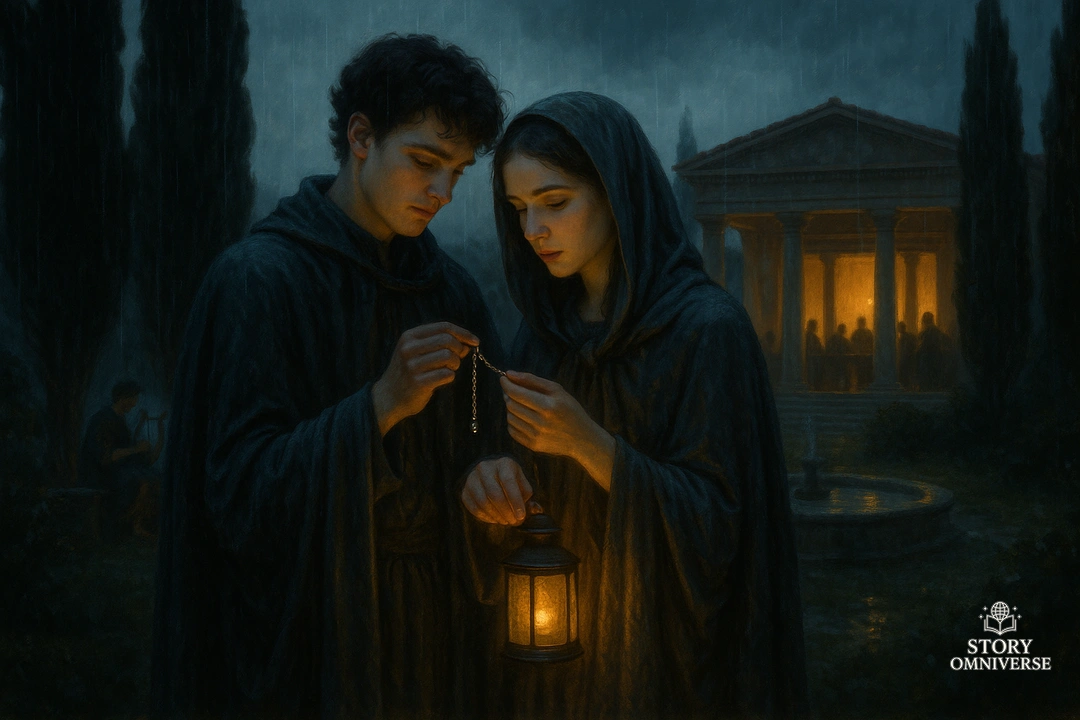
“You always look like you are about to argue with the page,” the barista murmurs as she sets tea beside my elbow.
“I used to,” I answer, and the paper warms under my palm. “Tonight I am only remembering.”
I unfold it. The first line pulls me backward, past candlewax and porcelain, into twilight that tasted of rain and laurel.
I didn’t know their name, only their smile.
In that other world, I was not yet the scholar with clean margins and careful proofs. I was a runaway, breath tight in my chest, slipping through a garden outside a symposium where men spoke as if words were weapons and wine their shield.
Weeks had passed since I fled the life chosen for me. Weeks of borrowed roofs, of careful footsteps, of learning how quickly safety can be revoked. That night, hunger and fear drove me close to the villa’s open shutters, close enough to hear the symposium whispers threading the leaves like distant music.
“Did you hear him?” someone inside crowed. “He skewered the old teacher with a single question.”
Another voice, sharp with admiration: “That is why we come. For daring.”
I kept to the shadowed path, listening for my pursuers in every rustle. Solace was a dangerous thing to seek.
Then, through the veil of leaves, I saw them.
They stood near the garden wall where lantern light thinned, a figure half-lit, half-made of dusk. Their gaze lifted, not to the symposium, but outward, as if they too wanted escape. Rain gathered on their lashes. When their eyes met mine, their mouth curved, brief and quiet.
A smile, not mocking. Not triumphant. Something gentler, like a note held after the last chord.
I froze. Rival. I knew them by reputation even before I knew their name. The one the symposium adored for quick wit and fearless speech.
Their smile lingered after they turned away, and I hated myself for how it followed me like music you cannot forget once you have heard it.
Chapter 2: Rain Under the Cypress
The rain came as if summoned by my trembling.
One moment the air was only heavy, the next it split open, cold and sudden. Leaves shuddered. Lantern flames hissed. The garden path turned slick beneath my sandals, and my cloak drank water like a thirsty animal.
I ran, not toward the house with its voices, but toward the wall where an old stone alcove offered a shallow shelter. It was hardly a refuge, only a curved lip of masonry under cypress branches. Still, it was something.
I ducked in, breath ragged, and found I was not alone.
They were already there, pressed to the back of the alcove, hair darkened by rain, shoulders squared as if the storm itself had challenged them. For a heartbeat, we stared. Rival recognition sharpened the air.
“You,” they said, voice low. “The shadow in the garden.”
“And you,” I returned, forcing steadiness. “The symposium’s favorite blade.”
Their lips twitched, almost a smile again, but pride held it back. “If you are hiding, you chose poorly. The wall is watched.”
“I am not hiding,” I lied, teeth chattering as water ran down my neck.
They glanced at my shaking hands. “Then you are foolish.”
“Better foolish than loud,” I snapped. “Loud people are noticed.”
“So are those who run,” they said, and stepped half a pace closer, not threatening, only making room as the rain drove sideways under the cypress. Our shoulders nearly touched.
Heat rose between us, unwanted and undeniable.
“You should go inside,” I said, though the thought of entering the symposium made my stomach twist. “They are waiting to praise you.”
“They praise whoever entertains them,” they replied. “Tonight I did not come to be praised.”
Outside, rain hammered the stones. The garden smelled of wet earth and crushed herbs. In the narrow shelter, our breath fogged the air.
“You are shivering,” they observed, as if it offended their sense of order.
“And you are drenched,” I shot back.
They laughed once, short and surprised, then fell quiet. “What is your name?”
I hesitated. Names were hooks. Names were how you were found.
“I don’t give it to rivals,” I said.
“Then we are even,” they answered, gaze steady. “Because I don’t offer warmth to strangers.”
Yet when a gust pushed rain into the alcove and I flinched, they lifted their cloak edge without thinking, angling it so it shielded us both. Pride made the gesture stiff, but it was shelter all the same.
For a moment, rivalry thinned. Shared soaked shivers made our sharpness feel like a costume we were too tired to keep wearing.
“Just until the storm passes,” they said.
“Just until,” I echoed, and my voice sounded like a promise I did not understand.
Chapter 3: Symposium Whispers, Scholar’s Pride
When the rain eased, we emerged with damp hair and guarded faces, as if the cypress had not witnessed our closeness. The symposium’s light spilled into the garden, gold and warm, and the voices inside rose again, eager as flames.
I followed at a distance, keeping to the edges. A runaway learns the art of being unseen, even among men who believe the world exists to watch them.
Inside, couches circled low tables. Wine gleamed in cups. Oil lamps painted everyone in soft amber. Philosophers argued as if they could wrestle truth into submission.
And there I was too, though I wished to be nothing but a shadow. I had once belonged to these rooms, prized for careful logic, for the way I could build an argument stone by stone until no one could deny its shape. I had left in haste, for reasons I did not speak aloud, and now I returned only because hunger and fear had driven me to the garden’s edge.
“Ah,” a voice called, and my shoulders tightened. “The meticulous one returns.”
A man with heavy rings beckoned me closer, amusement in his eyes. “Tell us, scholar. Do you still believe the world can be measured like a scroll?”
Murmurs rippled. Some recognized me, some only recognized the sport of pitting minds against each other.
Before I could answer, my rival rose, cup in hand, posture easy as a dancer’s. “Do not bait them,” they said lightly. “A careful mind is a rare thing. We should not waste it on cheap laughter.”
The room turned toward them with approval. They had that power, the kind that made men lean in.
I forced my chin up. “Careful minds do not need defending.”
Their gaze met mine, and for an instant the alcove returned, rain and shared breath. Then they smiled in public, sharp and bright. “Then defend yourself. Tell us why the gods allow injustice.”
The challenge landed like a thrown coin. I could not refuse without losing what little safety my reputation still offered. Yet speaking meant being noticed.
I answered anyway, because pride is its own chain. I spoke of order, of law, of the way humans create injustice and then blame the heavens for it. My words were measured, my tone calm.
They countered with daring, with stories and questions that made the room gasp and laugh. Their wit cut, but it also illuminated. Rivalry became a public sport, and the symposium drank it like wine.
Between exchanges, their eyes flicked toward my damp cloak, toward the way I held myself as if expecting a hand on my shoulder. Their smile softened, almost imperceptible, then vanished as the room demanded performance.
I should have hated them. Instead, I felt the pull of that quiet smile like a melody beneath the argument, lingering after each spoken note.
Chapter 4: The Charm Bracelet With Missing Pieces
The symposium blurred into late hours. Cups emptied. Arguments grew softer, more intimate, like secrets spoken into the hollow of a hand. I slipped out when no one was looking, breath tight with relief.
The garden received me with twilight’s last violet. Rain still clung to leaves. The cypress smelled clean and sharp.
I heard footsteps behind me and turned, ready to flee. It was them.
“You left mid-debate,” they said. “Either you were bored, or you were afraid.”
“Both,” I admitted before I could stop myself.
Their brows lifted. “Honesty. That will ruin you in these rooms.”
“I am already ruined,” I said, and the word tasted like iron.
They stepped closer, voice gentler. “Who are you running from?”
I should have lied. Instead, I reached for something I could control. My wrist. I pushed back my damp sleeve and showed them the bracelet there, a chain of small charms that caught lantern light.
It was beautiful and incomplete. Several links hung empty, as if teeth were missing from a smile.
Their gaze fixed on it. “That is a fine piece.”
“It was finer,” I said. My thumb brushed an empty link. “Each missing charm is a note I never got to hear to the end.”
They studied me as if I were a riddle. “Show me.”
I hesitated, then turned my wrist. A small charm shaped like a lyre remained, dulled by wear. Another, a tiny olive branch. And one more, a fragment of blue glass set in bronze.
Their breath caught. “That glass.”
“What of it?” I asked, pulse quickening.
They reached out, then stopped short of touching. “I have seen its match. A charm like that belonged to someone I…” Their voice faltered, pride stumbling over tenderness. “Someone I am loyal to.”
The air shifted. Forbiddenness entered like a third presence, cold and clear.
“Loyal,” I repeated, and the word made my throat ache.
They nodded once, jaw tight. “They fed me when I had nothing but my mouth and my pride. They spoke for me when I was too young to be heard. I swore I would not shame them.”
A kindness, a debt, a vow. Suddenly the chain had weight.
“And still you followed me into the garden,” I said.
“I followed the question,” they answered. “Why you wear what should not be yours.”
“It was given,” I whispered. “And then taken back, piece by piece, until only this remained.”
Their eyes softened, and that quiet smile returned, shadowed by sorrow. “You are living between lives.”
“So are you,” I said, and the truth hung between us like a charm waiting to be clasped.
They finally touched my wrist, only two fingers, careful as if I might shatter. The contact sent warmth through me, swift and frightening.
Then they pulled away, as if burned by their own desire.
“We should not,” they said.
“I know,” I answered, and still my wrist felt empty where their touch had been.
Chapter 5: A Song After the Last Note
The next evening, twilight arrived like a bruise, purple and tender. The garden filled with guests spilling from the symposium, their laughter softened by wine. Somewhere near the fountain, a musician plucked a lyre.
The melody rose and fell, simple and aching. It threaded through leaves and lantern smoke, and when the final note faded, it did not truly vanish. It lingered, as if the air refused to let it go.
I stood beneath the cypress, listening, telling myself I was only there for the music, for the comfort of something that asked nothing of me.
“You came back,” a voice said.
They stepped from the path, cloak dry tonight, hair tied back. In the lantern glow, their expression was cautious, as if they feared their own hope.
“I didn’t mean to,” I replied, and hated the honesty even as it relieved me.
They glanced toward the symposium house. “They will notice if I’m gone too long.”
“Then go,” I said, though my hands curled into my sleeves as if holding onto warmth.
They did not move. “The song. Did you hear it?”
“Yes,” I breathed. “It stays.”
Their smile was faint. “Like certain arguments.”
“Like certain looks,” I countered, and my heart stuttered at my own boldness.
We walked a few steps along the garden wall, staying where shadows pooled. Leaves dripped softly. The musician began another tune, quieter, as if playing for the garden itself.
“You speak in careful lines,” they said. “But you carry chaos.”
“And you,” I replied, “speak like chaos, but your eyes… your eyes are careful.”
They laughed under their breath. “You think you know me.”
“I think I recognize struggle,” I said. “The way you perform bravery because the room demands it.”
Their gaze sharpened, then softened. “And you perform distance because you fear being held.”
I stopped walking. The truth of it pressed against my ribs.
“Why are you here?” I asked, voice low. “If loyalty binds you elsewhere.”
They looked away, toward the fountain where the lyre’s notes floated. “Because when the last note ends, I don’t want the silence. Not tonight.”
My throat tightened. “Neither do I.”
We stood close enough that our sleeves brushed when the breeze shifted. No touch, only nearness, and yet it felt like intimacy.
In the distance, symposium voices swelled, then ebbed. Here, beneath the cypress, the melody remained in the leaves and in our breathing, and our rivalry began to sound less like war and more like two harmonies searching for the same resolve.
Chapter 6: Lessons Shared in Secret
After that, the garden became our quiet rebellion.
Not every night. Not boldly. Always in the hours when lanterns dimmed and most guests were too drunk to notice who slipped away. We met where the shadows fell kind, near the wall’s old stones, where ivy hid the gaps.
The first time I brought a scrap of papyrus, my hands shook. I held it out like an offering.
“A poem?” they asked, amused.
“A line,” I corrected. “One line is safer than a whole confession.”
They took it, reading aloud in a whisper. “Even the moon hides its face when love is named.”
“That’s not mine,” I said quickly. “It’s old.”
“Still true,” they murmured, then surprised me by producing their own folded scrap. “Then take mine.”
Their handwriting was fast, bold, slanting like a runner. The line read: Rivals are only strangers who listen too closely.
I looked up. “You wrote that?”
They shrugged, trying for indifference. “It came to me after you argued about justice.”
Heat rose in my chest, part pride, part longing. “You listened.”
“Of course I listened,” they said. “How else would I defeat you?”
The words were rivalry, but their eyes were not. Their gaze held me as if my existence mattered beyond sport.
We began trading more than lines. Small truths. The kind you speak only when you believe the listener will not use them as knives.
“I left because I couldn’t be what they wanted,” I admitted one night, fingers tracing the empty links of my bracelet.
“They wanted you obedient,” they guessed.
“They wanted me available,” I corrected, voice flat. “To a life I did not choose.”
Their jaw tightened with anger that was not for themselves. “Then stay hidden. I can help.”
“You?” I scoffed, though gratitude trembled beneath it. “The symposium’s darling?”
Their smile turned melancholy. “Darling is another kind of cage.”
One night, the help became more than words. I arrived with mud on my hem and panic in my throat, having spotted a familiar servant in the street, one who might recognize me.
“They’re closer,” I whispered.
They did not ask for details. They simply took my cloak, turned it inside out, and tied it differently at my shoulder. “Walk with your head high,” they instructed. “If anyone asks, you are with me.”
“With you?” My voice cracked.
Their eyes held mine, steady. “Let them think I claimed your company for debate. Let them underestimate tenderness.”
We crossed the garden path together, slow, deliberate, as if we belonged to the lantern light. When a pair of guests glanced our way, my rival lifted their cup in greeting and spoke some bright remark about a philosopher’s foolishness. The guests laughed and moved on.
Only when we reached the cypress shadow again did I breathe.
“You risked yourself,” I said.
“I risked a rumor,” they replied, softer. “You risk your life.”
In that moment, my scholar’s rivalry became a mask for longing. I argued with them over metaphors and gods, over whether courage was born or made, while my heart argued for something simpler: their presence.
And I, runaway, found solace in being seen without being claimed.
Chapter 7: Loyalty’s Chain
The confession came on a night when the garden smelled of crushed mint and old rain. The symposium had ended early, voices fading into the city beyond the wall. Lanterns flickered low, as if tired of witnessing human longing.
They waited for me by the fountain, hands clasped behind their back like someone preparing to face judgment.
“You’re late,” they said, but the words lacked bite.
“I had to be sure I wasn’t followed,” I replied. My bracelet chimed softly when I moved, a delicate sound that always made me think of missing music.
Their eyes dropped to it, then lifted to my face. “We cannot keep pretending this is only rivalry softened by moonlight.”
My pulse jumped. “Then what is it?”
They swallowed. For once, their quick wit failed them. “It is wanting,” they said at last. “And it is wrong.”
“Wrong because of the symposium?” I asked, though I already knew.
They shook their head. “Wrong because of my loyalty.”
The word landed like a stone in water, ripples spreading through my chest. “To the one who owned the matching charm.”
“Yes.” Their voice roughened. “A bond made before desire complicated the world. A promise spoken when I believed I could live without… this.”
They gestured between us, helpless.
I forced myself to breathe. “Do you love them?”
They looked away, eyes shining with something like shame. “I honor them. I owe them. They are not cruel. That is what makes this worse.”
The honesty hurt more than any insult. I stepped closer anyway, because my body betrayed my caution.
“I have lived between two lives,” I said quietly. “One where I am safe if I surrender. One where I am hunted if I refuse. I thought running would free me, but it only made me lonely.”
Their gaze snapped to mine, fierce with tenderness. “You are not alone when you are with me.”
“And yet you are chained,” I whispered.
They nodded, throat working. “Yes.”
A gust stirred the cypress. The fountain’s water sounded like distant applause, cruel in its steadiness.
I lifted my wrist, letting the bracelet catch lantern light. “These missing pieces,” I said, voice trembling, “are the notes I never got to finish. Now you stand before me with a choice you fear.”
Their hand hovered near my wrist, then fell. “If I choose you, I betray them.”
“If you choose them,” I said, “you betray yourself.”
They flinched as if struck. “Don’t make it simple.”
“It isn’t,” I admitted, tears hot behind my eyes. “Love can be a shelter and a storm at once.”
Their expression broke, the daring speaker reduced to a person in pain. “I want to shelter you,” they whispered. “But I am the storm.”
I reached out, and this time I touched them first, fingers resting on their sleeve. The contact was small, but it felt like defiance.
“Then stand with me in the rain,” I said. “Even if we cannot yet step into the sun.”
They closed their eyes, leaning into my touch for one stolen heartbeat, as if memorizing it against the coming loss.
Chapter 8: The Slow Reveal of Us
Rumors began the way smoke begins, thin and easy to dismiss, until suddenly it stings your eyes and you cannot pretend there is no fire.
At the symposium, voices dipped when I entered. A pause, then a forced laugh. Men watched my rival with new curiosity, as if searching for the crack in their perfect bravado.
“Your debates have grown… gentle,” one man teased them, loud enough for others to hear. “Have you found a muse?”
My rival lifted their cup, smile bright as polished bronze. “If I had, would I admit it to you?”
Laughter erupted, but it did not erase the way their gaze flicked toward me, quick as a plucked string.
I tried to keep distance. I answered challenges with colder logic. I avoided the garden for two nights, telling myself it was wisdom, that mismatched timing and forbidden loyalty would only end in ruin.
On the third night, I found my feet carrying me there anyway.
The garden was quieter than usual. Twilight deepened. The musician’s lyre played from somewhere unseen, a tune that seemed to stretch one note too long, aching.
They were waiting under the cypress, posture tense.
“You stayed away,” they said.
“I had to,” I replied, though my voice cracked. “They are watching.”
“They have always watched,” they answered. “Now they suspect.”
I folded my arms. “Then stop coming.”
Their laugh was bitter. “You say that as if it is simple.”
“It should be,” I insisted. “You have loyalty. I have danger. We have nothing that can survive daylight.”
They stepped closer, eyes dark. “We have what we have built in the dark.”
“That is not enough,” I said, and hated myself for the lie.
They reached into their cloak and drew out a small object. One of the bracelet’s missing charms, not attached, resting in their palm. A tiny bronze bell, dulled with age.
“I found this,” they said. “In a chest that belonged to the one I owe. It was meant for you, I think. Or taken from you.”
My breath caught. “How did you…”
“I asked,” they admitted, voice raw. “And in asking, I stepped closer to betrayal.”
The bell charm trembled in their hand. It looked like a note you could almost hear.
“Give it back,” I whispered.
They closed their fingers around it. “Not yet. If I return it, they will know I have touched what I should not.”
“And you haven’t chosen,” I said.
Their eyes shone. “I am choosing, every time I come here.”
The words unraveled my resolve. I stepped forward until we were close enough that the garden seemed to hold its breath.
“We’re becoming a story,” I murmured. “The kind told with smirks.”
“Let them smirk,” they said softly. “They do not know what it costs to be tender in forbidden soil.”
I lifted my hand, stopping just short of their cheek. “If we are caught…”
“We will be,” they finished, voice gentle. “But not tonight.”
Their forehead touched mine, a contact so light it felt like the last note of the lyre hovering in the air. No kiss, only closeness, intimacy shaped by restraint.
In the distance, symposium laughter rose again, unaware of the quiet revolution happening beneath the cypress.
Chapter 9: Mismatched Timing at Twilight
The message came at dusk, delivered by a boy with wide eyes and a nervous bow.
“For you,” he said, thrusting a scrap of papyrus into my hand. “They said it was urgent.”
I read it once, then again, as if repetition could change the words.
A ship at dawn. A chance to leave. A friend of a friend, offering passage, no questions. Safety, if I moved quickly.
My lungs tightened. I should have felt relief. Instead, grief arrived first, sharp as salt.
I found them in the garden before the lanterns were fully lit. Twilight painted the cypress black against a bruised sky.
“I have to go,” I said without greeting.
They turned, and the look on their face told me they already knew something had shifted. “Tonight?”
“Before dawn,” I whispered. “It’s the only opening I may ever have.”
Their hands clenched. “And if you don’t take it?”
“I might be found,” I said. “Or forced back. Or worse.”
They took a step toward me, then stopped as if an invisible line barred them. “I was called,” they said hoarsely.
“Called?” I echoed, fear rising.
“To honor my loyalty in public,” they admitted. “A ceremony. A vow renewed. They want me beside them at sunrise.”
The world narrowed to the space between us, filled with everything unsaid.
“Sunrise,” I murmured. “Of course.”
Mismatched timing. The cruelest kind of fate. When love arrives and duty arrives, and they refuse to share the same hour.
They reached into their cloak and opened their palm. The bronze bell charm lay there, catching the last light.
“I wanted to give it to you,” they said. “To complete something.”
I shook my head, tears stinging. “If you give it, you choose.”
“And if I don’t,” they said, voice breaking, “I lose you.”
I lifted my wrist, bracelet chiming softly. Empty links waited like unanswered questions.
“Keep it,” I whispered. “For now. Let it be a promise that cannot yet be fulfilled.”
Their eyes closed. When they opened them, they were wet. “You are asking me to live with missing notes.”
“I have lived with them for weeks,” I said. “You taught me how to hear the music anyway.”
They stepped close enough to take my hands, finally, fully, fingers wrapping around mine as if anchoring themselves.
“Tell me where,” they pleaded. “Tell me where you will be.”
“If I tell you,” I said, “you might come. And if you come, you might destroy your life.”
“And if I don’t,” they whispered, “I destroy mine slowly.”
We stood in the garden’s last light, hands clasped, while somewhere a lyre began a song that sounded like farewell.
“I don’t know what will happen,” I admitted.
Their thumb brushed my knuckles. “Then promise me only this. Do not forget the sound of my name when you learn it.”
I almost laughed through tears. “I still don’t know it.”
They leaned close, mouth near my ear. “Not yet,” they breathed. “Not until it is safe.”
Even their name was forbidden, held back like the final chord of a song.
Chapter 10: Choosing Between Two Lives
The night before my leaving felt too short, as if time itself had betrayed me. The symposium house glowed behind the garden wall, but the garden held the truer fire, lanterns trembling in the wind.
We met one last time in the garden’s last light, where cypress shadows stretched long across the path.
They arrived with a ceremonial ribbon tucked into their belt, the kind worn when vows were spoken before witnesses. The sight of it made my stomach twist.
“You look ready to be claimed,” I said, bitterness slipping through my grief.
They flinched. “And you look ready to vanish.”
“Because I have to,” I replied, then softened. “I’m sorry. I know you didn’t choose this timing.”
They exhaled, shoulders sagging. “Timing chooses us more often than we admit.”
We stood facing each other, hands open at our sides, as if any touch might tip the balance.
“Say it,” I demanded, voice shaking. “Tell me you will choose me. Tell me you will break loyalty for love.”
Pain crossed their face. “If I do, I am not only breaking a promise. I am breaking a person who trusted me before I knew myself.”
“And if you don’t,” I said, “you break me.”
They stepped closer, eyes fierce. “You are not breakable.”
I laughed, small and hollow. “That is the kindest lie you have ever told.”
The lyre’s music drifted from somewhere beyond the fountain, a melody that circled the same theme without resolving. It felt like the world’s own hesitation.
They reached into their cloak and drew out my bracelet, which I had not realized they carried until now. My breath caught.
“You left it behind,” they said softly. “The night you ran from the symposium after the rumors started. I kept it to return.”
I stared at it, at the empty links. “Give it to me.”
They placed it in my palm, then closed my fingers around it, slow and reverent. “This is choosing,” they whispered. “Not fully. Not publicly. But truly.”
I held the bracelet to my chest. “Then what do we do?”
They looked toward the symposium house, toward duty and safety. Then they looked back at me, toward love and uncertainty.
“We choose not to erase what we have become together,” they said. “Even if we cannot yet live it.”
Tears slid down my cheek. I did not wipe them away.
They lifted a hand and, with trembling restraint, brushed the tear from my skin with their thumb. The touch was so gentle it felt like an apology.
“I will stand in public at sunrise,” they said. “And I will hate it.”
“And I will leave at dawn,” I replied. “And I will hate it.”
Their forehead rested against mine again, a familiar almost-kiss, a defiance made of closeness without crossing the final line.
“Two lives,” I whispered.
“Yes,” they answered. “And tonight, we let both be true.”
When we finally stepped apart, the garden seemed to hold onto the shape of us, as if refusing to let the last note fade.
Chapter 11: The Letter Left Like Music
The symposium slept. Wine cups sat abandoned like fallen crowns. Lamps dimmed, their oil nearly gone. I sat alone in a small side room with a single candle, the flame wavering as if it, too, was uncertain.
My hands ached from holding back tears. Dawn was a shadow on the horizon, approaching with indifferent certainty.
I took up a stylus and papyrus. I wrote because I could not carry all of it in my chest. I wrote because rivalry had taught me to sharpen thought, and longing had taught me to soften it.
The words came slow at first, then steadier, like a melody finding its path.
I didn’t know your name, only your smile…
I paused, hearing the garden’s lyre in memory, the way the last note lingered after the musician’s fingers lifted. I wrote again.
You argued as if truth were a prize, and I answered as if safety could be proven. We were both wrong. Truth is not won. Safety is not earned. And yet, with you, I felt something like both.
Footsteps sounded in the corridor, and I froze. Silence followed. Only the candle crackled.
I continued, heart pounding.
I am leaving before dawn. You will stand in public, and I will become rumor. But hear this, even if no one ever reads it aloud: rivalry taught me to listen. And listening taught me to love you.
My throat tightened. I pressed my palm to my mouth, then forced myself on.
Do not destroy your loyalty for me tonight. I will not ask you to become cruel in the name of tenderness. But do not pretend we were nothing. Do not let them rewrite us into a joke.
I folded the letter carefully, creasing it with the tenderness of a final touch. Then I took the bracelet, its missing pieces still missing, its emptiness still speaking. I wrapped the letter in a strip of cloth and tucked it with the bracelet into a small wooden box beneath the loose stone by the garden wall, where ivy hid secrets.
As I pressed the stone back into place, I heard a soft sound behind me.
They stood at the edge of lantern light, face pale, eyes wide with grief.
“You’re writing goodbye,” they said.
“I’m writing music,” I corrected, voice trembling. “Something that lingers even after I’m gone.”
Their gaze dropped to the wall, understanding flickering. “You hid it.”
“Yes.”
They stepped closer, hands hovering as if wanting to touch me, the box, the whole impossible situation. “Will you ever come back?”
“I don’t know,” I admitted. “But I am not denying us. Only deferring.”
Their eyes closed. When they opened them, their smile returned, small and broken and beautiful. “Promise deferred,” they whispered. “Not denied.”
I nodded, and in that nod lived everything we could not say in daylight.
Closing Frame
The Café’s candle has burned lower while I read, and the old paper warms beneath my palms as if it still carries a living pulse. Somewhere behind me, porcelain clinks softly, and a melody from a hidden corner seems to linger after it ends, one note held just a breath too long.
A listener at the next table leans forward, voice careful. “Did you ever learn their name?”
I look down at the letter’s final lines, ink faded but stubborn. “I learned it later,” I say, and my throat tightens with the old ache. “But that is not the point of this page. The point is the smile that carried me through the leaving.”
The barista returns, eyes soft, and sets a small dish of honeyed bread beside my tea. The scent rises warm and floral, and for an instant I taste laurel and rain.
“For the bitterness,” she murmurs.
“For the memory,” I correct gently, and she nods as if she understands the difference.
I refold the letter and return it to the drawer, not to bury it, but to keep it near the place that understands unfinished vows. The pressed rose rests against the parchment like a quiet witness.
My fingers brush the velvet quill beside the Café’s open journal. The communal page waits, blank in the candle’s dimming glow.
I set the quill down gently, and in the fading light, I let the room hold the promise the way music holds its last note, refusing to disappear all at once.

0 Comments