
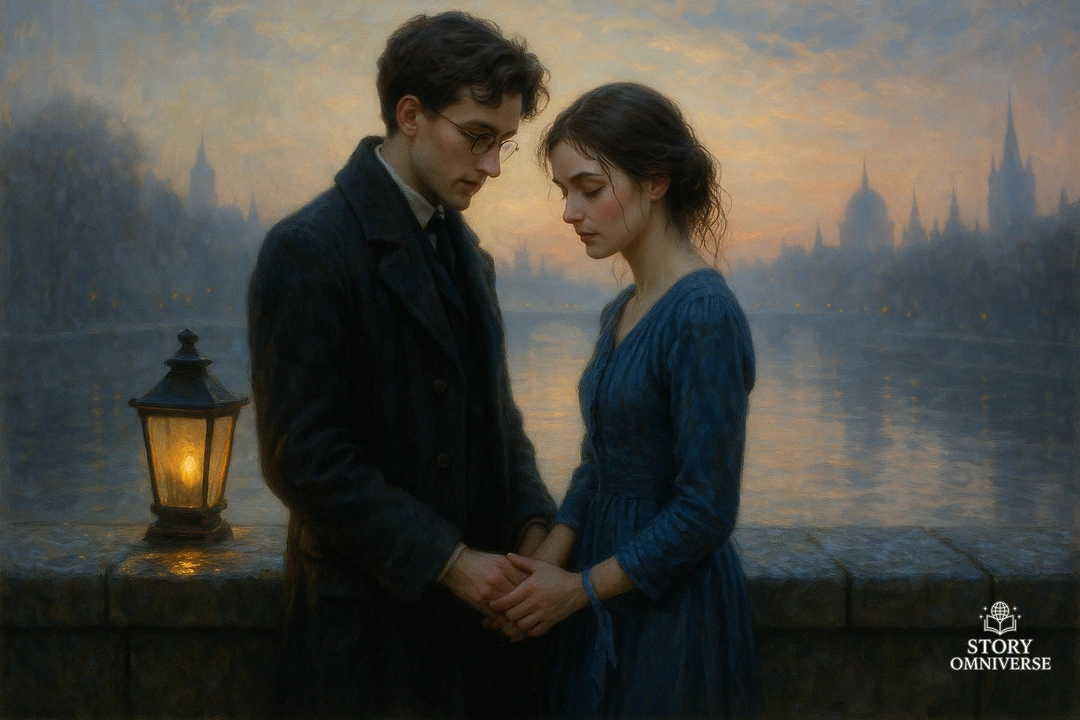
Chapter 1: The Song That Would Not Stay Buried
The Café smelled of roses that evening, steeped into tea and clinging to velvet curtains long after cups were cleared. I sat near the central table, close enough to see the pressed rose in the communal journal, far enough to pretend I was only another quiet shadow among the listeners.
Someone had set a small vase of pale blooms by the candle. Their petals looked too soft for the world. I watched the flame wobble and told myself I had come only to listen.
Then the violin began.
It was not loud. It never is, in that place. It rose as if from behind the curtains, as if the velvet itself breathed music. The melody was old, the sort that once drifted through drawing rooms and lecture halls when people wanted to believe the future could be arranged like silver on a tray. The first phrase struck like a remembered footstep in an empty corridor.
A woman at the next table murmured, “I know that song.”
A man answered, “Everyone does, somewhere.”
I did not speak. I reached for my worn notebook instead, the one with the cracked leather spine and pages softened by years of being opened and shut like a secret. My fingers were ink-stained already, though I had not written a line in days.
The melody insisted. It tugged at a dawn I had tried to fold away neatly, between chapters of safer texts.
I set my notebook on the table and opened it. The paper smelled faintly of dust and lavender, and something else, something that tightened my throat.
“Are you writing tonight?” a server asked softly as she placed a cup of rose tea near my hand.
“I am only… copying,” I lied.
She looked at the notebook with a kind of patience that felt like being seen. “Copying is still a way of telling,” she said, and moved on.
The violin turned the corner of the melody, and suddenly I was not in candlelight at all. I was in morning fog, with river air cold enough to sting. I was younger and more foolish, clutching books like armor, walking toward a bridge where lovers were rumored to meet the day.
I had told myself I did not believe in rumors. I had told myself I did not believe in love that made people brave.
And yet.
The candle beside me burned lower. I bent over the page and began to stitch my entries together before courage could cool. The ink flowed as if it had been waiting, as if the story had been tapping at the inside of my ribs for years, whispering, Let me out.
I wrote the date of the first entry, and the name I had tried not to taste too often.
Eleanor Harrow.
Chapter 2: The Scholar and the Rival
9 October, 1909.
I have decided, for my own sanity, to keep a record of the term. If I do not write, I will either shout in the lecture hall or vanish into the stacks and never return.
Today, Professor Wainwright posed a question on the nature of moral duty in times of national strain. I had read ahead, of course. I had annotated the text. I had prepared a careful argument, neat as a row of books on a shelf.
Then Eleanor Harrow spoke.
She did not raise her hand. She never does. She simply lifted her chin and offered her thoughts as if the room belonged to her, as if the world had been waiting for her voice to correct it.
“It is easy,” she said, “to speak of duty in the abstract. But duty is not a concept. It is a person. It is the face you cannot refuse.”
A few students laughed quietly, charmed. Professor Wainwright leaned forward, delighted in the way men are delighted by cleverness they cannot quite control.
I felt my cheeks warm. Not from attraction. Certainly not. From irritation.
When my turn came, I stood and presented my argument. I kept my voice level. I kept my eyes on the professor. I did not look at Eleanor.
She interrupted anyway.
“Your premise assumes,” she said, “that responsibility can be weighed like coins. As if one may pay a little here and be forgiven there.”
“It can be reasoned,” I replied, and hated that my tone sharpened. “If we cannot reason, we have only impulse.”
Eleanor’s mouth curved, not quite a smile. “And if we have only reason, we have only excuses.”
The room hummed. I heard the scratch of pencils, the shifting of bodies. A contest, as usual. A spectacle.
Afterward, in the corridor outside the hall, I tried to pass her without looking. Foolish. She stepped into my path with the ease of someone who never doubts she will be accommodated.
“Your reading list,” she said, nodding at the books in my arms, “is ambitious.”
“It is necessary,” I answered.
“For what?” she asked, eyes bright. “For winning?”
I tightened my grip on the books. “For understanding.”
She tilted her head, and for a moment I saw something behind her sharpness. Weariness, perhaps. Or loneliness. Then she smoothed it away.
“Understanding is rarely tidy,” she said. “You should try leaving a margin unruled.”
“I prefer my pages to behave,” I said before I could stop myself.
Eleanor laughed, a short sound like a bell. “Then we shall remain enemies,” she declared lightly, and stepped past me.
Enemies. Yes. That was safer. That word made sense of the way she unsettled me, the way she shone too easily.
Yet as she walked away, I found myself watching the line of her shoulders, the sure rhythm of her steps. Admiration arrived disguised as disdain, and I hated how quickly my mind began to catalog her: her arguments, her expressions, the way she looked as if the world had promised her something and she intended to collect.
In the library later, I tried to lose her by burying myself in Latin footnotes. But even there, between the stacks, I heard her voice in my memory.
Duty is a person. The face you cannot refuse.
I do not know why that sentence follows me.
Chapter 3: Footsteps in the Corridor
21 November, 1909.
There are sounds that stay with one longer than words.
Tonight there was another debate, this one in the smaller hall with the high windows that always seem to hold the last of the day’s gray light. Eleanor spoke again, of course. I argued back, of course. We circled each other like fencers, careful not to show where we might be wounded.
Afterward, the others spilled out laughing, discussing supper, making plans. I lingered to gather my papers, because lingering is what I do when I do not know how to leave without looking foolish.
Eleanor gathered nothing. She never seems to carry evidence of effort. She simply turned and walked out.
I followed at a distance, not by intention, I told myself, but because my feet moved before my pride could command them otherwise.
The corridor outside the hall is long and narrow, paneled in dark wood. The lamps cast pools of light that never quite reach the corners. It is the kind of corridor where secrets can breathe.
Eleanor’s footsteps echoed ahead of me, brisk and certain. Heel, heel, heel. A rhythm that suggested she had somewhere important to be, someone important to see.
I stopped near the window and watched her reflection in the glass as she went. She did not look back. She never looks back.
When her steps finally faded, the silence that followed startled me. It felt like loss, absurd as that is. As if the corridor had been filled with warmth and then abruptly emptied.
I shook myself and turned toward the stairs, intending to go down to the library and hide among the shelves until the world felt orderly again.
Halfway down, I saw it.
A silk ribbon lay draped over the stair rail, as if it had slipped from a sleeve or fallen from a book. It was a pale blue, almost gray in the lamplight, and it carried the faintest trace of perfume. Not the heavy kind worn by women trying to announce themselves. Something softer, like violets pressed between pages.
I looked around. The corridor was empty. Only the distant murmur of students below, and the tick of a clock that sounded too loud.
I should have left it. A rational person would have left it. A proper person would have taken it to the porter.
Instead, I reached out and touched it with two fingers. The silk was cool. It slid against my skin like water.
I lifted it, meaning only to examine it, to satisfy curiosity. But the moment it lay across my palm, my chest tightened. The ribbon was intimate in a way a glove or a hatpin is not. It had been tied somewhere. Around a wrist, perhaps. Or in hair.
Eleanor’s hair is dark, usually pinned with ruthless efficiency. Yet I had once, in a moment when she bent over her notes, seen a loose curl at her nape. The thought came unbidden, and I felt foolish.
“You’ve found something?” a voice called from below.
I startled. A young man from the debate committee appeared at the foot of the stairs. He squinted up at me.
“Only… a ribbon,” I said.
“Ah, take it to lost and found,” he suggested, already distracted. “People leave all sorts.”
“Yes,” I said, and tucked it into my pocket.
I do not know why I did that. My mind offered excuses. I would return it tomorrow. I would ask discreetly. I would not keep it.
But when I reached my rooms and emptied my pockets, the ribbon lay there like a question. I held it to the lamplight. The perfume rose faintly. Violets, and something like rain.
I placed it between the pages of my notebook, as if that made the act respectable. Then I closed the cover and sat for a long time listening to the corridor outside my door, to other people’s footsteps fading away.
Chapter 4: The Bridge at Dawn
3 February, 1910.
Fog makes the world feel newly invented.
I rose before the bell, before my mind could gather enough arguments to keep me in bed. I told myself I needed air. I told myself I needed to walk for the sake of health. I told myself anything but the truth, which was that I had dreamed of footsteps in a corridor and woken with the taste of violets in my throat.
The city at that hour was hushed, its Edwardian elegance still half asleep. Lamps burned low. Carriages were rare. The river’s breath crept between buildings, cold and damp, curling around my ankles like a cat.
I carried three books under my arm. Armor, as always.
The bridge appeared out of the fog with the slow solemnity of a cathedral. It arched over the river in pale stone, its balustrades beaded with moisture. People say lovers meet there at dawn, as if the day itself is a witness that cannot lie.
I did not believe in such things.
Then I saw her.
Eleanor stood near the midpoint, hands resting on the stone, looking down at the water. Her coat was buttoned to the throat. Her hat sat perfectly, as if even the fog could not disarrange her. She looked like a figure cut from a fashion plate, except for the stillness in her shoulders.
I stopped so abruptly I nearly dropped my books.
She turned at the sound. For once, surprise crossed her face.
“You,” she said, as if the fog had produced me as a trick.
“I walk,” I managed. “For… air.”
Eleanor’s gaze flicked to my books. “For air,” she repeated, and there was amusement in it, but gentler than usual.
“I could ask the same of you,” I said, because rivalry is my reflex.
“You could,” she agreed. She looked back at the river. “But you will not.”
The truth is I wanted to. I wanted to demand why she was here, why she stood alone on a lovers’ bridge as if waiting for someone who did not come. But the fog made the world intimate, and her voice sounded different without an audience.
“I did not know you rose early,” I said instead.
“I did not know you did anything without consulting a book,” she replied, but her tone lacked bite.
A gust of damp wind lifted the edge of her scarf. She caught it with quick fingers. The movement revealed her wrist, pale against the dark sleeve.
My pocket seemed suddenly heavy with the silk ribbon, hidden like a stolen thought.
“Is this your bridge?” I asked, gesturing vaguely, hating myself for how awkward I sounded.
Eleanor’s eyes narrowed slightly. “No bridge belongs to anyone,” she said. “But some places… make it easier to breathe.”
I understood that more than I wished to admit.
We stood side by side, not close enough for propriety to complain, but close enough that I could sense her warmth through the chill. The river below moved like a secret. Somewhere, a gull cried.
“Do you come here often?” I asked, and immediately regretted it.
Eleanor’s mouth tightened. “Sometimes,” she said. “When I cannot sleep.”
“Because of studies?” I offered, safe ground.
She let out a short breath. “Because of life.”
I had no clever reply. I looked down at my books, suddenly ashamed of them. Of how I used them to keep the world at a distance.
Eleanor glanced at me, and for the first time her expression softened into something almost unguarded.
“You look less insufferable in fog,” she said.
I blinked. “Is that meant kindly?”
“It is meant honestly,” she replied. Then, after a pause, “You may stand here. If you like. The day will come whether we argue or not.”
So I did. And when the first pale line of dawn lifted over the rooftops, I found myself watching the light touch Eleanor’s face, and thinking that rivalry can soften when the world is still.
Chapter 5: An Unlikely Truce
17 March, 1910.
It has become a habit, though neither of us will name it.
I tell myself I go to the bridge at dawn because the walk clears my head before lectures. Eleanor, I suspect, tells herself something similar. We never admit to intention. We arrive as if by accident, as if the fog and river simply gather scholars and sharp-tongued women the way a hearth gathers hands.
This morning the sky was clear, the river a sheet of pewter. The city behind us began to wake with the faint clatter of milk carts and the distant call of newsboys.
Eleanor was already there, her hands tucked into her muff. She looked up as I approached, and her eyes widened a fraction.
“You are late,” she said.
“I am precisely on time,” I replied, and felt absurdly pleased to be expected.
She made a sound that might have been a laugh. “Your devotion to precision will be your undoing.”
“And your devotion to mystery will be yours,” I said, then softened it. “How are you?”
Her gaze flicked away. “Functional.”
I shifted my books, then realized I had brought only one today. A slim volume of poetry, hidden under my coat like contraband.
Eleanor noticed. Of course she did.
“Poems?” she asked, suspicion and curiosity warring on her face.
“It was… recommended,” I lied.
“By whom?” she pressed.
I hesitated. “By myself.”
Eleanor’s expression changed. Not mockery. Something like approval, quickly masked. “Perhaps you are capable of leaving a margin unruled after all,” she said.
We leaned on the stone balustrade, watching a barge drift under the arch. For a long moment, neither of us spoke. The silence did not feel like defeat. It felt like permission.
“I have been thinking,” Eleanor said finally, voice quieter than in any hall.
“That is dangerous,” I replied automatically.
She turned her head, and her eyes caught mine. “Not for me,” she said. “For you. You remember me as an enemy.”
I stiffened. “Do I?”
“Yes,” she said, and there was no anger in it. Only clarity. “I see it in the way you brace when I speak. In the way you prepare your retorts before I finish a sentence.”
Heat rose in my face. “You do enjoy provoking,” I said.
“I do,” she admitted. Then she looked back at the river. “But I do not enjoy being misremembered.”
Misremembered. The word struck. Memory, I realized, had painted her in harsh strokes because it was easier than admitting the truth. That I admired her. That I watched her. That I listened for her footsteps.
The present, however, kept offering details that did not fit my old story. The way she held herself when she thought no one watched. The way she looked at the river as if asking it questions. The way her sharpness softened when she spoke of books, of music, of the lives we might have if duty did not press so hard.
A gust of wind lifted her hair slightly, and she caught it with a gloved hand. I thought again of the ribbon in my notebook, tucked between pages like a pressed flower.
“Eleanor,” I said, surprising myself with her name.
She glanced at me. “Yes?”
“I do not know what you do here,” I confessed. “But I find… I am glad you are here.”
For once, she did not answer with a blade. Her mouth parted as if she might. Then she closed it and nodded once.
“Do not grow sentimental,” she said, but her voice was not cruel.
“I would not dare,” I replied.
Yet as we stood together and the day brightened, I felt something shifting. Not a surrender. Not a victory. An unlikely truce, forming quietly, like light on water.
Chapter 6: Loyalty’s Knot
2 August, 1911.
The air has changed. Even in summer, even with the city dressed in lace and polished brass, there is a tension beneath the elegance. Newspapers speak of alliances and borders. Men in uniforms appear more often on streets that once belonged to strolling couples.
This morning, the bridge smelled of river weeds and distant smoke. Eleanor arrived late, and the moment I saw her face I knew something had tightened.
“You have not been sleeping,” I said.
She gave a short laugh without humor. “Neither have you, if you can see that.”
I wanted to reach out, to touch her sleeve, to offer something simple. But I kept my hands on my books, as if paper could substitute for comfort.
We stood in silence until she spoke, abruptly, as if tearing a stitch.
“I owe you an explanation,” she said.
My heart stumbled. “You owe me nothing.”
Eleanor’s eyes flashed. “Do not be noble. It does not suit you.”
I swallowed. “Then tell me.”
She looked out over the water. Her jaw worked once, as if she were chewing back words.
“My brother,” she said. “Thomas. He has taken a commission.”
The sentence fell into the morning like a stone into the river. I had heard other students speak of brothers and cousins leaving. It was always said with a forced brightness, as if bravery could be summoned by tone alone.
“I did not know you had a brother,” I admitted.
“I do not speak of him,” she said, and her voice softened on the last word. “I have promised him. Before he goes, I will be what he needs. I will not be distracted. I will not chase… things that make me selfish.”
I searched her face. “And what does he need?”
Eleanor’s throat moved. “He needs me to keep our household steady. He needs me to write. To visit Mother. To attend the committees. To smile at the right people. To pretend we are not terrified.”
Her hands clenched on the stone. I saw, for the first time, how much effort her composure cost.
“And you will do it,” I said quietly.
“I will,” she replied, fierce with loyalty. “Because he is my duty. He is the face I cannot refuse.”
Her own old words. I felt them land in me with a bitter kind of understanding.
I hesitated, then reached into my coat pocket. My fingers brushed the edge of the silk ribbon, still folded small, still faintly perfumed. I had carried it so long it felt like part of my body, like a secret bone.
“I found something,” I said.
Eleanor turned, wary. “What?”
I pulled the ribbon out and held it between us. The pale blue caught the morning light. The perfume rose, faint and familiar.
Eleanor’s breath caught. For a moment her mask cracked, and I saw raw surprise.
“You kept it,” she whispered.
“I did not know it was yours,” I began, then could not bear the lie. “I suspected. I did not return it. I do not know why.”
Eleanor reached out, then stopped short, as if touching it would burn. “It was my mother’s,” she said softly. “I wore it the day Thomas left for school. He asked me to keep it. As a reminder that someone waited.”
The ribbon trembled slightly in my hand. “Then you should have it,” I said, and offered it.
She took it slowly, her gloved fingers brushing mine for the briefest moment. The contact was nothing and everything.
“I cannot promise you anything,” she said, eyes fixed on the ribbon. “Not now. Not when the world is turning.”
“I am not asking for promises,” I said. Shameful hope rose anyway, hot and bright. “Only… do not vanish without a word.”
Eleanor looked up, and in her gaze I saw the knot of loyalty pulling tight around her heart.
“I will try,” she said.
And I, scholar that I am, wrote the moment down later with trembling hands, as if ink could hold what life might take.
Chapter 7: The World Interrupts
14 November, 1914.
I have not written in months. The pages accuse me when I open the notebook, as if silence were a moral failing. Perhaps it is.
War has pressed into everything. It has changed the schedules of lectures, the content of conversations, the shape of streets. Posters bloom on walls like ugly flowers. Men who once argued philosophy now argue enlistment. Even the river seems to run darker, burdened by the city’s mood.
The bridge remains, but it is no longer a place of rumors. It has become a place of endurance.
This morning, I went before dawn out of habit and something like desperation. The air bit at my ears. The fog was thin, and the lamps along the embankment glowed like tired eyes.
Eleanor was not there.
I waited anyway, hands shoved into my coat pockets, the collar turned up. My books felt heavier than ever, as if knowledge could not keep pace with grief.
A man I recognized from the neighborhood approached, carrying a parcel wrapped in brown paper. He nodded at me.
“Waiting for someone?” he asked.
“Yes,” I said, then realized how foolish it sounded. “Perhaps.”
He glanced down the bridge. “Many wait these days,” he said. “Some do not get what they wait for.”
His words settled like ash. “Have you seen Miss Harrow?” I asked, hating the urgency in my voice.
He shrugged. “The Harrow girl? Not lately. She’s been at the hospital, I hear. Volunteering. Good on her.”
Of course. Eleanor would fling herself into usefulness like a shield. She would call it duty and never admit it was also fear.
I thanked him, and he walked on, his footsteps fading. The sound followed me, that old motif of corridors and loss. Footsteps fading where I could not follow.
Later, at the college, the corridors were crowded with men in uniform and women carrying bundles of bandages. My own steps felt out of place, too soft, too bookish.
I saw Eleanor only once that week, across the courtyard. She wore a plain coat, her hair pinned severely, her face pale with exhaustion. She spoke to an officer, her posture rigid with self-command. I started toward her.
She turned, as if sensing me, and our eyes met for a heartbeat.
I lifted a hand, uncertain.
Eleanor’s expression softened, just a fraction. Then the officer spoke, and she looked away. When I reached the place where she had been, she was gone.
In my rooms that night, I opened my notebook and tried to write something brave. The words came out sparse, as if war had stolen even my adjectives.
Eleanor absent again. Her silence is louder than any debate. I fear the world will swallow her, and I have no right to pull her back.
Outside, in the corridor, someone ran, boots striking hard. The sound echoed, then faded. I lay awake listening, thinking of the bridge, thinking of the ribbon, thinking of how responsibility demands choices, and how I have always chosen the safest silence.
Chapter 8: Letters Never Sent
3 May, 1916.
I have written her name so many times it has worn a groove in the page.
Tonight I drafted another confession and hid it, as I always do.
The paper lies between the covers of a book on my shelf, pressed flat like a flower that will never be given. I chose a volume Eleanor once mocked, calling it “too sentimental for you.” Perhaps that is why I chose it. A private rebellion.
The letter begins plainly.
Eleanor, I have loved you in ways I did not understand at first. I mistook admiration for irritation because irritation felt safer. I listened for your footsteps in corridors and called it rivalry because rivalry gave me permission to watch you.
Then I stopped. My pen hovered. The ink pooled at the tip like a tear.
Because what right have I to burden her?
Her loyalty is a knot tied around her brother’s name, around her mother’s fragile health, around the war that has taken so much from everyone. If I speak, do I ask her to loosen that knot? Would my love become another demand, another weight?
I folded the letter anyway, hands shaking, and slid it into the book. Then I wrote a different kind of entry, one that pretended to be about anything else.
But the truth is I have become a listener in my own life. I wait for permission that never comes. I wait for Eleanor to look back, to open a margin in her ruled page and invite me into it.
This is the part I cannot say aloud to anyone, not even in the Café, not even to the velvet curtains that seem to hold secrets kindly.
In the Café’s present, the violin’s old song still lingers in my ears. The candlelight makes my ink look darker, as if courage has a color. I glance around and see faces turned toward me, strangers and not strangers, all of them quiet with that peculiar attention the Café invites.
A young woman across the room leans toward her companion and whispers, “Why didn’t he send them?”
Her companion answers softly, “Because love can feel like theft when duty is already owed.”
I swallow and keep writing.
Back then, in 1916, I walked to the bridge at dawn less often. There were days when the streets were blocked, days when trains were delayed, days when the city felt hostile to tenderness. When I did go, Eleanor was rarely there. Her absences were a refrain, echoing like footsteps fading in long corridors.
Once, I saw her from afar, exiting a carriage outside the hospital. She looked thinner. She moved as if she were carrying invisible loads. I wanted to run to her.
Instead, I stood behind a lamppost like a coward and watched her disappear inside.
That night I wrote another letter and hid it too.
If you ever turn and find me still here, I will not ask you to betray anyone. I will only ask you to let me stand beside you.
I did not send it. I did not send any of them.
I listened to my own heart as if it belonged to someone else, and I waited for a world that did not pause for longing.
Chapter 9: Ribbon in the Rain
28 October, 1918.
Rain can make even stone look tender.
I went to the bridge before dawn because I could not bear the walls of my rooms. The war had stretched thin, fraying everyone’s nerves. Rumors of armistice floated through the city like cautious birds. Nothing felt certain except exhaustion.
The rain fell in fine threads, soaking my coat, darkening the spine of the book I carried. The river below churned, and the lamps along the embankment smeared into watery halos.
I nearly turned back. Then I saw a figure at the center of the bridge.
Eleanor.
She stood with her head bowed, rain threading through her hair. Her hat was gone. Her coat hung open at the throat as if she had forgotten to fasten it. Around her wrist, tied like a fragile flag, was the pale blue silk ribbon.
My breath left me in a painful rush.
I approached slowly, as if sudden movement might shatter her.
“Eleanor,” I said.
She lifted her head. Her eyes were red-rimmed, her face drawn. Yet when she saw me, something in her expression flickered, not joy exactly, but recognition that felt like being allowed into a locked room.
“You came,” she said, voice hoarse.
“I always come,” I replied, and hated how it sounded like accusation. I softened it. “When I can.”
Eleanor looked down at the ribbon. Her fingers worried the knot. “Thomas is gone,” she said.
The sentence was simple. It destroyed the world anyway.
I stepped closer. “Eleanor…” My voice failed.
“I kept my promise,” she whispered. “I wrote. I visited. I smiled. I did everything I said I would.” Her throat tightened. “And I would do it again, because he was my brother. But it has cost me more than I knew.”
The rain ran down her cheeks, indistinguishable from tears. She laughed once, a broken sound. “Is that wicked? To admit it cost me?”
“No,” I said fiercely. “It is human.”
She looked at me then, really looked, as if she had been too busy surviving to see me clearly until now. “I thought duty would fill the emptiness,” she said. “I thought if I did enough, I would not feel the lack.”
I wanted to reach for her hand. I did not, not yet. I remembered all my hidden letters and felt sick with regret.
“I have nothing left to be loyal to,” she said, and the words frightened her as she spoke them. “Do you understand? The promise is fulfilled. And now there is only… space.”
The terrifying emptiness left behind. I saw it in her eyes, that hollow place where purpose had lived.
Memory could not comfort her. Not the way a living hand could.
I lifted my hand slowly, giving her time to refuse. “May I?” I asked.
Eleanor’s gaze dropped to my hand, then rose to my face. Her lips trembled. “Yes,” she said.
I took her fingers gently. Her skin was cold from rain. The ribbon brushed my knuckles, perfumed faintly despite everything, violets and old days.
Eleanor’s grip tightened as if she were holding on to the only solid thing left. “I am afraid,” she admitted.
“I am too,” I said. “But you do not have to stand here alone.”
For the first time in years, her shoulders sagged, releasing a fraction of the weight. She leaned toward me, not collapsing, not surrendering, simply allowing closeness.
Rain fell around us, and the bridge, rumored to be for lovers, held us quietly as the sky began to pale.
Chapter 10: The Choice and the First Step
29 October, 1918.
Dawn arrived as if hesitant to intrude.
We remained on the bridge longer than propriety would have approved, though the city was still mostly asleep. Eleanor’s hand stayed in mine. It felt unreal, like a scene from one of the poems I pretended not to read.
At last she spoke, voice steadier. “I do not know what I am now,” she said. “Without Thomas’s needs to organize my days.”
“You are Eleanor Harrow,” I said softly. “You are yourself, even when no one requires you.”
She looked at me with that old sharpness, dulled by grief but not extinguished. “And you?” she asked. “Are you still hiding behind books?”
I glanced at the slim volume under my arm, its cover damp. “Less,” I admitted. “I have been… practicing.”
Eleanor’s mouth twitched. “Practicing what?”
“Saying what I mean,” I said, and felt my heart hammer. “Eleanor, I have loved you for years.”
Her breath caught. She did not pull away. But her gaze dropped to the ribbon, as if loyalty still sat there, tied to her wrist.
“I cannot betray him,” she said, voice tight. “Even now. Even with him gone. My love for him, my promise, it is all I have left that feels… clean.”
“I am not asking you to betray anything,” I said quickly. “Your loyalty is part of you. I would not steal it. I would not want a love that required you to become someone else.”
Eleanor’s eyes lifted. “Then what are you asking?”
I swallowed, then spoke carefully, choosing each word like a step on uncertain ground. “I am asking to be with you in a way that honors what you have carried. To be your companion. Your friend, still, if that is all you can bear. But I will not hide behind silence anymore.”
The rain had eased to a mist. The river below moved on, indifferent and eternal.
Eleanor studied me as if searching for the familiar rival, the safe enemy. Perhaps she expected me to demand, to claim, to insist.
Instead I held her hand and waited.
“You always listened,” she said finally, wonder threaded through grief. “Even when I wanted you to fight.”
“I fought,” I murmured. “In lecture halls. In corridors. In my head.” I let out a shaky breath. “I am tired of fighting you. I want to stand beside you.”
Eleanor’s lashes lowered. When she looked up again, her eyes were bright, and not only from tears. “If we do this,” she said, “it cannot be a consolation prize. I will not be pitied.”
“You will be admired,” I said, and the truth of it steadied me. “As I have always admired you. Even when I called it irritation.”
A quiet sound escaped her, almost a laugh. “Unlikely man,” she whispered.
“Unlikely woman,” I returned.
She squeezed my hand. “We should go,” she said.
“Where?” I asked.
“Anywhere that is not this bridge,” Eleanor replied. Then, after a pause, “But we will come back.”
“To the bridge?” I asked.
“To dawn,” she corrected gently. “Meet me again tomorrow. If you still mean it when the day is fully awake.”
“I will,” I said, and felt something unclench inside me. A choice made, not against responsibility, but alongside it.
We began to walk, side by side. Our footsteps struck the stone in unison, not fading into separate corridors. When we reached the end of the bridge, Eleanor glanced at me.
“Do not be late,” she said.
“I will be precisely on time,” I replied.
And we kept walking into the lightening city, carrying grief and hope together, a new beginning hinted in the simplest plan: to meet again at dawn.
Closing Frame
In the Café, my candle gutters, and the room feels close with listening, as if every chair has leaned in. The roses still scent the air, sweet and insistent, and the violin’s old song has softened into something gentler, as if it too has chosen peace.
My hand aches. Ink stains my fingers, dark as dried petals. I look down at the final line and realize I have been holding my breath.
A listener near the central table clears his throat softly. “Did you meet again?” he asks, not demanding, only hoping.
I lift my eyes. The pressed rose in the communal journal seems to watch me, patient as memory. The velvet curtains sway as if someone has just passed through them, though no breeze touches the flame.
“I did,” I say, and my voice is quieter than I expect. “More than once.”
A woman with a teacup cradled in both hands murmurs, “Some beginnings deserve to stay half-lit.”
“Yes,” I agree, and feel the truth of it settle warm in my chest. I do not say what happened after that final dawn, not fully. I will not pin it down like a specimen. I have spent too long treating life as something to be cataloged.
Instead I glance at my notebook. Tucked between its pages, as if it has always belonged there, lies a pale blue silk ribbon, perfumed faintly. Violets, and rain, and a bridge at dawn. It is not a trophy. It is a reminder that loyalty and love can share the same wrist, tied in a knot that does not choke.
Someone rises and steps to the central table. They add a line to the Café’s open journal with the velvet quill. I do not read it, but I hear the scratch of ink, and it sounds like footsteps that do not fade.
My candle dips lower, light thinning. I set the quill down beside the communal journal, my fingers stained with ink that looks too much like courage.
Outside the Café’s windows, the night remains timeless and unhurried. Inside, the roses hold their scent. The song ends, and in the hush that follows, I can almost hear a bridge waking under a pale sky.
Not an ending. A new beginning, waiting for the next page and the next morning.

0 Comments