
Chapter 1: Winter Paper, February 1885
Brussels wore its damp cold like a second skin. Rain darkened the cobbles and turned the canal edges to slick black stone. In shop windows, new maps of Africa hung beside lace and umbrellas. Men paused to admire the bold lines and fresh labels, speaking of rivers and borders as if they were streets in their own city.
Étienne Verhaegen hurried to the shipping office near the water. Inside, the air was thick with lamp oil, wet wool, and ink. He was nineteen and already practiced at keeping his handwriting neat even when his fingers cramped. His employer liked neatness. Neatness made trade look like virtue.
“Write it exactly,” the chief clerk said, pacing. “International Association of the Congo. Stations. Roads. Legitimate commerce. Protection for the natives. Civilization.”
The words fell into place like stamps. Étienne copied them until they seemed to belong to the paper more than to the world.
At midday, the post arrived in a bundle tied with twine. Among invoices and circulars lay a thin envelope addressed in a hand Étienne knew at once—his brother Luc’s. Luc had left two years earlier, full of pride and restless energy, convinced that service in Africa would lift the family’s fortunes. He had written cheerful letters at first. Then fewer. Then none.
Étienne waited until the office noise softened, then slid a penknife under the flap.
Little brother, the letter began, send quinine if you can. And needles. Keep the ribbon safe. Do not show it to anyone here.
A small red ribbon fell onto his desk, pressed flat, the kind used to tie official bundles. Luc had always laughed at such office ornaments. Yet this ribbon was handled with care, as if it mattered more than the words.
There were no stories of the river. No jokes. No mention of work, friends, or the stations praised in newspapers. Only the request, and the warning.
That evening, Étienne walked home through drizzle that turned gaslight into blurred halos. In the apartment, his mother stirred soup and tried to keep her voice steady.
“Any word?” she asked.
He placed the letter on the table. She read it once, then again, her hands beginning to tremble. When she touched the ribbon, she did it lightly, as if it might sting.
“He wants medicine,” she whispered. “That is all he says?”
“That is all,” Étienne answered.
His father returned later, boots muddy, face set. He had the stubborn faith of a man who had watched poverty win too often and wanted to believe in opportunity.
“The Berlin Conference is finished,” his father said, as if treaties could protect a son. “They say the Congo Free State is recognized now. There will be rules. Luc will be safer.”
Étienne said nothing. He had read the same reports: in February 1885, the powers in Berlin had signed papers that opened the Congo basin to trade under promises of humanitarian concern and “civilizing” work. It sounded clean in print. But Luc’s ribbon asked for secrecy, not celebration.
Two days later, Étienne signed a contract with the Association’s shipping network. Clerk to an inland expedition. Passage provided. Wages that could help his parents. The promise of advancement. He told himself he was going to deliver quinine and bring his brother home.
The red ribbon sat in his pocket, warming against his skin like a quiet warning he refused to name.
Chapter 2: Salt Air and Cargo
The steamer’s iron body groaned as if it disliked being loaded with ambition. The deck smelled of tar, salt, and fresh paint meant to impress investors and officials. Crates rose in careful stacks: cloth bales stamped with bright patterns, strings of beads that caught the light, coils of brass wire, and long wooden boxes marked Fusils. Rifles were handled with a respect that food did not always receive.
Étienne leaned on the rail as Belgium became a gray smear behind them. The sea was rough enough to turn his stomach, but he kept his face composed. He had promised his mother he would be brave. He had promised himself he would return with Luc.
On the upper deck, men in pale uniforms spoke with the confidence of people who believed the world could be arranged like a ledger.
“It is recognized now,” one said, tapping a newspaper. “A flag, a sovereign. No more confusion.”
“Order,” another added, then chuckled. “And profit. Order pays.”
Étienne pretended to study the horizon. He respected wages; he had grown up counting coins before buying bread. Yet he had also been raised to think that service should mean something more than gain.
He met Sister Margarethe on the second day. She traveled under a Protestant mission society, German by birth, with careful French and a plain bonnet that made her look older than she was. She carried a wooden case of bandages, bottles, and a small stock of quinine. Her hands were already stained with iodine.
“You have ink on your fingers,” she observed, nodding at his hands. “A writer.”
“A clerk,” Étienne said. “I keep records.”
“And what will those records do?” she asked, glancing toward the crates.
He did not answer quickly enough. A man approached with a sailor’s steady walk and a jacket too neat for the sea. His skin was dark, hair cut short, eyes alert and guarded.
“Kiala,” he introduced himself. “Interpreter.”
“You learned French in Europe?” Étienne asked.
Kiala’s mouth curved into a small smile that did not soften his eyes. “In many places. In Europe they like an interpreter who can say yes in several languages.”
At night, the ship’s lamps swayed. Étienne lay in a narrow bunk, listening to the creak of iron and the distant laughter of officers drinking. He took out Luc’s letter and tied it again with the ribbon, making a private seal. The ribbon felt ordinary, yet Luc had sent it like a signal.
Sister Margarethe’s question returned: what would his records do? He pictured a chief being shown a paper and a pen like a magic trick, and an officer smiling as if generosity were the same as ownership.
Above, laughter rose and fell. Étienne tried to imagine Luc laughing with them, but Luc’s letter sounded like a cough held back.
He whispered into the dark, “I am coming.”
The sea answered with steady slaps against the hull, indifferent as the ship carried them south toward heat, fever, and a river Europe had just claimed with ink.
Chapter 3: Boma and the First Ledger
Boma appeared along the riverbank like a settlement built in haste: whitewashed offices, corrugated roofs, and flagpoles planted in red soil. The air hit Étienne like a wet cloth. It smelled of smoke, rot, salt, and the sharp sourness of sickness.
On the landing, porters moved under loads that bent their backs. European clerks sat behind shutters, pale faces shining with sweat. A bell rang, then stopped, as if even sound tired quickly here.
An official greeted newcomers with practiced cheer. “Welcome to the Congo Free State,” he said, savoring the words as if they were newly minted coins.
Free, Étienne thought, and the word snagged in his throat.
He was assigned to a cramped records room near the river offices, where caravans were organized for the long haul inland toward Léopoldville. The room held a desk, a stool, and a cabinet that smelled of damp paper. A ceiling fan turned slowly, powered by a thin boy who pushed the handle with dull patience.
The station chief, a bearded man with red cheeks, placed a ledger before Étienne. “Everything is counted,” he said. “Cloth, wire, beads, ivory, recruits. The King’s agents demand clarity. We are building a state.”
Étienne dipped his pen. The ink spread like a bruise across the page.
The language of the work came quickly. Treaties. Stations. Recruits. Taxes. Discipline. Each word had a column. Each number had a place. On paper, the Congo looked orderly.
Outside the columns, life refused to behave.
On the second day, a porter collapsed near the gate, shaking with fever. Two men dragged him into shade and left him there. Sister Margarethe knelt, opened her case, and pressed a cloth to his forehead.
“He needs quinine,” she said. “Do you have any at the station?”
Étienne checked the supply list. “Very little.”
“Then we ration mercy,” she murmured, and the bitterness in her voice startled him.
Kiala stood in the doorway, watching the ledger. “You write names?” he asked.
“Sometimes,” Étienne said. “Mostly numbers.”
Kiala’s gaze slid toward the yard where men stood in a line, wrists bound with fiber. A soldier with a rifle barked at them in a language Étienne did not know. “Numbers are easier,” Kiala said quietly. “Numbers do not cry.”
Later, Étienne heard a sharp crack—leather on skin. He looked out and saw a soldier whipping a man whose load had slipped. The man did not shout. He bit his own arm until blood ran, as if sound would only bring worse.
Étienne turned back to the ledger, but the lines blurred. He had expected hardship. He had not expected cruelty to sit so close to the office door, as ordinary as a chair.
That night, he hid the quinine he had brought for Luc under his bed. He did not trust the station stores. Supplies could become “inventory,” and inventory could vanish.
He tried to write home and failed. How could he explain the smell of sickness, the rifles leaning against office walls like umbrellas? Brussels would not recognize this place from its newspapers.
Outside, the river moved with slow power. Flagpoles looked childish against it. Somewhere beyond Boma, Luc waited—or suffered.
Kiala stood beside him in the dark. “The river has many names,” he said. “In your papers it is one thing. In our mouths it is many things.”
Étienne swallowed. “Can paper lie?”
Kiala’s eyes caught faint lamplight. “Paper can say whatever the hand wants,” he replied. “The river does not care.”
Chapter 4: Inland Road, Blue Flag
The caravan left at dawn, when the air was briefly cooler and the sky a washed, pale blue. Étienne walked with contracts and receipts in a satchel pressed to his ribs like armor. He had been told his duty was simple: count trade goods, record expenses, keep documents dry.
Nothing stayed dry for long. Sweat soaked shirts. Rain arrived without warning. The path became a ribbon of mud through green that seemed to have no end. Insects rose in clouds when the brush was disturbed. Porters moved in a long line, each man carrying a load tied to his forehead by a strap. Rifles set the pace.
At the first inland station, a new flag snapped in the wind—blue with a yellow star. Fresh paint on buildings tried to hide the smell of sweat and sickness inside. A European agent greeted them loudly, eager for witnesses.
“Progress!” he announced. “Stations, roads. Civilization. You see?”
Behind him, a man coughed until he spat red into the dirt.
A Force Publique recruiter sat near the gate, polishing his rifle with slow pride. He looked barely older than Étienne, but his eyes were hard. “We need men,” he told the station chief. “Strong ones. The State must be obeyed.”
“Obeyed,” Étienne echoed before he could stop himself.
The recruiter grinned. “How else do you build order? These people understand strength.”
Kiala translated for local men who had been summoned. His voice stayed even, but his jaw tightened when “service” became a demand. Étienne watched his hands—steady, controlled—as if he held something fragile inside.
Sister Margarethe moved among the porters, checking swollen feet and infected cuts, cleaning wounds that had festered in heat. She spoke little, but once, as Étienne handed her a strip of cloth, she asked softly, “Is this what Europe meant by progress?”
Étienne looked at the station’s neat signboard and the fresh flag. Then he looked at a boy no older than twelve carrying a bundle of wire that weighed more than his thin body should bear.
“I don’t know,” Étienne admitted.
They continued from station to station, each one a small island of European rules surrounded by forest that did not bend. At each stop, Étienne’s ledger grew heavier: cloth distributed, beads traded, porters hired, “fines” collected. The words stayed clean even when reality was not.
One evening, a porter dropped his load and could not rise. The recruiter kicked dirt near his face.
“Lazy,” he said. “We cannot carry the weak.”
Sister Margarethe stepped forward. “He is ill.”
The recruiter’s smile vanished. “Sister, this is not your concern.”
Étienne found his voice, thin as paper. “He will die.”
The recruiter shrugged. “Then he dies.”
That night, Étienne wrote by lantern light, his hand shaking. He thought of Luc’s note with its missing details. He began to understand: details could be used against a man. They could be twisted, denied, buried.
Across the fire, Kiala sharpened a small knife used for cutting rope. “You are learning,” he said without looking up.
“What?” Étienne asked.
“That flags are light,” Kiala replied. “But loads are heavy.”
The forest hummed around them. Far off, drums answered each other. Étienne stared at neat columns and felt the first crack in his pride—like ink spreading where it should not.
Chapter 5: Luc and the Hidden Bundle
They reached a riverside station where the water widened and slowed, smelling of fish and wet wood. Canoes waited at the bank, tied to posts. An office stood on stilts with shutters half closed against the sun.
Étienne’s heart beat faster. At every station he had asked for Luc and received the same vague answers: “Further inland.” “He passed last month.” “Try the next post.” Hope had become a kind of hunger.
A clerk inside looked up. “Verhaegen?” he repeated. “Yes. There is one here.”
Étienne followed him behind the building, past a stack of ivory tusks that gleamed like pale bones, to a small hut shaded by mangroves.
Luc stepped out.
For a moment Étienne did not recognize him. Luc’s face was thinner, cheeks hollow, beard uneven as if shaving required strength he no longer had. His eyes, once bright with jokes, were careful now, always checking the space behind Étienne.
Then Luc smiled—quick and small—and Étienne felt his chest tighten.
“Little brother,” Luc said, voice hoarse.
Étienne grabbed his arms. “I brought quinine.”
Luc’s fingers closed around Étienne’s sleeve with surprising force. “Quiet,” he murmured. His gaze flicked toward the office. “Not here.”
Inside the hut, the air was stale with sweat and old paper. Luc sat on a crate and coughed into a cloth. When he lowered it, Étienne saw a faint stain and looked away too late.
“You’re sick,” Étienne said.
“Everyone is sick,” Luc replied. He tried to laugh, then stopped. “Did you keep the ribbon?”
Étienne pulled it from his pocket. Luc stared at it as if it were a key.
“I kept two ledgers,” Luc said, voice dropping. “The official one. And another—private. Names, dates. Deaths. Beatings. Food taken. Things the reports never say.”
Étienne’s skin went cold. “Why keep that?”
Luc’s eyes flashed. “Because they write ‘deserted’ when men die. Because they call it ‘tax’ when they take a village’s last goats. Because the new state is hungry for results—ivory, rubber, praise from Brussels. Officers compete. They will do anything to look successful.”
“Then we show someone,” Étienne said, desperate.
“To whom?” Luc asked. “The men above the commander want clean paper. They want numbers that climb. They want Berlin’s promises to look true.”
He lifted a loose plank and pulled out a bundle wrapped in oilcloth. Inside were pages covered in tight writing—Luc’s hand, smaller and more urgent than Étienne remembered. Luc tied the bundle with the red ribbon.
“This ribbon is not decoration,” Luc said. “It is memory. If I disappear, you take this to the coast. Find a missionary, someone who can send letters. Promise me.”
Étienne’s throat burned. “I came to bring you home.”
Luc’s face softened for a moment. “Home is far,” he said. “And I am already tied here.”
A shadow crossed the doorway. An officer stood outside, uniform too clean, eyes too sharp.
“Verhaegen,” the officer called pleasantly. “A word.”
Luc’s hand tightened on the bundle, then slid it back under the plank with practiced speed. He stood and forced a smile.
As he passed Étienne, he whispered, “Do not speak freely. Walls have ears. Even huts.”
Étienne watched his brother step into the sun, shoulders squared like a man pretending not to be afraid. The officer’s gaze flicked toward Étienne, then away, as if noting a detail for later.
In the dim hut, the ribbon’s meaning settled on Étienne like weight. It was not a token of love. It was a signal: carry this truth out, if you can.
Chapter 6: A Treaty Written with Fear
The village lay on higher ground, ringed by banana trees and cooking smoke. Children paused to stare at the strangers: porters, soldiers, and Europeans sweating in pale clothes. Dogs barked, then fell silent when rifles came into view.
Commander De Roo rode at the front on a tired horse. He wore a sun helmet and gloves despite the heat, as if distance from dirt proved authority.
“We will make a treaty,” he said. “Friendship. Protection. The usual.”
“The usual” meant a table unfolded under a tree, gifts arranged in neat piles: cloth, beads, brass wire. Étienne was ordered to bring papers and ink. His stomach tightened as he smoothed the page, as if neatness could soften what was coming.
Kiala stood beside De Roo to translate. His face was calm, but tension pinched his mouth.
Village leaders arrived—older men with careful eyes, and a younger man who stood slightly apart, arms crossed. De Roo smiled broadly.
“Tell them,” De Roo said to Kiala, “the State offers protection. Trade will flourish. In return, they provide labor for road work and a small tax in food and rubber. Also, hostages—two boys—to ensure good faith.”
Kiala’s eyes flicked to Étienne, then back. He spoke in the local language, voice controlled. Yet the commander’s smooth French could not remain smooth in translation. Demands sounded like demands in any tongue.
An elder replied slowly. Kiala translated: “He says they protect themselves. He asks what labor means. He asks why boys must go.”
De Roo’s smile thinned. “Tell him it is law now. The Congo Free State is recognized. They are under its protection.”
The younger man stepped forward and spoke quickly, anger rising. Kiala’s jaw tightened.
“He says protection with rifles is not protection,” Kiala translated. “He says you bring sickness and take men.”
A soldier shifted, lifting his rifle slightly. De Roo’s voice stayed polite. “Disrespect,” he said. “We cannot allow it.”
“Write,” De Roo ordered Étienne. “Date. Place. Treaty of friendship.”
The leaders stared at the paper. They did not read French. De Roo pointed to the signature line.
“Marks will do,” he said. “Crosses. Thumbprints.”
One man pressed his thumb into ink and onto the page. The print looked like a bruise. Another made a shaky cross. The younger man protested again. Two soldiers seized him. A rifle butt struck his shoulder. He fell to his knees.
“Enough,” Sister Margarethe said suddenly, stepping forward. Her voice was quiet but firm.
De Roo turned slowly. “Sister,” he said, “this is not your sphere.”
The soldiers dragged the young man behind a hut. Étienne heard a dull sound—another blow—and then a muffled cry. No one in the village moved. Fear held them like rope.
Étienne wrote the date and place. His hand shook so badly ink splattered. The words friendship and protection looked obscene on the page.
Kiala leaned close, voice barely audible. “You see now,” he murmured. “Paper is a weapon. It cuts without blood on the page.”
Étienne swallowed bile. He had come to deliver quinine and hope. Instead he watched conquest take a thumbprint and call it consent.
Chapter 7: Rains and the Word “Deserted”
The rains came like a siege. Clouds rolled in low, then the sky broke open. Water hammered leaves, turned paths into streams, and soaked oilcloth-wrapped supplies. The air grew so heavy it felt like breathing warm water.
Mosquitoes multiplied, whining around ears and wrists. Men slapped at their own skin until it bled. Camp smelled of wet cloth, smoke that could not dry anything, and the sweet-sour odor of fever.
Quinine ran low. Étienne’s small bottles meant for Luc dwindled fast, not only for Luc but for others when Sister Margarethe’s eyes pleaded without words. She had begun to ration mercy as if it were coin.
One evening, Étienne felt a chill that did not fit the heat. His teeth chattered. He tried to stand and nearly fell.
Sister Margarethe touched his forehead. “You are burning,” she said.
“I’m fine,” he lied, ashamed.
“You are not,” she answered. “Sit.”
Fever took him in waves. He drifted into dreams where the river became a long red ribbon winding through paper trees. In the fever, Luc’s voice seemed close.
“Do not trust the commander,” Luc whispered. “He will bury you in forms.”
Étienne woke to shouting—boots stomping, men arguing about rations. Kiala hovered over him, face blurred by sweat and lamplight.
“They say porters deserted,” Kiala muttered, anger tight. “But I saw them die on the trail.”
Étienne tried to sit up. His head spun. “Write it,” he whispered. “Write the truth.”
Kiala’s eyes flashed. “In your ledger? They will not keep it. They will burn it if it displeases them.”
Sister Margarethe held a cup to Étienne’s lips. The water tasted of metal. “How many doses left?” she asked softly, more to herself than to him.
“Luc,” Étienne rasped. “Save some for Luc.”
Her face tightened. “I am trying to save everyone,” she said, and her voice broke on the last word.
When Étienne could stand again, his legs shook as if he were learning to walk. The camp had changed. Fewer porters. More empty places near the fire. More quiet.
He returned to the ledger because the work did not pause for illness. He found the entry that made his stomach twist:
Porters — three — deserted.
Deserted meant choice. It meant blame. It meant the State did not lose men; men simply vanished, irresponsible and ungrateful.
Étienne remembered one porter with a scar on his chin who had shared roasted plantain with him early on. The man had died with eyes open while rain fell on his face.
Étienne’s fingers hovered over the page. He wanted to cross out the lie and write died in thick black ink. But he could already hear De Roo: Young clerk, you are replaceable.
He dipped his pen. The ink was obedient. He wrote the next entry neatly, and understood that a ledger could hold more than numbers. It could hold silence—and silence could become policy.
Chapter 8: Discipline and a Missing Crate
The missing crate was discovered at dawn. The supply officer counted, recounted, and counted again with red-rimmed eyes. Camp was still damp from night rain. Smoke clung low. Men stood in a half circle, shivering despite the heat.
Commander De Roo’s face was calm, but his jaw worked as if chewing anger. “A crate of brass wire,” he said. “Gone. This is theft from the State.”
His gaze swept across the porters, then settled on Kiala, as if an interpreter could be blamed for any language he spoke.
“We will search,” De Roo announced. “And we will teach.”
Soldiers moved through the line, pulling at bundles, opening baskets, poking into huts. A porter protested in a rush of words. A soldier struck him across the mouth. Blood appeared bright, startling in the gray morning.
Étienne stood by the desk with his ledger open, ordered to record the “investigation.” His pen felt too clean for what he witnessed.
Kiala stepped forward. “Commander,” he said in careful French, “the men have nothing. The crate may have been miscounted at the last station.”
De Roo’s eyes narrowed. “You speak boldly for a hired tongue.”
“I speak truth,” Kiala replied.
A soldier raised a rifle butt. Kiala did not flinch. Étienne saw his hands clench, then loosen again, as if he refused to give them the satisfaction of fear.
Sister Margarethe stood at the edge, lips pressed tight. When punishment began, she did not argue. She only moved in afterward with bandages, hands steady, eyes hollow.
A man was tied to a post. Another was forced to kneel. Whips cracked the air in sharp snaps that made Étienne’s stomach turn.
“Write,” De Roo said without looking at him. “Write that discipline was administered. Write that order was restored.”
Étienne’s voice came out small. “Sir… they may die.”
De Roo turned, smiling thinly. “Then they will serve as an example. Do you think a state is built with softness, clerk?”
Étienne wrote the report with words that felt like betrayal. Each sentence was a clean coat thrown over a wound.
That night rain drummed on the roof of Étienne’s hut. He sat staring at the page until the ink seemed to swim. A quiet scratch came at the door.
Luc slipped inside, wet-haired, breathing hard. His eyes were wide, whites showing.
“They are accusing me,” Luc whispered. “Of the crate.”
Étienne stood so fast his stool fell. “Why you?”
Luc’s laugh was bitter. “Because the commander’s own men sell wire on the side. Because someone must be blamed. And because I keep notes.”
“They searched you?” Étienne asked.
Luc nodded once. “Last week. They almost found—” He stopped, swallowing. “An arrest is coming.”
“We go to Boma,” Étienne said, desperate. “We speak to someone above him.”
Luc shook his head. “Above him they want results. They will believe what is convenient.”
He gripped Étienne’s wrist. “If they take me, you take the private papers. Promise again.”
Fear made the word thin, but Étienne forced it out. “I promise.”
Luc’s face looked suddenly older than any age should allow. “Then whatever happens,” he said, “do not let our silence become their victory.”
When Luc slipped back into the rain, Étienne sat hard on the bed. The ledger lay open, waiting for the next neat lie.
Chapter 9: Arrest at Dawn, Tin Box at Night
Dawn arrived pale and sharp. Mist rose from the ground like breath. Étienne had not slept. He sat with his satchel packed, palms sweating despite the cool air.
Boots approached in a cluster. Orders snapped in French. Luc’s hut door banged open.
Étienne stepped outside in time to see Luc dragged out, wrists bound. Luc’s face was set, but his eyes found Étienne for a brief second. There was no pleading now, only command: remember.
Commander De Roo stood with arms folded. “Luc Verhaegen,” he declared, voice carrying. “Accused of theft from the State.”
“It is a lie,” Étienne blurted before he could stop himself.
De Roo turned slowly, as if examining an insect. “And you are?”
“Étienne Verhaegen,” he said, forcing steadiness. “Clerk.”
De Roo’s smile returned, polite and dangerous. “Young clerk,” he said, “you are far from Brussels. Here, you will learn your place.”
Luc was shoved forward. He stumbled, regained balance, and did not look back again.
When soldiers marched him away, something in Étienne broke with a quiet snap. As soon as he could, he slipped into Luc’s hut. He pried up the loose plank with shaking hands. The oilcloth bundle was still there.
He wrapped it tighter and found a dented tin biscuit box in his own supplies. He placed the papers inside, then tied the lid with the red ribbon. The ribbon looked absurd against metal, like a child trying to bind a storm.
Kiala appeared in the doorway. “They took him,” he said, flatly.
Étienne nodded, throat tight.
Kiala stepped closer, lowering his voice. “If you stay, they will take you too. Or they will make you write lies until you forget they are lies.”
“I can’t leave Luc,” Étienne whispered.
“If you stay,” Kiala replied, “Luc still suffers. And the papers die with you.”
Sister Margarethe came behind Kiala, face drawn. “De Roo will not stop,” she said. “He will crush anything that threatens his reports.”
“What can I do?” Étienne asked, clutching the tin.
Kiala spoke quickly, practical. “A riverboat is due downstream. It carries ivory and letters. Missionaries sometimes send messages through it. If we reach it, we can pass the papers to someone who can send them to Europe.”
“And if we are caught?”
Kiala’s mouth tightened. “Then we are caught.”
Étienne pictured Luc feverish in custody, accused and isolated. He pictured himself staying and writing death as “desertion” until the word felt normal.
“I will go,” he said at last. “Not because I am brave. Because I cannot become part of this.”
Sister Margarethe held his gaze. Then she nodded once, as if agreeing to a hard duty. “I can delay them,” she said. “For a little while.”
“Tonight,” Kiala said. “When the camp sleeps.”
Étienne tied the red ribbon tighter until his fingers hurt. Above the station, the blue flag with its yellow star fluttered bright against gray sky. From a distance it looked clean. Up close, mud splashed the pole, and Étienne understood that symbols stained easily.
Chapter 10: Canoe in the Reeds
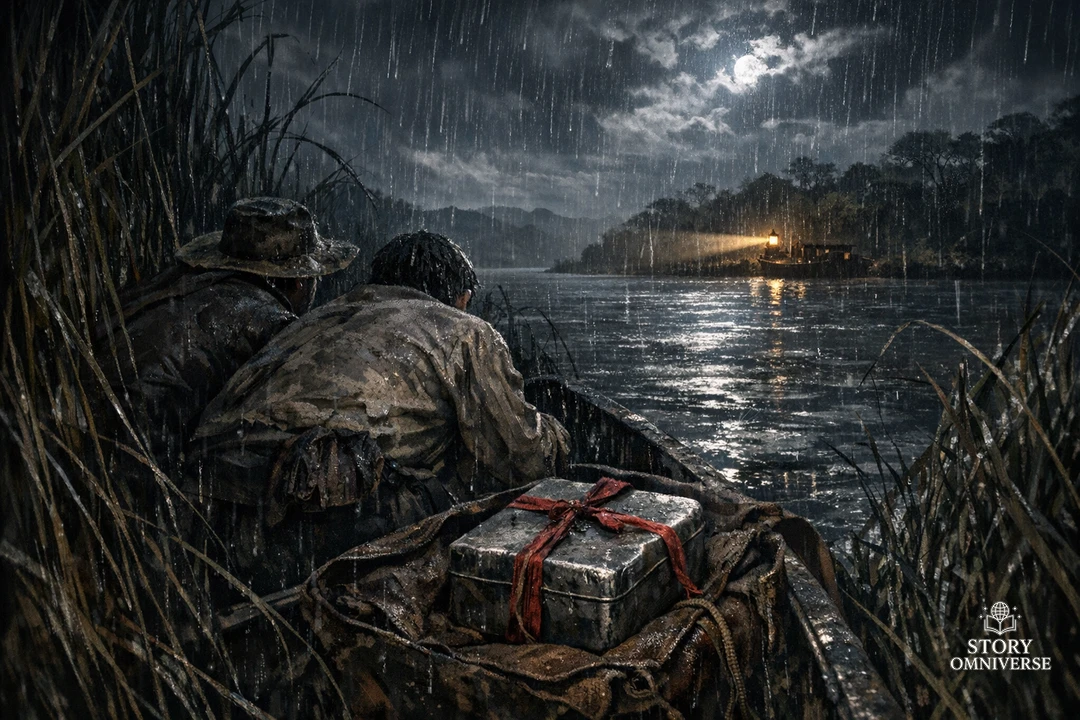
Night on the river was not silent. Frogs called from mud banks. Insects ticked in the grass. Distant drums beat patterns that might have been celebration or warning. The water spoke in soft slaps against wood, steady as a pulse.
Étienne and Kiala moved without lanterns. They kept close to reeds, their canoe a dark shape sliding through darker water. Étienne held the satchel tight, the tin box inside pressing against his ribs.
“Do not let it get wet,” Kiala whispered.
“It’s metal,” Étienne murmured, trying to sound calm.
Kiala’s voice stayed flat. “Truth can drown even in metal.”
Behind them, upriver, a shout carried faintly. Then another. Dogs barked. The pursuit had begun sooner than Étienne hoped.
Sister Margarethe had done what she could. Before dusk, she had walked into De Roo’s office and insisted on quarantine—fever spreading, men too weak to travel, the danger of moving sick porters. Her authority as a nurse and missionary gave her a thin shield, but Étienne had seen De Roo’s eyes narrow as she spoke, as if he were measuring how much disobedience he could tolerate.
Now, in the canoe, Étienne imagined her standing alone under that gaze. Guilt rose in him like bile.
“She will be punished,” he whispered.
“She chose,” Kiala replied. “Like you.”
The river widened, then narrowed, forcing them closer to the bank. A crocodile slid off a muddy edge with hardly a sound. Étienne’s breath caught, but Kiala did not change pace.
“Keep your fear inside,” Kiala said softly. “Fear makes noise.”
Hours passed. The moon appeared and vanished behind clouds. Once, voices sounded on the far bank—soldiers calling, searching. Kiala guided the canoe into floating plants and held it still. Étienne froze, muscles aching, trying not to breathe too loudly.
A lantern bobbed along the shore. Light swept over water, then moved on. Étienne heard his heartbeat as if it were a drum.
When the lantern vanished, Kiala exhaled. “They think you will take the main channel,” he said.
“Where do we go?” Étienne asked.
“To the boat,” Kiala answered. “To the place where paper travels faster than men.”
Near dawn, they reached a small landing where a station’s outline sat against a paling sky. Smoke rose from a cooking fire. A riverboat was tied up—ugly, practical, its smokestack like a blunt finger pointing upward.
Étienne’s legs trembled as he stepped onto land. His clothes were damp. His hands were raw from gripping the canoe. The tin box felt heavier than metal should, because it carried Luc’s hand, Luc’s fear, Luc’s stubborn insistence that words could still matter.
Kiala touched Étienne’s shoulder. “Now you must speak to strangers,” he said. “That is sometimes harder than running.”
Étienne nodded. The river behind them kept moving, indifferent. But the red ribbon knot held tight, as if refusing to let the truth slip away.
Chapter 11: Polite Walls at Boma
Boma looked the same as when Étienne first arrived: white offices, shutters, the river breathing beside them. Yet it felt colder now, as if the heat had learned to hide behind polite faces.
They were brought to an office where a superior official sat at a desk too large for the room. His cuffs were starched, his suit clean, as if linen could defeat the climate and the conscience alike. He listened while Étienne spoke—voice shaking at first, then steadier as the words forced their way out: the coerced treaty, the beatings, the deaths written as “desertions,” Luc’s arrest, the private ledger.
Kiala stood beside him, translating when needed, posture rigid.
Sister Margarethe was not there. Étienne had no news of her beyond rumor. Her absence made the room feel more dangerous.
When Étienne finished, he placed the tin box on the desk. The red ribbon, damp and frayed, lay across the lid like a wound.
The official opened the box carefully, as if handling property. He skimmed a page, eyes moving fast, then set it down.
His expression remained polite. “Monsieur Verhaegen,” he said, “you are very young.”
“My brother—” Étienne began.
“Yes,” the official interrupted softly. “Your brother. I am told he is in custody inland. These matters will be handled.”
“They will kill him,” Étienne said, and hated the desperate sound of his own voice.
The official sighed, almost weary. “The Congo Free State has just been recognized,” he replied, as if that mattered more than a life. “There are many eyes on us. We cannot afford scandal based on misunderstandings and… personal grievances.”
“Misunderstandings?” Étienne echoed, heat rising.
The official’s gaze sharpened. “Accusations against the State can be treated as treason,” he said calmly. “Do you understand?”
A clerk entered and whispered to the official. The official nodded, then looked at Kiala.
“You will remain for questioning,” he said.
Kiala’s face did not change. “For questioning,” he repeated. “Or for silence?”
Two guards stepped forward. Kiala did not resist, but as he passed Étienne he murmured, “Do not trade your voice for your skin.”
Étienne turned back to the official. “He has done nothing,” he said.
The official ignored it. He slid a paper across the desk. “Sign this statement,” he said. “It says you retract your claims. You were confused by illness. You will return to service, and this ends.”
The pen lay ready, neat as a trap.
“And if I do not sign?” Étienne asked.
The official’s voice remained mild. “Then you will be detained. Perhaps tried. Perhaps sent home in disgrace. Your family will suffer. Your brother’s situation will not improve.”
The room seemed to tilt. Étienne thought of Brussels, of his mother’s shaking hands, of his father’s faith in newspapers. He thought of Luc tying the ribbon with a cough in his throat.
Étienne pushed the paper back. “I will not sign,” he said, surprised by his own steadiness.
For the first time, the official’s politeness slipped. His eyes went flat. He closed the tin box and placed it out of reach.
“This will be kept,” he said. “As evidence. You have done enough harm.”
Guards moved in. Étienne wanted to grab the box, to shout, to run. But rifles stood at the door, and the walls felt thick with power. As he was led away, he looked back once.
The red ribbon lay on polished wood, no longer in his hands. It looked small and harmless—exactly how they wanted the truth to seem.
Chapter 12: Homecoming Without Justice
Weeks later, Étienne stood on the deck of a steamer bound north. He was not a traveler with purpose now. He was an inconvenience removed, a problem shipped away before it could stain the official story.
The coast air was still heavy, but the sea breeze carried distance. He watched Boma shrink until the buildings became pale blocks, then disappeared. Behind him, Africa did not close like a book. It stayed open in his mind, page after page he could not unsee.
A clerk had told him the news in a voice meant to sound kind. “Your brother died in custody,” the man said. “Fever. Common here.”
Étienne had not answered. The world narrowed to a single thought: they wrote fever because fever is convenient. Fever needs no trial. Fever leaves no guilty hand.
He later heard whispers from sailors—talk of beatings, of men who did not survive questioning, of commanders who needed examples. Nothing was spoken loudly. Even rumors feared paper.
Sister Margarethe’s fate came only in fragments. She was sent inland again under stricter supervision. Letters were censored. Her name was spoken with irritation, as if compassion were a kind of rebellion.
Kiala’s fate was worse. Étienne saw him once from a distance on the dock, guarded and bruised. Kiala’s eyes met his briefly—steady, accusing, and still alive. Then guards pushed him forward and he vanished into the crowd like a sentence crossed out.
Étienne had been allowed one small possession. When the tin box was taken, when papers were seized, when his bags were searched, a guard missed the red ribbon tucked inside the lining of Étienne’s coat. Or perhaps the guard did not care. A ribbon seemed harmless.
Now Étienne rolled it between his fingers. It was frayed, stained at the edges, no longer the neat strip Luc had pressed into a letter. He held it as if warmth could bring his brother back.
Brussels greeted him with the same wet gray as February. Gaslights glowed. Shops displayed maps. Men in cafés spoke proudly of commerce and progress, of a “free state” opened by diplomacy and courage. They quoted speeches and read headlines as if ink were proof of goodness.
Étienne walked past them like a ghost.
At home, his mother saw his face and understood before he spoke. She made a sound that was more breath than voice. His father stood rigid, as if refusing to let grief bend him.
“They said it is a mission,” his father whispered, voice cracking. “They said—”
Étienne could not bear the lie completing itself. He went to his small room, sat at the desk where he had once practiced neat handwriting, and placed his pen before him.
He tied the red ribbon around the pen’s shaft. The knot was clumsy. His hands were not steady anymore.
He began to write—not a report, not a receipt, not a clean letter meant to reassure. He wrote names he remembered, places, the sound of the whip, the way “deserted” was used like a knife. He wrote Luc’s warning, Kiala’s steady eyes, Sister Margarethe bandaging wounds she could not prevent.
He did not know if anyone would read it. In 1885, Europe still applauded Berlin’s signatures and praised the new lines on maps. The world preferred a clean story.
But Étienne wrote because the ribbon had been a promise. And because forgetting would be easier—and therefore unforgivable.
Outside, rain tapped the window softly, like fingers asking to be let in. Étienne tightened the ribbon once more around the pen and kept writing until his hand ached, refusing the comfort that silence offered.

0 Comments