
Marcus Renn
Northstar
A steady leader who carries the quiet weight of past failures.
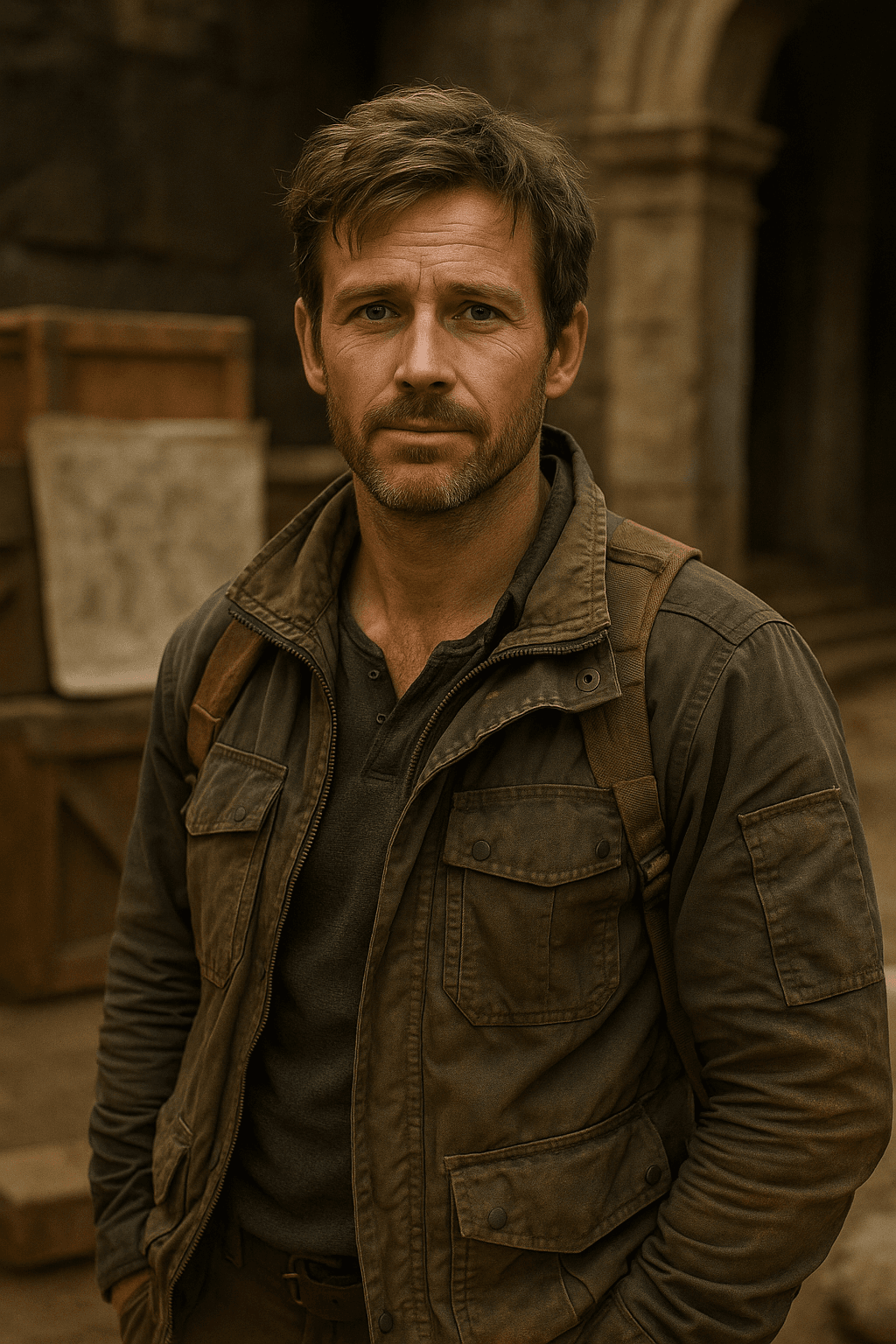
Marcus Renn is the kind of leader who does not need to announce his authority. His presence alone speaks to years of choices made under pressure, some successful, some regretted, all etched into the quiet lines around his eyes. Known among the Archivian Museum as “Northstar,” he is the compass point by which the Field Core finds its way. His humor makes him approachable, his hesitation makes him human, and his persistence makes him unforgettable.
Born into a modest family in the Midlands, Marcus grew up idolizing his younger brother, Adrian. Where Marcus was pragmatic and cautious, Adrian was bold and restless, pushing into wilderness trails that others considered reckless. The two were inseparable until tragedy struck: Adrian vanished during a poorly supervised archaeological venture, a mission that should never have been approved. The official report labeled it an accident, but Marcus never accepted that conclusion. His brother’s loss became the defining wound of his life, pushing him into military service first, and later, reluctantly, into the Archivian Museum’s orbit.
As a military logistics officer, Marcus proved capable of organization and resource allocation under extreme duress. But he also witnessed orders that cost lives for the sake of strategy, and this broke his faith in blind obedience. When the Museum approached him, offering a chance to apply his discipline and leadership in the pursuit of knowledge rather than conquest, he agreed, though not without suspicion.
In the Field Core, Marcus has built his reputation on balance. He weighs risks against rewards, but he never forgets that his team members are not expendable. He often lightens the atmosphere with jokes, even in the most desperate of situations, but beneath the levity is an unspoken fear: the dread of losing those who depend on him. His rivals have sensed this weakness and exploited it, setting traps that force him to choose between the mission’s success and the safety of his people.
Marcus is not flawless. His hesitation in critical moments has cost opportunities, and in the shadows of his conscience, he relives those seconds with crushing guilt. Yet it is precisely this hesitation that keeps him from becoming reckless. He has learned the cost of overconfidence, and he carries that lesson into every ruin, every negotiation, and every confrontation with rivals.
The Museum values him not only for his leadership but also for his moral compass. While others may see artifacts as prizes, Marcus sees them as echoes of lost lives and untold histories. He constantly reminds his team that their task is not merely to retrieve but to respect. To him, every expedition is a dialogue with the past, one in which the living must tread carefully.
His callsign, “Northstar,” came not from himself but from those he led. On nights when the team seemed directionless, they found themselves looking to Marcus as one might look to the night sky — not for perfection, but for guidance. Even when unsure of the path, he gives them the will to keep moving.
To this day, Marcus searches for fragments of his brother’s trail, often concealed in old reports or whispered legends encountered in the field. He knows that the answers may never come, but every expedition feels like one more chance to redeem the failure that still haunts him. And so he leads, with laughter in his voice, sorrow in his heart, and a steadfast resolve that makes him indispensable to the Archivian Museum and to the Field Core.