
Chapter 1: The Weight of Chains
In the heart of Britannia, the land lay heavy under the oppressive weight of Roman occupation. The fields, once lush with the promise of harvest, now bore the scars of conflict and subjugation. Boudica, queen of the Iceni tribe, stood amidst her people, her eyes scanning the horizon with a mixture of sorrow and defiance. The Romans, having breached their trust, seized lands and imposed crushing taxes, stripping the Iceni of their dignity and autonomy.
A bitter wind swept through the encampment as Boudica’s daughters, their clothes torn and their spirits broken, stumbled toward her. Their suffering was a silent testament to Roman cruelty, a cruelty that had crossed a line too far. Boudica’s heart burned with a righteous fury that demanded justice. She knelt beside her daughters, her hands trembling as they brushed over their bruised skin.
“What have they done?” she whispered, a question filled with the weight of her ancestors’ struggles and her own maternal anguish.
The elder daughter, her voice barely above a whisper, replied, “They have taken from us what is not theirs to take. They have shamed us, Mother.”
Boudica’s rage simmered beneath her calm exterior. She rose to her full height, her voice carrying the strength of her conviction. “No more,” she declared, her words a vow as much to her daughters as to the land that had borne her.
The Iceni tribespeople gathered around, their expressions a mix of fear and hope. The Romans may have thought they had broken these people, but they had merely awakened a sleeping lioness. Boudica’s voice rang out clearer, commanding, “We will not be slaves in our own land. We will rise, for ourselves and for those who cannot.”
The crowd murmured in agreement, their anger and pain galvanized into a singular purpose. Boudica’s eyes burned with a newfound resolve. She knew the path ahead would be fraught with danger, but the fire within her heart could not be extinguished. The weight of chains would be lifted; the time for action was now.
Chapter 2: The Gathering Storm
The call for rebellion spread like wildfire across Britannia, carried by the whispers of the wind from one tribal gathering to the next. Boudica, with the weight of leadership upon her shoulders, reached out to neighboring tribes, seeking unity against a common enemy. The Celtic tribes, each with their own customs and rivalries, were not easily swayed to a single cause. Yet, the Roman yoke was a burden they all bore.
Under the cover of dense forests and in hidden valleys, Boudica met with the leaders of the Trinovantes, the Catuvellauni, and others. The air was tense with the scent of damp earth and the sounds of nature, as if the land itself listened to their hushed conversations.
Aeldred, a chieftain of the Trinovantes, spoke first, skepticism lacing his words. “Why should we risk everything for a rebellion that might be crushed as swiftly as it begins?”
Boudica met his gaze, her voice steady and persuasive. “Because if we do not stand now, our children will suffer as we have suffered. The Romans have shown their true nature. They respect nothing but strength.”
Her words hung in the air, and the gathered leaders exchanged glances. They knew the truth in her statement, but fear of the Roman legions loomed large.
Morna, a fierce warrior of the Catuvellauni, leaned forward. “If we unite, we have a chance. We know these lands better than they ever will. We can strike at their weaknesses.”
Boudica nodded, feeling the tide beginning to turn. “Together, we are strong. Alone, we will fall, one by one.”
Discussion continued late into the night, the flickering flames of campfires illuminating faces etched with determination and doubt. Finally, with the glow of dawn breaking, a tentative consensus was reached. They would stand together, a coalition of the brave ready to fight for their freedom.
As the leaders dispersed, Boudica felt a surge of hope. The storm was gathering, and she was at its heart, ready to unleash its fury upon those who dared to oppress her people.
Chapter 3: Call to Arms
The chill of early morning was pierced by the clang of metal on metal as the Iceni warriors and their newfound allies prepared for the struggle ahead. Weapons were sharpened, and war paint was applied with solemn ritual. The people of the tribes moved with a sense of purpose, their minds focused and their hearts steeled for the battle to come.
Boudica stood before her assembled warriors, her presence commanding and inspiring. She wore her battle attire, a cloak of deep blue and a torque of twisted gold around her neck, symbolizing her status and the divine favor she invoked.
She raised her voice, clear and unwavering, to address her people. “We have gathered here, united by a single purpose: to reclaim our freedom and dignity. The Romans believe us weak, divided. They have underestimated us.”
The warriors responded with a fierce cheer, their spirits bolstered by her words. Boudica paced before them, maintaining the momentum of her speech. “We fight not just for ourselves, but for our children, for our ancestors who have walked these lands. For every indignity we have suffered, for every life lost to Roman greed.”
Her words cut through the morning mist, igniting a fire in the hearts of those present. The warriors pounded their shields, a rhythmic drumbeat that echoed through the encampment.
Boudica’s eyes blazed with conviction as she concluded, “Let us show them the strength of the Iceni, the power of the free tribes! On this day, let the world know that we will not be broken!”
The roar of approval that followed was a promise, a collective vow to fight with every ounce of strength they possessed. As the warriors dispersed to make final preparations, Boudica allowed herself a moment of solitude, her thoughts returning to her daughters. She would not fail them, nor would she fail her people.
With their resolve fortified and their spirits high, the tribes moved as one, ready to strike at the heart of Roman power in Britannia. The call to arms had been answered, and there was no turning back.
Chapter 4: The Flames of Camulodunum
The sun rose over the Roman city of Camulodunum, casting long shadows over its stone edifices and bustling streets. Unbeknownst to its inhabitants, this day would mark the beginning of a rebellion that would shake the foundations of Roman authority in Britannia.
Boudica led her forces toward the city, the earth trembling beneath the march of thousands of warriors united in purpose. As they approached, the sound of Roman life—traders, soldiers, and citizens—faded beneath the rhythmic beat of war drums and the cries of warriors eager for battle.
The attack was swift and fierce. With a cry that echoed through the ages, Boudica unleashed her forces upon Camulodunum. The city, unprepared for such an assault, was quickly engulfed in chaos.
Roman soldiers scrambled to defend their outposts, but they were overwhelmed by the sheer ferocity and numbers of the Celtic warriors. The clash of swords and the screams of the dying filled the air, mingling with the acrid smell of smoke as the city was set ablaze.
Boudica rode at the forefront, her presence a beacon to her people and a terror to her enemies. She cut through the Roman ranks, her blade a blur of deadly precision. The sight of their once-proud city engulfed in flames struck fear into the hearts of the Romans, who had thought themselves invincible.
Amidst the chaos, Boudica’s thoughts remained focused on her daughters and the vengeance she sought for them. Each Roman that fell was a step closer to justice.
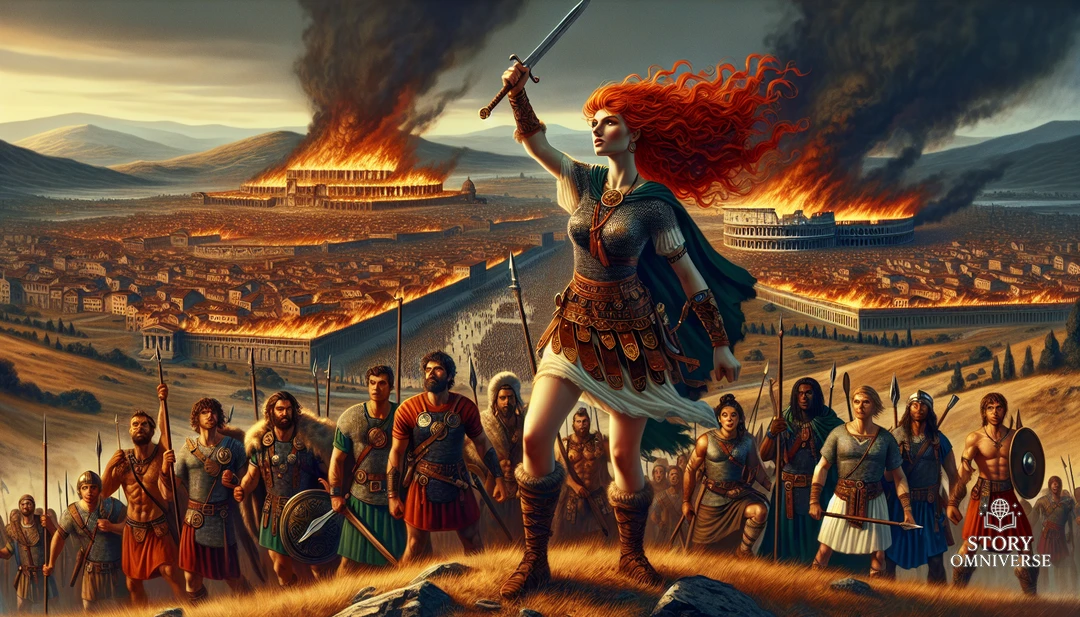
As the city’s defenses crumbled, Boudica halted her horse atop a hill overlooking the burning ruins. Her warriors gathered around, their faces marked with the soot and blood of battle. They had won a great victory, but the war was far from over.
“Today, we have shown them the strength of our spirit,” Boudica declared, her voice carrying over the crackling flames. “Let this be a warning to all who would oppress us. We will not be tamed.”
The cheers of her warriors rang out, defiant and proud, a promise of more battles to come. Camulodunum had fallen, and with it, the first spark of rebellion had ignited into a raging inferno.
Chapter 5: The Rise of the Phoenix
The embers of Camulodunum’s ruins still smoldered as Boudica’s forces readied themselves for the next phase of their campaign. The victory had invigorated them, but there was no time to rest. Londinium, the thriving hub of Roman power and commerce, lay ahead—a prize that, if captured, would send shockwaves across the empire.
As the army marched, Boudica found herself grappling with the enormity of her role. She was no longer just a queen; she was the symbol of resistance, the embodiment of her people’s hopes and dreams. The burden was heavy, yet she bore it with unwavering resolve.
In the Roman camps, news of Camulodunum’s fall spread like wildfire. Governor Suetonius Paulinus, a seasoned commander, recognized the threat Boudica posed. He scrambled to reinforce Londinium, deploying legions and fortifying defenses. The Romans were on high alert, and they would not be caught off guard again.
Despite the growing threat, Boudica pressed forward. The path to Londinium was fraught with danger, but the determination of her warriors was unshakable. They moved with a sense of purpose, each step echoing their commitment to the cause.
As they neared their target, Boudica took a moment to reflect, her thoughts once more drawn to her daughters. Their suffering fueled her drive, reminding her of what was at stake. She would not allow their pain to be in vain.
Her trusted advisor, Eogan, approached her, sensing the weight she carried. “Boudica, the men trust you. They believe in what we are fighting for. Your strength gives them strength.”
She nodded, grateful for his support. “We fight for more than just land or power. We fight for our right to exist as free people.”
Eogan smiled, a rare moment of warmth amid the tension. “And that, my queen, is why we will succeed.”
Together, they surveyed the horizon, where the silhouette of Londinium loomed. The city awaited them, unaware of the storm that approached. The rise of the phoenix had begun, and Boudica was ready to lead her people to victory or meet her fate.
Chapter 6: Ashes of Londinium
The bustling city of Londinium, a jewel of Roman civilization in Britannia, stood on the brink of disaster. Its streets, filled with merchants and soldiers, thrummed with the pulse of empire. Yet beneath this veneer of normalcy lay an undercurrent of fear, for the specter of rebellion loomed large.
Boudica’s forces approached the city with a relentless momentum. The warriors, fueled by their victory at Camulodunum, were eager for another triumph. As they reached the outskirts, they were met by hastily assembled Roman defenses. The stage was set for a clash of wills and wits.
The battle for Londinium erupted with a ferocity that shook the earth. The disciplined Roman legions, clad in their gleaming armor, clashed with the wild, unyielding Celtic warriors. The air was thick with the sounds of combat—the clang of weapons, the cries of the wounded, and the roars of determination.
Boudica, astride her chariot, directed the assault with keen strategic insight. She maneuvered her forces with precision, exploiting weaknesses in the Roman lines. Her presence on the battlefield was both a rallying point for her troops and a symbol of defiance to her enemies.
Despite their superior training, the Romans found themselves overwhelmed by the sheer numbers and ferocity of the rebels. The city, once a symbol of Roman might, became a battleground of chaos and destruction.
Amidst the turmoil, Boudica’s mind remained sharp, her thoughts focused on victory. She fought with the fury of a mother avenging her children, her blade a blur as it cut through the opposition.
As the day wore on, the tide of battle turned in favor of the rebels. The flames of Londinium rose high into the sky, a pillar of smoke and fire visible for miles. The city’s defenses crumbled, and its streets ran red with the blood of its defenders.
Boudica’s warriors cheered as they claimed another victory, their cries of triumph echoing through the charred ruins. Yet, amidst the jubilation, Boudica knew the road ahead remained perilous. The Romans would not take this defeat lightly.
With Londinium in ashes, Boudica regrouped her forces, preparing for the inevitable Roman retaliation. She stood amidst the ruins, her heart heavy with both victory and the weight of what still lay ahead. The ashes of Londinium marked a turning point in their struggle, a testament to the enduring spirit of the Iceni and their allies.
Chapter 7: The Turning Tide
The rebellion’s momentum surged as news of Londinium’s fall spread across Britannia. The tribes, emboldened by their victories, rallied to Boudica’s cause, swelling the ranks of her army. Yet, as their resolve strengthened, so too did the response of the Roman Empire.
Governor Suetonius Paulinus, a veteran of many campaigns, began to regroup his forces with a steely determination. He understood the threat Boudica posed and knew that decisive action was required to quell the uprising. Under his command, the legions prepared for a counteroffensive, their discipline and experience formidable assets.
As Boudica’s army advanced, internal tensions began to surface among the tribal leaders. The euphoria of victory was tempered by the realities of sustaining a prolonged campaign. Supplies ran low, and the strain of leadership weighed heavily on Boudica’s shoulders.
In a council meeting, the tribal leaders debated their next move. Aeldred voiced his concerns. “We have struck hard and fast, but the Romans will not rest. We must be cautious, lest we overextend ourselves.”
Morna countered, her voice fierce. “Caution will not win us freedom. We must press on and seize the advantage while we have it.”
Boudica listened, absorbing their views before speaking. “Unity is our strength. We must remain together, even as the Romans regroup. The road is difficult, but we cannot falter now.”
Her words resonated with the leaders, reminding them of the purpose that had brought them together. The council concluded with renewed commitment, though the challenges ahead remained daunting.
As the tribes prepared for the next confrontation, Boudica took time to reflect in solitude, seeking solace in the quiet of the night. The stars above seemed to whisper of destiny and the sacrifices yet to come.
Her thoughts turned to her daughters, whose suffering had ignited this rebellion. She vowed silently to them that she would not rest until their honor was restored and their people free.
The tide of rebellion had turned, and the stakes had never been higher. Boudica knew the final confrontation with the Romans was inevitable, and she steeled herself for the battles to come. The turning tide was upon them, and the fate of Britannia hung in the balance.
Chapter 8: The Battle of Watling Street
The fateful day dawned under a steel-gray sky, the air charged with anticipation. Boudica’s forces, bolstered by their victories, faced the Roman legions on the open field at Watling Street. It was here that the future of Britannia would be decided.
The Roman legions, under the command of Suetonius Paulinus, were arrayed in disciplined ranks, their armor gleaming despite the overcast skies. They formed a tight formation, leveraging their training and experience to withstand the coming onslaught.
Boudica’s warriors, fierce and determined, spread across the battlefield, their numbers vast but their lines less disciplined. The Celts beat their weapons against their shields, a thunderous sound that echoed across the field.
Boudica rode to the front, her chariot a symbol of defiance. Her voice rang out over the din, rallying her warriors. “Today, we fight not just for ourselves, but for all who yearn for freedom. Let the Romans feel the wrath of the free tribes!”
Her words ignited the spirits of her warriors, and with a resounding cry, they surged forward. The battle was joined, a brutal clash of wills and steel.
The Celts charged with wild abandon, their ferocity a stark contrast to the disciplined Roman lines. The initial impact was devastating, the Celts’ momentum driving them deep into the Roman ranks.
But the Romans held firm, their discipline and tactics proving their worth. They absorbed the shock of the charge, their lines bending but not breaking. Suetonius, a master tactician, exploited the terrain and his troops’ discipline to counter the Celtic assault.
The battle raged with unrelenting intensity, the air filled with the cries of the wounded and the clash of weapons. Boudica fought at the forefront, her presence a beacon to her warriors. Yet, despite their courage, the Celts began to falter against the Roman machine.
As the day wore on, the tide of battle shifted. The Roman legions, leveraging their discipline and tactics, began to push back. The Celts, though numerous, struggled to maintain cohesion as the Romans advanced with grim determination.
Boudica, witnessing the unfolding tragedy, fought with renewed fury, her heart heavy with the weight of the struggle. She knew the cost of failure, yet she would not yield.
In the end, the discipline of the Roman legions prevailed. The Celtic forces, despite their valor, were driven back, their lines breaking under the relentless Roman advance. The battle was lost, but Boudica’s spirit remained unbroken.
As the sun set on the blood-soaked field, Boudica gathered her remaining warriors, her heart heavy with the knowledge of what had been lost. Yet even in defeat, her defiance burned bright, a symbol of resistance that would echo through the ages.
Chapter 9: Echoes of Defeat
The aftermath of the Battle of Watling Street was a somber reckoning for the Celtic tribes. The rebellion, which had flared with such promise, lay crushed beneath the might of the Roman legions. The fields were littered with the fallen, a grim testament to the cost of their struggle.
Boudica, her spirit unyielded despite the defeat, gathered the survivors. Her heart ached with the weight of loss, yet she stood tall, her presence a comfort to those who had followed her into battle.
In the shadows of the battlefield, the surviving leaders convened to chart a course forward. Aeldred’s voice, once filled with skepticism, now carried a note of respect. “We fought bravely, but the Romans were stronger than we anticipated.”
Morna, her fierce spirit undimmed, spoke with conviction. “We may have lost the battle, but the spirit of our people remains unbroken. We will endure, and we will rise again.”
Boudica nodded, her eyes reflecting the fire that still burned within. “The Romans may have won this day, but they will never extinguish the flame of our spirit. They will know that we are not mere subjects, but a people with a voice, a people who will not be tamed.”
The council’s resolve was echoed by the warriors who stood in silence, their eyes fixed on their queen. They understood the significance of their struggle, even in defeat.
As the Roman reprisals began, they were swift and ruthless. Yet, the Celtic spirit endured. The stories of Boudica’s courage and the rebellion spread across Britannia, becoming a symbol of resistance and defiance.
Boudica herself, though her fate remained shrouded in mystery, became a legend. Her fight, her determination, and her leadership inspired generations to come, a beacon of hope in the dark times that followed.
In the aftermath, the tribes returned to their lands, their numbers diminished but their resolve strengthened. They carried with them the echoes of their struggle, a reminder of the price of freedom.
The Romans, triumphant in battle, would find that the Celtic spirit was not so easily subdued. Britannia remained a land of fierce independence, where the flame of rebellion, once kindled, could never be fully extinguished.
Chapter 10: Legacy of the Flame
Years passed, yet the story of Boudica and her rebellion endured, woven into the fabric of Britannia’s history. Her legacy became a flame that burned brightly in the hearts of those who valued freedom over subjugation.
In the years following the rebellion, the Roman presence in Britannia was marked by a cautious respect for the tribes they governed. The memory of Boudica’s uprising served as a constant reminder of the price of arrogance and oppression.
Among the Celtic tribes, Boudica’s name was spoken with reverence. She became a symbol of resistance, her courage and leadership a beacon for those who would stand against tyranny. Her tale was told around fires and in halls, inspiring generations to carry forward the fight for liberty.
The Romans, too, felt the impact of her legacy. Though they had quelled the immediate rebellion, they could not erase the spirit of defiance she had ignited. Over time, Britannia remained a land of unrest, its people ever watchful for the next opportunity to assert their independence.
Boudica’s daughters, who had suffered so greatly, carried their mother’s legacy forward. They worked tirelessly to preserve the cultural identity of their people, ensuring that the next generation would remember the sacrifices made for their freedom.
In the annals of history, Boudica emerged not just as a warrior queen, but as a symbol of enduring strength. Her actions, though ultimately unsuccessful in their immediate goals, left an indelible mark on the world. She reminded all who heard her story that one voice, one act of courage, could inspire a movement.
The legacy of the flame, kindled by Boudica, continued to burn brightly, lighting the way for those who would dare to dream of a world free from the chains of oppression. Her spirit, undiminished by time, stood as a testament to the power of resistance and the unyielding will of a people determined to be free.

0 Comments